The Invisible Identity: Navigating the Unique Challenges of Being a Young Caregiver in 2026
One in three family caregivers in the United States is now under the age of 50. While the 2026 Lifespan Respite Care Reauthorization Act finally clarifies that even those under 18 are eligible for support, millions of young adults still operate in a silent, exhausting vacuum. You're likely living a double life. You manage complex medical needs by sunrise and try to sustain a career by noon. The unique challenges of being a young caregiver often mean watching peers hit traditional milestones while you struggle with chronic guilt, financial strain, and profound social isolation.
It's okay to acknowledge that this role feels entirely out of sequence with the life you envisioned. We understand the "parentification" and the professional stagnation that your friends can't quite grasp. This article offers an honest, journalistic exploration of the emotional and social hurdles that define your experience. We'll examine practical frameworks for setting boundaries and finding a community that embraces the messy reality of your daily life. You'll discover that while the weight is heavy, there are resilient strategies to help you find a path forward without losing your own identity in the process.
Table of Contents
The Invisible Identity: Defining the Young Caregiver Experience
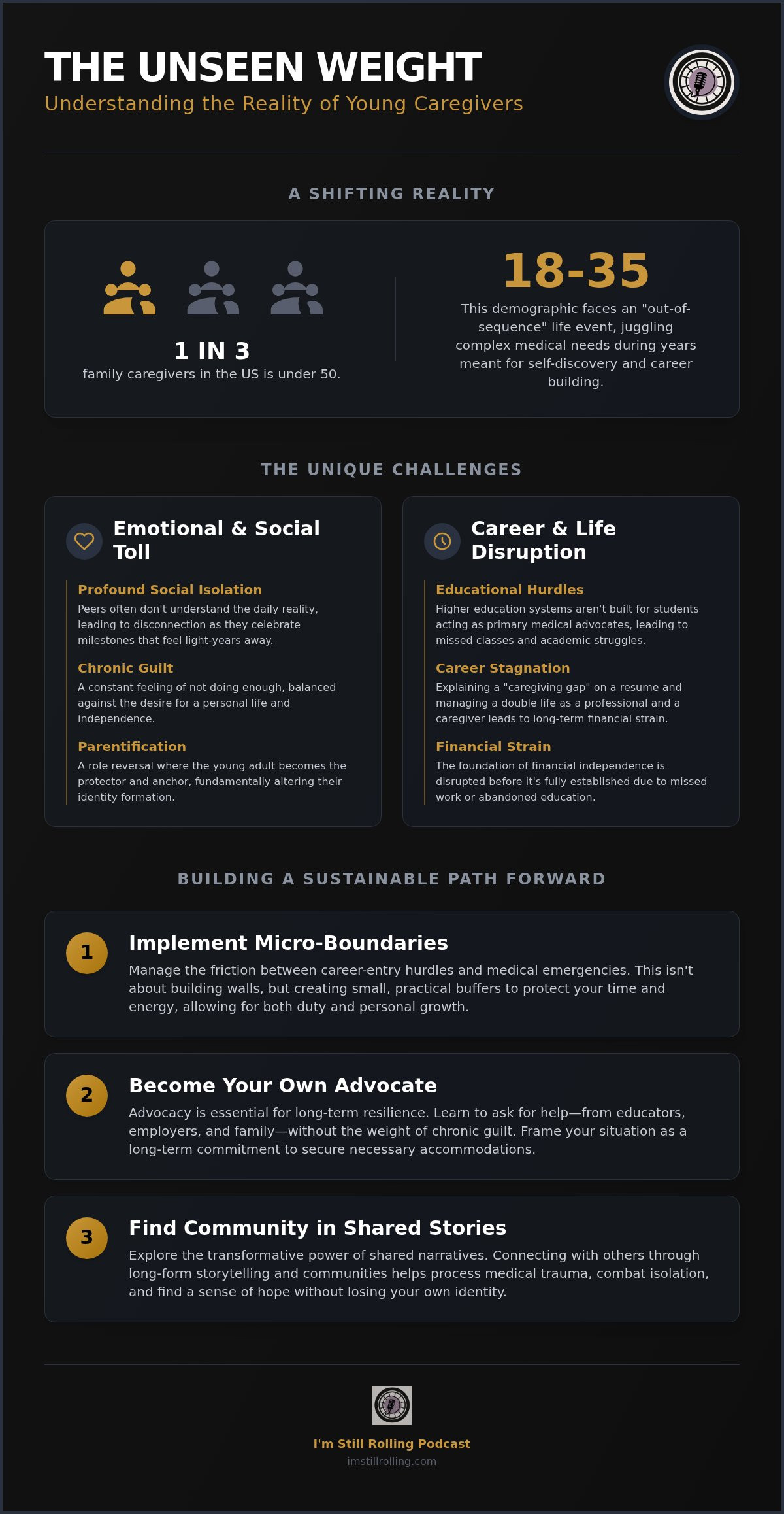
In 2026, the face of family support is changing. Recent data from the National Alliance for Caregiving and AARP reveals that one in three caregivers in the United States is under age 50. For the 18 to 35 demographic, the challenges of being a young caregiver often arrive as an "out-of-sequence" life event, landing during the very years meant for self-discovery and career building. These individuals aren't just helping out; they're managing complex medical realities while trying to anchor their own futures. The young caregiver experience is a profound blend of deep-seated duty and a premature maturity that redefines what it means to be an adult.
Breaking the Silence on the Invisible Demographic
Many young adults don't realize they're caregivers until they hit a wall. They see their labor as a natural extension of being a "good child" or a "loyal partner," a perspective often reinforced by cultural expectations that prioritize family sacrifice. This lack of a formal label makes them an invisible demographic in media and policy. Without a name for their experience, they're less likely to seek help, which often results in severe psychological and physical health problems. The journalistic lens has historically focused on the elderly, leaving a massive gap in representation for those balancing college or entry-level jobs with the demands of a sick or disabled loved one.
The Emotional Stakes of Early Responsibility
Early caregiving fundamentally alters how a person builds their identity. When you become the primary anchor for your family in your twenties, you enter the "parentification" trap. The roles reverse, and the child becomes the protector. This shift creates a constant friction between the natural desire for independence and the weight of responsibility. You're forced to develop a level of empathy and endurance that your peers might not touch for decades. While this premature maturity can be a source of strength, it also creates a sense of isolation, as the milestones your friends celebrate feel light-years away from your daily reality.
The High Cost of Care: Educational and Career Disruptions
For a young adult, the distance between a lecture hall and a hospital room is measured in more than just miles. It's a psychological chasm that forces a choice between a future career and a present crisis. While peers are building professional networks or studying for finals, young caregivers are often calculating the cost of a missed shift or an abandoned credit hour. The challenges of being a young caregiver at this stage are unique because they disrupt the very foundation of financial and professional independence before it's even fully established.
The Academic Toll: When Caregiving Meets the Classroom
Higher education is rarely designed for the student who acts as a primary medical advocate. Traditional support systems often overlook the 18 to 35 demographic, assuming "family emergencies" are rare rather than a daily reality. This constant friction leads to missed lectures and a profound social disconnection from a campus life that feels increasingly trivial. Research shows that taking on these roles early can lead to significant developmental challenges and health impacts, making it harder to maintain the focus required for academic success. If you're struggling, communicating with educators early is vital; framing your situation as a long-term commitment rather than a temporary hurdle can help secure the accommodations you need to stay enrolled.
Career Stagnation and the 'Caregiving Gap'
Entering the workforce is difficult enough without a "caregiving gap" on your resume. Many young adults find themselves explaining periods of unemployment or underemployment to recruiters who may not understand the maturity required to manage a household's medical needs. This creates a cycle of career-entry hurdles that can lead to long-term financial strain. While remote work is often touted as a solution, it can be a double-edged sword. It offers the flexibility to attend doctor appointments, but it also turns your home into a permanent clinic, deepening a sense of professional isolation.
Living this "double life" as a professional by day and a nurse by night is exhausting. You're often forced to hide the intensity of your home life to appear "committed" to your employer. Acknowledging this strain is the first step toward finding a sustainable rhythm. Hearing others discuss these specific trade-offs can provide a sense of clarity. You may find a sense of community and shared experience in the I'm Still Rolling podcast episodes, where we explore the grit required to balance career aspirations with the weight of caregiving. Building a future doesn't mean ignoring your present, but it does require a different kind of professional roadmap, one that values your resilience as a core competency.
The Psychological Landscape: Navigating Guilt and Social Isolation
The emotional weight of this role is often heavier than the physical labor. While your friends are debating weekend plans or booking spontaneous trips, you're likely anchored to a rigid schedule of medication and monitoring. This "Peer Gap" creates a profound sense of alienation. It's difficult to relate to the trivial stresses of early adulthood when you're managing life-altering medical decisions. The challenges of being a young caregiver involve more than just time management; they require an emotional endurance that most people your age haven't yet been asked to develop.
Living in the "Resentment-Guilt Cycle" is a common, though rarely discussed, reality. You might feel a flash of anger at the loss of your freedom, only to be immediately crushed by a wave of guilt for feeling that way. This cycle is exhausting. It's compounded by a total loss of spontaneity. Every outing requires a logistical blueprint. Every "yes" to a social invitation comes with a mental checklist of what might go wrong while you're away. Realistic optimism is the quiet acknowledgment of a difficult reality paired with a commitment to endure, whereas toxic positivity is a forced cheerfulness that denies the validity of struggle.
The Social Shrinkage: When Your World Becomes a Patient's Room
Friendships often shift when you become a caregiver. Some friends drift away, unable to handle the "heavy" nature of your life. Others stay but remain on the surface, unsure of what to say. Dating adds another layer of complexity. Introducing a potential partner to your reality feels like a high-stakes disclosure. You aren't just introducing them to yourself; you're introducing them to a lifestyle of responsibility. The challenges of being a young caregiver often manifest as a gradual narrowing of your social circle, as the heavy reality of your life becomes a filter for those who can truly stand by you.
Mental Health and the Burden of Resilience
There's a danger in the "Hero" narrative that society often pushes on caregivers. You don't have to be strong all the time. Constant strength is a recipe for burnout, which can quickly spiral into medical trauma if left unchecked. Identifying the signs of exhaustion early is a form of self-preservation, not a sign of weakness. We've seen that healing begins when we share these "messy" parts of our stories. If you're feeling overwhelmed, exploring stories of recovery and hope can help you realize that resilience isn't about never breaking; it's about finding the grace to rebuild after the break occurs.
Building a Sustainable Path: Balancing Duty with Personal Growth
Sustainability in caregiving isn't about doing more; it's about protecting the person doing the work. In 2026, the landscape for support is shifting in meaningful ways. The Lifespan Respite Care Reauthorization Act, signed in February, has finally acknowledged younger caregivers, but legislative wins are only half the battle. To manage the challenges of being a young caregiver without losing your sense of self, you must establish "micro-boundaries." These are small, non-negotiable windows of time, perhaps just fifteen minutes, where you aren't a nurse, a bookkeeper, or an advocate. You're simply yourself.
The Framework for Sustainable Care
Building a life alongside caregiving requires a methodical approach that prioritizes your endurance. First, perform an energy audit. Identify which tasks, like navigating insurance or managing nighttime wake-ups, drain you most. Second, assemble your "village." With the number of family caregivers rising 45% since 2015, you aren't alone, but you must be intentional about recruiting professional help or dependable friends. Finally, define your non-negotiables. Whether it's a weekly workout or a specific career goal, these are the anchors that prevent you from drifting into total self-sacrifice. Integrating these habits is a source of strength, not an afterthought.
Advocating for the Caregiver
You're often the most informed person in the room during medical consultations, yet your needs are frequently sidelined by the clinical focus on the patient. When talking to doctors or social workers, be explicit about your capacity. It isn't a failure to state that you cannot provide 24/7 care. This advocacy is especially critical when caregiving for a spouse with alzheimer's, where the emotional and practical shifts are constant. The challenges of being a young caregiver often involve navigating complex systems, but you can leverage 2026 resources like the $7,500 Dependent Care FSA limit or the updated Medicaid waiver income limits of $2,982 per month to fund necessary help.
Finding the courage to say "no" to family demands is a vital skill for your long-term health. Resilience isn't about infinite capacity; it's about knowing when to pause. If you're looking for a companion who understands the grit required for this life, subscribing to our I'm Still Rolling newsletter provides a space for deep reflection and shared wisdom. Technology, from AI-driven remote monitoring to digital care coordination apps, can reclaim hours of your day, but it's your voice that will ultimately protect your future.
Resilience in Motion: How Shared Stories Light the Way
Storytelling is more than a distraction; it's a vital mechanism for processing medical trauma. When you engage with a long-form "Deep Dive" narrative, you're doing more than consuming content. You're witnessing a roadmap of endurance. The challenges of being a young caregiver often feel like a solitary sentence, but these shared stories act as a mirror, reflecting your own grit back to you. By listening to how others have navigated the same messy, unscripted moments, you begin to find your own "Still Rolling" moment, where the weight of the role no longer feels like the end of your story.
The Healing Power of Honest Conversations
There's a specific kind of relief that comes from hearing someone else voice the thoughts you've been too afraid to say out loud. Honest conversations strip away the shame that often accompanies the resentment or exhaustion of caregiving. When we stop sanitizing the experience, we create a space where vulnerability becomes a bridge rather than a burden. Exploring the I'm Still Rolling Podcast Episodes offers this kind of journalistic truth. These episodes aren't just interviews; they're deep explorations of what it means to thrive after life has been altered by medical crisis. Hearing these "messy" parts of a journey helps you move from merely surviving the day to finding a sense of community that truly understands your reality.
Your Journey is Not a Detour
It's easy to view these years as a tragic interruption to your "real" life. However, reframing the challenges of being a young caregiver as a foundational part of your personal growth can be transformative. The empathy you're developing and the crisis management skills you're honing are not wasted. They're making you a person of profound depth and resilience. You aren't just waiting for your life to start; you're living a life that requires a rare brand of courage. Finding meaning in the struggle doesn't mean ignoring the hardship. It means acknowledging that you're enduring something significant and that your endurance has value.
We invite you to join our community for continued journalistic truth. Subscribing to our newsletter ensures you receive weekly resilience insights, helping you stay grounded as you navigate the complexities of your journey. You're still rolling, and you don't have to do it alone.
Reclaiming Your Narrative and Finding Your Way Forward
The path you're walking is undoubtedly heavy, but it doesn't have to be a solitary sentence. We've explored how the challenges of being a young caregiver can disrupt your education, stall your career, and create a profound social gap between you and your peers. Yet, through the establishment of micro-boundaries and the courage to advocate for your own needs, you can build a life that honors both your duty and your personal growth. Resilience isn't found in a clinical checklist; it's forged in the raw, honest sharing of our lived experiences. Your identity is not lost to caregiving. It's being refined by it.
You can find a companion for this journey by listening to award-winning journalists share real-life stories of overcoming medical trauma and adversity. Listen to the latest stories of resilience on the I'm Still Rolling Podcast and join a community of over 10,000 resilient listeners who are navigating these same messy realities together. By connecting with those who speak your language, you'll find the strength to keep your own life in motion. Keep moving forward, one steady, unhurried step at a time.
Frequently Asked Questions
What exactly defines a 'young caregiver'?
A young caregiver is typically defined as an individual aged 18 to 35 who provides unpaid care for a loved one with a chronic illness or disability. While the 2026 Lifespan Respite Care Reauthorization Act now explicitly includes those under 18, the core demographic remains young adults navigating critical developmental milestones. The challenges of being a young caregiver are unique because this labor occurs during formative years for education and professional entry, often creating a profound sense of isolation.
How do I deal with the guilt of wanting my own life back?
Dealing with guilt requires shifting from toxic positivity to a state of realistic optimism. It's natural to feel resentment when your personal aspirations are sidelined by duty. Acknowledging the "resentment-guilt cycle" as a standard part of the human experience can help reduce the shame you feel. You aren't a failure for wanting a life beyond a patient's room; you're simply an adult experiencing a complex role reversal. Finding a vulnerable peer group can help normalize these messy emotions.
Can being a young caregiver cause long-term career damage?
Career damage is a significant risk, as 61% of family caregivers report that their responsibilities have a direct impact on their work life. The "caregiving gap" on a resume can be difficult to explain to traditional employers, potentially leading to career stagnation or lost wages. To mitigate this, look for flexible remote work options and leverage 2026 resources like the $7,500 Dependent Care FSA limit to help fund external support while you build your professional future.
What are the most common signs of caregiver burnout in young adults?
Burnout often manifests as chronic exhaustion, irritability, and a loss of interest in personal goals. In 2026, 78% of caregivers report experiencing burnout, often on a daily basis. For young adults, it frequently looks like "social shrinkage," where you stop responding to friends because you lack the energy for trivial conversation. Physical signs include disrupted sleep and a weakened immune system. Recognizing these symptoms early is vital to preventing long-term psychological or medical trauma.
How can I explain my caregiving situation to friends who don't understand?
Explain your situation by focusing on the "Peer Gap" and setting clear expectations. You might say, "I value our friendship, but my schedule is currently dictated by medical needs that require my presence." Honesty about the heavy parts of your life helps filter for friends who can truly stand by you. While it's hard when peers only worry about weekend plans, being a truth-teller about your reality invites deeper, more authentic connections with those who truly care.
Are there specific financial resources for caregivers under 35?
Yes, several updated 2026 resources exist to help ease financial strain. The individual income limit for many Medicaid waiver programs that pay family members is $2,982 per month. You can also set aside up to $7,500 in a pre-tax Dependent Care FSA for elder care expenses. If you're caring for a veteran, the maximum Aid and Attendance pension payout is $2,874 per month. These tools are essential for the 47% of caregivers facing negative financial impacts.
How do I set boundaries with a family member who needs constant care?
Setting boundaries starts with "micro-boundaries," which are small, non-negotiable windows of time for your own well-being. Communicate these clearly to your family member, explaining that your ability to care for them depends on your own endurance. You must become an advocate for yourself, just as you are for them. This might involve utilizing 2026 respite services, which recently received an 11 million dollar funding boost to support caregivers of all ages across the country.
Where can I find a community of other young caregivers?
You can find a community of over 10,000 resilient listeners through the I'm Still Rolling Podcast. Hosted by seasoned journalists with lived experience, the show provides a platform for honest conversations about the challenges of being a young caregiver. Subscribing to the newsletter and reading podcast transcripts offers a way to engage with deep-dive stories that move beyond clinical advice. Sharing these messy parts of life helps build a collective resilience that reminds you that you're never rolling alone.


Comments