Caregiving for a Sibling with a Disability: Navigating a Lifelong Journey of Resilience
You might remember the quiet hum of your childhood home, where your needs often felt secondary to the specialized care your brother or sister required. It's a common experience for those who grew up as "glass children," looking through the lens of another's needs while wondering when their own turn to lead an independent life would come. For millions of adults, caregiving for a sibling with a disability isn't a sudden crisis but a lifelong evolution of a shared history. It's a role that demands a rare blend of fierce advocacy and quiet endurance, often beginning in the playroom and extending into the complexities of adulthood.
You aren't alone in feeling that heavy mix of profound love and the nagging guilt of wanting a life that belongs solely to you. The anxiety about the eventual hand-off of care from your aging parents is a weight that sits at the back of your mind, unvoiced but ever present. We'll explore how to handle these complex emotions with journalistic honesty and realistic optimism. This guide provides a framework for sustainable caregiving, offering emotional validation alongside practical steps for managing legal and financial transitions like ABLE accounts and SSI benefits to ensure your sibling's future is secure.
Table of Contents
The Unique Landscape of Sibling Caregiving
2026 marks a turning point for those caregiving for a sibling with a disability. We're seeing a shift where the "hand-off" from parents is happening earlier, driven by a desire for more intentional transitions rather than waiting for a family crisis. This isn't just about filling a gap in service; it's about a lifelong commitment that carries its own unique weight. While society often views caregiving through a lens of pity, the journalistic truth is far more complex. It's a blend of raw exhaustion and fierce, unshakeable loyalty. Family caregivers in this position are often the silent backbone of the disability community, providing a level of continuity that professional services cannot match.
Understanding the 'Glass Child' History
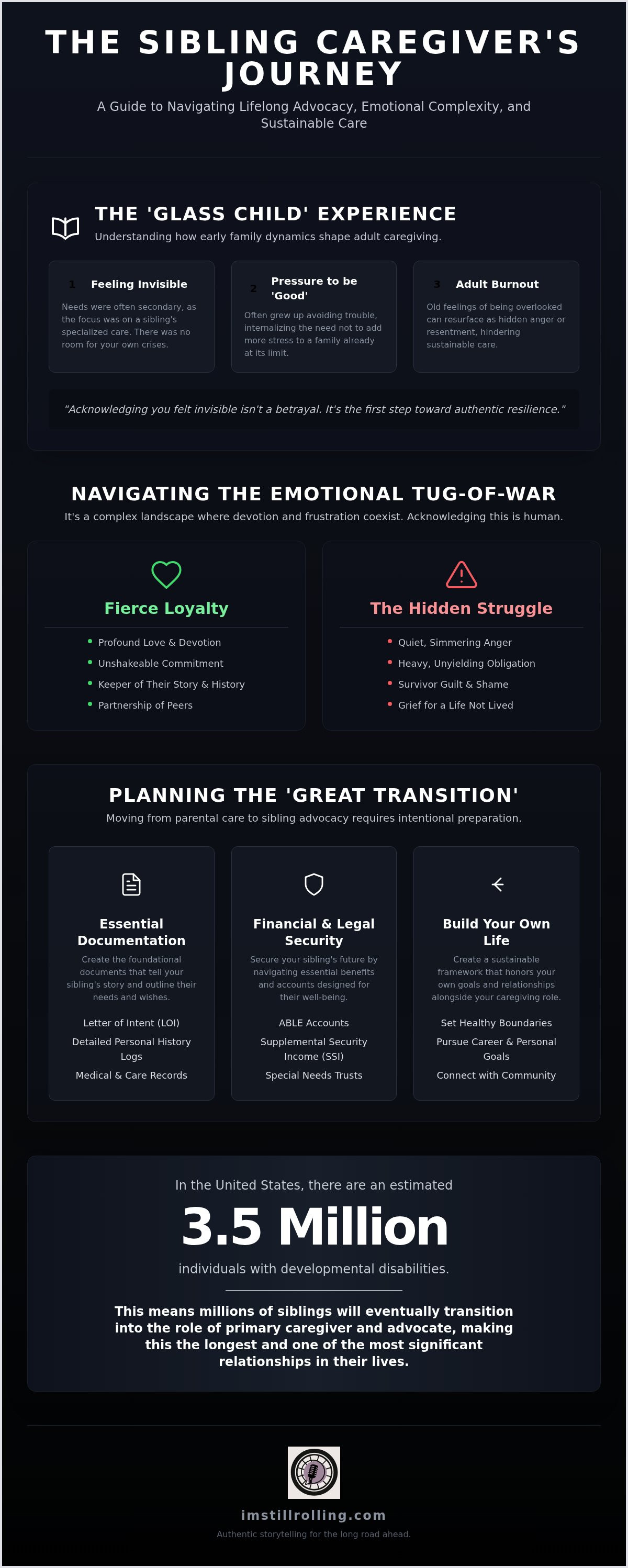
The "Glass Child" concept is more than just a social media buzzword. It's a foundational experience for many adults currently caregiving for a sibling with a disability. You were likely the child who had to be "good," the one who didn't cause trouble because there was no room for your crises in a home already stretched to its limits. When you step into adult caregiving, those old feelings of being overlooked can resurface as burnout or hidden anger. Resentment is a heavy word, but it's an honest one. Acknowledging that you felt invisible as a child isn't a betrayal of your sibling. It's the first step toward finding an authentic resilience that doesn't rely on total self-sacrifice. You can't provide sustainable care if you're still operating from a place of childhood neglect.
The Longest Relationship: A Lifelong Horizon
A sibling relationship is often the longest one we'll ever have. You are the keeper of the story. You're the one who remembers the small victories and the specific fears that aren't recorded in any medical chart. Unlike the parent-child dynamic, which is often rooted in a hierarchy of protection, the sibling bond can evolve into a partnership of peers. With an estimated 3.5 million individuals with developmental disabilities living in the U.S., the statistical reality is that millions of siblings will eventually become primary advocates. This transition isn't just a change in chores. It's a profound shift in how you see your future. It requires moving from the sidelines to the center of the narrative, ensuring the story you've shared for decades continues with dignity and realistic optimism.
Navigating the Emotional Shift and Caregiver Guilt
Caregiving for a sibling with a disability often feels like a tug-of-war between a fierce, protective loyalty and a quiet, simmering anger. It is a landscape where love doesn't always feel light; sometimes it feels like a heavy, unyielding obligation. We often hide these "messy" emotions because we fear they make us ungrateful or "bad" siblings. However, journalistic honesty requires us to look at these feelings without flinching. Acknowledging your frustration doesn't diminish your devotion. It simply makes you human.
The myth of the "perfect" sibling caregiver is a dangerous fiction that many of us try to live up to. It suggests that if you just work harder or love more deeply, you won't feel the sting of a "stolen" childhood or a future that feels pre-determined. We must process the grief of the lives we didn't get to lead. You aren't just grieving who your sibling might have been without their disability; you're also grieving the version of yourself that didn't have to carry this weight before you were ready. Honesty is the first step toward healing because it strips away the shame that keeps us isolated.
Deconstructing Caregiver Guilt
Survivor guilt is a particularly potent force within the sibling dynamic. You might feel a strange, lingering shame for your own health, your career milestones, or your ability to move through the world with ease. This emotional complexity mirrors other high-stakes roles, such as caregiving for a spouse with Alzheimer's, where the person you love is still present, yet the relationship has fundamentally shifted. Reframing duty as a conscious choice of resilience allows you to reclaim your agency. It moves the narrative from "I am trapped by this" to "I am choosing to honor our shared history while maintaining my own identity."
The Power of Realistic Optimism
Realistic optimism isn't about ignoring the exhaustion or the rising costs of care. It's about acknowledging the gravity of the situation while refusing to be crushed by it. While organizations like the Center for Future Planning provide the structural support needed to turn anxiety into action, the emotional endurance comes from the power of storytelling. Hearing others share their raw, unvarnished truths reminds us that our struggles aren't failures; they're part of a shared human condition. Resilience is the ability to roll forward despite the weight. By embracing this mindset, you can find a grounded, soulful connection to your role that feels both authoritative and deeply personal. If you're looking for a tribe that understands this balance, you can listen to real stories of endurance that mirror your own journey.
Practical Planning for the 'Next Generation' Hand-off
The "Great Transition" is a phrase that carries both the weight of impending loss and the necessity of meticulous preparation. For decades, your parents have likely held the blueprints to your sibling's life, managing everything from medication schedules to the subtle nuances of their social world. As parents age, the responsibility of caregiving for a sibling with a disability inevitably shifts. This hand-off isn't a single event but a methodical process of capturing a lifetime of knowledge. It starts with the "uncomfortable" conversation. You must sit with your aging parents and ask the hard questions about housing, daily rhythms, and the specific vision they have for your sibling's future when they are no longer the primary anchors.
The Letter of Intent: More Than a Legal Document
A Letter of Intent acts as the emotional soul of your sibling's future care plan. While a will provides the legal "what," this document provides the deeply personal "how." It bridges the gap between clinical data and the lived reality of your sibling's day-to-day existence. In 2026, a comprehensive letter must evolve to include digital footprints alongside traditional medical history. Consider including the following elements to ensure emotional continuity:
Daily Rhythms: What are their specific sensory triggers? What time is their "anchor" meal that keeps the day on track?
Personal Joy: List their favorite movies, cherished hobbies, and the "unwritten" rules of their communication style.
Modern Access: Include a directory of digital passwords, social media accounts, and access codes for specialized medical portals.
Professional Network: A clear list of specialists, including those who understand the sibling's history and personality, not just their diagnosis.
Financial and Legal Safeguards
Navigating the financial landscape requires a disciplined mix of legal structures and government benefits. As of January 1, 2026, eligibility for ABLE accounts has expanded significantly, now including individuals whose disability began before age 46. These accounts are vital for fostering independence, as the annual contribution limit has reached $20,000. This allows your sibling to save for their own needs without jeopardizing their eligibility for essential government support.
Special Needs Trusts (SNTs) remain the gold standard for protecting inherited assets while maintaining access to the maximum federal SSI payment, which is $994 per month for an individual in 2026. However, the most robust financial plan is useless without a "Care Team" to execute it. This team should include a mix of family members and professionals, such as special needs planners or attorneys. By distributing the weight, you ensure that your advocacy remains sustainable. You aren't just a caregiver; you're the manager of a support system designed to endure for decades. This structured approach allows you to move forward with a sense of realistic optimism, knowing the foundation is secure.
Balancing Your Own Life While Rolling Forward
For many siblings, the identity crisis begins when your personal ambitions collide with familial expectations. Unlike aging parents whose lives are often entering a quieter phase, you are likely in the prime of your career, building romantic partnerships, or raising your own children. Caregiving for a sibling with a disability shouldn't mean the erasure of these personal milestones. It is a common misconception that total self-sacrifice is the only measure of devotion. In reality, maintaining a life that exists entirely outside the orbit of disability is what allows you to remain a present, effective advocate for the decades to come.
The practical challenge lies in the "intentional" absence. This isn't about abandonment; it's about the strategic use of respite care to prevent the slow erosion of your own mental health. With the national median cost for non-medical in-home care reaching $34 per hour in 2026, finding professional support requires financial planning, but the cost of burnout is far higher. You must be able to step away to nurture your career and your relationships without the shadow of guilt trailing behind you. This balance is the only way to ensure the caregiving journey remains a marathon rather than a sprint toward exhaustion.
Boundaries as a Form of Love
Setting boundaries often feels like a betrayal, especially when communicating with aging parents who have carried the weight for so long. However, learning to say "no" to certain parental demands is frequently the only way to say "yes" to a healthy, sustainable sibling bond. Taking a journalistic, objective approach to boundary-setting helps remove the emotional sting. Instead of reacting to a crisis, define your availability and your limits before the emergency happens. By creating a life that isn't defined solely by your sibling's needs, you provide them with something more valuable than a servant: you provide them with a brother or sister who is whole, resilient, and capable of genuine connection.
Finding Your Own Resilience
Resilience isn't a static trait you either have or don't; it's a muscle built through the stories we tell ourselves about our struggles. Processing your journey through long-form storytelling or community connection allows you to find meaning within the messiness of your role. You can find inspiration in Stories of Recovery and Hope, which highlight how others have found light after life-altering adversity. Prioritizing your mental health in this high-stakes environment isn't a luxury. Self-care is a tactical necessity for the long haul. To stay connected with a tribe that understands this delicate balance, you can subscribe to the I'm Still Rolling newsletter for weekly insights into living a full life alongside the responsibilities of caregiving.
Finding Community through Journalistic Truth
Isolation is often the heaviest burden when caregiving for a sibling with a disability. It's a quiet, pervasive feeling that no one else truly understands the specific cadence of your life or the unique gravity of your responsibilities. Authentic storytelling acts as the antidote to this loneliness. When we hear our own unspoken fears and quiet triumphs reflected in the voices of others, the weight of the journey begins to shift. It transforms from a solitary struggle into a shared human experience, grounded in the reality of what it means to endure with realistic optimism.
Connecting with other "glass children" and sibling advocates provides a mirror for your own resilience. You aren't just a caregiver; you're part of a vast, often invisible network of people who have been the silent pillars of their families for decades. Finding your tribe doesn't mean the challenges disappear, but it does mean you no longer have to navigate them in the dark. This community is built on the journalistic truth that life is messy, difficult, and profoundly beautiful all at once.
Hearing Your Story in Others
The power of the long-form interview lies in its ability to strip away the superficial and uncover universal truths. In a world that often favors quick, sensationalist takes on disability, the I'm Still Rolling Podcast Episodes: A Journalistic Guide to Resilience offer a different path. Hosted by seasoned journalists Mike Sugerman and Janice Wright, these conversations dive deep into the raw, lived intimacy of life after adversity. For sibling caregivers, hearing another person speak about the transition from the background to the forefront of family care provides a profound sense of validation. It's a soulful connection that feels both authoritative and deeply personal, offering the perspective of a vulnerable peer who is also a trusted guide.
Taking the Next Step
Resilience isn't a destination you reach alone; it's a practice maintained through consistent connection and reflection. To keep this momentum, you can join a community that values unflinching honesty over easy platitudes. Subscribing to the I'm Still Rolling newsletter provides a steady pulse of insight, offering ongoing support as you navigate the practical and emotional shifts of your role. If you feel called to contribute, the podcast also offers a platform to share your own story of endurance. By speaking your truth, you help build the roadmap for the next generation of sibling advocates. We don't have to carry the weight in silence. Let's keep rolling together, honoring our shared history while building a future defined by meaning and strength.
Embracing the Road Ahead with Resilience
Approaching the lifelong path of caregiving for a sibling with a disability requires more than just endurance; it demands a strategic shift toward realistic optimism. You've learned that acknowledging the "glass child" history is the first step toward building a sustainable future, one where practical tools like ABLE accounts and Letters of Intent provide a necessary safety net. By setting objective boundaries and prioritizing your own mental health, you ensure that your advocacy remains a choice rather than a burden. This journey is undoubtedly heavy, but it doesn't have to be solitary.
Finding a tribe that speaks your truth is essential for the long haul. Award-winning journalists Mike Sugerman and Janice Wright bring professional rigor and raw intimacy to every conversation, creating a space where the "messy" parts of life are explored with grace. Whether you are navigating SCI, Alzheimer's, or developmental disabilities, you are part of a global community that understands the weight you carry. Listen to the latest stories of resilience on the I'm Still Rolling Podcast to find the authentic connection you need. You've spent a lifetime looking out for others. Now, find the stories that look out for you. Your story is just as vital as the one you're helping to protect.
Frequently Asked Questions
What is a 'glass child' and how does it affect sibling caregiving?
A "glass child" is a sibling who grew up feeling effectively invisible because their parents' focus was entirely consumed by a brother or sister with a disability. This childhood experience often shapes your adult role in caregiving for a sibling with a disability, leading to a habit of suppressing your own needs. Recognizing this history allows you to move past resentment and build a caregiving dynamic rooted in choice rather than old patterns of neglect.
How do I start the conversation with my parents about taking over care?
Initiate the conversation by focusing on the shared goal of long-term stability rather than an immediate crisis. Ask your parents to collaborate on a Letter of Intent that captures the nuances of your sibling's daily life. This discussion should happen early to ensure a smooth transition of knowledge. Using a framework of realistic optimism helps acknowledge the difficulty of the topic while focusing on the security it provides for everyone involved.
What are the first legal steps I should take as a sibling caregiver?
The first legal steps involve establishing structural safeguards like Special Needs Trusts and ABLE accounts to protect your sibling's financial future. As of 2026, individuals whose disability began before age 46 are eligible for ABLE accounts with an annual contribution limit of $20,000. You should consult with a specialized attorney to discuss Power of Attorney and guardianship options. These tools ensure that your sibling remains eligible for federal benefits like SSI.
Can I be a caregiver and still have a full-time career?
Maintaining a full-time career is possible if you view your role as a manager of care rather than the sole provider of it. Utilizing respite care is essential for preventing burnout and protecting your professional identity. With the national median cost for in-home care at $34 per hour in 2026, you'll need to balance your budget with your need for "intentional" absence. Resilience in caregiving for a sibling with a disability requires these firm boundaries.
How do I deal with the guilt of wanting my own life?
Dealing with guilt requires reframing your desire for an independent life as a tactical necessity for long-term endurance. You can't provide high-quality care if you're operating from a place of total self-depletion. Accept that wanting a career, a partner, or personal time isn't a betrayal of your sibling. It's a way to ensure that when you are together, you're present and whole rather than exhausted and resentful of your role.
Where can I find a community of other sibling caregivers?
You can find community through organizations like the Sibling Leadership Network or by engaging with media that mirrors your lived experience. Authentic storytelling is the most effective antidote to the isolation often felt by sibling caregivers. Connecting with "vulnerable peers" who share raw, unflinching accounts of their own struggles helps you realize you aren't alone. These tribes offer the emotional validation needed to navigate the messy parts of caregiving with maturity and grace.
What happens if I am unable to provide physical care myself?
If you can't provide physical care, your role shifts from a direct caregiver to a lead advocate and system manager. You'll oversee the "Care Team" which might include professional caregiving services or residential care homes. In 2026, the national median monthly cost for a private room in a residential home is $5,500. Your value lies in maintaining the "Letter of Intent" and ensuring your sibling's emotional needs and personal history are respected by professional staff.
How can the I'm Still Rolling podcast help me in my caregiving journey?
The I'm Still Rolling podcast provides a sense of companionship through honest, long-form conversations about disability and resilience. Hosted by seasoned journalists Mike Sugerman and Janice Wright, the show explores the raw intimacy of life after adversity without descending into pity. By listening to these episodes, you'll find a safe space for deep reflection and the realistic optimism needed to keep rolling forward. It's a journalistic guide for those seeking meaning within their struggle.



Comments