Caregiver Isolation Support: Breaking the Silence of the Invisible Struggle
You sit in the quiet of a darkened hallway, listening for a breath or a shift in the sheets, and realize that while you're never physically alone, you've never felt more invisible. This is the profound gravity of the sandwich generation, where nearly half of caregivers under 50 are balancing the needs of children and aging parents, often losing their own sense of self in the process. It's an unseen labor that 63 million Americans performed this past year, and many find hope by listening to stories of overcoming caregiver isolation that mirror their own. You might feel a sharp pang of guilt for even wanting a life outside this room; however, that resentment is simply a testament that your soul is seeking air.
We're here to tell you that your struggle is seen and your voice matters. We promise to help you navigate the profound loneliness of this role and find a community that hears your story through the power of shared resilience. This guide provides validation for your emotional state and offers practical ways to reconnect with the world without adding more tasks to your schedule. You'll discover a community of fellow travelers who understand the messy parts of this journey, helping you move from a place of quiet endurance to one of shared strength and renewed selfhood.
Table of Contents
What is Caregiver Isolation? Defining the Invisible Wall
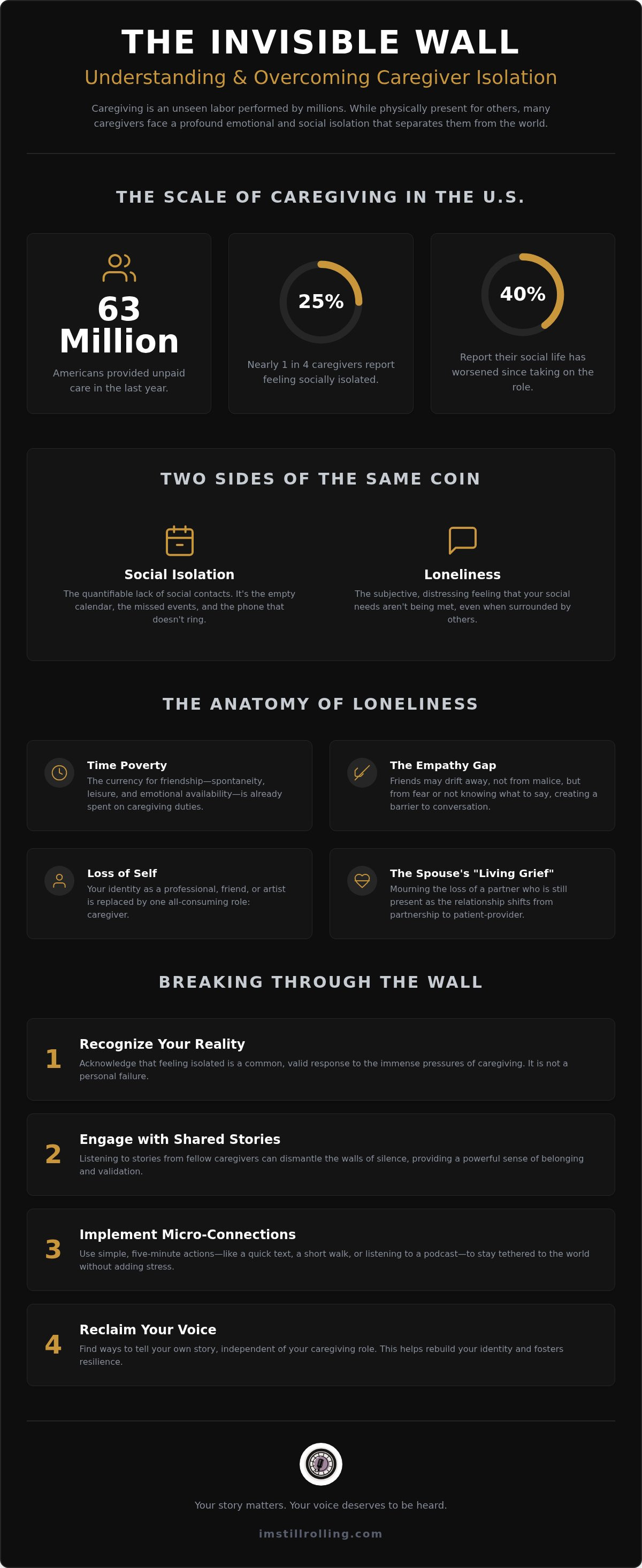
Caregiver isolation isn't a quiet choice or a preference for solitude. It's a wall that builds itself, brick by brick, as the relentless demands of care swallow the hours of the day. This isolation is both a physical withdrawal from social networks and an emotional retreat into a world that feels increasingly separate from the one your friends and neighbors inhabit. We often describe this as the invisible wall. It's the sense that the outside world no longer speaks your language or understands the high stakes of your daily life.
You aren't failing because you feel alone. According to AARP and the National Alliance for Caregiving, nearly 1 in 4 caregivers report feeling socially isolated, a figure that continues to grow. This state is a systemic outcome of a society that often expects family members to perform complex medical labor without adequate infrastructure. Reading research on Caregiver burden confirms that this weight is a collective experience. Finding stories of overcoming caregiver isolation becomes a vital way to realize that while your situation is unique, your emotional response is a shared human truth.
The Difference Between Social Isolation and Loneliness
Social isolation is the quantifiable lack of social contacts. It's the empty calendar, the phone that doesn't ring, and the missed community events that once anchored your week. Loneliness, however, is the subjective, distressing feeling that your social needs aren't being met even when people are nearby. You can be in the same room as your loved one and still feel a profound sense of seclusion because the nature of your relationship has shifted from companionship to care. These two forces intersect to create a specific type of exhaustion that defines the edge of caregiver burnout.
Why Caregivers Often Feel Invisible
The world has a tendency to look at the patient and see the caregiver as an extension of the equipment or the environment. Friends ask how your loved one is doing, but they rarely ask how you are holding up. This creates a loss of self where your identity as a professional, a friend, or an artist is replaced by a single, all-consuming role that others find difficult to look at for too long.
You might feel a sharp edge of guilt for wanting to be seen as an individual again. It's common to resent the fact that your own dreams or needs have been shelved to accommodate the needs of another. Acknowledging this isn't a betrayal of your loved one; it's an honest appraisal of the human cost of long-term care. Seeking out stories of overcoming caregiver isolation helps bridge this gap, reminding you that you are still a person with a story worth telling, independent of the labor you provide.
The Anatomy of Loneliness: Why Caregiving Leads to Seclusion
The weight of caregiving creates a specific kind of time-poverty. It isn't just that your schedule is full. It's that the currency required for modern friendship, such as spontaneity, leisure, and emotional availability, is spent before the sun even sets. Nearly 40% of caregivers report that their social life has worsened since taking on their role, according to recent data from A Place for Mom. This creates an empathy gap. Friends often drift away, not out of malice, but because they fear the gravity of your reality or simply don't know what to say. They see the medical trauma you navigate and worry that their own lighthearted updates will seem trivial.
This silence creates a barrier to normal conversation. When your daily life is defined by high-stakes decisions, small talk feels like a foreign language you've forgotten how to speak. You might find yourself searching for stories of overcoming caregiver isolation just to prove that a world exists beyond the sterile walls of your current routine.
The Spouse Caregiver's Unique Challenge
When the person you care for is your partner, the isolation carries a sharper edge. This is often described as living grief. You are mourning the loss of a companion who is still physically present, witnessing the slow erosion of the marital dynamic as it shifts from a partnership to a patient-provider relationship. This is particularly true when caregiving for a spouse with Alzheimer's, where the person you once leaned on becomes the person who relies entirely on you. For those facing early-onset conditions, the seclusion is even deeper; your peers are in the prime of their careers while you're navigating a premature end to your shared plans.
The Physical and Mental Toll of Staying Isolated
Chronic isolation is more than an emotional burden. It's a health risk. Studies suggest that prolonged seclusion can lead to increased risks of depression, anxiety, and even cardiovascular issues. Without outside input, your mind becomes an echo chamber where negative thoughts and what-if scenarios go unchallenged. This psychological loop accelerates the trajectory toward total burnout and compassion fatigue, making it harder to provide the very care your loved one depends on.
If you're feeling the weight of this silence, hearing how others navigate these waters can be a lifeline. You can listen to honest conversations about the realities of caregiving to help break the cycle of seclusion. Finding these stories of overcoming caregiver isolation isn't just about entertainment; it's about breaking the echo chamber and remembering that you're still part of the human collective.
Breaking the Silence: The Power of Shared Narrative
When the only voices you hear are your own internal monologues or the clinical instructions of medical staff, the silence of your home becomes heavy. Breaking that silence requires more than just noise; it requires a specific kind of resonance that only comes from another person who truly understands the stakes. Hearing stories of overcoming caregiver isolation acts as the first essential step in dismantling the belief that you are the only one struggling with resentment, exhaustion, or a fading sense of self. It's a process of unmasking the "invisible" parts of your labor by seeing them reflected in the experiences of others.
Our approach to resilience is grounded in journalistic rigor. We don't look for superficial cheerfulness or easy answers. Instead, we seek the truth in the messy, unpolished parts of life. This involves connecting with what we call "vulnerable peers." These are individuals who have walked the difficult path of life-altering change and emerged not just as survivors, but as people who have found a new way to exist. Engaging with these stories of recovery and hope provides a lifeline that helps you pull yourself out of the immediate crisis and toward a broader perspective of endurance.
Why Podcasts are a Caregiver’s Best Friend
Audio content offers a unique form of passive companionship that fits perfectly into the fractured schedule of a caregiver. You can listen while preparing a meal, driving to a pharmacy, or sitting in a quiet room during the late hours of the night. The intimacy of the human voice reduces the immediate feeling of solitude, creating a bridge between your isolated reality and a wider community. Unlike the "highlight reels" found on social media, long-form interviews provide the depth and nuance necessary to address complex emotions. They allow for a slow build-up of narrative tension and emotional resonance, giving you the space to reflect on your own journey through the lens of another's experience.
The I'm Still Rolling Podcast Approach to Resilience
Hosted by seasoned journalists Mike Sugerman and Janice Wright, the I'm Still Rolling Podcast applies professional storytelling to the raw intimacy of caregiving and disability. We focus specifically on the "life after" narrative. We aren't just reporting on the tragedy or the initial diagnosis; we are exploring the long-term endurance and the discovery of meaning within the struggle. By listening to these stories of overcoming caregiver isolation, you are invited to see yourself not as a victim of circumstance, but as a fellow traveler in a resilient community. This shift in perspective is vital for self-preservation, helping you reclaim your voice in a world that often asks you to remain quiet.
Practical Strategies for Caregiver Isolation Support
Breaking the cycle of isolation doesn't require a total lifestyle overhaul. It happens in the margins of your day. We advocate for "micro-connections," which are social threads maintained in five minutes or less. Sending a quick voice note or a text while waiting for a kettle to boil keeps your identity tethered to the outside world without the exhaustion of a long-form phone call. These small acts prevent the complete erosion of your social self, ensuring that your voice remains a tool for connection rather than just a medium for clinical instructions.
Digital communities offer a similar low-friction escape. However, it's vital to find spaces that don't feel like another duty on your checklist. This is what we call a "respite of the mind." By engaging with media and podcasts, you can escape your immediate environment and find psychological relief without ever leaving the room. Hearing stories of overcoming caregiver isolation provides this mental shift, offering a window into lives that mirror your own and proving that your current seclusion is a chapter, not the whole book.
Finding the Right Support Community
Not all groups are created equal. Clinical support groups often focus on symptom management or legal hurdles, which are necessary but sometimes emotionally taxing. Peer-led narrative communities, on the other hand, focus on the human experience. To evaluate if a group is right for you, ask yourself these questions:
Does the conversation leave me feeling validated or more burdened?
Is there space for "unpolished" truth rather than just forced positivity?
Does the community offer multiple ways to engage, such as transcripts or newsletters, for when I'm too tired to listen?
For those seeking a consistent touchpoint that doesn't demand an immediate response, you can subscribe to our newsletter for regular reflections on resilience and shared strength.
Communicating Your Needs to the Outside World
Isolation is often compounded by well-meaning friends who offer unsolicited advice. Setting boundaries is an act of self-preservation. Use specific scripts to guide them: "I'm not looking for solutions right now; I just need you to listen while I vent for five minutes." This reframes the interaction from a problem-solving session into a genuine connection.
You can also ask for "micro-respite." Instead of asking for a whole afternoon off, which feels impossible, ask for small favors that break the seclusion. Ask a neighbor to pick up your groceries while they're out, or invite a friend to sit with you for a coffee in the garden. These small breaks remind you that you have a name and an identity that exists outside of your caregiving duties. Finding stories of overcoming caregiver isolation often reveals that these small, assertive steps are how most people begin to find their way back to themselves.
Reclaiming Your Voice with the I'm Still Rolling Podcast
The journey from the suffocating silence of the invisible wall to a place of genuine connection is paved with the truths of others. We believe that shared resilience is the primary antidote to the seclusion we've explored in this guide. By engaging with I'm Still Rolling Podcast Episodes, you aren't just consuming media. You're participating in a necessary ritual of self-preservation. These recorded conversations serve as a bridge between your isolated reality and a community that acknowledges the messy, unpolished parts of your life. Listening to these stories of overcoming caregiver isolation reminds you that while your circumstances have changed, your value as an individual remains entirely intact.
Our approach centers on the idea that connection is a lifeline, not a luxury. We move past the superficial advice often found in clinical settings to focus on the raw, lived experience of those who've navigated life-altering adversity. This is about finding meaning within the struggle and recognizing that your labor, while often unseen by the world, is a profound testament to human endurance. Reclaiming your voice starts with the realization that your story is part of a much larger, more resilient narrative.
Subscribe to the Resilience Community
The I'm Still Rolling Podcast newsletter provides a consistent touchpoint for those who find the world of caregiving too loud for constant interaction. It delivers regular bursts of connection directly to your inbox, acting as a gentle reminder that you aren't forgotten in the daily grind. For those moments when the house is finally quiet and you prefer the slow, meditative pace of reading, our Podcast Transcripts offer a space for private reflection. Taking the first step to break your own silence doesn't have to be a grand gesture. It can be as simple as opening an email or letting a new, empathetic voice into your space to sit with you in the quiet.
The Role of Journalistic Integrity in Support
What sets this platform apart is the professional background of our hosts, Mike Sugerman and Janice Wright. Their decades of reporting experience bring a level of rigor and honest inquiry that you won't find in a generic support blog. This isn't just about sharing anecdotes; it's about a commitment to truth-telling that actively fights the stigma often fueling caregiver seclusion. By reporting on disability and caregiving with the same intensity as a major news story, they validate your experience as something worthy of global attention and respect. They act as both trusted guides and vulnerable peers on this difficult journey.
We embrace a philosophy of realistic optimism. Life has undoubtedly shifted, and the road ahead may still be steep; however, you're still here, your story still matters, and your voice is worth reclaiming. You've heard the stories of overcoming caregiver isolation from those who've walked this path before you, and now it's time to remember one vital truth: you're rolling, and you're not rolling alone.
Moving From Silence to Shared Resilience
The journey through the invisible struggle of caregiving doesn't have to end in seclusion. We've moved through the anatomy of loneliness and identified the specific power of narrative to dismantle the empathy gap that often leaves caregivers feeling misunderstood. By immersing yourself in stories of overcoming caregiver isolation, you transform a solitary struggle into a shared human experience. This shift doesn't just provide comfort; it acts as a vital tool for self-preservation, allowing you to reclaim your voice in a world that often overlooks your needs.
Veteran journalists Mike Sugerman and Janice Wright bring decades of award-winning storytelling to every episode, ensuring that the "life after" narrative is told with both professional rigor and raw intimacy. With accessible options like Podcast Transcripts, video, and audio, we meet you wherever you are in your day, providing a low-friction way to stay connected to a community that truly hears you. Take the step today to reconnect with your own identity and discover the strength found in shared truth. Subscribe to the I'm Still Rolling Podcast and find your community of resilience. Life has changed, but you're still here, you're still rolling, and you're certainly not rolling alone.
Frequently Asked Questions
How do I know if my caregiver isolation is becoming clinical depression?
Isolation is a situational state, but clinical depression is a persistent medical condition. Signs often include a pervasive sense of hopelessness, loss of interest in previous hobbies, and significant changes in sleep or appetite. While we don't provide medical services, we recognize that chronic seclusion can lead to these states. If your feelings interfere with your ability to function daily, it's vital to consult a healthcare provider for professional support.
What are the first steps to take when I feel completely alone in my caregiving role?
Start by acknowledging that your solitude is a systemic result of your role and not a personal failure. Reach out for micro-connections by sending a single text or voice note to a trusted friend. Seeking out stories of overcoming caregiver isolation can also provide immediate validation. These narratives prove that others have navigated this exact silence and found a way back to themselves through the power of shared resilience.
Can listening to a podcast really help with my feelings of isolation?
Listening to a podcast provides passive companionship that can significantly reduce the immediate sensation of being alone. The intimacy of the human voice creates a bridge between your quiet home and the outside world. Long-form interviews, like those on I'm Still Rolling, offer a depth that social media lacks. They allow you to hear the unpolished truth of someone else's journey, which fosters a sense of belonging to a larger community.
How can I find time for support when my caregiving duties are 24/7?
You can integrate support into the margins of your caregiving tasks without adding more chores to your list. Audio content is ideal because you can listen while performing medical duties, cleaning, or driving to appointments. If listening isn't possible, our podcast transcripts provide a way to engage in short, quiet bursts during late-night shifts. The goal is to find low-friction ways to feed your own soul while you're already in motion.
What should I say to friends who have stopped calling since I became a caregiver?
Use honest scripts that guide them on how to interact with your new reality. You might say: "I've missed our connection, and while my life is very full of caregiving right now, I still value our friendship." Be specific about what you need, whether it's a five-minute check-in or just a text with news from the outside world. This reframes the relationship and lowers the barrier for them to reach back out.
Is it normal to feel resentful of the person I am caring for because I am lonely?
Feeling resentful of the person you care for is a common and normal reaction to the loss of your own freedom. It's often a symptom of burnout and deep isolation rather than a lack of love or commitment. Acknowledging this messy emotion is a key part of the journalistic truth we explore. You aren't a bad person for wanting your life back; you are simply a human experiencing the weight of struggle.
How do I explain my isolation to family members who think I am 'doing fine'?
Frame your experience around the invisible wall rather than just the physical tasks you perform. Explain that while you may look like you're handling the logistics, the emotional toll of being the sole provider is creating a sense of seclusion. Use clear language: "I am managing the care, but I am losing my sense of self in the process." This helps them understand that doing fine with tasks doesn't mean you're emotionally supported.
Where can I find caregiver support that doesn't feel like a clinical therapy session?
Look for narrative-driven communities that focus on shared human experiences rather than clinical checklists. Platforms like I'm Still Rolling offer stories of overcoming caregiver isolation through a journalistic lens, providing a vulnerable peer perspective. This type of support feels like a conversation with a seasoned traveler who has walked a similar path. It prioritizes realistic optimism and honest storytelling over medical advice or formal, dry therapy sessions that can feel like another obligation.


Comments