Caregiver Guilt and How to Cope: Navigating the Emotional Weight of Resilience
You sit in the stillness of 3 AM, listening to the rhythmic breathing of the person you love, but a relentless voice in your head whispers that you aren't doing enough. When you're drowning in caregiver guilt and how to cope feels like an impossible question, it's easy to believe your exhaustion is a moral failing. This is the raw, unvarnished reality of the caregiving experience that few people discuss openly.
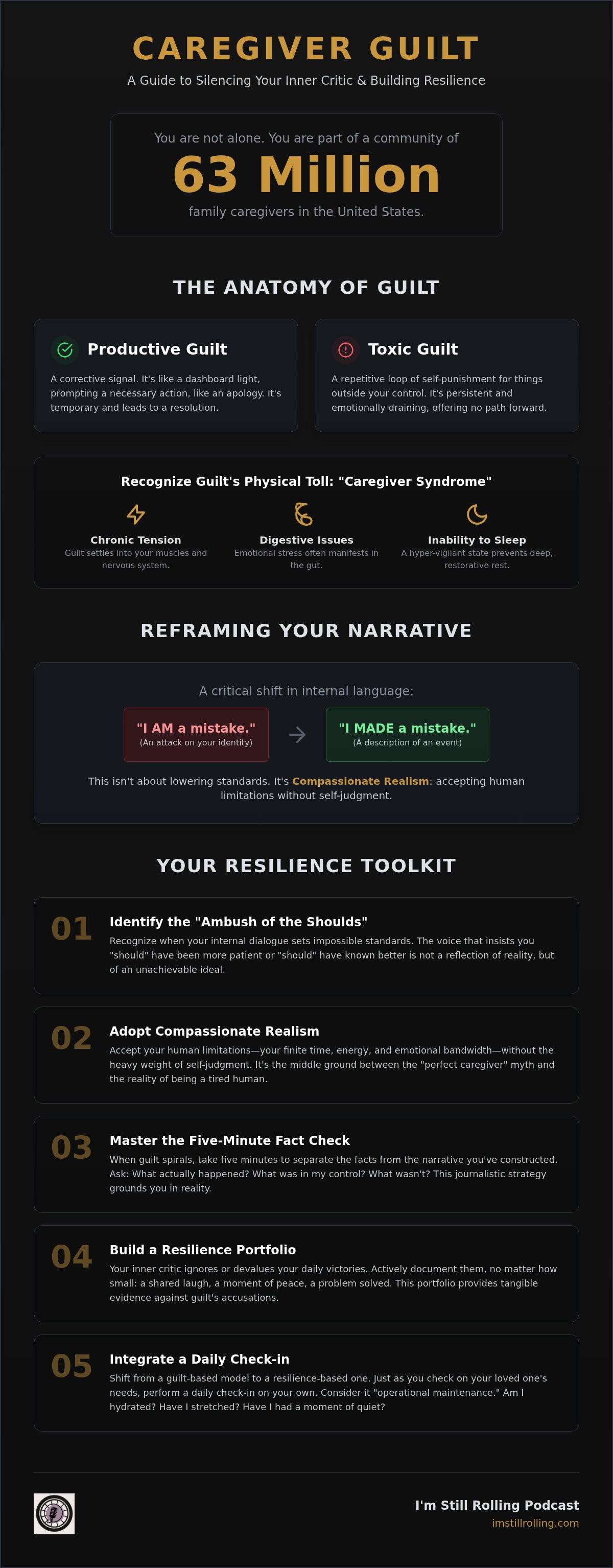
If this sounds familiar, you're part of a silent legion. Nearly 63 million family caregivers in the United States currently navigate this same emotional terrain; it's a space where profound love and sharp resentment often live side by side. We validate that your feelings are normal and that the weight you carry isn't just physical, but an internal pressure to be perfect in an imperfect situation.
In this guide, we'll deconstruct the "shoulds" of caregiving using a blend of journalistic truth and heart-centered strategies. You'll learn practical ways to silence your inner critic and transform emotional exhaustion into sustainable resilience. We'll explore how to move from feeling like a victim of your circumstances to becoming a fellow traveler who finds meaning within the struggle.
Table of Contents
The Anatomy of Caregiver Guilt: Why We Feel We Are Never Enough
Guilt is often the friction created when the ideal version of ourselves grinds against the exhausted, human reality of our daily lives. We define our success by a standard of "perfect" care that simply doesn't exist in the messy world of illness and disability. This cognitive gap is the primary source of caregiver guilt and how to cope starts with identifying this disconnect. We call this the "Ambush of the Shoulds," that internal prosecutor that insists you should have been more patient during a midnight crisis or should have anticipated a medical complication you couldn't possibly have seen coming.
We must distinguish between productive guilt and toxic guilt to find a path forward. Productive guilt acts as a corrective signal, like a light on a dashboard, prompting us to apologize if we've been unnecessarily sharp. Toxic guilt, however, is a repetitive loop of self-punishment for things beyond our control. It's vital to validate that feeling resentment or bone-deep exhaustion doesn't negate the love you have for your partner or parent. These emotions are parallel lines, not intersecting ones; you can be a devoted caregiver and still desperately wish for your old life back.
The Journalistic Truth About Caregiver Burnout
As journalists, we're trained to observe the facts of a situation rather than the narrative we've constructed around it. Burnout often disguises itself as guilt, making you feel like you aren't doing enough when the objective truth is that you're doing far too much. When caregiving for a spouse with alzheimer’s, this is compounded by "ambiguous loss," where you're grieving a person who is still physically present. This specific type of grief fuels an endless cycle of guilt because there's no clear finish line or "right" way to navigate the emotional shift.
Recognizing the Physical Toll of Emotional Weight
Guilt isn't just a mental state; it settles into your muscles and nervous system. Caregiver stress and guilt often present as chronic tension, digestive issues, or an inability to reach deep sleep. As of 2026, the medical community formally recognizes "caregiver syndrome" as a clinical condition characterized by the physiological depletion that occurs when emotional demands exceed physical capacity. Learning caregiver guilt and how to cope requires listening to your body's reporting. When your body sends signals of pain or hyper-vigilance, it's not a sign of failure, but a factual account of the unsustainable weight you're carrying.
Reframing the Narrative: Moving from Guilt to Compassionate Realism
Generic advice often suggests a bubble bath or a short walk to fix the heavy emotional toll of caregiving. These suggestions feel dismissive because they don't address the deep-seated belief that you're failing. To truly understand caregiver guilt and how to cope, we must move toward Compassionate Realism. This isn't about lowering your standards; it's about accepting the factual limitations of your time, energy, and emotional bandwidth without the subsequent self-judgment. It's the middle ground between the "perfect" caregiver myth and the reality of being a tired human being.
A critical shift involves the language we use in our internal monologues. There is a profound difference between saying "I made a mistake" and "I am a mistake." One describes an event, while the other attacks your identity. When you forget a medication time or lose your temper, that's a data point in a long, difficult day. It doesn't define your character. We often suggest the "Third-Person Perspective" as a journalistic tool for the soul. If you were reporting on another caregiver in your exact situation, would you write a headline that calls them a failure? Likely not. You'd report on the immense pressure they're under and the resilience they show despite the odds.
We also need to reframe self-care. The term has become a chore on an already overflowing to-do list. Instead, think of it as "operational maintenance." Just as a reporter needs a working camera and a reliable signal to file a story, you need sleep and nutrition to function. It's not a luxury; it's a requirement for the job. Hearing how others balance these demands can help you feel less alone. You can find these honest conversations on the I’m Still Rolling podcast.
Guilt vs. Regret: A Crucial Distinction
Guilt is an internalized sense of failure, but regret is simply acknowledging a difficult outcome. You can regret that a situation is hard without being guilty for its existence. This distinction is vital when reading spinal cord injury recovery stories. Progress in these cases is often slow and non-linear. You might regret that a loved one isn't hitting milestones as quickly as hoped, but that isn't your fault. Releasing the burden of outcomes you cannot control is the first step toward finding caregiver guilt and how to cope with the long-term nature of recovery.
Setting Boundaries as an Act of Resilience
In the world of journalism, we have a credo: honor the truth of the story. Your story includes your own capacity. "No" is a complete sentence and a necessary tool for your survival. You might feel guilty setting boundaries with family members who offer opinions but no help, yet those boundaries protect the energy you need for your loved one. Honoring the truth of your own limits isn't selfish; it's the only way to remain a resilient caregiver for the long haul.
Practical Strategies for Coping with Caregiver Guilt in 2026
Tactical resilience requires a toolkit, not just a mindset. When the weight of your responsibilities feels crushing, abstract concepts like "compassion" can feel out of reach. You need concrete methods to dismantle the internal prosecutor in real time. One of the most effective journalistic tools we've found is the "Five-Minute Fact Check." When a wave of guilt hits, stop and ask yourself three cold, hard questions: Did I intentionally cause harm? Did I do the best I could with the information I had at the time? Is this guilt based on a fact or a feeling? Stripping away the emotional narrative often reveals that the "crime" you're punishing yourself for is simply being a human with finite energy.
To balance the ledger, we recommend creating a "Resilience Portfolio." Guilt has a way of magnifying every mistake while rendering your successes invisible. By documenting small wins, such as successfully managing a difficult pharmacy call or finding a moment of shared laughter, you create a physical record of your competence. In 2026, technology offers new ways to delegate the "guilt-heavy" mental load. Automated scheduling and remote monitoring systems can now handle the logistics that often trigger anxiety when they slip through the cracks, allowing you to focus on the human connection rather than the administrative burden.
Finally, find your "Vulnerable Peer." This is one person, perhaps a fellow traveler on this journey, to whom you can tell the unfiltered, messy truth. Isolation is a petri dish for shame. Speaking your "darkest" thoughts aloud to someone who understands caregiver guilt and how to cope with it can instantly neutralize their power. It's the difference between carrying a secret and sharing a report from the front lines.
The Power of Micro-Respite
Respite doesn't always mean a week away; it can happen in sixty-second windows. Micro-respite is the practice of finding brief moments of presence amidst the chaos. You might find this while doing the dishes or waiting for a prescription. We've found that listening to stories of recovery and hope during these mundane chores can provide the necessary emotional distance to reset your nervous system. If the inner critic becomes too loud, try a simple grounding technique: name five things you can see and four things you can touch. It pulls you out of the "shoulds" and back into the "now."
Navigating the Shift in Identity
It's jarring when your primary role shifts from spouse, child, or friend to medical manager. Identity foreclosure in caregivers occurs when the relentless demands of the role cause one to prematurely abandon personal interests and self-definition, leaving only the label of "caregiver" behind. Preventing this requires fiercely guarding a thread of your pre-caregiver self. Whether it's a ten-minute reading habit or a specific morning coffee ritual, these non-negotiable habits act as an anchor. They remind you that while caregiving is what you do, it isn't the entirety of who you are. Understanding caregiver guilt and how to cope means acknowledging that you're allowed to exist outside of your service to others.
Shared Resilience: Why Community is the Antidote to Guilt
Isolation acts as a petri dish for guilt. In the quiet, lonely hours of the night, the "shoulds" grow unchecked, fed by the silence of a world that doesn't see your labor. Sharing your stories breaks this cycle of internal accusation. There's a transformative power in hearing someone else voice the very "secret" thoughts you've been ashamed to think. When another caregiver admits to wishing for their old life back, your own "hidden" guilt begins to lose its teeth. Understanding caregiver guilt and how to cope starts with realizing that your feelings aren't a sign of failure, but a universal response to an extreme human experience.
Our "I’m Still Rolling" philosophy is built on this foundation of radical honesty. We believe in finding strength within the raw, messy, and often unflattering parts of the human condition. This isn't about looking for a silver lining that isn't there or pretending that every day is a gift. Instead, we practice "Realistic Optimism." This is a long-term sustainability strategy where we acknowledge the full gravity of medical trauma while remaining fundamentally hopeful. It's a grounded, soulful connection that allows you to feel the weight of your reality without being crushed by it.
Finding Your Fellow Travelers
Finding your fellow travelers is a vital step in your endurance. Identifying safe communities is essential because you don't need toxic positivity; you need people who won't flinch when you describe the hardship. Podcasts offer a low-energy way to feel less alone during the hours you can't leave the house. I’m Still Rolling Podcast Episodes are specifically crafted to be that safe space for truth-telling. They act as a steady, reliable pulse, moving from professional observation to personal storytelling to keep you engaged through the heavy subject matter of caregiver guilt and how to cope.
The Journalist’s Lens on Disability Rights
We must also apply a journalist’s lens to the systemic landscape. Often, what we perceive as personal failure is actually a systemic gap in support. Understanding the evolution of the disability rights podcast helps reframe your struggle within a larger historical context. It shows that the lack of affordable respite care or the strain of navigating complex medical bureaucracies isn't your fault; it's a social and political issue. When you advocate for yourself, you're honoring the person you care for by ensuring the person providing that care stays whole.
Join a community of fellow travelers who understand the raw truth of the journey; explore the I’m Still Rolling podcast and newsletter for stories of resilience.
Moving Forward: A Roadmap for the Resilient Caregiver
Transitioning from a guilt-based model to one of resilience requires a fundamental shift in how we report on our own lives. Guilt asks what we did wrong, but resilience asks how we can keep moving forward sustainably. By deconstructing the impossible standards we've inherited, we create space for the raw truth of our experience. This is the core of understanding caregiver guilt and how to cope. It's not about achieving a state of perfection, but about maintaining the capacity to endure with your humanity intact.
The "Daily Rolling" check-in is a simple, unflinching diagnostic tool for your journey. Every morning, assess your own needs with the same journalistic precision you use for a medical chart. If your internal resources are depleted, you cannot provide the high-level care your loved one requires. Acknowledging this isn't a moral failure; it's a factual assessment of your current operational status. We invite you to join the I’m Still Rolling community, where we prioritize this kind of truth-telling over superficial cheerfulness.
Your Next Steps for Coping
Resilience isn't built in a day, but through small, consistent actions that honor your capacity. If you're feeling overwhelmed, try to focus on just three things today:
One phone call: Reach out to a "vulnerable peer" or a fellow traveler who understands the load.
One boundary: Identify one non-essential demand on your time and say "no" without providing a lengthy excuse.
One episode: Listen to a story that validates your feelings and offers a sense of shared resilience.
For weekly "resilience reporting" and insights delivered straight to your inbox, you can subscribe to the I’m Still Rolling Newsletter. It's a final reminder that you're still rolling, even on the days when it feels like you're just spinning in circles.
Connecting with Mike and Janice
Mike Sugerman and Janice Wright bring decades of award-winning journalistic experience to these difficult conversations. They've reported on the world's most complex stories, but their most profound work comes from their own lived intimacy with medical trauma and disability. They aren't just experts; they're fellow travelers who understand the nuances of caregiver guilt and how to cope because they've navigated the same emotional weight themselves.
We want to hear your story of resilience. Sharing the raw, messy parts of your journey helps break the isolation that fuels guilt for others. You can find all our latest conversations and subscribe on the I’m Still Rolling Podcast Episodes page. There's an unflinching hope that comes from acknowledging the hard parts of life together.
Honoring the Journey Ahead
Caregiving is one of the most profound acts of endurance a human can undertake, yet it's often shadowed by an internal dialogue of perceived failure. We've explored how shifting from a guilt-based model to one of Compassionate Realism allows you to acknowledge your limitations without losing your sense of self. By utilizing journalistic tools like the Five-Minute Fact Check and seeking out micro-respite, you can begin to dismantle the "shoulds" that weigh you down. Understanding caregiver guilt and how to cope isn't about finding a quick fix; it's about building a sustainable life where your needs exist alongside those you care for.
You don't have to carry this weight in silence. Hosted by Mike Sugerman and Janice Wright, who have won multiple journalistic awards for their unflinching disability reporting, our show offers a grounded space for deep reflection. Join a community of thousands of "fellow travelers" who find meaning within the struggle. Listen to "I’m Still Rolling" for honest stories of caregiving and resilience and discover that while the path is difficult, you aren't walking it alone. You're still rolling, and your story matters.
Frequently Asked Questions
Is it normal to feel guilty for wanting my old life back?
Yes, it is a universal experience among caregivers. This feeling doesn't mean you love the person less; it's a natural grief for your own lost autonomy. Acknowledging this "hidden" guilt is the first step in learning caregiver guilt and how to cope with the long-term emotional load. You're mourning a version of yourself that existed before the medical trauma, which is a valid and human response to life-altering change.
How do I stop the "inner critic" from telling me I’m not doing enough?
Use the "Five-Minute Fact Check" to challenge irrational thoughts with objective data. Ask yourself if you've intentionally caused harm or if you're simply hitting the limits of human capacity. Replacing the narrative of failure with one of "Compassionate Realism" helps silence the critic. By documenting small wins in a Resilience Portfolio, you provide your brain with evidence that you are, in fact, doing enough despite the immense pressure you face.
What is the difference between caregiver burnout and caregiver guilt?
Burnout is a state of physical, emotional, and mental exhaustion, while guilt is the internal judgment of your performance within that state. Burnout happens when you do too much for too long; guilt happens when you feel you aren't doing enough. Often, burnout masks itself as guilt, making you feel like a failure when you are actually depleted. Recognizing this distinction is key to finding sustainable resilience and managing the weight of your role.
Can caregiver guilt cause physical health problems?
Yes, chronic guilt creates sustained physiological stress that can manifest as "caregiver syndrome." This condition often includes sleep disturbances, digestive issues, and chronic muscle tension. Your body essentially "reports" on your emotional state through these physical signals. As of 2026, clinical recognition of this syndrome emphasizes that emotional weight is not just in your head; it has measurable impacts on your long-term health and your body's ability to recover from stress.
How can I set boundaries without feeling like I am abandoning my loved one?
Reframe boundaries as "operational maintenance" rather than an act of withdrawal. You cannot provide high-level care if you are structurally unsound. Setting a boundary, like a specific time for personal rest, ensures you remain a viable caregiver for the long haul. It's an act of resilience that protects the care recipient by protecting the caregiver. Remember that "No" is a complete sentence that honors the truth of your current capacity and energy.
What are the best podcasts for caregivers dealing with emotional stress?
Look for shows that prioritize "realistic optimism" and raw truth-telling over superficial advice. The I’m Still Rolling Podcast, hosted by award-winning journalists Mike Sugerman and Janice Wright, provides a safe space for these honest conversations. Each episode features fellow travelers sharing stories of life after medical trauma. Listening to these shared experiences helps reduce isolation and offers practical strategies for caregiver guilt and how to cope with the messy parts of the journey.
How do I handle guilt when I need to move a loved one to professional care?
View this transition as an expansion of the care team rather than a personal failure. Sometimes, the most loving act is recognizing when your loved one’s needs exceed what one person can safely provide at home. This decision is often based on the factual requirement for specialized medical or safety support. It allows you to return to the role of spouse or child, rather than remaining solely a medical manager or technician.
What are the first steps to take when I feel overwhelmed by guilt?
Start by identifying one "vulnerable peer" you can talk to without fear of judgment. Breaking the silence instantly reduces the power of the guilt. Next, perform a "Daily Rolling" check-in to assess your own needs alongside those of your loved one. Finally, choose one small, non-negotiable habit that anchors your pre-caregiver identity. These steps help move you from a guilt-based model to a resilience-based approach that preserves your own humanity.


Comments