Hearing loss journey stories of navigating noisy conversations
The hardest part of hearing loss can be keeping your place in a conversation when several voices compete at once. In hearing loss journey stories, people describe strategies such as telling others what helps, watching faces, asking for a clearer way to communicate, and relying less on pretending they heard. Their experiences also show how diagnosis and daily adaptations can reshape over time.
If noisy gatherings leave you tired or disconnected, hearing loss journey stories can show how others navigate similar moments. They don’t make the difficult parts disappear, but they can offer ideas and reassurance that adapting is a process, not a single decision. You’ll hear how people manage overlapping conversations, respond to a diagnosis, and adjust as hearing loss changes everyday life. Their experiences also highlight communication strategies and technology, while showing that each person’s path is different.
Table of Contents
Communication difficulties in noisy environments
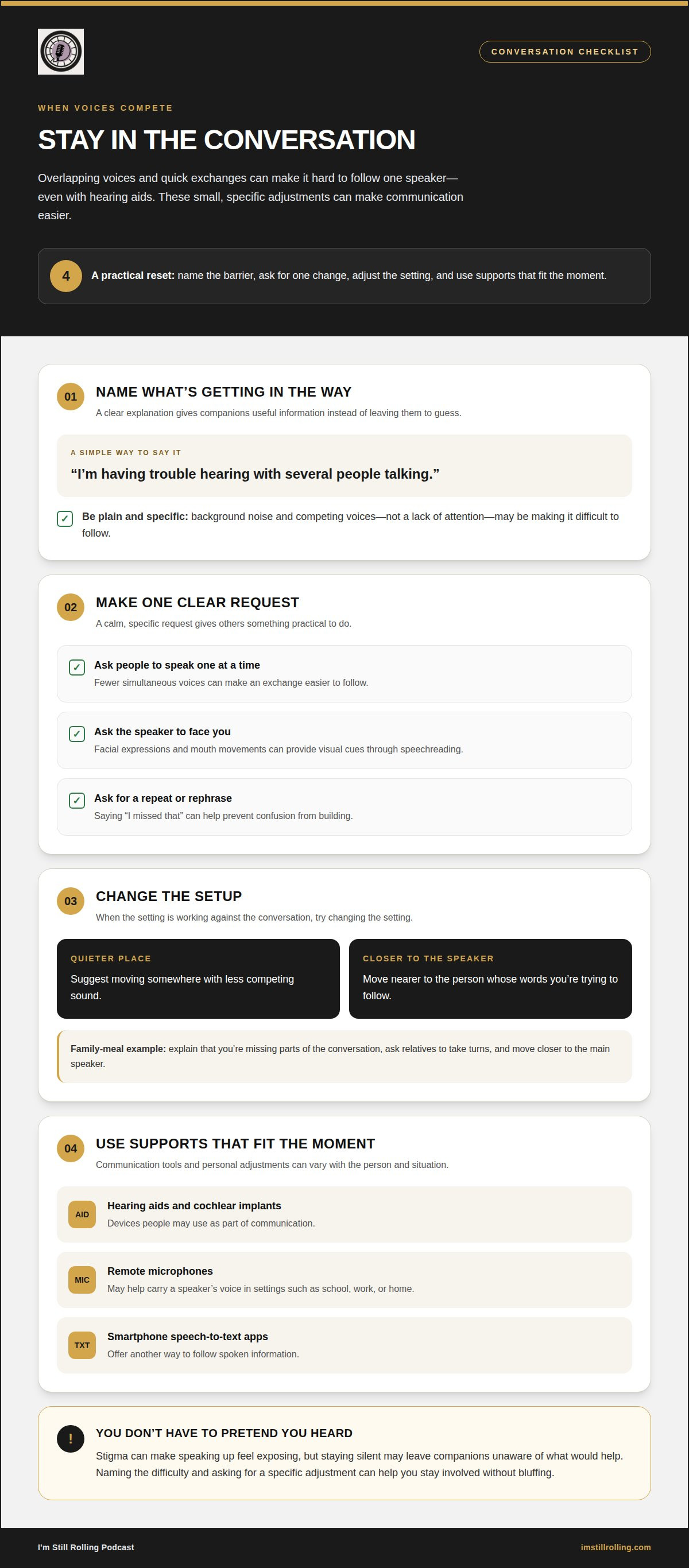
At a crowded dinner, overlapping voices can make it hard to follow one speaker, even with hearing aids. The strain often comes from competing sounds and quick exchanges, not a lack of attention. Try naming the difficulty plainly: “I’m having trouble hearing with several people talking.” This gives your companions useful information instead of leaving them to guess.
Self-advocacy can be specific and calm. Ask people to speak one at a time, move somewhere quieter, or face you while talking. Speechreading adds visual cues through facial expressions and mouth movements. It also helps to say “I missed that” rather than bluffing, so someone can repeat or rephrase and confusion doesn’t build. People also use hearing aids, cochlear implants, remote microphones, and smartphone speech-to-text apps.
Name the barrier: explain that background noise makes conversation difficult.
Make one request: ask a speaker to face you or repeat a key point.
Change the setup: suggest a quieter place or fewer simultaneous speakers.
At a noisy family meal, for example, someone might say they’re missing parts of the conversation, ask relatives to take turns, and move closer to the main speaker. Fewer competing voices can make the exchange easier to follow. Small adjustments help people stay involved without pretending they heard everything.
Stigma can make these requests feel exposing. Some people worry that disclosing hearing loss will change how others treat them. Staying silent, though, can leave companions unaware of what would help. Shared experiences can ease that isolation. Dr. David Myers founded the Loop America movement to encourage hearing access, while Shari Eberts and Gael Hannan have spent thousands of hours talking with people who have hearing loss. Connection with others can make self-advocacy feel less solitary.
The causes and timing of hearing loss vary. Meghan Bayer had congenital hearing loss, while Georgie St-Claire lost her hearing through meningitis at age three. Other personal accounts describe sudden or progressive hearing loss, showing that age alone doesn’t define someone’s experience.
Diagnosis and accepting hearing loss
Early signs can appear as repeated difficulties in familiar situations. Emily Truell was 27 when she realized she couldn’t answer the phone using her left ear. Meghan Bayer’s parents noticed she consistently turned her right ear toward speakers, and she was later diagnosed with bilateral moderate-severe sensorineural hearing loss on September 28th, 2000, at four years old. Turning one ear or struggling to hear through a particular side can be a reason to pay attention to a change.
A diagnosis names what someone has been experiencing, but it doesn’t settle every feeling at once. After Meghan’s diagnosis, her family began taking sign-language classes, adding another practical way to communicate. For a child, hearing loss can bring changes at home and school; for an adult, it may prompt a rethink of familiar routines, conversations, or independence. Acceptance doesn’t mean liking every change. It can start with recognizing what has changed and identifying what support helps.
Adult experiences also differ. Cheryl Hathaway says she was diagnosed with sudden sensorineural hearing loss in May 2021. Sheila was diagnosed in her 40s, and her eldest son received diagnoses of two types of hearing loss at 45. These accounts show how one family can encounter diagnosis at different life stages. Each person may need time to absorb the news, describe it to loved ones, and work out what it means in daily life.
Adjustment takes different amounts of time. For some, the first stage of the hearing-loss journey lasts many years; others move through stages over a few months. In one account, specialists may monitor hearing for two or three months to see whether it remains stable before offering definite information or advice. Waiting can mean balancing uncertainty with everyday responsibilities. Writing down questions, sharing the diagnosis with someone trusted, and considering one decision at a time can help. There’s no single timeline for acceptance; each person’s circumstances shape how understanding develops.
Adapting to changes during the hearing-loss journey
Missed words can affect relationships, while spoken instructions that are hard to follow can complicate work. The effort of keeping up may also affect emotional wellbeing, especially when someone feels left out or has to explain repeatedly what helps.
People may use hearing aids, cochlear implants, remote microphones, and smartphone speech-to-text apps. Adjusting to hearing aids or implants can involve getting used to changed sound and learning how devices fit into daily communication. Experiences differ from person to person.
Meghan Bayer’s hearing progressively worsened, and she became profoundly deaf in her left ear. She received bilateral cochlear implants in the summer of 2010, with her second implant arriving days before her freshman year of high school. Her experience shows how communication tools may change as hearing changes, alongside major transitions in school and daily life.
Maya received her first hearing aids at four months. Her hearing loss progressed to severe-to-profound at two and a half years old, and a few months after her third birthday she had her first cochlear implant surgery. A few weeks after activation, she asked about lyrics in a song she had heard many times. For her, that moment marked a new listening experience.
Adapting can involve more than choosing a device. Notice which settings are difficult, explain what would help to people nearby, and try communication supports that suit the situation. At school, work, or home, a remote microphone may help carry a speaker’s voice, while speech-to-text offers another way to follow spoken information. Maya’s question about song lyrics shows how a change can bring previously unnoticed details into focus. As hearing needs change, communication routines may need to change, too.
Meghan Bayer received the French II Award for the highest academic average in her class during her sophomore year. This achievement is one part of her experience, alongside changes in hearing and communication. It doesn’t mean everyone adapts in the same way; school life can involve academic experiences, hearing needs, and communication support all at once.
What are personal stories of people who experienced hearing loss?
Personal accounts reveal how differently hearing loss can begin and alter a life. Katherine Bouton lost her hearing suddenly in her 30s, a rupture in the life she knew. Her experience became part of a wider conversation about hearing loss, including how people explain an invisible change to those around them. A story like hers offers recognition, not a single script for what comes next.
For Rachel Clare, the turning point came on her 14th birthday, when she woke unable to hear well out of her right ear. The sudden change gave her a precise moment to remember, even though that date alone cannot capture its emotional weight. Her account makes the contrast clear: a birthday expected to mark a celebration instead became a personal landmark in a changing relationship with sound.
Sharon Ruiz-Lopez’s story carries a different timeline. Born in 1988 in Atlacomulco, a small rural community in Mexico, she identifies August 27, 2007, as the day her life changed. Those details locate her experience in a particular place and moment. Rather than reducing hearing loss to a diagnosis, her account shows how an event can become part of a person’s broader life story.
Other accounts show how experiences unfold over time. One person said sudden hearing loss had begun just over six weeks earlier; another described living with sudden sensorineural hearing loss for just over two years. These accounts offer different perspectives: the disorientation of a recent event and the insight that can come with a longer adjustment. Hearing loss journey stories show that no single timeline or response represents everyone. They can also help families listen without assuming they already understand.
To hear more first-person conversations about resilience and life after adversity, explore stories of lived experience.
Dr. David Myers’s book explains the psychology of hearing loss and shares his experience as a hard-of-hearing person. Meghan Bayer attended a private school and was mainstreamed throughout her education. During school hours, she received hearing-support instruction for a half hour twice a week.
Maya received her first hearing aids when she was 4 months old, and her hearing loss progressed to severe-to-profound when she was 2 ½ years old. A commenter said they had experienced sudden sensorineural hearing loss just over two years earlier.
I'm Still Rolling Podcast
I'm Still Rolling Podcast shares candid conversations about disability, resilience, and life after adversity. If hearing loss has changed how you take part in everyday conversations, hearing people describe their own experiences can offer perspective without suggesting that everyone’s path is the same.
Explore I'm Still Rolling Podcast Episodes for personal stories, or read Podcast Transcripts to follow conversations in written form. The I'm Still Rolling Newsletter offers another way to stay connected with these reflections. The podcast shares lived experiences, not medical guidance or treatment.
If you’d like to learn more or share what would help you, contact I'm Still Rolling Podcast.
Make room for your next conversation
Choose one upcoming conversation and decide what would make it easier to take part. You might tell a friend what helps, suggest a quieter setting, or ask someone to share important details in writing. A small, clear request gives others a practical way to support you without requiring you to explain everything at once.
There’s no need to measure your progress against someone else’s timeline. Hearing loss journey stories can offer perspective, but your own needs and choices remain your guide. Notice what helps you connect now, and let those choices change as life changes.
If you’d like to continue the conversation, contact I'm Still Rolling Podcast. Keep making space for the conversations that matter to you.
Comments