From patient to advocate stories: oncology and policy examples
A diagnosis can change more than a person’s health; it can change what they feel compelled to speak up about. From patient to advocate, stories show how lived experience can become a practical voice: asking difficult questions in oncology appointments, describing gaps that matter to health policy, or sharing what might help someone else feel less alone.
It’s understandable to wonder whether one person’s story can make a difference. Advocacy doesn’t require having every answer or turning pain into a public mission. Sometimes it begins with naming what happened and what needs to change. A personal experience can’t guarantee influence, but a clear account can help make an overlooked need easier to see.
This article explores how patients advocate during cancer care, how personal stories can inform policy discussions, and what makes an experience useful to others. The examples trace a path from private disruption to public voice, while recognizing that no two journeys through illness are alike.
Table of Contents
Patient stories as tools for health policy advocacy
Policy advocacy can begin with a detail that a form or statistic leaves out. Gwen Darien had 25 years of experience as a patient, survivor, and advocate when reflecting on her cancer experiences. By then, she had faced three cancer diagnoses. Her account connects individual treatment experiences with broader questions about what patients need. To shape a story for advocacy, identify the care problem, describe its effect, and state what change could address it.
Treatment can also affect health and daily life beyond the immediate appointment. Darien says patient advocates may face physical and emotional issues during treatment that they couldn’t anticipate beforehand. That matters when policy discussions treat a treatment plan as a clinical decision alone. A patient’s account can make visible the practical consequences that follow, while avoiding the claim that one person’s experience represents every cancer journey.
A health insurance denial can become an advocacy issue when it interrupts care. A patient can explain which treatment was denied, how the delay affected care, and what explanation or change they sought. Keep the account specific by separating the decision, its impact, and the requested remedy. This helps decision-makers understand the human consequences without implying that an appeal will succeed.
Barriers to accessing health care also call for clear examples. Someone unable to get to an appointment, for instance, can explain what part of the process created the obstacle and what would have made care accessible. Those details frame access as a policy concern, rather than an individual failure.
Volunteer patient advocates draw on lived experience to support patients or speak alongside them. Professional advocates take on advocacy as a role, which may involve helping people navigate care or systems; responsibilities depend on the position. Training and certification requirements vary by role and employer, so there is no universal credential for every advocate.
In the United States, search for advocacy organizations by cancer type, patient advocacy, or health policy, then review each group’s focus and activities. Advocates may face emotional strain and privacy concerns, as well as the challenge of speaking for themselves without implying they speak for everyone. Darien’s account shows why boundaries matter: a personal story can illuminate a policy problem, but it remains one patient’s experience.
Personal transformation through illness
Illness can redraw a person’s sense of time, certainty, and responsibility. Kiana’s experience offers a stark example: she had a heart transplant in 2023, then received a stage 4 DLBCL diagnosis six months later. Those events outline a life altered by serious illness, but they don’t tell us what Kiana felt or chose afterward. Respectful storytelling keeps that distinction clear.
A useful account doesn’t force a neat lesson onto a difficult experience. It describes what changed, what remained unresolved, and what the person chose to do next. The strongest from patient to advocate stories let the person define their own meaning. If you’re considering advocacy, start by identifying one issue illness helped clarify, such as communication or access to care.
Collective action offers another kind of transformation. In the late 1980s, HIV/AIDS activists began raising their voices to seek more research funding and better access to treatment. Their action made urgent needs visible through advocacy. The result was a public effort centered on research and treatment access, rather than isolated accounts of individual hardship. This history shows how shared experience can turn private urgency into a public demand.
Personal change doesn’t automatically make someone an advocate. A patient may speak publicly, support another person, or keep the experience private. Each choice can be meaningful. Before sharing, consider which details feel safe to make public, what the audience needs to understand, and whether you’re asking for awareness, support, or change. Setting boundaries matters when illness remains part of daily life.
Well-told from patient to advocate stories preserve complexity. They can include fear alongside resolve, or gratitude alongside criticism, without reducing someone to a diagnosis. Kiana’s timeline and the HIV/AIDS activists’ collective action are distinct examples, not interchangeable journeys. Together, they show that changed circumstances may prompt a response, while advocacy takes shape through the choices a person makes.
Advocating during oncology appointments
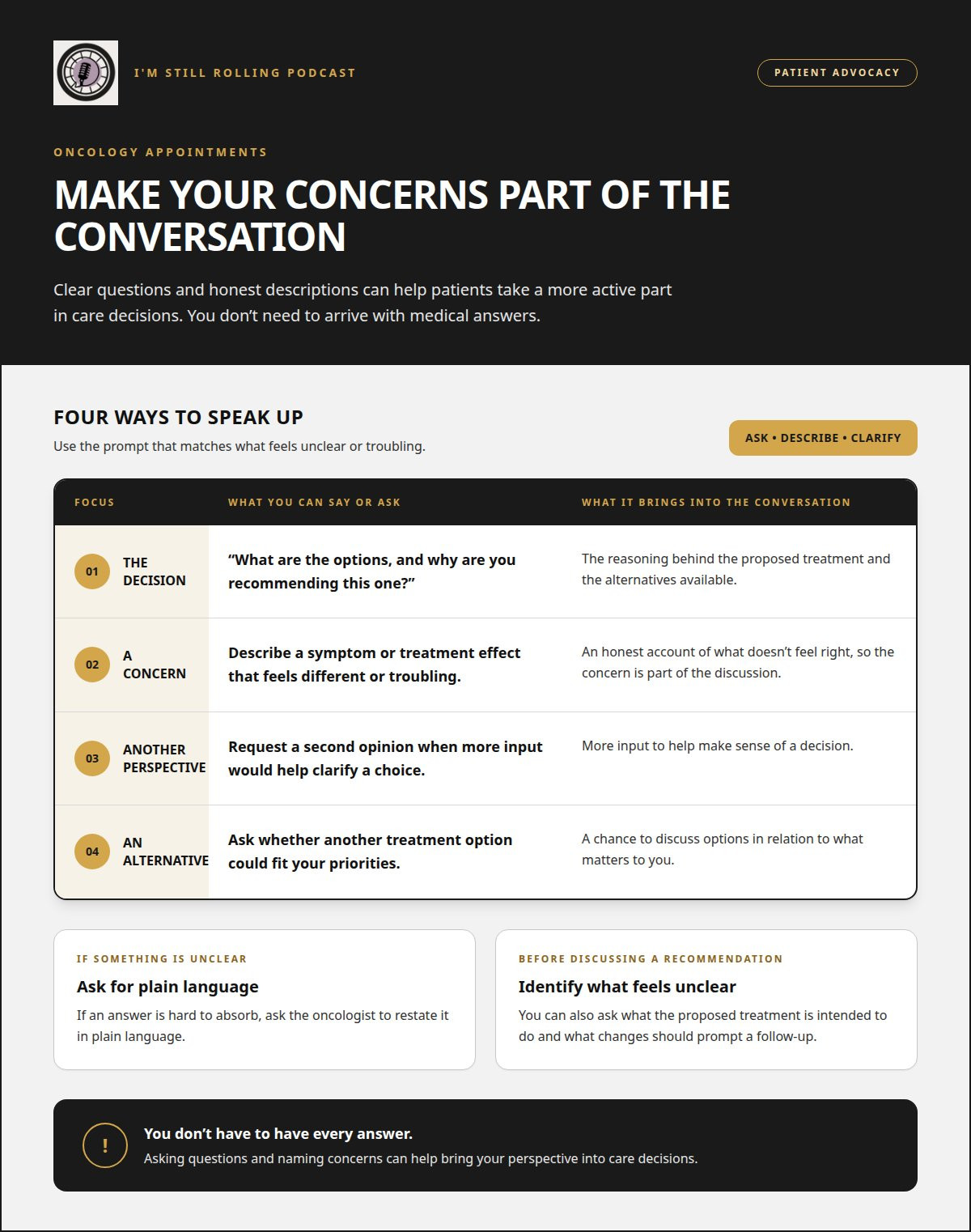
An oncology appointment can move quickly, especially when a diagnosis or treatment plan feels overwhelming. Patients can advocate by asking difficult questions, seeking a second opinion, requesting another treatment option, or saying when something doesn’t feel right. These steps bring their concerns into the conversation; patients don’t need to arrive with medical answers.
Before discussing a recommendation, identify what feels unclear. A patient might ask what the proposed treatment is intended to do, which alternatives are available, and what changes should prompt a follow-up. Direct questions can show where more explanation is needed. If an answer is hard to absorb, ask the oncologist to restate it in plain language.
Ask about the decision: “What are the options, and why are you recommending this one?”
Name a concern: Describe a symptom or treatment effect that feels different or troubling.
Request another perspective: Seek a second opinion when more input would help clarify a choice.
Raise an alternative: Ask whether another treatment option could fit the patient’s priorities.
Consider a patient who feels uneasy about a proposed treatment. They can ask the oncologist to explain the reasoning and discuss alternatives. That may lead to a more focused conversation, but it doesn’t guarantee a change in treatment. If uncertainty remains, the patient can seek a second opinion.
Another example is a patient who notices a symptom that feels wrong during care. Instead of minimizing it, they can describe what they noticed and when, then ask what it could mean for the current plan. That specific account gives the care team something concrete to address. It also makes the patient’s concern part of the appointment record and discussion.
Advocacy can be quiet and precise. Patients may bring a trusted support person, write down questions beforehand, or pause the conversation to clarify a point. Each step helps keep the appointment connected to what matters to the person receiving care. A patient’s account can also show others that speaking up is possible without pretending the experience is simple.
Sharing patient stories to influence advocacy
A personal story can help an audience understand how a policy issue affects daily life. Make it useful by connecting a specific moment to a clear need, then explaining what listeners can take away. A story needn’t represent every patient. Its value lies in describing one experience honestly and making its central point clear.
The I.M.P.A.C.T. storytelling framework offers six components: Introduction, Moment, Problem, Ask, Connection, and Takeaway. Start by saying who you are, then describe the moment that exposed a challenge. Name the problem, make a specific ask, connect your experience to others, and leave the audience with one clear takeaway. This structure can help from patient to advocate stories lead to a meaningful request.
Frank’s story about proposing to his partner before stomach cancer surgery was listed on October 5, 2026. The situation was an upcoming operation; his action was proposing before surgery. That detail places love and uncertainty beside the medical event. The story’s emotional focus can help readers recognize the person within a diagnosis, without suggesting every patient responds in the same way.
To share safely, decide which details are essential and which should remain private. Leave out identifying information about others unless they’ve agreed to its inclusion, and choose an audience and format that feel manageable. You can also revise or withdraw a story before sharing it publicly.
Sharing an experience of self-advocacy or supporting a loved one can offer others validation, encouragement, and practical tips for navigating cancer care. For example, from patient to advocate stories may show how someone prepared for a difficult conversation. Keep the sequence clear: the situation, the action, and what you learned. Avoid promising that someone else will get the same outcome by taking the same step.
Stories can inform advocacy without ending in a simple victory. Name the unresolved difficulty, state what change you hope to see, and make your request concrete. To hear more lived experiences, explore patient stories and conversations.
I'm Still Rolling Podcast
I'm Still Rolling Podcast shares candid conversations about resilience, disability, and life after adversity. These lived experiences add texture to the ideas in this article, showing how people make sense of hardship and decide what to share. Listen to episodes when you want to hear personal stories in the speakers’ own voices. The newsletter offers another way to stay connected, and podcast transcripts let you read conversations at your own pace.
Stories don’t replace medical guidance or advocacy services. They can, however, offer perspective and help readers recognize the different ways people respond to difficult experiences. If you’d like to learn more or share a question, contact I'm Still Rolling Podcast.
Let your next step be your own
You don’t have to turn a private experience into a public statement all at once. Start by choosing one moment you want others to understand, then decide what to keep for yourself. Stories that follow someone from patient to advocate can hold uncertainty and change without pretending every experience has a neat resolution.
If you’re considering sharing, write for one person or audience rather than everyone. Explain what happened, why it mattered, and what you hope the listener will understand. You can revise the story, pause, or choose not to publish it. Your experience belongs to you, including the decision about how much to make public.
For thoughtful conversations about resilience and life after adversity, explore I'm Still Rolling Podcast episodes, read the newsletter, or use podcast transcripts at your own pace. If you’d like to ask a question or share a thought, contact I'm Still Rolling Podcast. A story doesn’t need to be polished to matter; it needs to remain yours.
Frequently Asked Questions
What does “patient to advocate” mean?
It means using lived experience of illness or care to support patients or influence decisions. Advocacy can be personal rather than professional: someone might speak at a community meeting, help another patient prepare for a difficult conversation, or share a perspective with a policy group. Becoming an advocate doesn’t require public speaking, formal training, or making every detail of an illness public.
What are inspiring stories of patients who became health advocates?
Gwen Darien’s advocacy journey shows one patient drawing on cancer experiences to speak about patient needs. Its value isn’t that it offers a universal path, but that it shows how someone can shape experience into a voice for change. Other accounts may focus on a single decision, a barrier to care, or support for people facing a similar challenge.
What experiences lead patients to become advocates?
People may feel moved to advocate after a diagnosis, a difficult experience with care, or supporting someone close to them. A relative who struggles to understand a treatment plan, for example, might later share ways to make health information clearer. Some people speak from anger or grief; others want to preserve what helped. An experience can prompt advocacy, but it doesn’t obligate anyone to take on that role.
What steps can patients take to become advocates?
Start by choosing one issue you feel ready to address, such as clearer patient information or better support for a particular community. Learn how people affected describe the issue, then decide who needs to hear your perspective. You might share a short written account, join a community discussion, or support an advocacy effort. Set boundaries around personal details and choose a pace that feels sustainable.



Comments