Finding Accessible Housing: A Practical Step-by-Step Guide
Finding accessible housing is easier to manage when you start with what a home needs to make possible, rather than scrolling through more listings. A listing may call a place “accessible” without explaining whether the entrance, bathroom, or route between rooms will work for you. That uncertainty can make an already demanding search feel even heavier.
If you’re looking for a home that fits your specific access needs, broad labels and hopeful guesses aren’t enough. The details of daily life matter: getting inside, moving between rooms, reaching essential spaces, and feeling at ease in your home.
This practical guide will help you turn everyday needs into clear housing criteria, screen listings more effectively, and check important features during a visit. You’ll also learn how to organize next steps around applications, accommodation requests, and move-in planning. The goal isn’t to find a perfect listing on the first try. It’s to make each step more informed, manageable, and grounded in what works for you.
Table of Contents
Start finding accessible housing by defining what access means to you
Search for accessible housing with clearer listings and better questions
Compare accessible homes by checking how each space works in practice
Plan for accommodation requests, modifications, and housing rules
Move from finding accessible housing to a confident next step
Start finding accessible housing by defining what access means to you
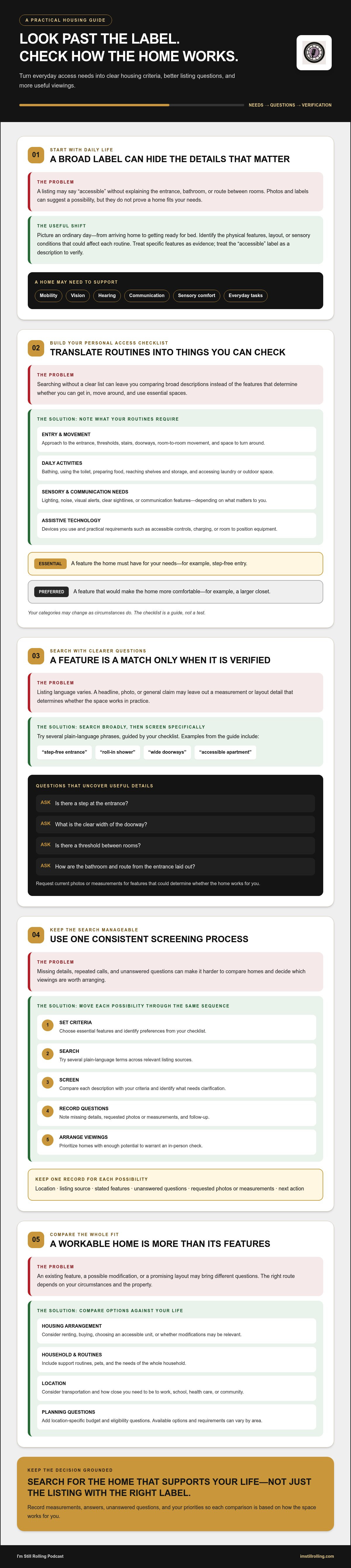
A housing search can wear you down when listings use broad labels but leave out the details that determine whether you can get through the front door, use the bathroom, or move comfortably from room to room. Before comparing properties, define what a workable home means in your daily life. Accessible housing isn’t one specific design or a synonym for wheelchair access. Needs can involve mobility, vision, hearing, communication, sensory comfort, or everyday tasks.
Accessible features are specific things a person can use; an “accessible” label is only a description until those features are clear. The Accessible housing overview discusses the concept and related adaptations, but your own routines are the most useful starting point for deciding what to look for.
Turn daily routines into a personal access checklist
Walk through an ordinary day in your mind, from arriving home to getting ready for bed. Note where a physical feature, layout, or sensory condition could make a routine difficult. Then separate what a home must have from what would make it more comfortable.
Entry and movement: Consider the approach to the entrance, thresholds, stairs, doorways, and the space needed to move between rooms or turn around.
Daily activities: Think about bathing, using the toilet, preparing food, reaching shelves and storage, and accessing laundry or outdoor space.
Sensory and communication needs: Depending on what matters to you, note lighting, noise, visual alerts, clear sightlines, or communication features.
Assistive technology: List devices you use and their practical requirements, such as accessible controls, charging, or room to position equipment.
Mark each item “essential” or “preferred.” For example, step-free entry might be essential, while a larger closet could be a preference. Your categories may change as circumstances do. This list is a guide, not a test.
Decide which housing arrangement fits your circumstances
Renting, buying, choosing an accessible unit, or considering modifications each brings different questions. An existing feature may suit you as it is; a possible change may depend on the property, your plans, and applicable rules. There’s no single right route. Compare what each option could mean for your needs, timeline, and flexibility.
Include the whole household in that comparison. Consider support routines, pets, transportation, and how close you need to be to work, school, health care, or community. Add location-specific budget and eligibility questions to your planning notes, since available options and requirements can vary. This groundwork makes finding accessible housing more focused: you’re searching for a home that supports your life, not just a listing that uses the right label.
Search for accessible housing with clearer listings and better questions
Once you have a personal access checklist, use it to guide the search rather than relying on a listing’s headline. Descriptions may use different terms for similar features, or label a home “accessible” without explaining what that means in practice. Photos and labels can help you identify possibilities, but they’re a starting point, not proof that a home fits your needs.
A feature is only a match when it’s verified against your measurements and the way you use the space. This principle can help you consider homes described in unfamiliar ways while still checking what matters.
Build a search that reflects your location and priorities
Search with several plain-language phrases, such as “step-free entrance,” “roll-in shower,” “wide doorways,” or “accessible apartment.” Listing language varies, so different terms may surface different options. Use the priorities from your checklist to guide filters and conversations, and remember that available homes and local resources differ by area. The AARP resource on Housing Accessibility also discusses universal design, a useful perspective when considering how a home may serve you over time.
Screen a listing before investing time in a viewing
Before arranging a visit, ask focused questions about the features most important to you. Specific questions are more useful than asking whether a home is accessible. For example: Is there a step at the entrance? What is the clear width of the doorway? Is there a threshold between rooms? How are the bathroom and route from the entrance laid out? Request current photos or measurements for features that could determine whether the home works for you.
Keep a simple record for each possibility: location, listing source, stated features, unanswered questions, and your next action. A short note can prevent repeated calls and make it easier to compare options later.
Set criteria: Choose essential features and identify preferences from your checklist.
Search: Try several plain-language terms across relevant listing sources.
Screen: Compare each description with your criteria and identify what needs clarification.
Record questions: Note missing details, requested photos or measurements, and follow-up.
Arrange viewings: Prioritize homes with enough potential to warrant an in-person check.
As you search, broader conversations about disability rights and representation can add context. Explore this disability rights podcast guide alongside your practical planning. For lived-experience conversations about disability and resilience, listen to the I'm Still Rolling Podcast.
Compare accessible homes by checking how each space works in practice
A home can have an accessible feature and still be difficult to use. A level entrance, for example, doesn’t tell you whether the route from the property boundary is smooth, whether interior doors accommodate your equipment, or whether you can reach the rooms you use most. During a viewing, assess the whole journey and compare what you observe with the routines and priorities you’ve already identified.
Use a simple comparison table for each home, with these columns: feature, observed condition, measurement, unanswered question, and priority. Record actual dimensions where they matter, then compare them with your mobility equipment and the space you need to use it. There’s no single measurement that determines whether a space works for everyone.
Assess entrances, routes, and essential rooms
Start at the property boundary and follow the route to the entrance, through thresholds and interior pathways, and into the rooms you use every day. Note changes in level, tight turns, obstructions, and whether you can open doors and move through the space as needed. Check turning space where you need it instead of assuming a wide-looking room will be practical.
In the bathroom and kitchen, consider how the layout fits your routines and equipment. Can you approach and use the sink, toilet, shower, counters, and storage in a way that works for you? Mark each item as verified in person or still needs clarification. This distinction keeps assumptions from quietly becoming facts as you compare homes.
Include sensory access, safety, and the surrounding area
Access extends beyond dimensions. Notice lighting, glare, background sound, signage, and communication features that affect how you experience the home. Consider whether building entrances, shared spaces, and emergency information are usable for you. If a key detail isn’t apparent during the visit, add it to your unanswered questions instead of guessing.
Then widen the view to the area around the home. Consider parking, transit, and the route to everyday necessities, such as groceries or other destinations important to your routine. A property may work indoors yet create barriers on the way to the places you need to reach.
Finding accessible housing involves weighing physical access alongside usability, comfort, safety, and the possibility of future changes. One home may meet your essential needs now; another may offer more room to adapt as circumstances shift. For a lived-experience perspective on resilience after spinal cord injury, explore these spinal cord injury recovery stories. They offer personal perspective, not housing guidance, and may broaden how you think about daily life and changing needs.
Plan for accommodation requests, modifications, and housing rules
As you compare homes, separate what already works from what you may need to request. An existing feature, such as a step-free entrance, can be assessed during a viewing. A change to a policy or a physical alteration to the property raises different questions, including who can approve it and what rules apply.
The Fair Housing Act, Section 504 of the Rehabilitation Act, and the Americans with Disabilities Act have different scopes. Broadly, the Fair Housing Act concerns housing, Section 504 applies to programs receiving federal financial assistance, and the ADA generally covers public accommodations and certain shared spaces. Which protections and procedures apply depends on the housing type and circumstances. Treat this as general information, not legal advice, and verify current requirements with relevant federal, state, and local sources.
Prepare a clear, practical accommodation request
If you need a change related to a housing rule or practice, describe the issue in plain language. Identify the barrier, explain the housing-related need, and state the adjustment you’re requesting. For example, you might explain that a particular communication method is needed to receive building notices and ask whether notices can be provided that way. Keep dated copies of requests and responses, along with notes about any follow-up. Processes and documentation vary, so don’t assume there’s one universal requirement or timeline, or that a request will automatically be approved.
Think through modifications before making commitments
Physical changes could include an access improvement at an entrance or an adjustment to fixtures. These are examples, not a promise that a particular change will be permitted or suitable. Before committing to a home or a project, clarify permission, responsibility, and costs under the applicable arrangement and rules. The answers may differ for rental housing, subsidized housing, and other settings.
Describe the need: Connect the barrier to a specific housing-related activity.
Define the change: Distinguish a request about a rule or practice from a physical alteration.
Keep a record: Save dated communications, responses, and relevant documents.
Check the context: Verify which current federal, state, and local requirements apply to the property and situation.
These steps can bring structure to finding accessible housing without requiring you to resolve every legal question alone. For thoughtful conversations about disability and resilience as you consider the next stage, explore I'm Still Rolling podcast episodes.
Move from finding accessible housing to a confident next step
A search becomes more manageable when each promising home has a clear next step. Use your notes to rank options by essential access needs first, then by preferences and location. A home that looks appealing but leaves a critical access question unanswered may need more follow-up before it belongs at the top of your list.
Create a manageable shortlist and follow-up plan
For each shortlisted home, gather unanswered questions in one place and identify what would answer each one: a measurement, a document, or a conversation. After a viewing, update your priorities if you discover that an overlooked detail affects your routine. Revising the checklist isn’t a setback; it’s useful information that can make the next comparison more accurate.
Keep one record for measurements, listing details, answers, application documents, accommodation communications, and follow-up dates. Then choose a small, time-bounded task, such as spending 20 minutes contacting one listing or organizing the measurements from a viewing. A defined next step can help reduce the fatigue of trying to manage the entire search at once.
Prepare for application and move-in without losing sight of access
As you move from viewing to application, organize the materials you need and keep personal information in a secure place. Store housing-related communications separately from general notes so you can find relevant details without sharing more than necessary. If you’ve discussed an accommodation or possible modification, retain the dated messages and any responses with your other records.
Before moving, map out the route into and through the home, and plan where essential equipment will go. Consider utilities, deliveries, and the order in which you’ll set up spaces you rely on for daily routines. A move-in plan doesn’t need to account for every surprise. It should make the first days easier by keeping essential items and access routes in view.
Finding accessible housing rarely follows a perfectly straight line. Listings leave details out, and a visit may reveal that a preference matters more than you expected, or that a feature needs another look. Keep what you’ve learned, adjust the shortlist, and take the next step at a pace you can sustain.
For honest conversations about disability and resilience, explore I'm Still Rolling's podcast episodes, hosted by journalists Mike Sugerman and Janice Wright and available in audio, video, and written transcripts.
Take your next step toward a home that works for you
Finding accessible housing can feel like a long series of questions, especially when listings leave important details unclear. A needs-first approach gives you a steadier way forward: define what your daily life requires, verify how each home works in practice, and keep measurements, answers, and follow-ups together as you compare options.
Your priorities may shift after a viewing, and that’s useful information, not a failure of planning. Let what you learn shape your shortlist, then move through applications and move-in preparation one manageable step at a time. The right choice is grounded in how a home supports your routines, comfort, and independence.
For thoughtful conversations about disability and resilience, explore I'm Still Rolling's podcast episodes. Hosted by seasoned journalists Mike Sugerman and Janice Wright, episodes are available in audio, video, and written transcripts, so you can choose the format that works for you. Subscribe to the I'm Still Rolling newsletter to stay updated on new content.
Frequently Asked Questions
How do I find accessible housing near me?
To find accessible housing near you, start with a list of essential access needs, then search local listings using varied accessibility terms and location filters. Treat labels as leads, not guarantees. Screen promising homes by asking about specific features, measurements, or current photos, and keep a record of responses. Availability, terminology, and local resources vary, so tailor your search to the area and housing type you’re considering.
What should I look for when viewing an accessible home?
Follow the route from the property approach and entrance to the rooms you use every day. Check thresholds, doorways, circulation space, bathroom and kitchen layouts, storage, controls, lighting, and communication features that matter to you. Compare what you observe with your own equipment and routines. Record measurements and unanswered questions as you go. A general accessibility label can’t establish whether a particular home will work for your needs.
Can I request changes to a rental home because of a disability?
You may be able to request a disability-related accommodation or modification, depending on the housing and circumstances. Applicable rules, processes, and responsibilities can differ across housing types and jurisdictions. Describe the barrier, the housing-related need, and the change you’re requesting in plain language. Keep dated copies of communications and responses, and verify current requirements before relying on a general summary. This is informational guidance, not legal advice.
What is the difference between accessible housing and an accommodation?
Accessible housing describes features that may make a home usable for people with particular access needs. An accommodation generally refers to a change to a rule, policy, practice, or service. A modification usually means a physical change to a space. These terms can have specific legal meanings, and their application depends on context. Verify the federal, state, and local rules that may apply to your housing situation.
How can I tell whether an accessible housing listing is accurate?
Ask what “accessible” means in that specific listing, then request details about features that matter to you, such as entrance conditions, doorway widths, bathroom layout, or routes between rooms. Photos may help, but they can leave out thresholds, dimensions, or obstacles. Whenever possible, compare verified details with your own requirements during a viewing. Note anything you still can’t verify, so you can follow up rather than rely on an assumption.
Does the ADA apply to every home or apartment?
No. Accessibility laws don’t apply in the same way to every residential setting. The Americans with Disabilities Act (ADA), Fair Housing Act, and Section 504 of the Rehabilitation Act have different scopes, and the details can depend on a property’s use, funding, and circumstances. Don’t assume a requirement applies universally. Check current official guidance for the specific housing situation, and seek qualified legal information if you need an answer about individual rights.
What if I cannot find a home that meets all my access needs?
Revisit your list and rank features by how essential they are to safety and daily activities, while respecting needs that are important to you. If practical, broaden your search area or consider other housing types. Record gaps that might be addressed through a permitted change, but don’t assume a change will be approved. Availability varies. A staged search, clear notes, and one manageable next step can help you compare options without having to solve everything at once.



Comments