Dating with a chronic illness: support, disclosure and intimacy
There’s no universal deadline for disclosing a chronic condition. Dating with a chronic illness means deciding what to share and when, based on your comfort and sense of safety. You can tell someone early or wait until trust begins to form. Either choice is valid.
It’s understandable if dating apps, changing symptoms, or the prospect of discussing intimacy make the first steps feel complicated. You deserve connection without revealing your entire medical history before you’re ready, and you deserve to have your needs met with respect rather than doubt.
This guide explores how to find support, choose your pace for disclosure, communicate boundaries, and adapt plans when symptoms shift. It also offers ways to discuss physical intimacy and consider whether dating apps can help you meet people who understand disability and chronic illness. The aim isn’t to make dating effortless; it’s to help you make it more honest, safer, and more your own.
Table of Contents
1. Finding support from therapists, coaches, or peer communities
Dating can bring health needs into conversations about time, energy, and closeness. In the United States, 51.4% of adults, representing 130 million people, reported MCC, according to the U.S. Centers for Disease Control and Prevention. The figures were 27.1% among young adults, 52.7% among midlife adults, and 78.8% among older adults. Your diagnosis may feel isolating, but it exists within a broad landscape of lived experience.
Support can help you sort through your feelings before sharing them with someone new. A therapist can help you work through anxiety, grief, or past rejection; a coach may help you practice conversations and identify relationship goals. Peer communities offer another kind of understanding: people who know what it means to cancel plans because symptoms changed. Choose support based on the challenge you want to address, whether that’s dating confidence, communication, or coping with dismissal.
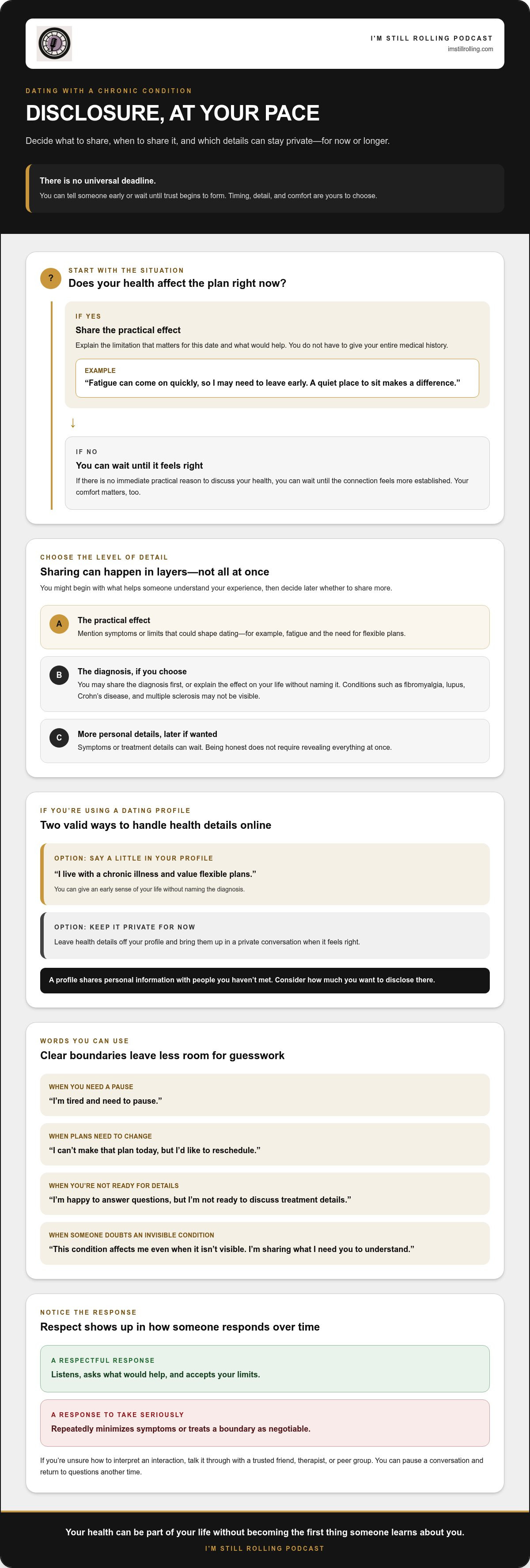
Prepare a clear way to describe what dating may involve for you. Name the symptoms that could affect a date, the limitations a partner might notice, and the practical support that helps. For example: “Fatigue can come on quickly, so I may need to leave early. A quiet place to sit makes a difference.” This gives someone useful context without requiring you to share your entire medical history.
Direct communication works best when you state a need or boundary plainly. Try, “I’m tired and need to pause,” or, “I can’t make that plan today, but I’d like to reschedule.” These statements leave less room for guesswork than pretending everything is fine. You can also say, “I’m happy to answer questions, but I’m not ready to discuss treatment details.” A respectful date listens, asks what would help, and accepts your limits.
Support also means noticing how a person responds over time. If someone repeatedly minimizes your symptoms or treats a boundary as negotiable, name the behavior: “When you call my pain an excuse, I feel dismissed. I need you to take what I say seriously.” Discuss the interaction with a trusted friend, therapist, or peer group, especially if you’re unsure how to interpret it. A support circle can help you stay grounded as you decide what feels safe and sustainable in relationships alongside work or a career.
2. Deciding when to disclose a chronic condition
There’s no universally right time to tell someone you’re dating about a chronic illness. You can disclose early or wait until you feel emotionally safer; the timing is yours to choose.
To disclose a chronic illness to a new partner, start with what they need to understand about your experience and its practical effects on dating. For example, explain that your condition can cause fatigue and that you may need flexible plans, then decide whether to share more.
Disclosure is a choice about timing, detail, and trust, not a single all-or-nothing confession. You might share the diagnosis first, then describe symptoms or treatment as the relationship develops. A chronic condition can be part of your life without becoming the first thing another person learns about you.
Before a conversation, consider what the other person needs to know right now. If symptoms could affect an upcoming date, describe the relevant limitation and what would help. If there’s no immediate practical reason to discuss your health, you can wait until the connection feels more established. Your comfort matters, too.
Online dating creates a separate decision: whether to mention your condition in a profile or wait for a private conversation. A profile can give an early sense of your life, but it also shares personal information with people you haven’t met. You might write, “I live with a chronic illness and value flexible plans,” without naming the diagnosis. Or leave health details off your profile and bring them up when the conversation turns to meeting.
Conditions such as fibromyalgia, lupus, Crohn’s disease, and multiple sclerosis may not be visible. If someone questions your experience because they can’t see your symptoms, you can correct the assumption without sharing your entire medical history. Try: “This condition affects me even when it isn’t visible. I’m sharing what I need you to understand.” Their response can help you judge whether the conversation feels respectful.
Being vulnerable doesn’t mean revealing everything at once. You can prepare a brief explanation, pause if the exchange becomes overwhelming, and return to questions another time. For instance, say, “I’d like to explain how this affects my energy, but I’m not ready to discuss treatment.” That boundary allows for honesty while keeping private details in your hands.
If firsthand accounts help you reflect on how people share difficult experiences, explore stories of resilience and disability as you consider what feels right for you.
3. Managing plans around unpredictable symptoms
Fatigue, pain, and flare-ups can shift without warning, changing what feels possible on a given day. A date that suits your body can still feel thoughtful and romantic. For a first meeting, choose coffee, a short walk at your own pace, or a video call. You don’t need to prove your interest through a demanding activity. One writer living with endometriosis said she didn’t want a 10-mile hike as a first date.
Build flexibility into the plan before symptoms intervene. Choose a venue where you can sit, leave easily, or move indoors if needed. If travel takes energy, suggest meeting near home or keeping the visit short. You might say, “I’d enjoy coffee somewhere quiet, and I’d like to keep the plan open-ended.” This gives both people a clear picture without making the date revolve around illness.
When symptoms change, explain the practical update and offer a next step. For example: “My pain has increased, so I need to cancel tonight. Could we try a video call tomorrow or reschedule?” If you can’t suggest another time, say so plainly. These conversations become easier with practice, especially when you distinguish a change in your health from your interest in the person.
A partner may also need time to adjust when plans change repeatedly. Talk together about what helps: a backup activity, shorter outings, or deciding closer to the date. One week, a walk may feel manageable; another week, staying home may be the wiser choice. Adapting is not a test of devotion. It’s a practical way to make room for both connection and changing capacity.
Your health remains part of the plan, not an obstacle to overcome for someone else. Keep medical appointments and follow your treatment plan, even when a new relationship feels exciting. During a flare, consider stepping back from dating to focus on rest or other self-care that supports you. A message such as “I’m taking a few days to focus on my health” communicates the pause without requiring a long explanation.
Rejection after a cancellation can sting, but one person’s response doesn’t define your worth. If someone loses interest because you need to change a plan, that response reflects their fit with your circumstances, not your value. Give yourself time to feel disappointed, then reconnect with a trusted friend or an activity that steadies you. You can return to dating when you have the energy and desire, rather than treating each missed date as a deadline.
Keep a simple note after dates: what activity felt manageable, what drained you, and what you’d change next time. Over several outings, those observations can reveal useful patterns, such as a preference for daytime meetings or shorter plans. Use what you learn to suggest dates that respect your limits while leaving room for spontaneity when your body allows it.
4. Discussing sex and physical intimacy
A chronic illness can affect dating, intimacy, and relationships through pain, fatigue, symptoms, or medication effects on libido and physical comfort. These changes can influence what feels pleasurable, how much energy intimacy takes, and when you want to pause.
You don’t have to discuss sex or starting a family over a drink on a first date. Choose a private, unhurried moment, such as a conversation at home before intimacy becomes likely. You can introduce the subject gently: “I want to talk about what feels comfortable for me before we get physical.” This gives both people room to listen and respond rather than rushing through a sensitive conversation.
Be specific about what affects your comfort, while sharing only the details you choose. For example, you might say that pain can make certain kinds of touch uncomfortable, or that fatigue means you’d prefer to take things slowly. If medication affects your libido or physical response, you can describe the impact without naming the medication. Focus on what you want your partner to understand and how they can respect your boundaries.
It can help to discuss preferences outside the moment, when neither person feels pressured to continue. Talk about what feels good, what doesn’t, and how you’ll signal a pause. A phrase like “Let’s stop for a moment” or “I’d rather try something gentler” can make adjustments clearer. Consent remains an ongoing conversation; either person can change their mind, even after intimacy has begun.
Devices, scars, and mobility aids may be part of physical intimacy for some people with chronic illness or disability. If you want to explain them, you could say, “This aid helps me move comfortably,” or, “I’d rather you ask before touching this area.” You don’t owe anyone a full account of your disease or medical history to set that boundary.
Intimacy can make room for mutual care, creativity, and presence instead of treating performance as the measure of connection. If an approach causes discomfort, pause and decide together whether to adjust, switch activities, or stop. A quiet conversation afterward can help: “I liked being close, but that position hurt. Could we try another way next time?” This keeps feedback specific without turning it into blame.
Partners may also need to discuss expectations as symptoms or comfort change over time. A check-in such as “How are you feeling about intimacy lately?” invites an honest answer without assuming desire or ability stays constant. Respectful curiosity, patience, and clear boundaries help make physical closeness a shared experience rather than another test to pass.
5. Dating apps for people with chronic illness or disability
Start by choosing a dating app that feels manageable, then set a small goal, such as having a conversation or arranging a short call. You don’t need to resolve disclosure, symptoms, and future compatibility before creating a profile. A first step can be as simple as writing a few lines about what you enjoy and the kind of connection you’re seeking.
Some people prefer a general dating app; others may feel more at ease in a space centered on disability or chronic illness. Consider what matters most to you: a larger pool of potential matches, shared understanding of disability, or more control over what you reveal. The right setting is the one where you can communicate on your terms, not the one that promises instant understanding.
Your profile can disclose as much or as little as you choose. You might mention a chronic condition directly, say your energy can vary, or leave health details for a private conversation. For example: “I enjoy quiet coffee dates and appreciate flexible plans.” That gives a potential match a concrete sense of your dating life without turning your profile into a medical summary.
If you describe an invisible condition, remember that a profile can’t show every part of your experience. You can explain more when a conversation feels respectful and relevant. A simple message could be: “I have a chronic illness that sometimes changes my plans. I’m happy to share more as we get to know each other.” You can also say you’d rather discuss personal health details later.
Before meeting, choose a format and plan that fit your current capacity. A video call can be a first step; a short coffee date can make an in-person meeting feel more manageable. If symptoms shift, send a direct message instead of disappearing: “I’m having a difficult health day. Could we reschedule?” Take a break from the app during a flare if messaging starts to feel like another demand.
Notice how a match responds to what you share. A considerate person respects your pace and asks questions without treating your condition as your whole identity. If someone pressures you for private details or dismisses your limits, you can end the conversation. For a broader perspective, explore lived experiences of disability and resilience as you decide what kind of connection feels possible.
I'm Still Rolling Podcast: I'm Still Rolling Podcast Episodes
I'm Still Rolling Podcast features honest conversations about resilience, disability, and life after adversity. If you’re weighing disclosure, navigating changing symptoms, or seeking a more grounded view of connection, hearing people describe their lived experiences can offer perspective beyond advice lists. These stories don’t replace personal support; they make room for complexity, uncertainty, and the ways people keep moving through difficult circumstances.
Choose an episode when you want to listen at your own pace, or use Podcast Transcripts if reading feels more accessible. The I'm Still Rolling Newsletter offers another way to stay connected with the show’s stories. Each format lets you engage in a way that suits your attention and energy.
Explore I'm Still Rolling Podcast episodes for honest stories about disability, resilience, and life after adversity.
Let connection unfold at your pace
The next step doesn’t have to be a grand declaration or a perfectly planned date. It can be deciding how you want to feel after a conversation, or noticing whether you’re making room for your own needs as well as someone else’s. In dating with a chronic illness, that attention can help you recognize relationships that let you show up as a whole person, not just manage how others respond to your health.
There may be awkward moments, changed plans, or conversations that reveal a mismatch. Those moments don’t erase the possibility of affection, desire, laughter, and being understood. Let each experience teach you what feels safe and meaningful, without demanding that you have every answer in advance.
If honest stories about disability and resilience help you feel less alone, explore the I'm Still Rolling Podcast Episodes, newsletter, or transcripts. Contact I'm Still Rolling Podcast to continue the conversation. Your path toward connection can be imperfect, deliberate, and entirely your own.
Frequently Asked Questions
How do you set boundaries and communicate your needs while dating with a chronic illness?
State the boundary, explain what it protects, and offer a practical alternative. For example: “I can’t discuss my diagnosis at work, but I’m comfortable talking about how it affects our plans.” For texting, you might say you sometimes need longer to reply. Clear limits help a new partner understand what’s welcome without guessing, and you can revise them as trust or circumstances change.
How can you plan dates around symptoms, fatigue, or mobility needs?
Choose a plan with options rather than a fixed sequence. For instance, meet at a café with seating, then decide together whether to stay longer or head home. Before agreeing, consider travel, noise, accessible entrances, places to rest, and how easy it is to leave. You can also agree on a simple check-in message, so a change of plan doesn’t require explaining everything in public.
What are signs of a supportive partner versus a partner who stigmatizes chronic illness?
A supportive partner listens when you describe an impact, follows your lead on personal questions, and adjusts shared plans without punishing you. Stigma can look like jokes about being unreliable, insisting symptoms are “all in your head,” or treating you as fragile without asking. Pay attention to patterns, not one awkward sentence: a sincere apology followed by changed behavior is different from repeated dismissal.
How can you handle rejection or stigma when dating with a chronic illness?
Let yourself feel hurt without treating someone else’s judgment as a verdict on your desirability. If a match makes a stigmatizing remark, you can end the exchange with, “That comment isn’t okay with me,” then disengage. Afterward, reconnect with a trusted person or write down what happened. Separating the other person’s prejudice from your worth can help you decide what you want next.
What dating apps or communities are helpful for people with chronic illness in the United States?
Start with an app whose profile and messaging options let you control what personal information you share. You can also look for peer communities organized around disability, a specific condition, or shared interests, including groups that discuss relationships. Read a community’s guidelines before participating, and choose spaces where members can set boundaries and discuss dating without pressure to disclose more than they want.
How can you discuss sex, treatment, and health risks with a dating partner?
Separate what you want your partner to know from private treatment details you’d rather keep confidential. Before sexual intimacy, explain relevant precautions you’ve been advised to follow, describe what affects your comfort, and ask what your partner needs to feel informed. You might say, “There’s something about my health that could affect intimacy; can we talk before we decide what feels right?” Make room for either person to pause.



Comments