Cystic fibrosis life stories of family support and daily life
Cystic fibrosis life stories show how daily life is shaped not by lung function alone, but by relationships, treatment, and change. R. Klein developed diabetes at 21, while other accounts follow young adults moving into adult care, families showing up through long hospital stays, and people facing declining lung function. Together, these experiences offer a human view of living with the condition.
It’s natural to seek cystic fibrosis life stories that hold both the hard parts and the moments of connection, without reducing a person to a diagnosis. These accounts show what family support can look like, how young adulthood brings new decisions, and how diabetes and hospital treatment shape some people’s experiences.
You’ll also hear about changing lung function and the realities of hospital tune-ups, through individual experiences rather than a single path everyone is expected to follow. Each story offers a distinct perspective on endurance, care, and building a life around cystic fibrosis.
Table of Contents
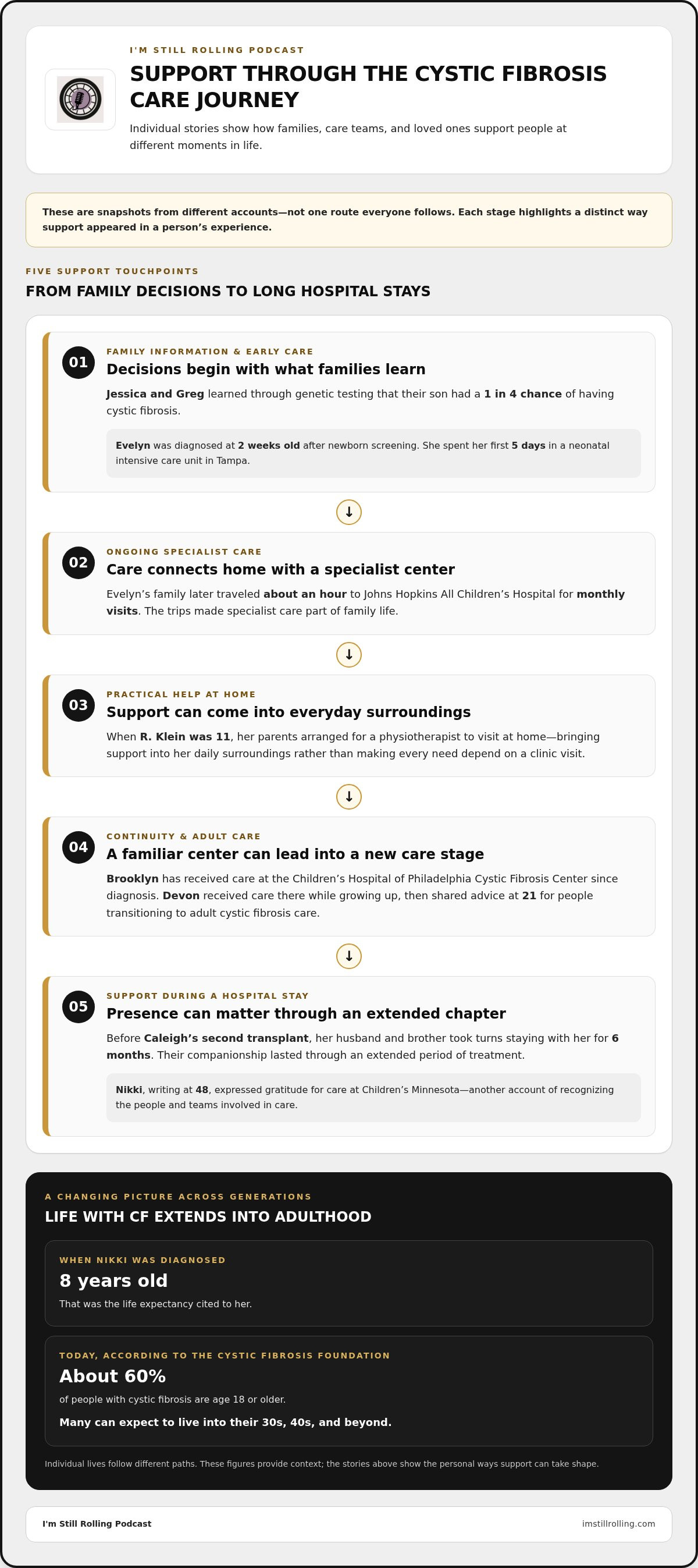
Support from family, friends, and healthcare teams
Life expectancy in cystic fibrosis has changed markedly across generations, though individual lives follow different paths. When Nikki was diagnosed, the life expectancy cited to her was 8 years old. Today, about 60% of people with cystic fibrosis are age 18 or older, and many can expect to live into their 30s, 40s, and beyond, according to the Cystic Fibrosis Foundation. That contrast shows why treatment and ongoing care matter across adulthood, not only childhood.
For Evelyn, support meant making the journey to care part of family life. Diagnosed at 2 weeks old after newborn screening, she spent her first five days in a neonatal intensive care unit at a Tampa hospital. Her family later traveled about an hour to Johns Hopkins All Children’s Hospital for monthly visits. The repeated trips connected home life with a specialist center and made care a shared family responsibility.
R. Klein’s parents responded to a practical need at home. When she was 11 years old, they arranged for a physiotherapist to visit. That step brought support into her daily surroundings rather than making every need depend on a clinic visit. Her story also reflects how family decisions can shape care: her parents acted on the challenge in front of them, while her later account describes the continuing demands of cystic fibrosis.
Brooklyn has received care at the Children’s Hospital of Philadelphia Cystic Fibrosis Center since her diagnosis. Devon also received care there while growing up, then, at 21, shared advice for people transitioning to adult cystic fibrosis care. These accounts show how a center can be a steady presence through childhood, while adulthood brings a new stage of managing care. The Cystic Fibrosis Foundation’s role in the wider care landscape is also reflected in its work supporting people at different ages.
Family support can become especially tangible during a hospital stay. Before Caleigh’s second transplant, her husband and brother took turns staying with her for six months. Their presence offered companionship through an extended period of treatment, not a quick fix for its physical or emotional strain. In Nikki’s account, written when she was 48 years old, she expressed gratitude for care at Children’s Minnesota. Both examples show support taking different forms: relatives staying close, and a patient recognizing the people and teams involved in care.
Genetic information can also shape family decisions before a child’s birth. Jessica and Greg learned their son had a 1 in 4 chance of having cystic fibrosis based on genetic testing. That knowledge framed a family’s uncertainty, while later care required attention to the child’s actual needs. Across these cystic fibrosis life stories, support is not one gesture. It may be a monthly trip, help arranged at age 11, continuity at a center, or someone staying through a long hospital chapter.
Experiences of children and young adults with cystic fibrosis
Age and disease severity shape different parts of life, from early tests and family routines to hospital treatment and growing independence. These accounts show there is no single childhood or transition to adulthood: a seven-year-old may play football, while a teenager may face a collapsed lung and a young adult may be learning to manage care independently.
For Janeil Whitworth, diagnosis came at age 4 after an emergency-room visit, when she weighed 26 lb. A positive sweat test led to her first appointment at a cystic fibrosis clinic the next day. She continued seeing that same clinic for 28 years. Her experience shows how a test can lead quickly into ongoing specialist care, while a long relationship with one clinic can span childhood and adulthood.
Kiley Mahoney’s diagnosis came much earlier, one month after birth. When her story was written, she was 21, and she had started taking Trikafta in 2021. Her account brings together two stages: a condition identified in infancy and treatment decisions described from young adulthood. Those details show how a person’s experience can change over time, even as the diagnosis remains part of their life.
At age 10, Chad was receiving care from the Cystic Fibrosis Center at Children’s Hospital of Philadelphia. During that period, he was spending less time in the hospital. That concrete change sits alongside the reality of ongoing care: a child’s experience includes ordinary routines, as well as treatment and visits to a specialist center. By contrast, Chase was seven and played football, a detail that places childhood activity beside the condition without reducing his story to it.
Jessie was 20 when his story described him as a strong-willed, resilient young man. Nikki’s experience at 16 was more acute: in spring 1992, she went to the Children’s Minnesota emergency room with a collapsed lung. A chest tube was placed, and she spent 10 days in the hospital. These accounts illustrate how young people’s experiences can differ sharply, from a portrait of resilience to an emergency requiring hospital treatment.
More than 75% of people with cystic fibrosis are diagnosed by age 2, but diagnosis can also come later. Janeil’s story follows the steps after a positive sweat test, while Nikki’s account shows how a serious event at 16 brought hospital care into focus. At 25, Nikki transitioned from Children’s Minnesota to adult cystic fibrosis care. Such a transition changes the setting and responsibilities of care; her story gives that shift a clear age and a named starting point.
Personal experiences of living with cystic fibrosis
Accounts of life before and after CFTR modulators show how one person’s experience can change. Maré Smit reported that her sinuses began draining spontaneously within three hours of taking ETI. After one week, she said she had stopped coughing and had no hemoptysis. Her account offers a specific before-and-after perspective, not a promise that everyone will experience the same changes.
For adults, daily life can include relationships, family responsibilities, travel, and ongoing treatment. Caleigh and her husband began traveling through North America in 2021 and continued for over three years. Adrian has two children. These details show adult life extending beyond clinical care, while each person’s routines and health needs remain part of their individual story.
Treatment routines can involve repeated steps woven into everyday schedules. R. Klein says she receives intravenous antibiotics every three months for two weeks. Airway clearance is another part of care for people with cystic fibrosis, and routines may need to fit around work, school, or family life. Discussing treatment timing and airway-clearance routines with the care team can help align the plan with the person’s clinical needs.
Cystic fibrosis can affect school, work, relationships, and family life in different ways. Caleigh’s account includes traveling with her husband, while R. Klein’s story includes becoming a parent. For children, parents may organize appointments and treatment; as children grow older, they often take a larger role in coordinating their own care. These stories show how family life and treatment can coexist.
Mental health and isolation deserve space in any honest account of cystic fibrosis. Jess was 18 when she was told she had six months to live, a stark moment with emotional weight beyond the clinical facts. Stories can make room for fear, uncertainty, and the strain of living with a serious condition, as well as the relationships and personal choices that continue alongside it.
For firsthand accounts from U.S. patients and families, this article includes Nikki’s experience at Children’s Minnesota and Caleigh’s stories of hospital stays and transplants. Reading them as individual accounts keeps each person’s circumstances in view. Their experiences differ in age, treatment, and family context, but each offers a close look at how cystic fibrosis can shape daily life.
Maré Smit was diagnosed with cystic fibrosis at 3 months old, and said she wanted to prevent others with cystic fibrosis from experiencing the hardships she had faced over 39 years. Brooklyn was also diagnosed with cystic fibrosis at 3 months old. Nikki was diagnosed with cystic fibrosis at age 5, while Julia was diagnosed with cystic fibrosis at age six.
When she was diagnosed with cystic fibrosis, R. Klein was prescribed five pancreatic enzyme capsules a day. Her account includes an early diagnosis and a specific treatment detail, offering a glimpse of how personal stories can hold both long-term memories and the routines of daily care.
Repeated hospital stays and CF-related diabetes
Repeated hospital stays can reshape ordinary routines, while CF-related diabetes adds another chapter to a person’s experience. R. Klein developed diabetes at 21 years old. That detail places a new health challenge within young adulthood, rather than childhood diagnosis alone. Her story makes the timing visible, even as each person’s experience with cystic fibrosis remains distinct.
Nikki’s account shows how hospital care can become a recurring part of life. She sometimes stayed in the hospital for six weeks at a time for cystic fibrosis complications and treatment. She also had a Hickman IV line for eight months each year to deliver antibiotics. These details show how treatment can extend beyond admission, involving time in hospital followed by ongoing care throughout the rest of the year.
For family members, repeated admissions can mean adapting plans around long periods of care. Nikki’s experience follows a clear sequence: health complications led to hospital stays, treatment continued through an IV line, and family life had to make room for that routine. The account doesn’t turn a difficult period into a simple lesson. It records the time involved and lets readers feel its weight.
R. Klein’s account adds a different kind of change. Her diabetes developed at 21, and that age is the concrete point the story offers. For someone reading about CF-related diabetes, it helps distinguish the experience of an individual from a general explanation: a personal account can show when an added diagnosis entered someone’s life, but it doesn’t establish what every patient’s course will be.
Doctors and care teams are part of these accounts, but hospital stories also show what patients and families learn through repetition. They may become familiar with admission routines, treatment schedules, and the practical demands of being away from home. Nikki’s six-week stays and yearly IV-line use make those demands tangible without suggesting that everyone with cystic fibrosis follows the same pattern.
These stories can help readers notice the separate threads within a difficult period: the reason for a hospital stay, the treatment described, its duration, and the people affected by the routine. In R. Klein’s case, the account identifies diabetes at 21; in Nikki’s, it describes prolonged stays and antibiotic delivery. Together, they show why repeated hospital care and CF-related diabetes deserve space in personal narratives, without reducing either person to a diagnosis.
Declining lung function and hospital tune-ups
Changes in lung function can make a person’s cystic fibrosis story feel newly uncertain. Maré Smit’s health took a sharp decline in 2022, a turning point in her account. Caleigh’s experiences show another difficult measure: her lung function had dropped to 20% when pneumonia led to hospitalization. The figures describe moments in individual lives, not a shared timetable or a measure of what every patient will experience.
For Caleigh, a hospital tune-up meant a two-week hospital stay for treatment. Her account links the admission to a broader effort to gain transplant approval, a process that took two years. The stay was one episode in a longer process, not a complete resolution of her challenges. Following the sequence matters: declining function, hospital treatment, and preparation for a possible transplant each mark a different stage.
Nikki’s story offers another view of severity and waiting. Her lung function was 19% while she waited for a lung transplant, and she received a double lung transplant in August 2013. Those details place a measurement beside a major change in treatment. They also show why a single percentage should be understood in context: Nikki’s account includes both the period of waiting and what followed, rather than isolating one number from her life.
Caleigh’s later experience became more critical before her second double lung transplant. Her lung function was 9% at that point, after a complicated history that included her first transplant and subsequent health challenges. In the months before her second transplant, her husband and brother took turns staying with her in the hospital for six months. The figures and family presence together convey the scale of that chapter without making it a model for another patient’s course.
Other accounts show how different lung-function figures can be. Sam says his lung function is below 20%, while Zahra says it reaches 52% on her good days. These self-reported experiences are not directly interchangeable: Zahra describes a good-day reading, while Sam’s account gives a level below a threshold. Each story gains meaning from its own context, including symptoms, treatment, hospital stays, and what the person says the measurement means in daily life.
When reading stories about declining function or hospital tune-ups, follow the events in order: what changed, what treatment or admission followed, and what happened next. Caleigh’s two-week stay, Nikki’s transplant in August 2013, and Sam’s account each offer a distinct perspective. To hear more firsthand accounts of life through changing health, explore personal resilience stories.
I'm Still Rolling Podcast: I'm Still Rolling Podcast Episodes
I'm Still Rolling Podcast offers a next step for readers who want to hear lived experiences in people’s own words. Its episodes feature honest conversations about disability, resilience, caregiving, and life after adversity, adding personal detail to themes such as family support, changing health, and daily life with cystic fibrosis.
Turn to an episode when a written account leaves you wanting to hear how someone describes their experience, choices, and relationships. The I'm Still Rolling Newsletter offers another way to follow these stories, while Podcast Transcripts make episode conversations available in text.
Stories can’t replace medical guidance, but they can offer perspective and recognition through the details people choose to share. Visit imstillrolling.com to explore the episodes, newsletter, and transcripts.
Carry These Stories Into the Conversations Ahead
A story can stay with you after the page ends. It may give words to an experience you’ve struggled to describe or help you listen differently to someone whose life includes cystic fibrosis. The value of cystic fibrosis life stories isn’t that they offer a script to follow. It’s that they make room for distinct voices, complicated feelings, and lives that reach beyond a diagnosis.
Let what you’ve read guide your next conversation, whether you’re sharing your own experience, supporting someone close to you, or making space to hear another person’s account. Keep asking what matters to the person living it. Their priorities, not assumptions, shape a more honest exchange.
If you’d like to continue listening to personal stories of resilience and life after adversity, visit I'm Still Rolling Podcast. Stay curious, stay open to each person’s truth, and let their words make connection possible.
Frequently Asked Questions
What are personal stories from people living with cystic fibrosis?
Personal stories are first-person accounts of how cystic fibrosis intersects with identity, choices, relationships, and ordinary routines. The most revealing cystic fibrosis life stories include the person’s own perspective, not only a diagnosis or treatment timeline. As you read, notice what the storyteller chooses to emphasize, how their priorities change, and where their experience differs from others. These accounts offer personal insight, not a universal template or medical guidance.
How do families describe raising a child with cystic fibrosis?
Families often describe raising a child with cystic fibrosis as balancing care routines with making room for childhood. A parent’s account may show how responsibilities shift as a child grows, learns to speak up, and takes part in decisions. Look for those changes rather than assuming one family’s approach fits another. Listening closely to what parents and children say keeps both care needs and individual identity in view.
What challenges do people with cystic fibrosis face with mental health and isolation?
People may face fear, uncertainty, emotional strain, and isolation alongside the demands of cystic fibrosis. Jess’s experience of being told at 18 that she had six months to live shows the emotional weight these challenges can carry.

Comments