Disabled parents stories through family voices and disability views
A parent’s disability doesn’t make their family story an exception; it makes assumptions about parenting easier to see. Disabled parents’ stories include the everyday work of raising children, the support families build, and the barriers they face. A Celebration of Family: Stories of Parents with Disabilities brings together stories from thirty families, offering a concrete starting point for looking beyond stereotypes.
Accounts of disabled parenting can be reduced to hardship or treated as proof that a parent must demonstrate their ability. But family life is more layered than those assumptions allow: it includes care, connection, frustration, joy, and the practical work of getting through the day.
Here, you’ll find family perspectives alongside #OwnVoices stories by disabled people, with insight into ableism and expectations placed on disabled parents. We’ll explore what makes these stories meaningful, how they challenge familiar portrayals, and why listening to families themselves matters.
Table of Contents
1. Stories from families with disabled parents
Family accounts show how parenting is shaped by relationships and daily decisions, not diagnosis alone. Disabled Mothers: Stories and Scholarship By and About Mothers with Disabilities brings together 18 essays about motherhood and disability. Its mix of personal experience and scholarship offers readers more than a single portrait of family life. Reading disabled parents’ stories side by side makes that variety easier to see.
Other books bring family voices into focus across generations. Mother Father Deaf draws on interviews with 150 adult children of deaf adults. Mom Dad Not Hear: 30 Powerful Stories and Lessons about Leadership, Life, and Love from My Deaf Parents was published in 2024. Together, these titles invite readers to consider how communication, identity, and closeness can take different forms.
How do disabled parents care for their children? They adapt routines and tools to their needs while sharing everyday care and connection with their children. Kisha’s story emphasizes communicating effectively with medical professionals and setting family boundaries to support a healthy environment for her daughter.
What support services are available to disabled parents in the United States? Support can include peer networks, disability-informed parenting information, and practical family resources. Start with the parent’s specific need, such as exchanging day-to-day strategies or finding information about a particular disability.
Where can disabled parents find peer support and resources in the U.S.? They can look to disability-focused parent networks and published first-person accounts. The Amplifying Voices event recording features 10 parents with disabilities, offering a starting point for hearing varied experiences and perspectives.
Family stories also challenge the idea that disability defines every parent-child interaction. A Celebration of Family: Stories of Parents with Disabilities, published in 2021, gathers experiences from families. For readers exploring caregiving across generations, Mother Father Deaf adds adult children’s reflections to parents’ accounts. Disabled parents’ stories make room for families to describe the choices, relationships, and routines outsiders may overlook.
2. #OwnVoices stories about disability
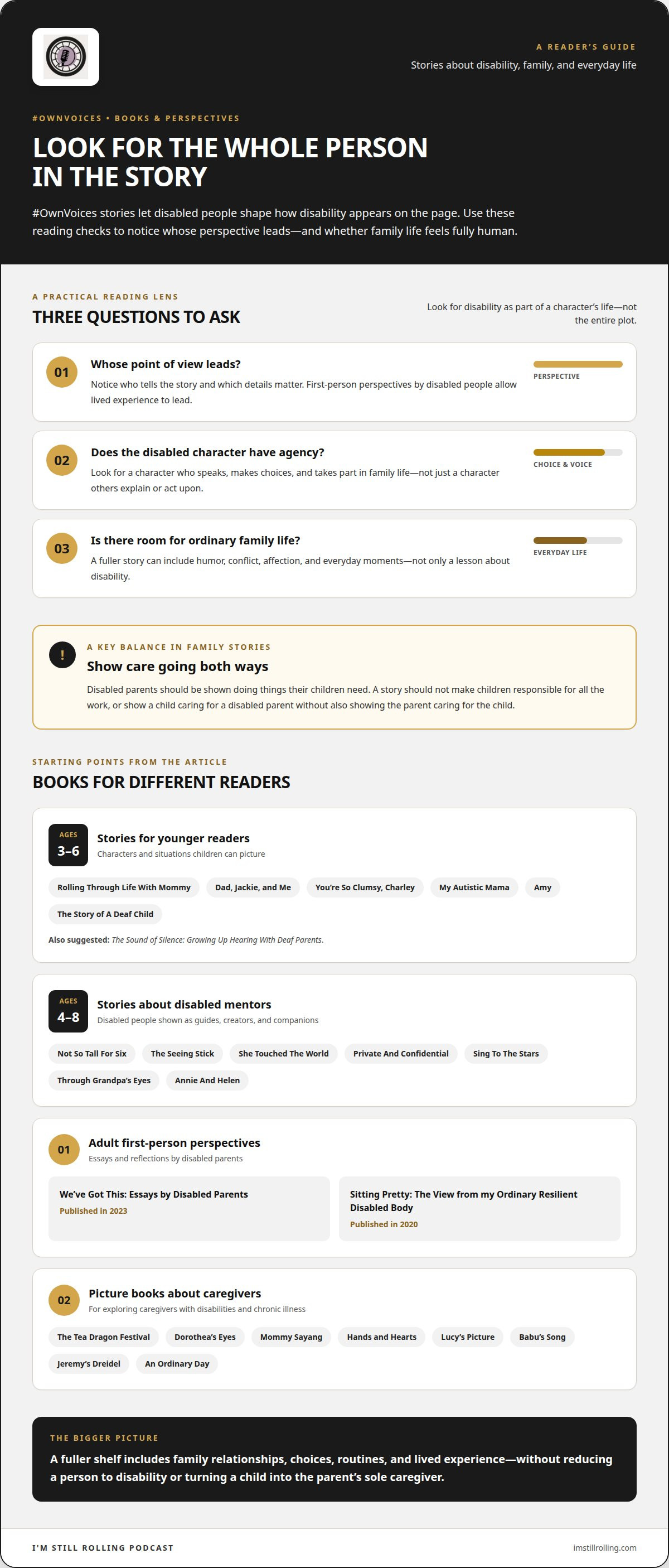
#OwnVoices stories let disabled people shape how disability appears on the page. In books about families, that perspective can change who tells the story, which details matter, and whether a disabled character is shown as a whole person. Look for stories where disability is part of the character’s life, not the entire plot.
For younger readers, suggested titles for ages 3-6 include Rolling Through Life With Mommy, Dad, Jackie, and Me, You’re So Clumsy, Charley, My Autistic Mama, Amy, and The Story of A Deaf Child. The Sound of Silence: Growing Up Hearing With Deaf Parents also centers family experience. These books can open conversations through characters and situations children can picture.
Choose a title by asking whose point of view it follows. Does the disabled character speak, make choices, and take part in family life? A story that gives the character agency offers children more than a lesson about disability. It makes room for humor, conflict, affection, and ordinary moments.
Stories about disabled mentors extend that view beyond the family. Suggested titles for ages 4-8 include Not So Tall For Six, The Seeing Stick, She Touched The World, Private And Confidential, Sing To The Stars, Through Grandpa’s Eyes, and Annie And Helen. These books can help children encounter disabled people as guides, creators, and companions.
Adult readers can turn to We’ve Got This: Essays by Disabled Parents, published in 2023, for essays by disabled parents. Sitting Pretty: The View from my Ordinary Resilient Disabled Body, published in 2020, offers another first-person perspective. Read these alongside children’s stories, then notice how voice and audience shape each account.
For further first-person disability perspectives, choose conversations that allow lived experience to lead.
Picture books about caregivers with disabilities and chronic illness can broaden this shelf: The Tea Dragon Festival, Dorothea’s Eyes, Mommy Sayang, Hands and Hearts, Lucy’s Picture, Babu’s Song, Jeremy’s Dreidel, and An Ordinary Day. These picture books can broaden the shelf for readers exploring caregivers with disabilities and chronic illness.
Stories about disabled parents should show them doing things their children need, without making children responsible for all the work. They should not show a child caring for a disabled parent without also showing the parent caring for the child. Disabled Mothers: Stories and Scholarship By and About Mothers with Disabilities, published in 2014, offers stories and scholarship by and about mothers with disabilities.
3. Ableism and assumptions about disabled parenting
Ableism often surfaces in a familiar question: can a disabled person really parent? In children’s books, disability should not be treated as a reasonable basis for doubting someone’s parenting ability. This principle matters beyond fiction, because assumptions can turn a diagnosis into a judgment before anyone considers the family’s actual needs.
What laws protect parents with disabilities from discrimination? In the United States, disability-discrimination protections are the relevant legal category, but the applicable provisions depend on the setting and conduct involved. A concern about school access differs from one involving a child-welfare investigation, so describe the specific barrier and its effects.
What challenges do parents with disabilities face? They may encounter inaccessible environments, assumptions about their competence, or pressure to explain ordinary parenting choices. For example, a parent who uses mobility equipment may find that a home or service setting makes routine tasks harder. The barrier is not proof of an inability to care for a child.
How do child welfare agencies assess disabled parents? A careful assessment should focus on the child’s needs, the parent’s caregiving, and any specific safety concern, rather than treating disability itself as evidence of risk. Concrete observations about care matter more than assumptions based on a diagnosis.
Stories can show how those assumptions take hold. Shubha Balabaer cares for their autistic child while advocating for inclusion and challenging societal gaps. Their experience raises a broader question: are difficulties caused by a parent’s disability, or by systems that fail to provide access and understanding?
Children’s books can reinforce or challenge these ideas. A child should not appear responsible for all the care simply because a parent is disabled. If a story shows a child helping, it should also show the parent caring for the child through a shared routine, comfort, or guidance. That balance lets both people remain fully present in the family relationship.
Use a practical lens as you read: identify the assumption, name the actual task, and distinguish a real access barrier from a stereotype. This approach makes room for more accurate accounts of parenting and lets families be seen beyond other people’s expectations.
4. Personal stories from parents with disabilities
First-person accounts can make the daily texture of parenting visible. Mom on Wheels: The Power of Purpose for a Parent with Paraplegia, published in 2022, places a parent’s own perspective at the center. Its title signals a story about purpose and parenting, rather than a diagnosis standing in for an entire life.
For pregnancy and early motherhood, From Here to Maternity: Pregnancy and Motherhood on the Autism Spectrum was published in 2015. Maternity Rolls: Pregnancy, Childbirth and Disability, published in 2010, brings disability into the account of pregnancy and childbirth. Read together, these titles show why personal narratives matter across different stages of family life.
Arthritis can also shape the practical details of raising young children. The online article Parenting Young Kids When You Have Arthritis: 24 Tips to Make the Day-to-Day a Little Easier was published in 2019. Its 24 tips focus on the demands of everyday parenting. Readers can use that example to look for specific strategies, rather than treating one person’s approach as universal.
Another way to encounter lived experience is through collected interviews. Judith Rogers’s book draws on extensive interviews with 90 women with disabilities. That breadth makes room for different accounts of motherhood, while reminding readers that no single story represents every disabled parent. Compare the situations described, then notice which practical details or barriers recur.
As you read, consider three questions: What does the parent say they need? Which adaptations or relationships help with a task? What does the account reveal about the surrounding environment? A challenging routine, for example, may reflect an inaccessible setup, not a lack of care or commitment. Keeping that distinction clear helps readers understand the parent’s own explanation.
These accounts can be read for pleasure, recognition, or insight into a life unlike your own. Explore more first-person disability stories and listen for the person’s perspective, not just the obstacles they describe.
Start early with board books for ages 6m-4y: Upsy-Daisy, Baby!, Clean It!, On The Go, and Mama Zooms normalize caregivers with disabilities. Magnolia Rose Riley was diagnosed with autism at 18 months old; Kisha became a single parent of a child with a disability at age 19. Schools are required to provide accommodations for people with disabilities.
I'm Still Rolling Podcast: I'm Still Rolling Podcast Episodes
I'm Still Rolling Podcast episodes offer another way to hear honest conversations about disability, resilience, and life after adversity. Turn to these stories when first-person voices can help you reflect on the realities behind assumptions about parenting and disability. The conversations bring personal experience into view without reducing a person’s life to a single challenge.
For continued reading, the I'm Still Rolling Newsletter and Podcast Transcripts offer additional ways to engage with the show’s stories. Choose the format that suits how you prefer to listen or read, and take time with the perspectives that resonate.
Visit I'm Still Rolling online to explore the podcast and its stories.
Carry these voices into the conversations ahead
Let the stories you’ve encountered shape the questions you bring to family life, classrooms, and community spaces. Instead of asking whether a disabled parent can belong, consider what access, respect, and practical support help family life work. That shift keeps attention on real circumstances rather than inherited assumptions.
The most meaningful disabled parents’ stories don’t ask readers to admire or pity their subjects. They invite us to listen closely, recognize complexity, and leave room for disabled parents to define their own experiences. That kind of attention can shape how we speak with children and respond when someone’s parenting is judged unfairly.
If you’d like to keep listening to personal perspectives on disability and resilience, explore I'm Still Rolling Podcast. Bring curiosity, stay open to what each voice reveals, and let listening become a more thoughtful way of meeting one another.

Comments