Changing Family Dynamics with Chronic Illness: Navigating the Seismic Shift
Chronic illness doesn't just enter a home; it rewrites the script for everyone living inside it without asking for permission. When you're managing the changing family dynamics with chronic illness, the person you once knew can feel like they're slipping away, replaced by a series of medical appointments and endless caregiving labor. It's common to feel a quiet resentment over the responsibilities you never chose or a heavy guilt for wishing things could go back to how they were. You're likely exhausted by the invisible work that no one sees but everyone feels.
You aren't alone in the messy parts of this journey. This article helps you navigate the profound role reversals and emotional shifts that a diagnosis brings through the lens of journalistic truth and lived experience. We'll explore how to find a new "normal" that isn't defined solely by illness. We'll examine ways to improve communication without it becoming a clinical checklist, ensuring your family unit remains resilient even when the ground feels like it's shifting beneath your feet.
Table of Contents
The Silent Transformation: Understanding Changing Family Dynamics with Chronic Illness
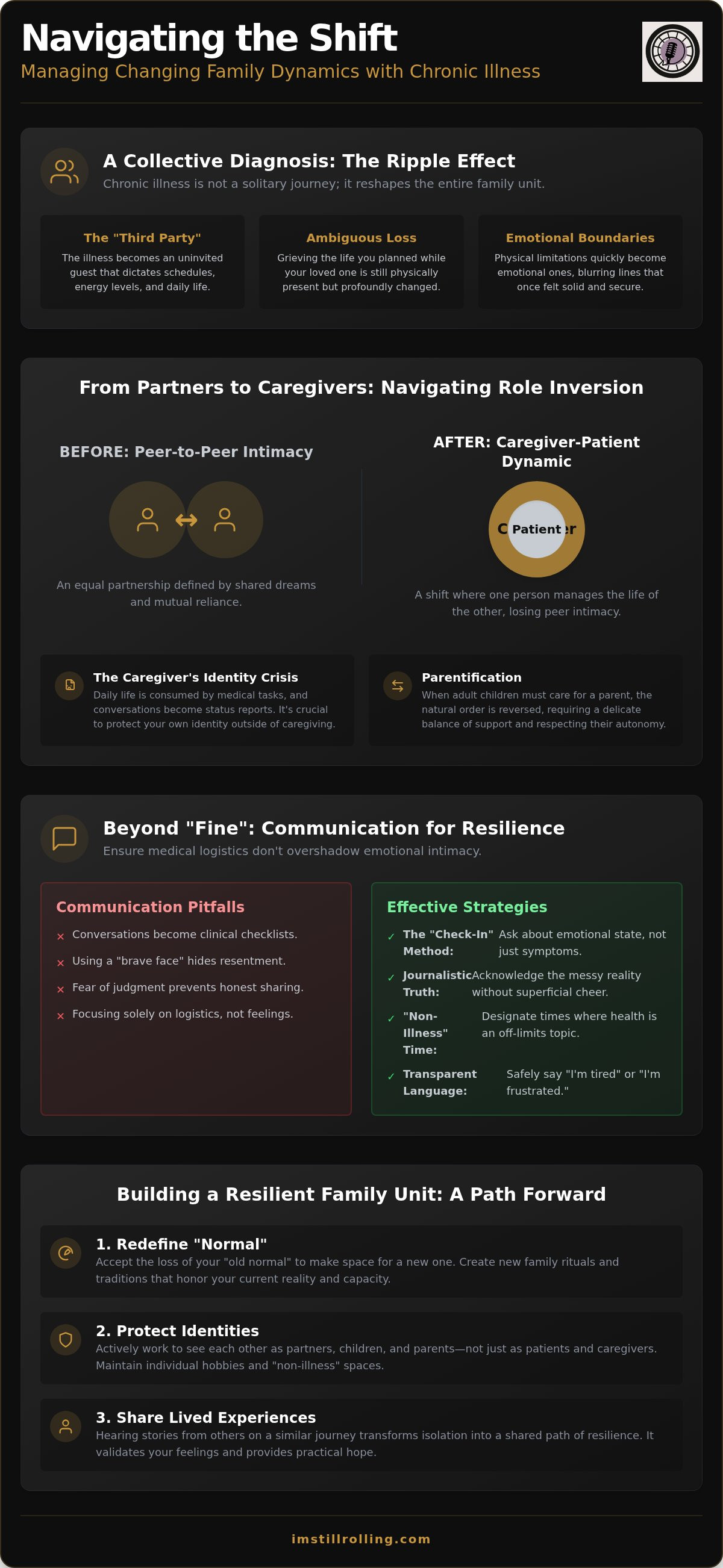
When a chronic diagnosis enters a home, it doesn't just change the patient's medical chart; it alters the fundamental architecture of the family. This is the seismic shift, a quiet but forceful movement where roles, expectations, and future plans are suddenly upended. We often treat illness as an individual struggle, but it's actually a collective diagnosis. Every member of the household feels the tremors, and the changing family dynamics with chronic illness require a new way of existing together.
In this new environment, the illness becomes the "third party" in the room. It's the uninvited guest that dictates when you eat, where you go, and how much energy you have for a basic conversation. This presence demands constant attention, often forcing the family to mourn the life they had planned while still living it. Ambiguous loss is the specific grief for a person who is still physically present but has been profoundly changed by their condition.
The Ripple Effect of a New Diagnosis
The impact of a diagnosis spreads like water through a cracked foundation. Physical limitations quickly become emotional ones, as boundaries that once felt solid begin to blur. For children, the shift is particularly complex. They're forced to balance their natural need for protection with the heavy reality of a parent's or sibling's struggle. Research into the impact on family members and caregivers shows that this environment can lead to significant stress and family discord if not addressed with care. It's about finding a middle ground where the truth is shared without overwhelming those who aren't ready to carry it.
Journalistic Truth: Acknowledging the Messy Reality
There's a common pressure to put on a "brave face," but that mask often hides a brewing storm of frustration and resentment. At I'm Still Rolling, we value journalistic truth, which means looking at the situation exactly as it is, without the filter of superficial cheerfulness. Realistic optimism isn't about ignoring the pain; it's about acknowledging that while things are hard, they're also manageable. It's the difference between a hollow "everything is fine" and a grounded "this is difficult, but we're still here."
Establishing a culture of honest, unflinching conversation within the home is the only way to survive the changing family dynamics with chronic illness. You have to be able to say, "I'm tired," or "I'm frustrated that we can't do what we used to," without fear of judgment. This transparency allows the family to move from a state of silent endurance to one of active, resilient adaptation. By documenting the truth of the struggle, you create the space for genuine healing to begin.
From Partners to Caregivers: Navigating the Inversion of Roles
The transition from an equal partnership to a caregiver-patient dynamic is one of the most jarring aspects of changing family dynamics with chronic illness. It's a fundamental inversion where the person you once relied on for strength now relies on you for survival. This shift carries a heavy psychological weight, as the labels of "spouse" or "child" are slowly eclipsed by the clinical requirements of a "caregiver." It isn't just about the labor; it's about the loss of the peer-to-peer intimacy that once defined your bond. You're no longer just sharing a life; you're managing one.
The Identity Crisis of the Caregiver
It's easy to lose yourself when your daily life is swallowed by medication schedules and physical therapy. You might find that your conversations have become a series of status reports rather than shared dreams. To prevent your identity from being entirely consumed, it's vital to maintain "non-illness" spaces in your home. This might mean keeping the bedroom as a sanctuary where medical equipment is hidden or designating an hour each evening where the topic of health is strictly off-limits. For those navigating specific cognitive shifts, understanding the nuances of caregiving for spouse with alzheimer's can provide a roadmap for preserving the personhood of your loved one while protecting your own mental health.
Adult children often face a unique version of this crisis through parentification, where the natural order of care is reversed. Watching a parent lose their independence requires a delicate balance of providing support without stripping away their dignity. It's a messy, emotionally taxing process that often requires external perspectives to navigate successfully. You can listen to honest accounts of these role reversals to feel less alone in your own experience.
Reclaiming the Partnership
Reclaiming your core relationship requires intentionality and a refusal to let the diagnosis be the only thing you talk about. It's about finding "micro-moments" of connection that have nothing to do with health or logistics. These small windows of normalcy act as the glue that holds a family together when everything else feels like it's pulling apart. Consider these strategies to help anchor your relationship:
Practice "Realistic Asking": Ask for help with specific, manageable tasks to avoid feeling like a burden, and offer help without becoming a "manager."
The "Partner First" Rule: Start every morning with a non-medical greeting, a shared joke, or physical touch that isn't related to caregiving.
Utilize Shared History: Use old photos, music, or stories to anchor your current reality in the strength of your past.
Resilience isn't about ignoring the changing family dynamics with chronic illness; it's about building a new future that incorporates the struggle without being defined by it. It's a slow, methodical process of rediscovering who you are to each other in this new landscape. By acknowledging the "messy" parts of this role inversion, you give yourself the grace to be both a caregiver and a loved one.
Beyond the 'Fine': Communication Strategies for High-Stakes Relationships
In a house where illness lives, the question "how are you?" often feels like a trap. For the patient, it can be a painful reminder of their limitations; for the caregiver, it's a prompt to perform a resilience they might not actually feel. When you're managing the changing family dynamics with chronic illness, communication must evolve from polite inquiry to functional, compassionate truth-telling. This requires moving beyond the standard script and creating a structure that allows for both medical logistics and emotional survival.
The "Check-In" method is a vital tool for maintaining clarity. It involves deliberately separating medical updates from emotional venting. You might spend twenty minutes discussing medication side effects and physical therapy schedules, then take a deliberate breath and ask, "How are you feeling as my partner today?" This separation prevents the medical chart from consuming every conversation and ensures that the personhood of both individuals remains visible amidst the chaos of care.
The Language of Resilience
Replacing "I'm fine" with specific needs is a radical act of honesty. Instead of masking exhaustion, try saying, "I'm feeling overwhelmed by the insurance paperwork today and need thirty minutes of quiet." Using "I" statements ensures that the patient doesn't feel like a problem to be solved or a project to be managed. Establish a daily 10-minute rule where all talk of doctors, symptoms, and schedules is strictly forbidden to protect your shared identity.
Navigating Conflict Under Pressure
Conflict is inevitable when everyone is operating on a deficit of sleep and a surplus of stress. It's helpful to recognize when a sharp word or a sudden outburst is actually displaced grief or the sheer weight of exhaustion. In these moments, the goal isn't to "win" an argument but to acknowledge the underlying pain that's driving the friction. This is also where the role of the "Information Gatekeeper" becomes critical, as one person often becomes the point of contact for the rest of the family, which can be an exhausting secondary job.
Setting firm boundaries with well-meaning but intrusive extended family is necessary to preserve the household's limited energy. You don't owe everyone a play-by-play of the latest crisis. Finding strength in stories of recovery and hope can help you frame these difficult conversations around resilience rather than just tragedy. By breaking the silence around fear and the future, you transform the changing family dynamics with chronic illness from a source of isolation into a foundation for a deeper, more unflinching connection.
Redefining 'Normal' and Building a Resilient Family Unit
The most difficult hurdle in changing family dynamics with chronic illness is the realization that the "old normal" is a ghost. It's a version of life that no longer exists, and clinging to its memory often breeds a deep, unspoken resentment. True resilience begins when a family stops trying to repair the past and starts building a new, functional present. This isn't a surrender; it's a strategic pivot. By accepting that the landscape has changed, you can finally map out a route that works for everyone involved, rather than exhausting yourselves trying to climb a mountain that's no longer there.
Building this new foundation requires a blend of journalistic honesty and practical creativity. It means looking at your limitations not as failures, but as the new boundaries of your playing field. When you stop comparing your current life to a pre-diagnosis ideal, you gain the clarity needed to identify what still brings you joy and purpose. This shift in perspective is the first step toward a family life that is defined by its endurance rather than its deficits.
Creating New Rituals
Rituals are the heartbeat of a family, but they often require radical adaptation after a diagnosis. If a long-standing travel tradition is now physically impossible, the goal isn't to abandon the spirit of adventure but to find a new way to manifest it. This might mean trading a hiking trip for a scenic train journey or utilizing accessible technology to remain connected to the world. Joy is often found in the "small" wins, like a successful afternoon in the garden or a meal where the illness wasn't the primary topic of conversation. Humor, even the dark variety, acts as a vital pressure valve, allowing the family to acknowledge the absurdity of their situation without being crushed by it.
The Power of External Support
Isolation is a common side effect of chronic conditions, but no household can survive as an island. You need a team that extends beyond your front door, including friends, support groups, and professional networks. Navigating the shift to a wheelchair or other mobility aids can feel like a loss of freedom, but it's actually the opposite. These tools are instruments of independence that allow the family to reclaim their place in the world. Hearing how others have managed this transition can be incredibly healing. You can find inspiration in these spinal cord injury recovery stories, which highlight the strength found in the struggle.
Building a resilient family unit is an ongoing project that requires patience and a willingness to fail. It's about finding meaning within the struggle and refusing to let a diagnosis dictate the limits of your love. To stay connected with a community that understands this journey, subscribe to the I'm Still Rolling newsletter for weekly insights and personal stories of resilience.
Finding Your Voice: How Stories of Resilience Help Families Heal
There is a specific kind of isolation that settles into a home when a diagnosis becomes the primary resident. You might find yourself surrounded by clinical guides and medical pamphlets that explain the "what" of a condition but completely ignore the "how" of living through it. When you're in the thick of changing family dynamics with chronic illness, hearing another person voice your unspoken truths is more than just comforting; it's therapeutic. It validates the messy, complicated emotions that don't fit into a doctor's report.
Mike Sugerman and Janice Wright use their decades of journalistic experience to bridge this gap between isolation and connection. By conducting long-form, unflinching interviews, they move past the surface-level "brave face" to explore the raw reality of life after a spinal cord injury or an Alzheimer's diagnosis. These stories offer a depth that clinical checklists cannot match, providing a space where resilience is seen as a slow, methodical process rather than a quick fix. You aren't just a caregiver or a patient; you're part of a community of "rollers" who are finding ways to move forward despite the weight.
Listening as a Form of Healing
The I'm Still Rolling Podcast Episodes act as a roadmap for the newly diagnosed family. When you hear a peer describe the same frustration over role reversals or the same guilt over needing a break, the shame begins to dissolve. These honest conversations about life after life-altering adversity prove that while your family's structure has changed, its capacity for connection has not. Encouraging your family members to listen and then share their own perspectives is a vital step toward collective healing. It transforms a private struggle into a shared narrative of endurance.
Next Steps for Your Family
Healing is rarely a straight line, but it's easier to navigate when you have a steady pulse of support. To keep these conversations going in your own home, consider these practical steps:
Subscribe to the Newsletter: Get weekly insights on resilience and stories of lived experience delivered to your inbox to remind you that you aren't alone.
Use Episodes as Bridges: Listen to a podcast episode together and use it as a low-stakes way to start difficult conversations about your own family dynamics.
Document Your Truth: Whether through journaling or shared family meetings, practice the same journalistic honesty Mike and Janice model to name your challenges and your wins.
The changing family dynamics with chronic illness don't have to signal the end of your family's story. Instead, they can be the beginning of a deeper, more resilient chapter. By finding your voice through the stories of others, you reclaim the power to define your own "normal." Join the community of those who are still rolling, still hope-filled, and still discovering the beauty within the struggle.
Moving Forward in a New Landscape
Navigating the changing family dynamics with chronic illness is not a destination but a continuous process of evolution. It requires a brave departure from the version of life you once knew and a commitment to the practical truth of your current circumstances. We've explored the tools for communication, the reclaiming of partnership, and the power of finding a community that speaks your unspoken fears. This journey is undoubtedly heavy, but it's also where the deepest forms of human resilience are forged.
Mike Sugerman and Janice Wright have created a safe space for this unflinching honesty, trusted by thousands of families navigating life-altering news. As seasoned journalists and fellow travelers, they bridge the gap between clinical isolation and soulful connection. Listen to the latest episodes of I'm Still Rolling Podcast for real stories of resilience.
Your family’s capacity to endure and find meaning within struggle is your greatest asset. While the diagnosis may have rewritten the script, you're the ones who determine the spirit of the performance. Keep rolling, keep connecting, and remember that even in the messiest parts of caregiving, you're moving forward.
Frequently Asked Questions
How do I deal with the guilt of feeling burnt out while caregiving?
Acknowledge that burnout is a natural biological response to prolonged stress, not a reflection of your character or your love for your family. Guilt often grows in the gap between your actual capacity and an unrealistic ideal of infinite energy. To manage this, practice radical honesty with your support network about your limitations. Shifting from self-judgment to a focus on sustainable self-preservation allows you to provide better care in the long term.
Can chronic illness actually make a family stronger in the long run?
Yes, navigating the changing family dynamics with chronic illness can forge a deeper, more resilient bond through the practice of shared vulnerability. While the initial transition is often traumatic, many families discover a level of transparency and mutual trust that wasn't present before the diagnosis. This new strength isn't found by avoiding the struggle, but by making a collective decision to face the daily "messy" parts of life with unflinching respect.
What are the most common role reversals in families with chronic illness?
The most frequent shifts involve adult children becoming the primary decision-makers for their parents or a spouse taking on the heavy mantle of a medical manager. These inversions can lead to the "parentification" of children or a significant loss of peer-to-peer intimacy between partners. Acknowledging these specific role changes is the first step toward managing the friction they create, ensuring that the core relationship isn't entirely consumed by the labor of caregiving.
How do we talk to our children about a parent's chronic illness?
Use age-appropriate honesty to explain the medical reality without overwhelming them with clinical complexity. Children often sense tension and may invent their own frightening explanations if they aren't given a clear, truthful narrative. Focus on what will change in their daily routine and, more importantly, what will remain the same. Providing a safe space for their questions helps them process the changing family dynamics with chronic illness with a sense of security.
What is the difference between caregiving and being a partner?
Caregiving is fundamentally task-oriented and often clinical, while partnership is rooted in emotional reciprocity and a shared personal identity. When one person becomes a primary medical aid, the power balance shifts, making it difficult to maintain romantic or peer-level intimacy. To preserve the partnership, you must intentionally carve out "non-medical" time where the diagnosis isn't the focal point, allowing you to connect as individuals rather than just as a patient and a provider.
How can I maintain my own identity while supporting a sick family member?
Protect your identity by maintaining interests and social connections that exist entirely outside the context of the illness. It's easy to be swallowed by the "caregiver" label, but your personal well-being is the foundation of the household's stability. Set firm boundaries that allow for personal time and hobbies. This isn't an act of selfishness; it's a necessary strategy to prevent your own life story from being completely erased by the demands of a diagnosis.
Why is storytelling important for families dealing with medical trauma?
Storytelling transforms a chaotic, isolating experience into a structured narrative that can be shared and understood by others. When families hear peers voice the same "unspoken" truths, the trauma feels less like a solitary prison and more like a shared human journey. Through the I'm Still Rolling Podcast, Mike Sugerman and Janice Wright use journalistic depth to help families bridge the gap between their private pain and a broader, more resilient community.


Comments