Autoimmune Disease Stories of Resilience: Finding Meaning in the Invisible Struggle
What if the most exhausting part of your illness isn't the physical pain, but the relentless pressure to prove you're actually sick? When you search for autoimmune disease stories of resilience, you're looking for more than just a survival guide; you're looking for a mirror. For many of the 50 million Americans with these conditions, the path to a diagnosis takes nearly five years, a period often defined by medical gaslighting and the burden of "performing" health for others. We know that the weight of this silence is often heavier than the symptoms themselves.
This exploration aims to validate your daily struggle while offering a roadmap through the fog. By leaning into raw, journalistic storytelling and the unvarnished experiences of fellow warriors, you'll discover how to reclaim your personal narrative from the grip of a diagnosis. We're going to examine the psychological tools necessary for building lasting endurance and show you how to find a community that embraces the messy parts of the journey. You don't have to carry the invisible struggle alone; there's a way to find profound meaning even when the path is uncertain.
Table of Contents
The Invisible Battle: Why Autoimmune Stories Require a New Narrative
The Anatomy of Resilience: Lessons from the Front Lines of Chronic Illness
Real Grit vs. Toxic Positivity: Navigating the "Messy" Middle
Your Resilience Toolkit: Practical Strategies for Reclaiming the Narrative
Why Every Story Matters: Joining the I’m Still Rolling Conversation
The Invisible Battle: Why Autoimmune Stories Require a New Narrative
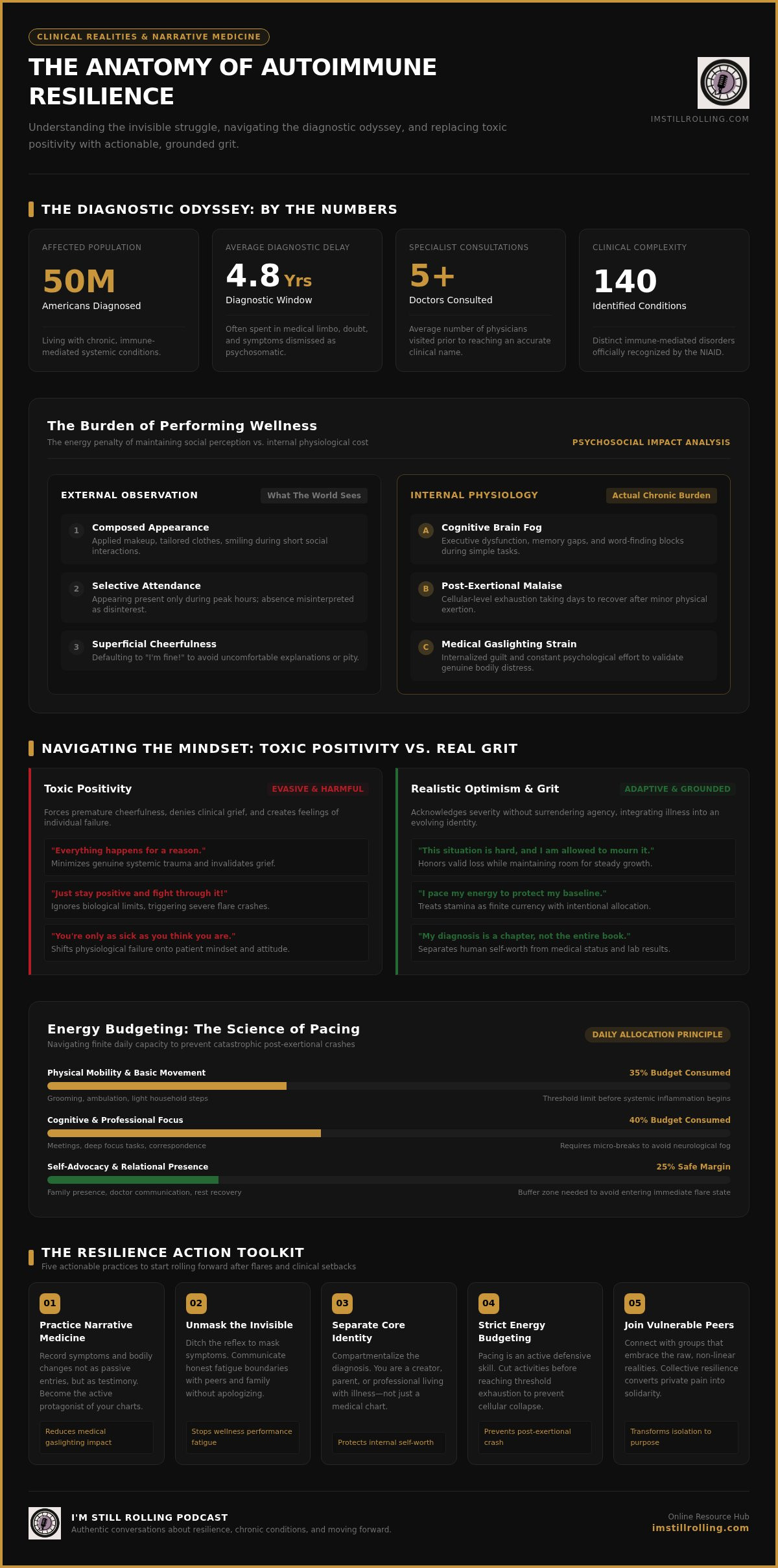
In 2026, our understanding of the immune system has reached a critical juncture. While the NIH Strategic Plan for Autoimmune Disease Research (2026–2030) prioritizes data interoperability and cross-disciplinary science, the individual experience remains largely hidden from view. For the 50 million Americans living with these conditions, the battle isn't fought in a lab; it's fought in the quiet moments of a grocery store aisle or a mid-morning meeting where the body feels like it's collapsing under its own weight. These autoimmune disease stories of resilience are rarely about a single heroic victory. Instead, they're about the grueling 4.5 to 5 year diagnostic odyssey where patients often consult five different specialists before finding a name for their pain. This systemic delay often leads to medical gaslighting, leaving individuals to wonder if their symptoms are merely a product of their imagination.
Resilience in this context isn't a destination we reach once we're cured. It's a rhythmic, ongoing process of adaptation. We're beginning to see the rise of narrative medicine, a field that suggests the act of telling our stories actually influences our biology. Narrative medicine goes beyond simple journaling; it's the practice of witnessing the patient's story with the same rigor a doctor applies to a physical exam. When we document our journey, we move from being a passive recipient of medical care to an active protagonist in our own life. A clinical overview of autoimmune diseases shows the complexity of these systemic attacks, but it cannot capture the soul's endurance.
The Burden of the Invisible Symptom
There's a particular exhaustion that comes from performing wellness. It's the act of applying makeup to hide a flare or smiling through the cognitive fog of a lupus episode just to put colleagues at ease. The "Invisible Struggle" is a core barrier to community support because when you look healthy, the world expects you to act healthy. Professional journalism helps unmask this reality by documenting the unvarnished truth of chronic fatigue and brain fog, providing a vocabulary for the things we cannot see. By bringing these internal states into the light, we strip away the shame of being unseen.
Moving Beyond the "Sick Person" Label
It's easy for a diagnosis to consume the entirety of a person's identity. You become a patient rather than a parent, an artist, or a friend. Reclaiming your narrative means finding the space where the person and the patient coexist without one erasing the other. Engaging with authentic autoimmune disease stories of resilience allows us to see that a diagnosis is a chapter, not the whole book. By sharing Stories of Recovery and Hope: Finding Light After Life-Altering Adversity, we bridge the gap between clinical status and human potential. We prove that while the body may be under siege, the person inside remains a vibrant, evolving force.
The Anatomy of Resilience: Lessons from the Front Lines of Chronic Illness
Resilience isn't a fixed trait you're born with; it's a muscle developed through the daily friction of survival. In our work documenting autoimmune disease stories of resilience, we've observed that survivors don't simply "bounce back" to their old selves. Instead, they integrate their illness into a more complex, weathered identity. This process requires "realistic optimism," a mindset that acknowledges the gravity of a condition without surrendering to despair. While a National Institute of Allergy and Infectious Diseases overview provides the clinical framework for the 140 recognized immune-mediated conditions, it's the personal act of meaning-making that transforms a diagnosis from a life sentence into a catalyst for growth.
Central to this endurance is the strategy of "pacing." It's both a physical necessity to avoid post-exertional malaise and a mental boundary that protects one's limited energy. By treating energy as a finite currency, individuals learn to navigate their lives with a level of intentionality that healthy people often overlook. This isn't about being "sick"; it's about being highly efficient with the resources you have left.
The Journalistic Insight into Grit
Mike Sugerman and Janice Wright bring a unique lens to these narratives, utilizing their broadcast backgrounds to dig beneath the surface of "inspiration." Through hundreds of interviews, they've identified a clear distinction between "toughing it out" and "adaptive resilience." Toughing it out often leads to burnout and physiological flares. Adaptive resilience, however, involves a fluid response to changing symptoms. It's the willingness to pivot when the body says "no" while maintaining your core sense of agency. The long-form interview format allows these nuanced truths to emerge, proving that strength is often found in the quiet, messy middle rather than a triumphant finish line.
Neuroplasticity and the Storytelling Brain
Science tells us that our brains are wired for story. When we reframe our personal history through the lens of endurance rather than victimhood, we can actually lower our physiological stress response. Research suggests that community storytelling can lead to a measurable reduction in cortisol levels. This isn't just about feeling better. It's about changing how our bodies react to the world. By listening to others, we experience "vicarious resilience," drawing strength from their survival to bolster our own. These autoimmune disease stories of resilience serve as a mirror for our own capabilities. You can explore these transformative narratives by listening to episodes of the I'm Still Rolling podcast, where the focus remains on the authentic, unvarnished human experience.
Real Grit vs. Toxic Positivity: Navigating the "Messy" Middle
There's a pervasive, often well-meaning pressure in our culture to "just stay positive" when facing a health crisis. For someone navigating the fluctuating flares of an incurable condition, this sentiment can feel like a secondary injury. This is the essence of toxic positivity—the insistence that a sunny disposition is the only acceptable response to suffering. When we prioritize forced optimism over honest experience, we inadvertently silence the 50 million Americans who are fighting internal battles every day. Genuine autoimmune disease stories of resilience don't ignore the darkness; they inhabit it, acknowledging that some days are defined by grief, anger, and the sheer weight of a body that feels like a stranger.
Resilience isn't about maintaining a permanent smile. It's about psychological flexibility. To move beyond superficial cheerfulness, we must look toward evidence-based resilience strategies that allow for the full spectrum of human emotion. The I’m Still Rolling Podcast operates from a place of unflinching honesty, recognizing that validating a "bad day" is a necessary part of the endurance cycle. By giving ourselves permission to feel the gravity of our situation, we actually build the capacity to carry it. This isn't a sign of defeat; it's a profound act of self-witnessing that builds a more durable foundation than any platitude ever could.
Embracing the Messy Truth
A realistic guide to adversity must include space for mourning. You can't reclaim your narrative if you haven't first acknowledged what was lost to the diagnosis. Holding space for both suffering and hope simultaneously is a complex, exhausting skill, yet it's the hallmark of true grit. Grit is the ability to persist through the uncurable, finding a way to move forward even when the horizon remains hazy. It's the quiet determination to wake up and try again, even when the previous day offered no relief. In this messy middle, we find the most authentic versions of ourselves.
The Role of Vulnerability in Strength
We often think of strength as a shield, but in the world of chronic illness, strength is often a window. Sharing our setbacks and "failures" builds far more trust within a community than a highlight reel of wins. From a journalistic perspective, there's immense value in the "uncomfortable silence"—those moments in an interview where words fail because the reality is too heavy. These pauses are where the most nuanced truths of autoimmune disease stories of resilience reside. To hear these unfiltered conversations, you can explore I’m Still Rolling Podcast Episodes: A Journalistic Guide to Resilience, where the focus is on the raw reality of the journey rather than a polished destination.
Your Resilience Toolkit: Practical Strategies for Reclaiming the Narrative
Endurance is rarely about the grand, heroic gesture. It's built in the small, repetitive choices we make when the body feels like a heavy anchor. To move from being a passive observer of your illness to an active narrator, you need a set of internal tools that prioritize your agency. When you engage with autoimmune disease stories of resilience, you're not just looking for inspiration; you're looking for a blueprint. This toolkit is designed to help you start "rolling" again, even when the momentum feels impossible to find.
One of the most effective ways to reclaim your strength is the "Micro-Win" strategy. On days when your physical energy is at its lowest, success isn't defined by a completed to-do list. It's defined by one small, intentional act: answering a single email, staying hydrated, or simply sitting in the sun for five minutes. These tiny victories signal to your brain that you still have a say in how your day unfolds. To dig deeper, try conducting a "personal interview" with yourself. Ask the hard questions a journalist would: What was the exact moment I felt the most capable during my last flare? What specific resource did I use to get through it? By reporting on your own survival, you uncover hidden strengths that often go unnoticed in the fog of a crisis.
Validate the Flare: Stop the "performance" of wellness and acknowledge the physiological reality without judgment.
Identify the Micro-Win: Choose one task that is achievable regardless of your energy level.
Energy Stewardship: Treat your energy as a finite currency, spending it only on what truly matters.
Advocacy as Action: Turn your personal pain into a systemic tool by sharing your truth with medical providers or employers.
Narrative Reframing: Remind yourself that a flare is a chapter in your story, not the final conclusion.
Building Your Support Ecosystem
Finding "your people" often requires looking beyond the clinical walls of a doctor’s office. There's a profound difference between a support group, which may focus on shared grievances, and a resilience community, which focuses on shared meaning. A resilience community acts as a mirror, reflecting your capacity for endurance back to you. Media and podcasts can serve as the "audio home" for this connection, providing a sense of companionship that doesn't require the physical energy of a face-to-face meeting. You can begin building this ecosystem today by subscribing to the I’m Still Rolling Newsletter for regular insights into the art of survival.
Communicating the Incommunicable
Explaining invisible symptoms to those who haven't experienced them is a constant, exhausting labor. It requires setting boundaries that feel like an act of self-preservation. Whether you're talking to a spouse, a friend, or an employer, the goal is to move from "complaining" to "reporting." Use precise, sensory language to describe the fatigue or the fog. This shift in communication also helps those who care for you. For instance, understanding the emotional toll on the other side of the relationship can provide a new perspective, as explored in our look at Caregiving for a Spouse with Alzheimer’s: Navigating the Emotional and Practical Shift. Resilience is a collaborative effort; by communicating clearly, you give your support system the tools they need to stand with you.
Why Every Story Matters: Joining the I’m Still Rolling Conversation
The personal history of illness is often treated as a private burden, but when we bring these experiences into the light, they become a collective resource. The I’m Still Rolling podcast serves as a living archive of human endurance, ensuring that no one has to reinvent the wheel of survival in isolation. By documenting these autoimmune disease stories of resilience, we create a roadmap for others to follow, turning individual struggle into a shared legacy of strength. As we move through 2026, the environment of disability rights is shifting toward greater representation and active patient-advocate partnerships. This reflects a society that is finally beginning to value the wisdom of those who live with chronic challenges.
Every story shared is a brick in the wall against medical isolation. Your life, with all its messy complexities and quiet victories, is a story worth telling. It’s a narrative of adaptation that deserves to be witnessed with integrity and heart. By recognizing the value in your own journey, you contribute to a broader cultural shift that sees disability not as a deficit, but as a different way of being in the world.
A Trusted Guide for the Difficult Journey
Mike Sugerman and Janice Wright bring decades of broadcast experience to every conversation, blending professional reporting with a deep, personal understanding of life-altering adversity. This background is crucial in an era where medical misinformation can spread faster than a flare. They prioritize "journalistic truth," cutting through the noise to find the grounded reality of the patient experience. This commitment to accuracy and empathy is part of a larger movement, as detailed in The Evolution of the Disability Rights Podcast: Trends and Truths in 2026. By listening, you aren't just consuming content; you're participating in a rigorous exploration of what it means to be human in the face of limitation.
Next Steps: Subscribe and Listen
Engagement doesn't have to end when the audio stops. For those who find value in the written word, podcast transcripts and the weekly newsletter offer a way to dive deeper into the themes of transformation and endurance. These resources provide a space for reflection, allowing you to process the insights at your own pace. We invite you to see your own milestones, no matter how small, as part of this ongoing conversation. Whether you've reached a new level of self-advocacy or simply found a way to thrive during a difficult week, your experience matters. You can join our community and stay connected by choosing to Subscribe to the I’m Still Rolling Podcast and Newsletter, where the journey of resilience continues with every episode.
Reclaiming Your Narrative in the Long Haul
Reclaiming your life from an autoimmune diagnosis is a slow, methodical act of defiance. It requires moving beyond the performance of wellness and embracing the messy reality of the invisible struggle. By utilizing tools like the micro-win strategy and seeking out realistic optimism, you transform from a patient into a powerful narrator of your own experience. These autoimmune disease stories of resilience prove that while the body may fluctuate, your agency remains a constant force.
You don't have to navigate this diagnostic odyssey alone. Mike Sugerman and Janice Wright bring award-winning journalistic insight to every conversation, offering a library of raw, honest dialogues that dismantle the isolation of chronic illness. Their work provides a safe space for deep reflection and a grounded connection to a community that truly understands. The path forward is unhurried, but it's steady. Every time you choose to witness your own strength or listen to another’s truth, you're building a more durable future. Your story is still being written, and it carries a weight that is both heavy and beautiful.
Listen to the latest stories of resilience on the I’m Still Rolling Podcast and discover the power of shared endurance. You're still here, and you're still rolling.
Frequently Asked Questions
What makes a story of resilience actually helpful for someone with an autoimmune disease?
A helpful story must be unflinchingly honest rather than performative. Effective autoimmune disease stories of resilience avoid toxic positivity and instead focus on the "messy middle," validating the grief of a diagnosis while showing the mechanics of adaptation. When a story acknowledges that some days are defined by failure, it builds trust and provides a realistic blueprint for others to follow in their own survival journey.
Can listening to podcasts really help with the emotional impact of chronic illness?
Yes, audio narratives act as a form of "vicarious resilience" by reducing the physiological sense of isolation. For those with limited physical energy, listening is a low-impact way to engage with a community of vulnerable peers without the exhaustion of face-to-face interaction. Hearing others navigate similar medical gaslighting or invisible symptoms provides a steady, reliable pulse of validation that can physically lower stress responses over time.
How do I tell my own story without it sounding like a "pity party"?
Shift your focus from being a passive victim to being an active reporter of your own experience. Describe your symptoms and setbacks with precision and sensory detail rather than vague emotional labels. By framing your narrative around the specific strategies you use to persist through a flare, you invite the listener to witness your agency. This journalistic approach ensures the weight of the story is felt without descending into pity.
Where can I find diverse stories of resilience that cover different autoimmune conditions?
The I’m Still Rolling podcast serves as a global, living archive that explores a wide spectrum of life-altering challenges. Because the hosts are seasoned journalists, they dig into the nuances of various conditions, from spinal cord injuries to systemic immune-mediated disorders. This diversity ensures that listeners can find mirrors for their own struggles, whether their condition is rare or one of the more common 140 recognized autoimmune diseases.
Is it possible to build resilience even if my physical health is declining?
Resilience is a psychological process of meaning-making that remains independent of a physical cure. Even when health declines, you can cultivate endurance by practicing energy stewardship and finding purpose within your current limitations. Building autoimmune disease stories of resilience is about reclaiming your identity from the diagnosis, proving that your internal agency can remain vibrant even when your body requires significant functional adaptation or rest.
How does journalistic storytelling differ from standard patient advocacy?
Standard advocacy often focuses on policy and systemic change, whereas journalistic storytelling prioritizes the raw, unvarnished human truth. Journalists like Mike Sugerman and Janice Wright utilize long-form interviews to explore the uncomfortable silences and nuanced contradictions of life after adversity. This approach doesn't just seek a "win"; it seeks to document the integrity of the human spirit with professional rigor and a deeply personal, open-hearted perspective.
What are some 2026 resources for connecting with other autoimmune warriors?
In 2026, the NIH Strategic Plan for Autoimmune Disease Research emphasizes active patient-advocate partnerships, offering new digital platforms for data-driven community connection. Beyond clinical portals, the I’m Still Rolling Newsletter provides a weekly audio home for those seeking authentic narratives. You can also utilize digital health tracking apps that now integrate peer-support features, allowing you to share symptom-management strategies with others who truly understand the invisible struggle.

Comments