Stories of Grit and Determination: Finding Meaning After Life-Altering Hardship
What if the most profound strength isn't found in a heroic surge of adrenaline, but in the slow, unglamorous work of rebuilding a life that no longer looks like the one you once knew? When nearly 70% of adults in the United States have experienced at least one traumatic event, the struggle to find footing after a medical crisis or a new disability is a heavy, collective reality. It's easy to feel buried under the weight of a "new normal" that feels entirely alien, especially when faced with superficial motivational content that ignores the raw, exhausting details of recovery. You deserve more than a platitude; you deserve a space where the gravity of your hardship is acknowledged without pity. These authentic stories of grit and determination reveal that resilience isn't about returning to who you were, but about the messy, soulful process of becoming someone new.
We'll move beyond the "bounce back" myth to explore how the quiet power of grit transforms medical trauma into a journey of profound meaning. You will discover a framework for understanding your own capacity for endurance and find a connection to a community that truly understands lived adversity. This is a deep dive into the reality of post-traumatic growth and the enduring strength found in the unhurried grind of moving forward.
Table of Contents
What are Stories of Grit and Determination in the Context of Adversity?
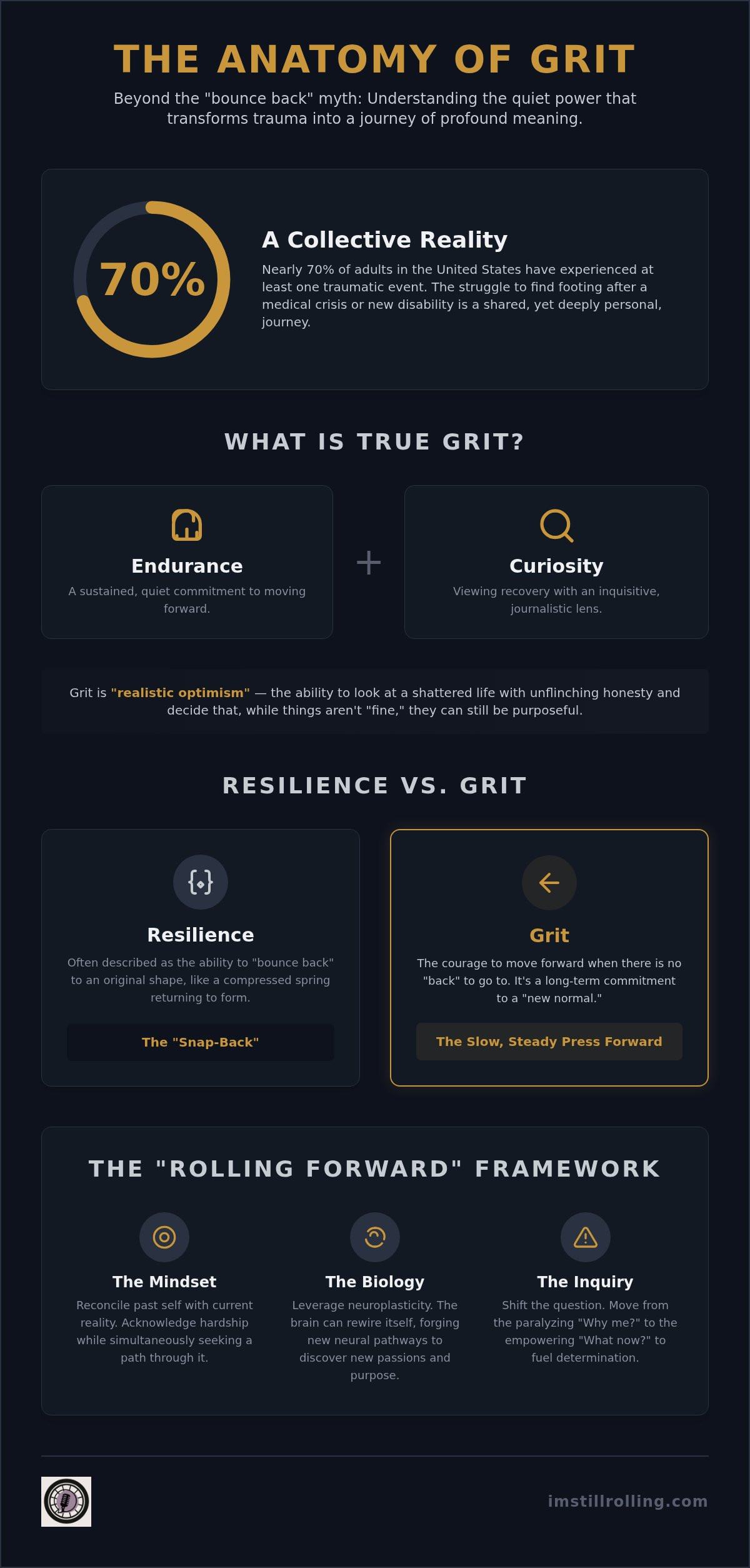
We often hear the word grit used to describe athletes or entrepreneurs, but in the context of life-altering hardship, the term takes on a much heavier, more visceral meaning. While the psychological definition of grit focuses on passion and perseverance for long-term goals, for someone living with a new disability or chronic illness, those goals might simply be getting through the next hour. True stories of grit and determination aren't about a singular heroic moment. They are about a sustained, unhurried commitment to finding meaning within a reality that has been irrevocably changed. This isn't a performance; it's a quiet, daily practice of endurance.
It's vital to distinguish this kind of determination from simple stubbornness or the hollow cheer of toxic positivity. Stubbornness often refuses to acknowledge change, while toxic positivity demands we ignore our grief. Grit, however, operates on "realistic optimism." It's the ability to look at a shattered life with unflinching honesty and decide that, while things aren't "fine," they can still be purposeful. This process of meaning-making is what transforms a medical trauma from a dead end into a complex, ongoing narrative. It's the difference between being a victim of your circumstances and becoming the lead reporter of your own survival.
Resilience vs. Grit: Understanding the Nuance
Resilience is frequently described as the ability to bounce back, much like a rubber band returning to its original shape. But when you are dealing with a spinal cord injury or a progressive diagnosis, there is no "back" to go to. Grit is different. If resilience is the spring, grit is the courage to crawl forward when the path is obscured. It's a long-term commitment to a "new normal" where the daily grind isn't just survived, but documented and understood. You feel it in the heavy silence of a physical therapy room or the slow, deliberate way you learn to navigate a world that wasn't built for your current body. It's less about the snap-back and more about the slow, steady press against resistance.
The Journalistic Pursuit of Truth in Hardship
Adopting a journalistic lens allows us to step outside our own suffering and view our recovery with a sense of curiosity. Instead of asking "why me?", a gritty perspective asks "what now?" This shift in inquiry fuels a deeper level of determination. It requires an unflinching honesty that doesn't shy away from the messy, uncomfortable parts of the journey. In this context, we can define grit as a disciplined conversation with one’s own limitations. By reporting on our own lives with the same rigor a seasoned journalist applies to a lead story, we begin to see the beauty in the struggle and the profound value in simply still being here. We aren't just telling a story; we're discovering the truth of our own endurance.
The Anatomy of Endurance: Why Some "Roll Forward" After Trauma
Recovery is rarely the linear climb depicted in cinematic montages. It's more often a jagged, unhurried series of adjustments that require a specific psychological framework known as realistic optimism. This mindset doesn't ignore the gravity of a permanent change; instead, it acknowledges the weight of the hardship while simultaneously seeking a path through it. The people who successfully "roll forward" after medical trauma aren't necessarily stronger than those who struggle. They've simply begun the difficult work of reconciling their past self with their current reality. This internal shift is supported by the brain's inherent capacity for change, a biological foundation for endurance.
Science provides a grounded perspective on this process. Research focused on defining grit and resilience shows that these qualities aren't static traits we're born with, but dynamic processes influenced by our environment and our mental habits. Through neuroplasticity, the brain can rewire itself in response to trauma, forging new neural pathways that allow for the discovery of new passions. This mental "rewiring" is often exhausting and invisible. It's the silent labor of a mind trying to make sense of a world that has suddenly become much harder to navigate.
The Role of Passion and Long-Term Vision
Setting long-term goals when your physical or cognitive abilities have fundamentally changed requires what we call "identity evolution." When the old "why" that drove your life is gone, you're forced to find a new one. This isn't about abandoning your history, but about integrating your past experiences into a new, cohesive narrative. Stories of grit and determination often highlight this pivotal moment where a survivor stops mourning the life they lost and starts building the life they have. It's a shift from looking back at what's missing to looking forward at what's possible, even if the pace is slower than before.
The "Vulnerable Peer" Perspective
While clinical advice from medical professionals is essential, it often lacks the raw, lived intimacy that a survivor needs to feel truly seen. The isolation of chronic illness or disability can be suffocating, making the "vulnerable peer" a vital lifeline. Seeing others who are "still rolling" provides a roadmap that no textbook can replicate. It offers validation for the messy, unpolished parts of recovery that aren't usually discussed in doctor's offices. Understanding The Art of Resilience: Why an Overcoming Adversity Podcast is Essential in 2026 illustrates how shared narratives act as a form of mental rehabilitation. These stories of grit and determination remind us that while our bodies may be altered, our capacity for connection and purpose remains intact. If you're looking for more authentic reflections on this journey, you might find comfort in the voices of those walking a similar path.
Iconic Stories of Grit and Determination That Changed the Narrative
Narratives of survival are often flattened into simple tales of "overcoming," yet the most authentic stories of grit and determination are those that embrace the complexity of a life interrupted. We're moving away from a culture that demands inspiration without acknowledging the cost of endurance. Instead, a new generation of advocates is reframing disability not as a deficit to be cured, but as a unique lens through which to view the world. By refusing to let a diagnosis serve as the final chapter, these individuals utilize creative expression to move from the isolation of trauma into a vibrant, purposeful new chapter.
Understanding the psychological link between grit and resilience reveals that meaning-making is the engine of long-term survival. When a survivor identifies a mission that transcends their physical or cognitive limitations, the daily grind of recovery transforms into a form of advocacy. This shift requires a journalistic commitment to the truth, documenting the "messy" parts of recovery with the same rigor one might apply to a major news lead. It's a disciplined reclamation of identity that proves resilience isn't just about surviving; it's about the bold act of thriving in a world that wasn't designed for your current reality.
Global Icons: Turning Scarcity into Abundance
Leaders like Alice Wong have fundamentally altered the landscape of disability rights by centering lived experience as the ultimate authority. In the context of 2026, longitudinal research suggests that post-traumatic growth often intensifies as more time passes since the initial trauma, a finding that validates the slow, steady work of these advocates. This trend is bolstered by increased representation in media, where the focus has shifted from pity to professional journalistic rigor. This evolution ensures that the voices of the disabled community are no longer just heard, but are actively shaping the policy and cultural conversations of the future.
The "Quiet Grit" of Everyday Survivors
Beyond the global stage, the most profound stories of grit and determination are often found in the unhurried lives of everyday survivors and their caregivers. Research from 2025 highlights the critical role of social support in this process, noting that for those in high-stress environments, peer connection is the most significant predictor of growth after a crisis. The I'm Still Rolling Podcast serves as a vital platform for these narratives, offering a space where the weight of Alzheimer’s or spinal cord injuries is met with raw, honest reflection. These stories remind us that the courage to keep "rolling forward" doesn't always require a headline; often, it's found in the quiet, steady dignity of a person who refuses to give up on their own story.
Navigating the Messy Middle: Strategies for Maintaining Determination
The most frequent barrier to resilience isn't a lack of character, but the bone-deep exhaustion that follows medical trauma. In the immediate wake of a crisis, adrenaline often carries us through the initial shock. However, as weeks turn into months, we enter the "messy middle," a space where the initial support has faded and the finish line remains invisible. This is where the primary objection arises: "I am simply too tired to be gritty." It's a valid, heavy truth. When many individuals report persistent feelings of hopelessness during recovery, acknowledging your fatigue isn't a sign of failure. It's the first step in building a sustainable version of endurance that doesn't require you to be a superhero every day.
Maintaining a steady, reliable pulse during these stagnant periods requires a shift from grand gestures to micro-goals. If you can't imagine where you'll be in a year, focus on the next ten minutes. In the context of rehabilitation, grit is often found in the unhurried repetition of a single exercise or the quiet patience required to navigate a difficult insurance call. These small wins are the bedrock of stories of grit and determination, proving that progress is still happening even when it isn't visible on a chart. By managing patient fatigue and caregiver burnout through these incremental steps, you protect your energy for the long haul.
Managing the Emotional Weight of Medical Trauma
Grief is not an obstacle to grit; it's a necessary component of it. To move forward, you must first allow space for the "messy" parts of your recovery, including the anger and sadness that come with a life-altering change. This deep-dive approach to self-reflection ensures that your optimism remains realistic rather than performative. Instead of suppressing your emotions, try to view them through a journalistic lens, documenting your internal state with honesty and grace. This grounded, soulful connection with yourself allows you to process the trauma without being consumed by it, turning your internal struggle into a source of wisdom.
Practical Strategies for the Daily Grind
Building a resilience toolkit is essential for those days when your internal reserves are low. This toolkit should include resources that offer both professional authority and peer-level vulnerability, such as authentic podcasts and newsletters that speak your language. Storytelling, whether through private journaling or recording your thoughts, acts as a form of mental processing that helps you reclaim your narrative. You can find these types of honest reflections and tactical advice by exploring the I'm Still Rolling Podcast, which provides a roadmap for those navigating the complexities of disability and caregiving. These resources remind you that while the daily hurdles of accessibility and insurance are real, they don't have to be the end of your story.
Finding Your Own Story of Resilience with I'm Still Rolling
The journey through life-altering hardship often begins in a place of profound silence, a space where the world you knew has vanished and the one you're inhabiting feels unrecognizable. In this transition, finding your own voice requires more than just time; it requires a mirror. Listening to authentic, journalistic stories of grit and determination serves as a form of mental rehabilitation, providing the scaffolding necessary to rebuild a shattered identity. It’s here that the I'm Still Rolling Podcast finds its purpose, acting as a bridge between the clinical facts of a diagnosis and the raw, unhurried reality of living through it. Hosted by Mike Sugerman and Janice Wright, the platform blends professional rigor with a vulnerable, open-hearted approach that invites you to move from being a passive observer to a fellow traveler on the path of resilience.
Mike Sugerman’s own journey with disability, coupled with his decades of experience reporting on the human condition, creates a unique space where hardship is discussed without descending into pity. This perspective is essential for those who are skeptical of superficial motivational content. By exploring complex topics like spinal cord injuries and Alzheimer’s caregiving with unflinching honesty, the platform offers a grounded form of realistic optimism. It’s a disciplined reclamation of the narrative, proving that while a medical crisis might change the rhythm of your life, it doesn't have to silence the music entirely. You aren't just listening to a broadcast; you're joining a community of bold truth-tellers who understand the weight and the beauty of the struggle.
Why Listening to Authentic Stories Matters
The science of narrative empathy suggests that when we engage deeply with the stories of others, our own capacity for endurance is strengthened. This process moves far beyond the shallow tropes often found in mainstream media, which frequently treat disability as a prop for sentimentality. Instead, a deep-dive interview on the I'm Still Rolling Podcast prioritizes a sophisticated, soulful connection that respects the intelligence and the agency of the survivor. These conversations allow for a slow build-up of emotional resonance, giving you the space to reflect on your own recovery process. By witnessing how others navigate their "new normal," you begin to see a framework for your own transformation, turning the isolation of trauma into a shared journalistic pursuit of meaning.
Joining a Community of Vulnerable Peers
Engaging with these narratives doesn't end when the audio stops. The community offers multiple layers of support, including a newsletter and detailed transcripts that allow for deeper, more methodical reflection. These resources act as a steady, reliable pulse for those navigating the long haul of recovery, providing tactical advice and emotional validation in equal measure. Through strategic brand partnerships, these vital stories are brought to a global audience, ensuring that the message of realistic optimism reaches everyone who needs it. It’s time to stop feeling overwhelmed by the silence and start documenting your own endurance. Subscribe to the I'm Still Rolling Podcast today and begin the unhurried work of finding your own story within the collective strength of others.
Embracing the Unhurried Path to a New Purpose
Reclaiming your life after a medical crisis isn't about finding a quick fix; it's about the steady, methodical work of rebuilding your narrative from the ground up. We've explored how grit operates as a form of realistic optimism, allowing you to acknowledge the weight of your hardship while still pursuing a life of profound meaning. These authentic stories of grit and determination remind us that even when our physical or cognitive landscapes change, our capacity for transformation remains unyielding. By shifting your focus from what was lost to what can be built, you transform the "messy middle" of recovery into a powerful testament to human endurance.
You don't have to navigate this transition alone. Hosted by award-winning journalists Mike Sugerman and Janice Wright, the I’m Still Rolling podcast provides a global platform for disability rights and personal growth through honest conversations that explore the raw reality of resilience. By joining this community, you connect with a network of vulnerable peers who are committed to the truth of their own survival. Join our community of resilient storytellers; Subscribe to the I’m Still Rolling Podcast and discover the strength in still being here. Your story is far from over; it's simply entering its most courageous chapter.
Frequently Asked Questions
What is the best way to develop grit when facing a new disability?
Developing grit begins with embracing the unhurried work of micro-goals rather than seeking a rapid return to your old life. It requires a shift toward realistic optimism, where you acknowledge your current limitations while steadily pressing against them. By focusing on the next ten minutes instead of the next ten years, you build the endurance necessary to navigate a world that has fundamentally changed. This disciplined practice turns survival into a purposeful act of reclamation.
How do stories of grit and determination help with caregiver burnout?
Authentic stories of grit and determination provide caregivers with a vital sense of validation and shared experience that reduces the crushing weight of isolation. Hearing others discuss the "messy" parts of Alzheimer's or spinal cord injury caregiving allows you to feel seen as a vulnerable peer rather than a clinical observer. This connection acts as a form of emotional rehabilitation, helping you manage the daily grind with a renewed sense of community and purpose.
Can grit be learned, or is it something you are born with?
Grit is a dynamic process that can be cultivated over time through the brain's inherent capacity for neuroplasticity. While some individuals may have a natural inclination toward perseverance, the ability to "roll forward" after trauma is a skill that is sharpened through repeated practice and social support. It's less of a fixed trait and more of a long-term commitment to finding meaning within struggle. You can develop this endurance by intentionally rewiring your response to adversity.
What is the difference between grit and toxic positivity?
The primary difference lies in the acknowledgement of pain; grit requires unflinching honesty about grief while toxic positivity demands its suppression. Grit operates on realistic optimism, which allows you to see the gravity of a situation without losing hope. Toxic positivity often feels dismissive or hollow because it ignores the raw, difficult parts of recovery. Choosing grit means you're allowed to be tired and frustrated while you continue to move forward.
How does the I’m Still Rolling podcast approach stories of resilience differently?
The I’m Still Rolling podcast bridges the gap between professional reporting and lived intimacy by featuring hosts who are fellow travelers on the journey. Mike Sugerman and Janice Wright use their background in journalism to ask the difficult, unvarnished questions that move beyond simple inspiration. This approach ensures that stories of grit and determination are presented with the gravity they deserve, providing a safe space for survivors to explore their new normal without being reduced to a cliché.
Where can I find real-life examples of grit in the disability community?
You can find authentic examples of resilience within the disability community by exploring the I’m Still Rolling podcast episodes and newsletter. These resources feature real survivors and caregivers who have reframed their experiences as platforms for advocacy and personal growth. Additionally, leaders like Alice Wong offer profound insights into the intersection of disability rights and individual endurance. These narratives move beyond the typical billionaire success story to highlight the quiet power of everyday survival.
How do I maintain determination when my medical recovery feels slow?
Maintaining determination during a slow recovery requires you to adopt a methodical, unhurried rhythm that prioritizes consistency over speed. It’s important to reframe your progress by documenting small, sensory wins that might not appear on a medical chart. By shifting your inquiry from "why me" to "what now," you fuel a deeper level of endurance that isn't dependent on rapid results. This steady approach protects your energy and prevents the burnout that often follows unrealistic expectations.
Why is journalistic integrity important in stories about overcoming adversity?
Journalistic integrity is vital because it prevents the commodification of struggle into what many call inspiration porn. By maintaining professional rigor, storytellers respect the agency of the survivor and document the true weight of the experience. This unflinching honesty creates a steady, reliable pulse of truth that helps others find genuine meaning in their own hardship. It ensures the narrative is grounded in reality rather than superficial cheerfulness.


Comments