Self-Advocacy with Doctors: A Guide to Medical Resilience
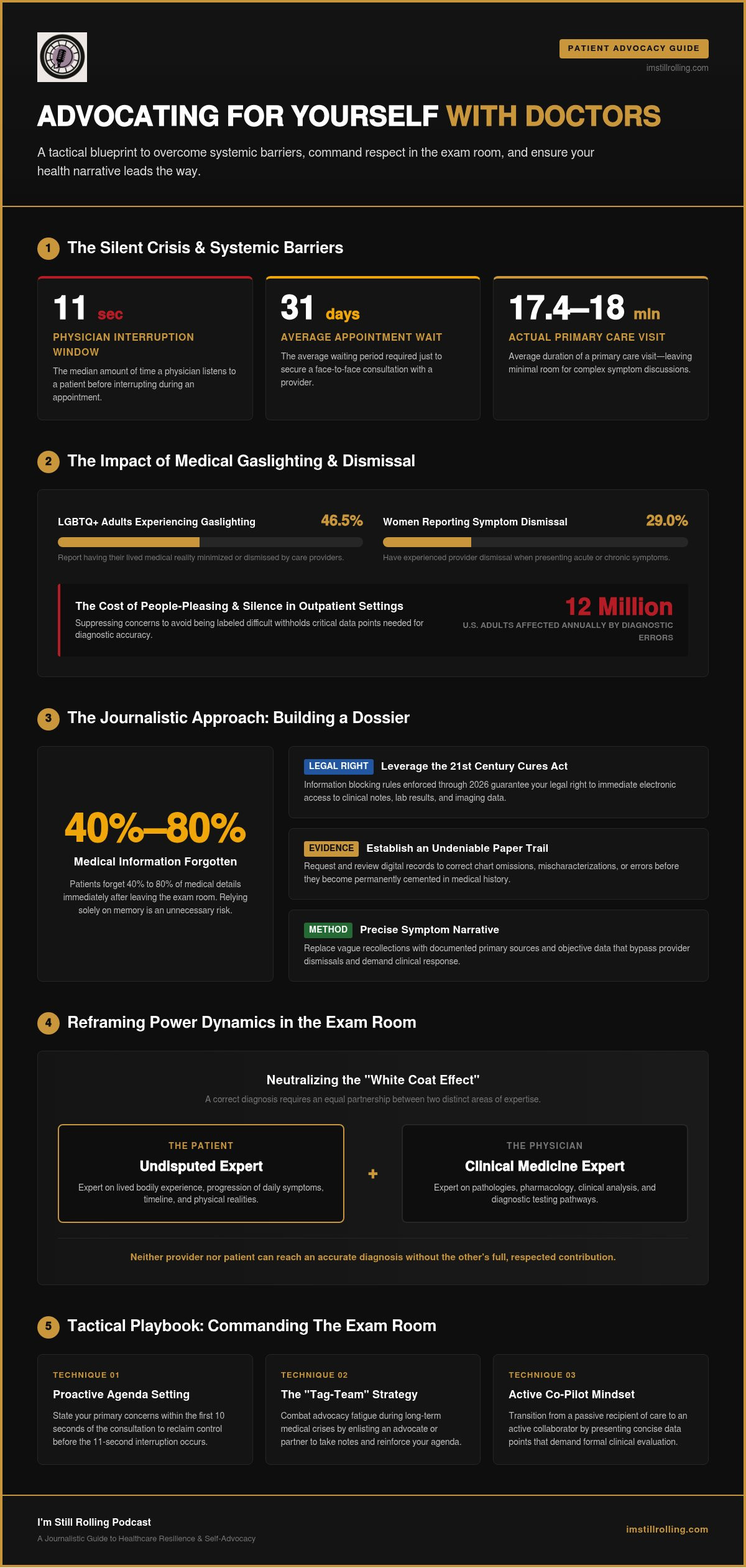
Did you know that the median amount of time a physician listens to a patient before interrupting is just 11 seconds? When you've waited an average of 31 days for an appointment only to be met with a 15-minute window and a screen full of clinical jargon, it's easy to feel like a passive recipient of care rather than a human being. Mastering the art of advocating for yourself with doctors is no longer just a suggestion; it's a vital act of medical resilience. You deserve to have your story heard, your symptoms believed, and your dignity preserved in a system that often feels designed to rush you through the door.
We know the weight of medical gaslighting and the hollow feeling that comes when a provider dismisses your lived experience as mere anxiety. It's an exhausting, lonely battle to fight for an accurate diagnosis while your body is already under siege. This guide promises to equip you with the tactical and emotional skills needed to command respect in the exam room and ensure your narrative is the one that leads the way. We'll break down how to leverage federal transparency laws, how to prepare a strategic dossier that bypasses the 11-second interruption, and the specific language that turns a cold consultation into a collaborative partnership.
Table of Contents
The Silent Crisis of Medical Dismissal: Why Advocacy is Essential
Medical advocacy is the active, deliberate process of ensuring your needs, symptoms, and values remain the absolute center of your care. It's a shift from being a passenger in your own health journey to becoming a co-pilot. In a system that often feels like an assembly line, advocating for yourself with doctors is the only way to ensure your humanity isn't lost in the paperwork. The foundational principles of patient advocacy remind us that healthcare should be a collaborative partnership, yet the reality of modern medicine often tells a different story.
The "15-minute problem" is a systemic reality that works against anyone with a complex or chronic condition. With the average primary care visit lasting between 17.4 and 18.0 minutes, there's little room for nuance. When you add the fact that physicians often interrupt within the first 11 seconds of a patient speaking, the window for being heard closes almost instantly. This structural rush leads to medical gaslighting, a form of trauma where your physical reality is dismissed or minimized. We approach this struggle with realistic optimism; we acknowledge the system is flawed, but we believe that with the right tools, you can command the attention you deserve.
Understanding the Power Dynamics of the Exam Room
Many of us experience the "White Coat Effect," a psychological phenomenon where we naturally defer to medical authority, often at the expense of our own intuition. This power imbalance is frequently worsened by systemic biases. Research shows that 29% of women have had their symptoms dismissed, while 46.5% of LGBTQ+ adults report experiencing medical gaslighting. To bridge this gap, we must reframe the relationship. You are the undisputed expert on your lived experience and your body; the doctor is the expert on clinical medicine. Neither can reach an accurate diagnosis without the other's full contribution.
The Cost of Silence: When Patients Don't Speak Up
Staying quiet to be a "good patient" carries a heavy price. People-pleasing in a medical context can lead directly to diagnostic error, which affects an estimated 12 million U.S. adults annually in outpatient settings. When we suppress our concerns to avoid being perceived as difficult, we withhold the very data points a doctor needs to solve the puzzle. Building medical resilience means finding the courage to speak the uncomfortable truths. You can hear real-world examples of this grit and transformation by exploring the I'm Still Rolling Podcast, where survivors and caregivers share how they found their voices in the middle of a crisis. Silence might feel safe in the moment, but advocacy is what leads to healing.
The Journalistic Approach: Building Your Medical Dossier
To survive a fractured healthcare system, you must become your own investigative reporter. This means shifting from a passive observer to a meticulous gatherer of evidence, treating your health journey as a long-form report that requires constant verification. A Medical Dossier is a living document of your physiological and emotional history; it's the anchor that keeps your story from drifting during a crisis. Relying on memory is a dangerous gamble when your health is on the line. Research indicates that patients forget 40% to 80% of medical information immediately after leaving an exam room. By building a rigorous paper trail, you ensure that the facts of your case remain static even when your energy levels or cognitive clarity fluctuate.
Gathering "primary sources" is the first step in this investigative process. Under the 21st Century Cures Act, specifically the information blocking rules enforced through 2026, you have a legal right to immediate electronic access to your clinical notes, lab results, and imaging. Requesting and reviewing these records allows you to see exactly how your symptoms are being translated into the digital record. If there are gaps, mischaracterizations, or errors in your chart, you can address them before they become cemented in your medical history. This level of detail is essential when advocating for yourself with doctors, as it replaces vague recollections with hard, verifiable data that demands a response.
The Art of the Precise Symptom Narrative
Vague descriptions like "I just feel bad" often trigger the systemic dismissal known as medical gaslighting. To bypass this, use the journalist’s "5 Ws" to document every new symptom: What is the sensation, Where is it located, When does it occur, and what are the triggers? The most critical metric you can provide is the "Impact on Life." Don't just report a pain level; describe what you can no longer do. If you can't walk to the mailbox or sit at a desk for more than twenty minutes, say so. These concrete, functional data points are much harder for a provider to minimize than a subjective number on a scale.
Organizing the Data for Maximum Impact
A doctor’s time is a scarce resource, so your presentation must be designed for 30-second digestibility. Create a one-page "Executive Summary" to hand over at the start of every new appointment. This sheet should include your current medications, a brief bulleted timeline of major health events, and your top three prioritized questions. Whether you prefer a digital folder or a physical binder, the organization should allow you to pull up a specific lab result or specialist report instantly. For more insights on maintaining your voice in the system, consider subscribing to the I'm Still Rolling Newsletter to join a community focused on medical resilience.
The Tactical Playbook: Commanding the Appointment
If the medical dossier is your research file, the appointment is your live interview. Commanding the room requires a shift in posture from a passive recipient to an active investigator. When advocating for yourself with doctors, the goal isn't to be "difficult" but to be disciplined. You're there to ensure the headline of your health story accurately reflects the facts on the ground. While the clinical environment often feels designed to minimize the patient's voice, adopting a structured conversational framework can bridge the gap between your lived experience and the doctor's expertise.
Setting the Stage in the First 60 Seconds
The first minute of an appointment often dictates the next fifteen. Use the "Opening Statement" method to anchor the conversation before the physician begins their standard routine. You might say, "I've prepared a brief agenda for our time today; I have three specific goals, including reviewing my recent imaging and discussing why the current treatment isn't reducing my pain." This signals that you're an informed participant who respects the clock but expects results. Foster a collaborative tone by using "we" language, such as, "How can we work together to narrow down the cause of these symptoms?" This positions you as a partner in the diagnostic process rather than an adversary.
Navigating Conflict and Dismissal
When a provider dismisses your concerns or refuses a specific diagnostic path, the dynamic can quickly become tense. If you face a firm "no" on a test you believe is necessary, use this specific script: "I understand your perspective, but I would like it noted in my chart that you are refusing this test and please include your clinical rationale for doing so." Because the 21st Century Cures Act ensures you can see these notes in real time, physicians are often more willing to reconsider a refusal when they must document it officially. If a doctor attributes your physical symptoms to "just stress," pivot back to the evidence. Acknowledge that stress is a factor, then ask, "Given the physical markers I've documented, what else could this be?"
Adopting the "Journalist's Follow-up" is essential for deep-dive advocacy. Don't leave without asking about the differential diagnosis. This forces the clinician to share the list of other conditions they've considered and ruled out. Resources like the Agency for Healthcare Research and Quality’s Questions Are the Answer framework provide excellent templates for these high-stakes moments. If you disagree with a proposed treatment, be firm. "I don't feel comfortable starting this medication until we've explored the underlying cause further." This isn't being uncooperative; it's being a steward of your own survival.
Overcoming Advocacy Burnout: When You're Too Tired to Fight
Advocacy isn't a sprint; it's an ultra-marathon through a landscape that often lacks clear signposts. When you're managing a chronic condition, the sheer labor of advocating for yourself with doctors can lead to a profound state of exhaustion known as resilience fatigue. It's the moment when the dossier feels too heavy to carry and the thought of another 15-minute appointment window feels like an insurmountable wall. Acknowledging this burnout isn't a sign of defeat. It's a necessary step in maintaining your medical resilience. To sustain the fight, you must eventually transition from a solo investigator to a member of a tag-team. Every advocate needs an advocate; whether it's a friend, a family member, or a professional navigator, having a second pair of ears in the room can halve the emotional burden and provide the clarity you lack when you're spent.
The Caregiver as the Lead Investigator
When you are caregiving for a spouse with Alzheimer's, the advocacy role becomes even more complex. You are tasked with translating symptoms for someone who may no longer have the words to describe their own internal reality. The challenge lies in speaking for your loved one without stripping them of their agency. It's a delicate balance of reporting objective data while honoring their personhood. This emotional weight is immense, often leading to a unique form of burnout where the caregiver's own health needs are neglected in favor of the patient's dossier. Finding a community of fellow travelers who understand this specific gravity is vital for long-term survival. Shared stories remind us that while the journey is difficult, we don't have to walk it in isolation.
Strategic Retreats: Knowing When to Pause
Sometimes, the most resilient act you can perform is a strategic retreat. Using an "Urgent vs. Important" framework, you can identify which tests require immediate action and which can wait for a few weeks. Communicating a "rest period" to your medical team is a valid tactical move. You might say, "I'm experiencing advocacy burnout and need to pause non-essential appointments for a month to refuel." This boundary preserves your mental health, allowing you to return to the exam room with renewed focus. You don't have to be a patient twenty-four hours a day. Finding meaning in non-medical pursuits isn't a distraction; it's the fuel that keeps you rolling. If you're feeling isolated by the clinical grind, listen to our latest episodes to find strength in our communal stories of endurance.
The Logical Conclusion: Transforming Care Through Resilience
The journey of medical resilience culminates in a profound internal shift. You've moved from being a subject in a clinical study to a partner in a shared investigation. Advocating for yourself with doctors isn't just about getting a prescription right; it's about building a legacy of data that protects your future self. A well-documented history creates a "north star" for your care team, ensuring that even if you change providers or face a new crisis, your physiological truth remains intact. This isn't just personal survival. Every time you push back against a 15-minute dismissal or request a chart correction, you're chipping away at the systemic biases that lead to diagnostic error. You're making the system safer for the person who follows you into that exam room.
We must remember that resilience is not a solo sport. It's a communal effort fueled by shared knowledge and the refusal to let hardship be the final word. In a healthcare landscape that can feel cold and transactional, your voice is the warmth that humanizes the process. By standing firm in your narrative, you transform the exam room from a place of anxiety into a space of mutual respect. This transformation doesn't happen overnight, but it begins the moment you decide that your lived experience is just as valid as the clinical data on the screen.
Lessons from the I'm Still Rolling Community
Our community is built on the belief that truth is a prerequisite for healing. We've seen how stories of recovery and hope often begin with a single, uncomfortable question. Whether it's a journalist's hunch or a caregiver's intuition, that initial act of advocacy is the catalyst for transformation. Journalistic truth isn't just for newsrooms; it's a vital tool for personal survival. We invite you to share your own advocacy "wins" with us. Your breakthroughs provide the communal resilience that others need to keep rolling when they feel they've hit a dead end.
Your Next Steps: The Advocate's Checklist
Transformation begins with a single, tangible action. Start your medical dossier today by requesting your last three visit notes through your patient portal to see exactly how your story is being recorded. This small step anchors you in the reality of your care and prepares you for the next consultation. To stay equipped with ongoing tactics and find strength in shared endurance, Subscribe to the I'm Still Rolling Newsletter. We're here to walk this path with you, ensuring that no matter how steep the climb, you don't have to face the medical system alone.
Stepping Into Your Power as a Medical Partner
Building medical resilience is an ongoing act of reclaiming your narrative. You've learned that a rigorous dossier and tactical conversational scripts are your best defenses against a system that often favors speed over depth. While the weight of advocating for yourself with doctors can lead to exhaustion, remember that your persistence transforms the very nature of the care you receive. You aren't just a patient; you're an essential investigator in your own survival.
Hosted by award-winning journalists Mike Sugerman and Janice Wright, our community offers deep-dive insights born from real-life medical trauma and recovery. We believe in a brand of realistic optimism that acknowledges the gravity of your struggle while celebrating the endurance of the human spirit. You've gained the tools to command respect in the exam room, and we're here to ensure you stay energized for the long haul. Resilience is a communal effort, and your story is a vital part of our collective strength.
Subscribe to the I'm Still Rolling Newsletter for more stories of resilience and join a network of fellow travelers committed to finding meaning within the struggle. Keep rolling, keep asking, and keep believing in the power of your own voice.
Frequently Asked Questions
What should I do if my doctor says my symptoms are 'just anxiety'?
If your doctor attributes physical symptoms to anxiety, acknowledge that stress can be a factor but pivot the conversation back to objective data. Ask for the differential diagnosis by saying, "What physical evidence led you to rule out other physiological causes?" This journalistic approach forces a review of the facts. Advocating for yourself with doctors requires you to insist on a thorough investigation before accepting a psychological explanation for physical distress.
How can I prepare for a medical appointment when I only have 15 minutes?
Maximize a brief 15-minute window by arriving with a one-page executive summary. This document should list your current medications, a bulleted timeline of symptoms, and your top three prioritized questions. Hand this to the clinician immediately to bypass the 11-second interruption window. Being organized allows you to spend the limited face-to-face time on high-level decision-making rather than reciting basic history that is already in your medical dossier.
Is it okay to record my doctor's appointments on my phone?
Recording legality depends on your location. In 39 U.S. jurisdictions, one-party consent allows you to record your own appointments legally. However, 11 states require all-party consent. Beyond legality, announcing your recording diplomatically can foster partnership. You might say, "I record these sessions because I often forget complex instructions." Since patients forget 40% to 80% of medical information almost immediately, having an objective audio record is a vital tool for medical resilience.
How do I ask for a second opinion without offending my current doctor?
Requesting a second opinion is a professional standard, not a personal slight. You can frame it as a collaborative step by saying, "I appreciate our work together, but I'd like another set of eyes on this complex case to ensure we haven't missed anything." Most physicians respect this journalistic rigor. If a provider is offended by your desire for clarity, it's a sign they may not be the right partner for your long-term health journey.
What are my rights if a doctor refuses to order a specific test?
If a provider refuses a specific test, you have the right to request that the refusal and the clinical rationale be documented in your chart. Under the 21st Century Cures Act, you can view these notes in real time through your patient portal. This request often prompts a reconsideration, as clinicians are aware that the chart is a legal document. Knowing your rights ensures that your medical story is shaped by evidence rather than administrative convenience.
How can a caregiver advocate for a patient who cannot speak for themselves?
Caregivers must act as lead investigators by documenting objective changes in the patient's behavior or physical state. Focus on "Impact on Life" metrics, such as a loved one's inability to perform daily tasks they previously mastered. When advocating for yourself with doctors on behalf of another, you provide the context the patient cannot. It's about being a voice for their dignity while ensuring the medical team has the data needed for an accurate diagnosis.
What is a 'medical dossier' and how do I start one?
A medical dossier is a living document that tracks your physiological and emotional history over time. It's far more comprehensive than a simple list of medications. To start one, request your clinical notes from your last three visits through your patient portal. Organize these with your own symptom logs and specialist reports. This paper trail ensures your narrative remains consistent, preventing vital details from being lost during the transitions between different care teams or specialists.
Can I really change the outcome of my treatment by speaking up?
Speaking up significantly improves the likelihood of an accurate diagnosis and effective treatment. With approximately 12 million U.S. adults affected by outpatient diagnostic errors annually, your active participation is a necessary safeguard. When you transition from a passive recipient to an informed partner, you help the medical team avoid the cognitive biases that lead to mistakes. Your advocacy is the catalyst that moves your care from a standard protocol to a personalized, effective strategy.



Comments