How to Accept Your Disability: A Compassionate, Realistic Guide
What if accepting your disability doesn’t mean feeling grateful for every change or deciding you’re okay with what you’ve lost? If you’re searching for how to accept your disability, you may already be carrying the added pressure of believing you should have reached acceptance by now. But grief over changed routines, roles, or plans can sit alongside hope, resolve, and moments of genuine ease.
Acceptance isn’t a finish line, and it doesn’t follow one clean timetable. Your feelings may shift as your needs and circumstances change. You don’t have to pretend everything is fine, force a positive outlook, or make peace with every part of your experience before taking a next step.
This guide explores acceptance as an ongoing relationship with a changing life. You’ll find practical ways to notice and respond to difficult feelings, make room for changing needs, and consider what a meaningful future might look like on your terms. Honest conversations and varied lived experiences, including those shared on the I'm Still Rolling Podcast, can offer company rather than a universal formula. There’s no single right way to move forward, and you don’t have to do it all at once.
Table of Contents
What Does It Mean to Accept Your Disability?
You may want to acknowledge what has changed while resisting the idea that you should simply be fine with it. That tension makes sense. Acceptance can be confused with approval, gratitude, or a decision to stop asking for things to be different. It doesn’t have to mean any of those.
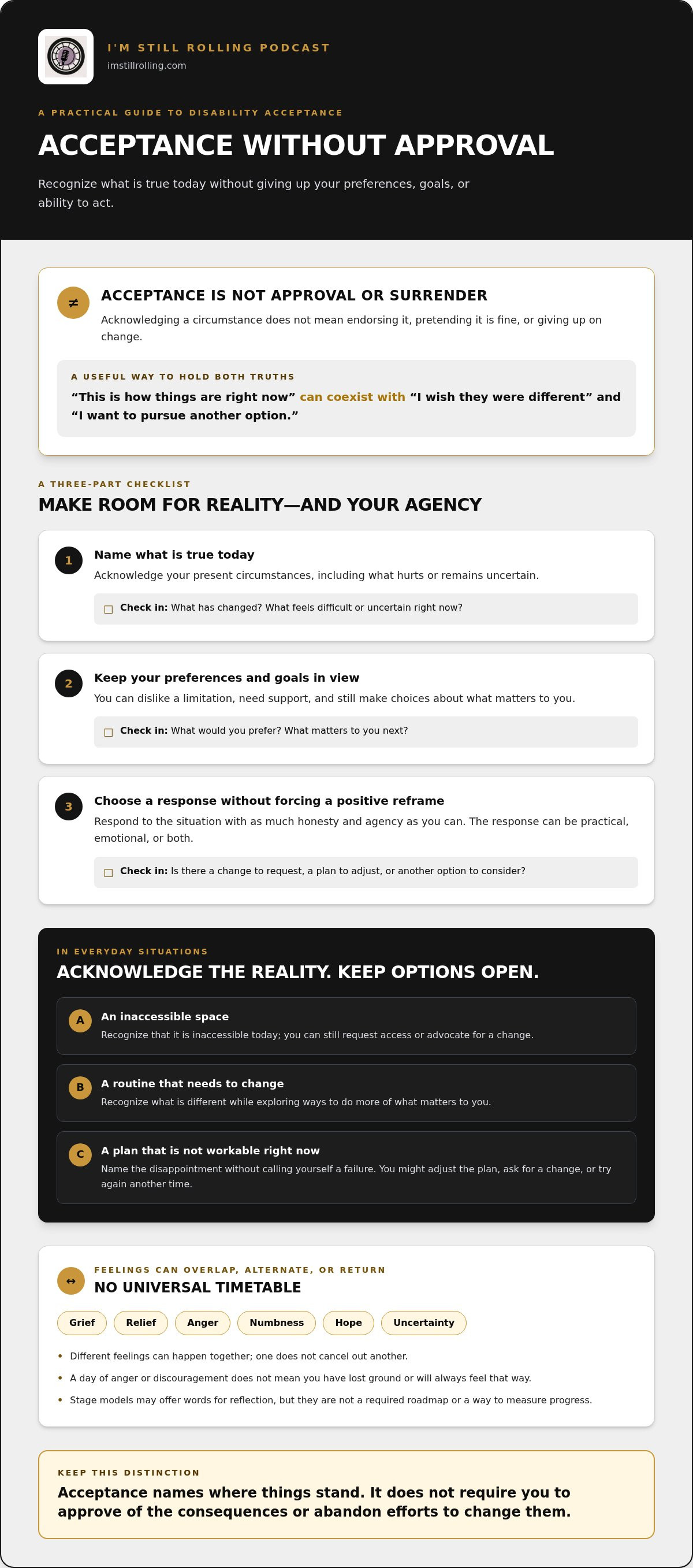
Acceptance is recognizing your present reality without surrendering your preferences, goals, or ability to act. It’s not a medical outcome or a verdict on how well you’re coping. It describes a way of relating to your circumstances: seeing what is true today, including what hurts or remains uncertain, while retaining a say in what matters next. You can dislike a limitation, need support, and still make choices about your life.
This distinction matters because disability isn’t only an individual experience. The history of the disability rights movement reflects ongoing efforts to challenge exclusion and secure equal rights and opportunities. Recognizing your own situation doesn’t mean treating inaccessible environments or dismissive attitudes as inevitable, or as your responsibility to accept without question.
Acceptance is not approval or surrender
Acknowledging a circumstance doesn’t mean endorsing it. You might accept that a space is inaccessible today while continuing to request access or advocate for a change. You might recognize that your current routine needs to be different while exploring ways to do more of what matters to you. Acceptance names where things stand; it doesn’t require you to approve of the consequences or abandon efforts to change them.
For example, if a plan isn’t workable with your needs as they are today, you can name that plainly, without calling yourself a failure or pretending the disappointment doesn’t matter. You might adjust the plan, ask for a change, or decide to try again another time. The point isn’t to find a cheerful interpretation. It’s to respond to reality with as much honesty and agency as you can.
So, if you’re wondering how to accept your disability, start by separating what you can acknowledge from what you’re being asked to approve. “This is how things are right now” can coexist with “I wish they were different” and “I want to pursue another option.” Those statements don’t cancel each other out.
There is no universal timetable
Disability is part of each person’s life in a different way. Identity, circumstances, support, and the changes someone faces all shape how they understand their experience. Feelings may be mixed, muted, intense, or hard to name. None of these responses proves that you’re accepting the situation well or badly, and there’s no required deadline for making sense of it.
Lived experience can help make room for that complexity, especially when other people’s encouragement feels too neat. The emotional impact of disability can’t be reduced to a single account or timeline. Another person’s story may offer recognition, but it doesn’t prescribe how yours should unfold. You’re allowed to take what resonates and leave the rest.
How Disability Acceptance Can Unfold Without a Fixed Set of Stages
Emotions rarely arrange themselves into a tidy sequence. Grief, relief, anger, numbness, hope, and uncertainty can arrive together, alternate, or return after a stretch when life felt more settled. Feeling relief about one change doesn’t cancel grief about another. A day of anger doesn’t mean you’ve lost ground.
Stage models can offer words for reflection, but they aren’t a diagnostic tool or a required roadmap. You don’t have to identify which stage you’re in, move through feelings in a prescribed order, or reach a final state called acceptance. These frameworks describe possible experiences, not rules for measuring your progress.
A feeling is real in the moment, but it isn’t a permanent verdict on your life. You can notice, “I feel discouraged today,” without deciding that you’ll always feel this way or that nothing can improve. That distinction leaves room for honesty without asking you to predict the future.
Why feelings may change from day to day
Emotions often shift alongside ordinary conditions: how much energy you have, what a day requires, whether your surroundings meet your needs, or how a conversation with someone close to you lands. A task that felt manageable yesterday may feel exhausting today. An unexpectedly supportive interaction may bring relief, while an access barrier can stir frustration again.
These changes don’t erase adaptation or predict what the rest of your life will feel like. Before judging yourself, notice what was different: “Today’s demands were heavier,” or “I needed more support than I had.” That observation isn’t a label such as denial or depression. It’s a way to understand a particular day without turning it into a diagnosis or a forecast.
Practical support can also shape how daily life feels. In higher education, for instance, the Association on Higher Education and Disability (AHEAD) focuses on equity and inclusive environments. That broader context matters: feelings don’t develop separately from the settings, relationships, and resources a person encounters.
Make room for grief without making it the whole story
Grief may involve more than a single loss. You might mourn a familiar routine, a role you held, assumptions you once made about the future, or plans that now need to change. Naming what hurts doesn’t mean you’re stuck there. It gives the loss a truthful place in your story, rather than forcing it into silence or a quick lesson about gratitude.
There’s room beside grief for continuity: relationships, interests, humor, values, and choices that remain meaningful, even as they take a different shape. You don’t have to find a silver lining to recognize those parts of yourself. If another person’s experience feels useful, explore stories of recovery and hope as varied human narratives, not promises or instructions. The journalist-hosted conversations on I'm Still Rolling Podcast offer another perspective to sit with, at your own pace.
What Makes Disability Acceptance Harder Than a Change in Mindset?
It’s difficult to build a new rhythm when the world around you keeps creating avoidable obstacles. A positive mindset can’t make an inaccessible entrance usable, remove stigma from an interaction, or resolve every practical strain. If acceptance is framed as the whole solution, you may be left feeling responsible for problems you didn’t create.
Disability-related barriers can arise from a person’s circumstances and from environments that weren’t designed to include them. Naming that reality isn’t self-pity. It helps distinguish adapting to what’s happening from changing exclusionary assumptions, spaces, and systems. Both matter, but they aren’t the same responsibility.
That distinction can make “how to accept your disability” a more useful question. Rather than asking yourself to feel differently about every difficulty, ask what you need, what is within your control, and what obstacle comes from the environment or other people’s expectations. Some challenges call for personal adjustments. Others call for access, respect, or a change in how people respond.
Separate self-acceptance from other people’s expectations
People may ask intrusive questions, offer pity, give unsolicited advice, or treat you as an example of resilience before they’ve taken time to know you. Even encouragement can feel isolating when it leaves no room for frustration, ambivalence, or an ordinary day. You don’t have to turn your life into an explanation, reassure anyone, or perform optimism to make them comfortable.
A brief boundary can be enough. Try, “I’d rather not discuss that,” “I’m not looking for advice right now,” or “Please ask before helping.” You can also change the subject or say nothing. These phrases aren’t obligations or scripts you must deliver perfectly; they’re options for protecting your energy when they fit. Your worth doesn’t depend on inspiring someone, and disability doesn’t make your life either a tragedy or a lesson for others.
Recognize access barriers without blaming yourself
Consider a routine task that becomes difficult because a space, process, or assumption doesn’t account for your needs. The difficulty may be real, but it isn’t proof that you’re inadequate or failing to adapt. Naming the specific barrier can clarify the situation: perhaps the information isn’t accessible, the setting creates an obstacle, or someone assumes you need help without asking.
Accessible design and disability rights are part of everyday life, not abstract ideas separate from personal adjustment. They shape whether people can participate, make choices, and be treated with dignity. Noticing where access breaks down doesn’t require you to take on every fight. You might describe the impact, request a change, seek support from someone you trust, or simply recognize that the obstacle isn’t a personal shortcoming.
Acceptance can include care for yourself and an honest account of what needs to change around you. You don’t have to choose between making adjustments and expecting better access. One can help you meet the present; the other can point toward a more inclusive future.
Practical Ways to Make Room for Acceptance in Everyday Life
Acceptance doesn’t have to arrive as a grand realization. It may take shape through small choices: finding words for what feels difficult, noticing what you need today, or changing one part of a routine so it works better. Treat the ideas below as a menu, not a test. Skip any step that doesn’t fit, adapt it to your circumstances, or return to it another time.
Start with honest language for what is happening
Begin with what’s true, without demanding a lesson or a positive reframe. If it helps, pause for a moment or write a few words privately. You might ask yourself:
What feels different or harder than I expected?
What do I need more of, less of, or in a different form today?
What still matters to me, even if I need to approach it differently?
Try describing the answer plainly: “I’m frustrated that this takes more energy,” or “I need more time before I decide.” A feeling doesn’t need to be justified or corrected before you can notice it. Journaling can help you gather your thoughts, but it’s optional. So is sharing them with someone else. Neither is a cure or a measure of how well you’re adjusting.
Choose one manageable adjustment and one source of connection
Once you’ve named a need, consider whether there’s a small, practical change within your control. Perhaps you can break a task into parts, change when you do it, or ask someone you trust to handle one specific thing. The aim isn’t to solve everything at once. It’s to see whether one adjustment makes this part of the day more workable.
You can also notice what remains meaningful, without insisting that it make up for what’s hard. A relationship, interest, value, or role may still matter even if how you take part in it changes. Ask, “Is there a version of this that feels possible for me right now?” The answer might be yes, no, or not yet. Each is useful information.
Connection is another option, not an assignment. You might tell a trusted person what kind of response would help, spend time with people who understand some part of your experience, or choose professional support if talking with someone feels useful. Asking for support doesn’t prove failure or dependence. It’s a choice you can make, revise, or decline according to your needs.
If hearing lived experiences feels like a welcome form of company, explore the I'm Still Rolling Podcast's conversations about disability and resilience. Take what resonates and leave what doesn’t. The next step doesn’t need to settle the question of acceptance; it only needs to meet you where you are today.
How Honest Disability Stories Can Help You Feel Less Alone
Advice can sound tidy from the outside. A lived story often holds more than one truth at once: someone may describe frustration without hiding moments of connection, or talk about a changed future without reducing their whole life to disability. Hearing that complexity can offer recognition, especially when you’ve felt alone with reactions that don’t fit a simple message about staying positive.
Another person’s experience isn’t evidence that you should feel the same way or reach the same outcome. Their circumstances, relationships, resources, and needs are their own. A story can be company, not a prescription. You’re free to pause, disagree, take something useful, or decide it isn’t what you need today.
Listen for recognition, not a blueprint
As you listen, notice what resonates without turning it into a rule for your own life. Perhaps you recognize a feeling, hear a question you haven’t found words for, or simply appreciate someone speaking honestly about an imperfect day. None of that requires you to match the speaker’s choices or timeline. A guest’s resilience doesn’t prove that everyone can or should achieve the same thing.
I’m Still Rolling features conversations about disability, resilience, and life after adversity, hosted by journalists Mike Sugerman and Janice Wright. Guests share lived experiences, not a universal formula for how to accept your disability. If you want to hear how different people describe change and resilience, these conversations offer one place to begin.
Let different formats meet different moments
Your attention and energy can vary, so choose a way of engaging that suits the moment. Episodes are available in audio, video, and written transcripts. You might listen while resting, watch when seeing the speakers feels meaningful, or read a transcript when you’d rather take in the conversation quietly. There’s no need to finish an episode or absorb every detail. One passage that stays with you can be enough.
Afterward, you could ask yourself: “What did I recognize?” or “What didn’t fit my experience?” Those questions can help you keep another person’s story in perspective while noticing what matters to you. Or you can simply close the episode and carry on with your day. Reflection doesn’t have to become homework.
If a candid conversation would feel welcome, Explore honest conversations on I’m Still Rolling. Choose a story or format that feels right for now, and let your own experience remain your own.
Let Your Next Step Be Yours
You don’t need to settle every question about disability or acceptance today. Your next step might be noticing what you need this week, protecting time for something that matters, or letting yourself stay uncertain without treating uncertainty as a failure. Small choices can honor both what’s difficult and what you still want for your life.
If you’re still wondering how to accept your disability, let the question remain open to change. Your understanding may shift as your circumstances do, and you’re allowed to move at a pace that feels honest rather than performative. You don’t have to turn your experience into a lesson or a promise about what comes next.
Sometimes hearing another person speak candidly can offer company, even when their path isn’t yours. Explore honest conversations about disability and resilience through I’m Still Rolling, hosted by journalists Mike Sugerman and Janice Wright, with episodes in audio, video, and transcript formats. Take what feels useful and leave the rest. Your next step can be small, and it can still be yours.
Frequently Asked Questions
Does accepting your disability mean you have to be happy about it?
No. You don’t have to feel happy, grateful, or approving in order to respond honestly to your life. You might feel sadness about a canceled plan and still enjoy a conversation later that day. If someone tells you to focus on the positive, you can remind yourself privately that mixed feelings are allowed. Acceptance isn’t a performance for other people, and you don’t need to manufacture a good mood to prove you’re coping.
Why do I feel guilty about struggling with my disability?
Guilt can grow from an expectation that you should cope quietly, need less help, or be more upbeat. Try writing down the thought behind it, such as “I’m inconveniencing everyone,” then ask whether you’d judge a loved one by the same standard. If you asked someone to change a plan or felt angry about a difficult day, that doesn’t make you selfish. It may simply show that something matters or that you need support.
Can I accept my disability and still hope for change?
Yes. You can make plans based on what you know now while keeping room for possibilities you can’t predict. For example, you might pursue an accommodation, discuss treatment options with a qualified professional, or continue toward a personal goal without demanding certainty about the result. If you’re considering how to accept your disability, you don’t have to decide whether hope is realistic before taking care of an immediate need. Both can have a place.
How do I explain my disability or changing needs to family?
You choose what to disclose. For a family visit, you could say, “I’d like to come, but I need a quieter place to rest,” without sharing medical details. If the conversation feels hard, write down the one request you most want understood and share it by message or in person. You can also say, “I’m not ready to discuss more.” A clear, specific request may be easier to respond to than an explanation of everything you’re experiencing.
What can I say when people tell me to stay positive?
You could respond, “I know you mean well, but I need you to hear me without trying to fix the feeling.” If that feels too direct, try, “I’d rather talk about what would help today.” You can choose a different response with different people, or let the comment pass if answering would take too much energy. You aren’t responsible for making someone else comfortable with your honest account of a difficult moment.
How can I support a friend who is newly disabled?
Start by listening, then offer specific choices rather than assuming what your friend needs. You might ask, “Would it help if I brought dinner, handled an errand, or just kept you company?” Accept a no without pressing for a reason. Avoid making promises about how things will turn out or sharing their news with others without permission. Consistent, ordinary contact can matter: invite them to something they enjoy, and let them decide what feels manageable.
Is it normal to feel different about your disability at different times?
Yes. A change in plans, a stressful interaction, or a new support need can affect how you feel on a given day. A difficult stretch doesn’t erase moments when you felt more settled, and a hopeful day doesn’t invalidate past frustration. If distress is interfering with daily life or feels difficult to carry alone, you might talk with a qualified professional you trust. You can choose what to share and what kind of support you want to discuss.


Comments