Finding Strength in Vulnerability: How Honesty Builds Connection
What if being vulnerable didn’t mean giving everyone access to your private life, but choosing to let someone trustworthy see what you’re carrying? Finding strength in vulnerability can feel difficult when honesty seems tied to weakness, judgment, or losing control. If you’ve been hurt before, keeping your guard up may feel safer than risking another disappointment.
That caution makes sense. Openness isn’t a demand to share everything with everyone, or to turn pain into a lesson before you’re ready. It can be a deliberate choice: naming what’s hard, setting limits around what you share, and asking for support when you need it. Honest connection doesn’t require forced positivity or perfect words.
This article explores what vulnerability can mean, why it often takes courage, and how to practise it without abandoning your boundaries. You’ll find language for difficult conversations and ways to recognize strength in self-awareness, connection, and reaching out. Real conversations from I'm Still Rolling Podcast, hosted by journalists Mike Sugerman and Janice Wright, offer glimpses of how people make meaning from adversity in their own ways.
Table of Contents
Finding Strength in Vulnerability: What It Means and What It Does Not
Openness can feel risky when life is uncertain or changing. You might worry that admitting fear will make you seem incapable, or that naming a need will give someone else power over you. Those concerns are understandable, especially if honesty has previously been met with dismissal or judgment. Vulnerability doesn’t erase the risk, and it doesn’t require you to ignore it.
Here, vulnerability means acknowledging a feeling, need, limit, or uncertainty by choice. That might mean telling a friend you’re struggling, admitting you don’t know what to do next, or recognizing privately that you’ve reached your limit. Vulnerability is chosen openness about what’s real, not compulsory disclosure of everything you’ve lived through.
This distinction matters. Vulnerability isn’t helplessness, and it doesn’t mean surrendering your judgment or control. It isn’t oversharing, either. Sharing more than feels safe, or more than a moment or relationship can hold, isn’t a measure of courage. Nor is vulnerability performing positivity by reshaping pain into an uplifting story before you’re ready. Finding strength in vulnerability begins with honesty about what is, not pressure to make it look inspiring.
Is vulnerability a strength or a weakness?
It can be an act of strength because naming uncertainty takes courage, even when the words come out quietly. But courage doesn’t make the moment easy, comfortable, or certain to go well. Someone may respond with care, they may not understand, or you might simply feel exposed afterward. Vulnerability doesn’t guarantee confidence, connection, or a positive outcome.
Its value can lie in the pause it creates. “I’m not sure what I need yet” isn’t a failure to cope. It’s a clear observation that can help you choose what comes next: take time, ask a question, seek company, or keep the matter private for now. Self-awareness doesn’t solve every difficulty, but it can make your next choice more deliberate.
What vulnerability can look like in everyday life
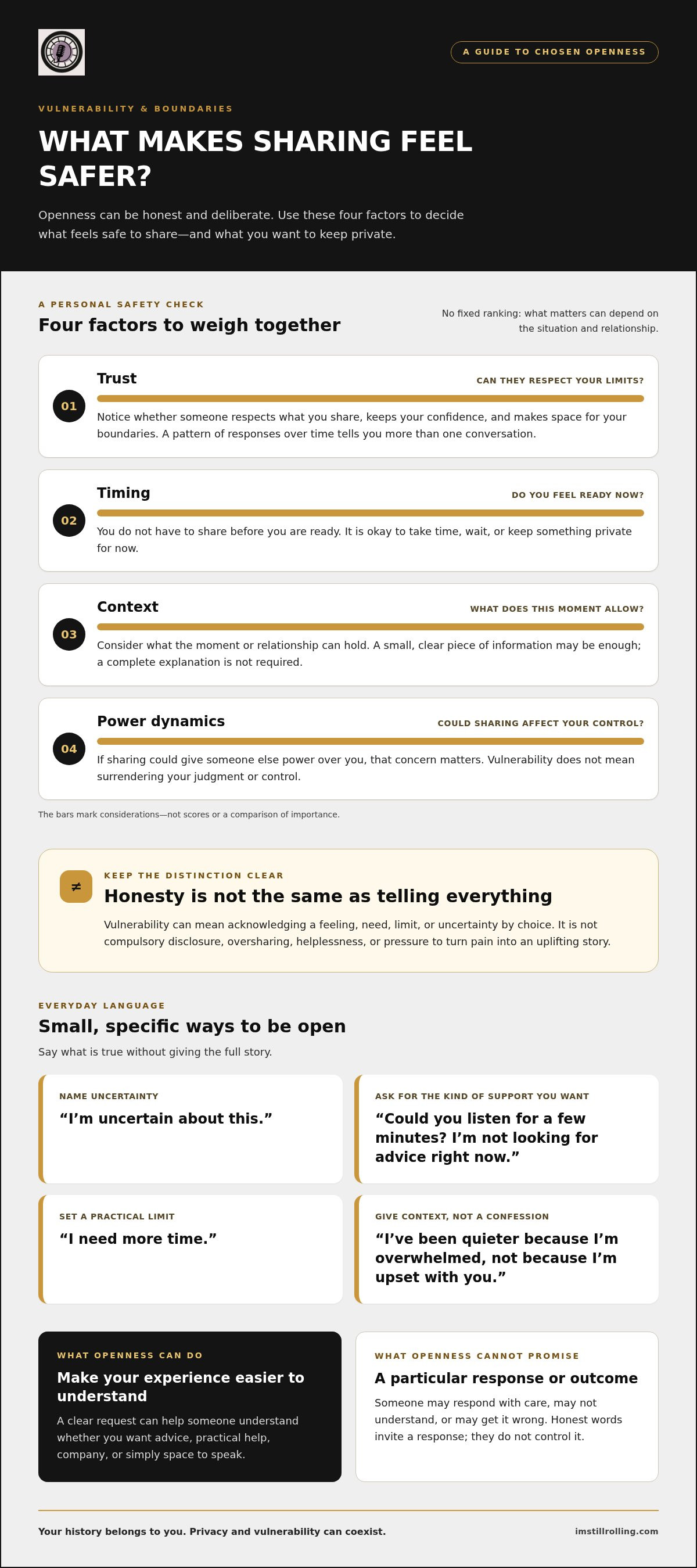
Often, openness is ordinary rather than dramatic. You might say, “I’m uncertain about this,” instead of pretending to have an answer, or ask, “Could you listen for a few minutes? I’m not looking for advice right now.” You might tell a colleague you need more time, or let a friend know that a change has been harder than you expected. Each example names something real without requiring a complete explanation.
There’s no single correct style. One person may speak directly; another may share a small piece and wait to see how the conversation feels. You can be honest while deciding not to discuss the details, and you can care about someone without making them your confidant. Privacy and vulnerability can coexist. Your history belongs to you, and nobody is owed the full version. Choosing what to share, and what to hold back, is part of knowing yourself.
How Vulnerability Can Create Room for Connection and Growth
Honest communication can make room for connection, but it can’t guarantee it. Sharing something personal doesn’t obligate another person to respond with care or understanding. It can, however, make your experience easier to see. Without that clarity, someone close to you may be left guessing whether you want advice, practical help, company, or simply a chance to speak without interruption.
A specific request can offer a useful starting point: “I’m worried about what happens next. Could you sit with me while I think it through?” You haven’t shared every detail, but you’ve given the other person a clearer way to respond. They may still get it wrong. Honest words invite a response; they don’t control it.
Chosen openness can help people understand one another by making feelings and needs visible, while leaving room for both people to listen and respond in their own way. That possibility, rather than a promise of instant closeness, is part of finding strength in vulnerability.
How honest sharing can deepen understanding
Measured sharing can replace guesswork with information. Instead of withdrawing and hoping someone notices, you might say, “I’ve been quieter because I’m overwhelmed, not because I’m upset with you.” That sentence gives context without turning the conversation into a full confession. It can also reduce the pressure to interpret silence, short replies, or a change in plans.
Connection is reciprocal, not a one-way act of disclosure. There should be room for the other person to ask, listen, or share in return without taking over your story. Trust is shaped by a pattern of responses: whether someone respects what you’ve shared, keeps your confidence, and makes space for your limits. One moving conversation may matter, but consistency over time tells you more.
Finding meaning without romanticizing hardship
People can learn, adapt, or discover new priorities after difficult experiences. That doesn’t mean the experience was necessary, worthwhile, or secretly a gift. Pain can remain painful; insight doesn’t cancel loss, exhaustion, or anger. Meaning-making belongs to the person living the experience. It may take time, change, or never arrive in a neat conclusion.
Outside pressure to “find the silver lining” can close conversation just when someone needs room to be honest. A more respectful response is to let people describe what happened in their own terms, including what still hurts and what, if anything, they’ve come to understand. Stories of recovery and hope can offer varied perspectives on how people make meaning without prescribing a single route through adversity.
If hearing those perspectives feels useful, explore I'm Still Rolling Podcast conversations at your own pace. Each person’s story is their own, not a formula for how anyone else should heal, connect, or grow.
Does Vulnerability Mean Oversharing? Boundaries, Safety, and Misconceptions
Being open doesn’t mean making private experiences public or giving everyone the same access to your inner life. You can be honest about having a difficult day without explaining its history. You can acknowledge uncertainty while keeping the details to yourself. Vulnerability is chosen openness, not the absence of boundaries. Strength isn’t measured by how much you reveal.
Sharing can bring relief or help someone understand what you need, but it can also leave you feeling exposed, especially if the listener responds poorly or the timing doesn’t feel right. Neither reaction proves you made the wrong choice. Consider the setting, the relationship, and what you hope to communicate instead of assuming disclosure is always brave or beneficial. Finding strength in vulnerability includes having the freedom to pause.
How to tell vulnerability apart from oversharing
Oversharing isn’t a fixed amount of detail. It may describe disclosure that feels unwanted, happens before you’re ready, or doesn’t fit the trust or purpose of a particular relationship. Vulnerability, by contrast, can be brief and carefully chosen: “I’m dealing with something personal, and I’m not ready to explain more.” That sentence communicates both truth and a limit. Choosing privacy deserves no shame, just as choosing to share deserves no judgment.
Ask yourself what you want the other person to know and what you’d prefer to keep private. You might share the impact without recounting every event: “This change has been harder than I expected” rather than offering a full account. You can also name a boundary: “I’d like to talk, but I’m not looking for advice,” or “I can share a little, though I may need to stop.”
When privacy and caution are the stronger choice
Some relationships and environments don’t feel safe for personal disclosure. There may be a power difference, a history of broken trust, or a real concern that what you say could be used against you. In those circumstances, holding back can be sound judgment, not emotional failure. You’re allowed to protect information until you have more clarity about the person, setting, or consequences.
Pause if you feel pushed to reveal more than you intended, or if someone seems to expect a particular emotional response. You don’t have to tell a painful story to reassure another person, prove trust, or make them comfortable. Try saying, “I’m not ready to discuss that,” or “I need time to think about what I want to share.” Then notice whether your limit is respected. That response can help you decide what, if anything, feels appropriate to share later.
There’s no single correct disclosure choice for every situation. Context, trust, timing, and power all shape what openness may cost or make possible. This guide offers ideas for reflection and communication; it isn’t mental-health or crisis care. If you’re in immediate danger or need urgent support, seek appropriate help where you are. You deserve care without being asked to disclose more than feels safe.
How to Practise Vulnerability Without Abandoning Your Boundaries
Openness doesn’t have to be a leap into a long, difficult conversation. You can approach it in small, deliberate steps, and stop or change course at any point. Finding strength in vulnerability can mean preparing one honest sentence rather than telling the whole story. The choice is yours, including the choice not to share today.
A simple way to prepare for an honest conversation
Before speaking, consider what you’re feeling and what you hope the other person will understand. You don’t need a polished explanation. A few notes, a message, or a quiet conversation may feel easier than speaking spontaneously. Choose a setting and pace that feel manageable, and share only what you’re ready to put into words.
Notice what you feel. Try naming it plainly to yourself: “I’m anxious,” “I feel worn down,” or “I’m unsure.” You can take time to find the right word.
Identify what you need. Do you want someone to listen, offer practical help, or simply keep you company? You might say, “I don’t need advice right now. I’d just like you to hear me.”
Choose a listener and format. Think about who has shown they can respect your limits. If face-to-face conversation feels like too much, you could write a message or share one manageable detail first.
Decide what to share, and where to pause. You might begin, “I’ve been having a hard time, but I’m not ready to explain all of it.” You can stop there, add more later, or decide that’s enough.
These steps aren’t a test to pass. Your feelings or needs may shift as you prepare. The point isn’t to follow a perfect script or secure a particular response; it’s to give yourself room to choose what feels honest and appropriate.
What to do when the response is imperfect
A listener may misunderstand, go quiet, or need time to take in what you’ve said. Their first response may not tell you everything about their care or capacity, but you don’t have to keep explaining if the conversation stops feeling right. You could clarify, “I think I wasn’t clear. I’m asking you to listen, not solve it,” or set a limit: “I’d rather not go into more detail.”
If you need to pause, try, “I’m feeling overwhelmed. Can we come back to this another time?” You can also follow up in writing if that gives you more space to express yourself. If the other person responds dismissively, their reaction doesn’t determine whether your feelings are valid or whether your experience matters. Take time to decide what you want from that relationship next.
Practising openness is optional, not an obligation. Let your judgment guide what you share, with whom, and when. If hearing honest conversations helps you reflect at your own pace, explore I'm Still Rolling Podcast episodes about resilience and life after adversity.
Finding Strength in Vulnerability Through Real Stories and Reflection
Ideas about courage and openness become more human when we encounter them through someone else’s experience. A story may help you recognize a feeling you haven’t been able to name, or remind you there’s more than one way to live through uncertainty. Recognition isn’t instruction, though. Another person’s choices can offer perspective without becoming a standard you’re expected to meet.
I'm Still Rolling Podcast, hosted by journalists Mike Sugerman and Janice Wright, shares conversations about resilience, disability, caregiving, and life after adversity. These are varied lived experiences, not templates for how to recover, ask for support, or make meaning. You may connect with one detail and feel differently about another. Both responses are valid.
Listening to lived experience without turning it into a formula
People define courage, privacy, and connection in their own terms. For one person, openness might mean speaking plainly about a hard moment. For another, it could mean choosing what to keep private while accepting practical support. Listening with curiosity makes space for those differences, rather than asking every story to confirm what strength should look like.
As you listen, notice what resonates and what doesn’t fit your life. You might ask yourself: What did this person choose to share? What did they hold back? What does their experience help me understand, and where is my situation different? Stories about spinal cord injury recovery offer one distinct context for hearing how an individual’s experience can hold complexities that a simple label or expected outcome cannot capture. No single story can speak for everyone.
That is part of the value of I'm Still Rolling Podcast stories: they bring lived experience and journalistic insight into conversation without asking every listener to draw the same conclusion. Listening can invite reflection, but it isn’t treatment or a substitute for support a person may need.
A reflective next step for the reader
For a moment, turn your attention back to your own life. Is there a feeling or need you could name privately, without deciding yet whether to share it? You might write, “I feel uncertain,” or “I need more time,” and let that be enough for now. Naming something to yourself can help clarify what you want, even if you choose to keep it private.
Then consider whether, when, and with whom you might share it. There’s no deadline and no obligation to turn reflection into disclosure. Choosing your next step, including waiting, is an expression of agency. If you’d like to hear more perspectives, explore I'm Still Rolling Podcast stories at your own pace.
Let Your Next Honest Step Be Your Own
You don’t have to make a sweeping declaration or resolve every uncertainty before you begin. Your next step might be noticing what you feel, writing down what you need, or deciding that today isn’t the day to share it. Finding strength in vulnerability can be quiet: a choice to meet yourself with honesty, then move at a pace that respects your limits.
If you want to hear how other people make sense of difficult experiences, choose the format that feels right for you. Mike Sugerman and Janice Wright bring a journalistic ear to conversations grounded in lived experience, available as podcast episodes, video, and transcripts. Their stories aren’t instructions for your life. They’re an invitation to listen, reflect, and take only what feels meaningful.
Explore honest stories of resilience on I’m Still Rolling through podcast episodes, video, or transcripts, and let your own next step unfold in its own time. You don’t need to share everything to move toward connection. Start where you are, with what feels true, and trust yourself to choose what comes next.
Frequently Asked Questions
Is vulnerability a sign of strength or weakness?
Vulnerability isn’t proof of either; it’s a human response, and choosing to acknowledge what’s happening can take strength. For example, telling a project partner, “I’m unclear on the next step,” may help you ask a useful question instead of pretending to understand. You might still feel awkward afterward. Courage doesn’t depend on feeling fearless, and needing support doesn’t make you less capable.
Can you be vulnerable without sharing personal details?
Yes. You can communicate honestly about the present without explaining the history behind it. For instance, “I’m having a difficult week, so I may be quieter than usual” gives someone helpful context while keeping the cause private. You can also name a preference, such as needing more time to decide. Vulnerability can concern how you’re feeling now, not the personal details you choose to withhold.
How do you practise vulnerability in a relationship?
Start with a small, relevant truth that helps your partner understand what’s happening between you. You might say, “I felt left out when plans changed, and I’d like us to talk about it.” Stick to what you experienced rather than assuming what the other person intended, then make room for their perspective. A conversation is a shared exchange, not a demand for agreement or an immediate resolution.
Does being vulnerable always make people feel closer?
No. Openness can create an opportunity for understanding, but people may respond differently, and closeness depends on more than one conversation. A friend might need time to take in what you’ve said, or you might discover that you want different kinds of support. Notice whether there’s mutual respect over time. A mixed or disappointing response doesn’t mean honest communication was pointless; it may tell you something about the relationship.
What is the difference between vulnerability and oversharing?
Vulnerability is sharing with intention; oversharing often describes disclosure that doesn’t feel right for the person, setting, or moment. The distinction isn’t simply how personal a detail is. A brief comment about a sensitive subject may feel appropriate with a close friend but uncomfortable in a work meeting. If you’re unsure, share less, see how the exchange feels, and decide later whether to add anything.
Can vulnerability help after a difficult life change?
It can help you put words to what has shifted, but it doesn’t make change painless or guarantee a particular kind of growth. Finding strength in vulnerability might mean telling someone, “I’m still adjusting, and I don’t know what I need yet.” That can mark an honest starting point, not a finished answer. Take time to notice what matters now, without forcing yourself to find a silver lining.
What if someone responds badly when I open up?
You can end or redirect the conversation rather than trying to persuade someone to understand. Try, “I’m going to stop here,” or “That response doesn’t feel helpful, so I need some space.” Later, consider whether the person misunderstood in the moment or has a pattern of dismissing you. You’re allowed to choose a different confidant next time. Their reaction doesn’t decide whether your experience deserves care.



Comments