Finding Purpose After Disability: A Journalistic Guide to Reclaiming Your Story
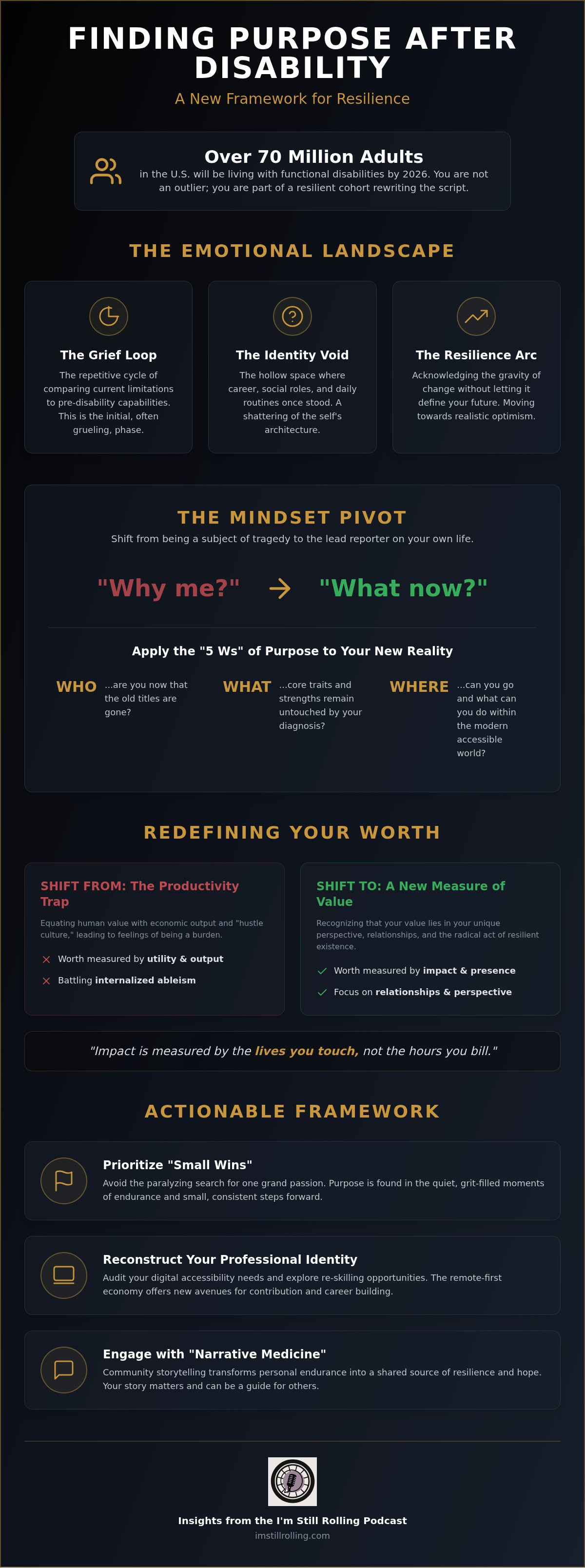
The most persistent myth about finding purpose after disability is that you must somehow "recover" your old self to lead a meaningful life. In reality, the path forward isn't a return to the past; it's a rigorous investigation into a new, uncharted territory. When your professional identity dissolves and the "grief loop" of comparison begins, it's easy to feel like the story has ended. With over 70 million adults in the U.S. living with functional disabilities in 2026, you aren't an outlier. You're part of a massive, resilient cohort learning to rewrite the script.
You likely feel the heavy weight of being a burden or the sting of a career left behind. We understand this because we've lived it and reported on it. This guide promises to help you navigate these profound identity shifts by applying a journalistic lens to your own resilience. We'll walk through a structured framework for mental endurance, provide actionable steps to uncover new passions, and introduce you to the I'm Still Rolling Podcast where these "second act" stories serve as a living library for your own transformation.
Table of Contents
The Emotional Landscape: Navigating Identity Loss After Disability
When a life-altering injury or diagnosis occurs, it doesn't just damage the body; it often shatters the architecture of the self. This "Identity Void" is the silent, hollow space where your career, social roles, and daily routines once stood. For many, the initial months are characterized by a "Grief Loop," a repetitive cycle of comparing current limitations to pre-disability capabilities. Breaking this cycle requires moving toward a "Resilience Arc," where you acknowledge the gravity of the change without letting it define the entirety of your future. Finding purpose after disability isn't about ignoring this messiness; it's about surviving it with realistic optimism.
The first six months are often the most grueling. During this window, purpose doesn't arrive in a straight line or a sudden epiphany. It's found in the quiet, grit-filled moments of endurance. Understanding the different models of disability can help frame this experience. While the medical model focuses on what's "broken," the social model reminds us that much of our struggle stems from a world built for a narrow range of bodies. This shift in perspective is the first step in reclaiming your narrative from a world that often views disability as a tragedy rather than a transition.
Mourning the 'Old Self' Without Getting Stuck
True healing requires you to treat your pre-disability life as a completed chapter rather than a lost book. You aren't a broken version of who you were; you're a new character in a continuing story. Some find peace through "ceremonial letting go," such as writing a letter to their former professional self or safely storing old gear that no longer serves them. These acts aren't about forgetting; they're about creating space for what comes next. Identity is a fluid narrative rather than a fixed state.
The Productivity Trap: Why Your Worth Isn't Your Output
Our culture often equates human value with economic output. This "Hustle Culture" makes the transition to disability feel like a moral failure. You might find yourself battling internalized ableism, that quiet voice suggesting you're a burden because you aren't "producing" at your previous rate. Reframing your worth is essential for finding purpose after disability. Shift your focus from "utility" to "impact" and "presence." Your value lies in the depth of your relationships, the unique perspective you offer, and the simple, radical act of existing in a world that requires your resilience. Impact is measured by the lives you touch, not the hours you bill.
The Journalistic Approach: Investigating Your New Reality
Mike Sugerman and Janice Wright spent decades in high-pressure newsrooms, developing a sharp eye for the "lead," that most critical part of any story. When disability entered their lives, they didn't leave those skills at the hospital door. Instead, they applied the same journalistic rigor to their own recovery, treating their new lives as an unfolding human interest piece. This investigative mindset is a powerful tool for finding purpose after disability because it forces you to look at the facts of your situation with unblinking honesty, while still hunting for the story that hasn't been told yet.
To begin this investigation, you must apply the "5 Ws" of purpose to your current state. Ask yourself: Who are you now that the old titles are gone? What core traits remain untouched by your diagnosis? Where can you go within the landscape of the 2026 accessible world? When you approach your life this way, you begin to fact-check your fears. You learn to separate the "hard news" of a medical reality from the "catastrophic editorializing" that suggests your life is over. When exploring the link between disability and purpose, it's clear that this investigative process is what bridges the gap between profound loss and a resilient second act.
Asking the Right Questions
The pivot from "Why me?" to "What now?" is the most important deadline you'll ever meet. It marks the transition from being a passive subject of a tragedy to being the lead reporter on your own life. By "interviewing" your new self, you can discover dormant strengths that were previously overshadowed by a busy career. You might find that your ability to manage complex medical schedules is actually a high-level project management skill in disguise. You can hear how others have navigated these interviews by listening to the I'm Still Rolling Podcast, where every episode is a deep-dive into these personal investigations.
Finding the 'Lead': Identifying Your Core Resilience
Every great story has a central theme, and your life is no different. Your "lead" is the one thing about your spirit that remains unchanged, whether it's your wit, your curiosity, or your stubbornness. Mining your past for "transferable resilience" allows you to take the grit you used in your old career and apply it to your current rehabilitation. Your trauma doesn't just change your body; it becomes a lens through which you can develop a deeper, more nuanced empathy for the human condition. This empathy often becomes the foundation for finding purpose after disability, as you realize your story has the power to guide others through their own dark chapters.
Redefining 'Purpose' in a Modern, Accessible World
The search for a grand, singular "calling" often creates a paralyzing pressure that stalls progress before it begins. We're conditioned to believe that purpose must be a massive, life-altering mission, but for those finding purpose after disability, that expectation can feel like just another mountain to climb. Real meaning is frequently found in the "Small Wins" framework. This isn't about lowering your standards; it's about acknowledging that micro-achievements are the essential bedrock of a sustainable second act. On the I'm Still Rolling Podcast, guests often share how they redefined "winning" not as a return to their former output, but as the mastery of a new, complex daily reality.
Central to this redefinition is a shift in perspective toward the social model of disability. This framework suggests that your body isn't the problem; the problem is an environment that fails to account for your needs. In 2026, as we see public entities finally meeting the April 24 deadline for WCAG 2.1 Level AA compliance, the digital world is becoming more inclusive. Recognizing that external barriers are the true obstacles allows you to stop blaming yourself for limitations and start investigating ways to navigate around them. Purpose thrives when you stop fighting your biology and start engaging with a world that is slowly, but surely, learning to accommodate you.
The Power of Incremental Meaning
Setting low-stakes goals is a vital strategy for rebuilding shattered confidence. These aren't "participation trophies" but rather calculated steps toward a larger narrative. You might find that "being" is just as purposeful as "doing." In a world obsessed with productivity, the simple act of maintaining a presence or engaging in creative expression becomes a radical form of resilience. Whether through digital art, writing, or exploring AI-powered mobility tools like the Glide Intelligent Guide, 2026 offers more avenues for self-actualization than ever before. These outlets provide a way to process the messy parts of your journey while creating something of value for others.
Advocacy as a Purpose-Driver
Many individuals find that their most profound sense of meaning comes from the transition from patient to mentor. When you help someone else navigate a complex system or provide the "insider's guide" to a specific challenge, you create a virtuous cycle of meaning. This shift allows you to view your own hardships as a form of expertise. By engaging with Disability Rights and Journalism, you can see how reporting on these systemic issues turns personal endurance into a tool for social change. Advocacy isn't just about politics; it's about ensuring that the person coming after you doesn't have to fight the same battles alone. This connection to a larger community provides a steady, reliable pulse of purpose that transcends individual struggle, proving that finding purpose after disability is often a collective endeavor.
Practical Strategies for Reconstructing Your Life
Reconstructing a life requires more than just a mindset shift; it demands a tactical audit of your environment and your tools. The first step involves a comprehensive evaluation of your physical and digital accessibility needs. As of June 2026, the employment-to-population ratio for people with disabilities stands at 38.0%, compared to 74.8% for those without. This gap is significant, but it highlights the necessity of re-skilling for a remote-first economy that finally values flexibility. By optimizing your resume for AI-driven hiring processes and mastering digital tools that meet the latest WCAG standards, you position yourself to reclaim professional agency. This methodical approach is the groundwork for finding purpose after disability in a world that is increasingly, though imperfectly, digital.
Leveraging 2026 Adaptive Technology
Technology in 2026 has moved beyond simple utility into the realm of true empowerment. Neural earbuds now allow for hands-free device control, while AI-powered mobility tools like the Glide Intelligent Guide provide a level of independence that was once purely speculative. For those whose physical travel is limited, virtual reality (VR) offers more than just entertainment; it provides a platform for social connection and immersive "travel" that can mitigate the isolation of rehabilitation. Smart home automation in the kitchen and office further reduces the daily "friction" of disability, allowing you to spend your limited energy on creative and meaningful pursuits rather than basic survival.
Building Your Resilience Circle
You cannot investigate your new life in a vacuum. Curating a "Resilience Circle" means identifying the people who act as builders rather than energy vampires. Builders are those who acknowledge your reality without pity, while vampires often dwell on the "loss" of your pre-disability self. Peer support groups and podcast communities are essential here, offering a space where your experiences are validated by those who truly "get it." Learning to ask for help isn't a surrender of agency; it's a strategic delegation that allows you to focus on your recovery and growth. To see how others have built these teams, you can browse our full library of podcast episodes for real-world examples of community-driven resilience.
Finally, integrate "Purpose Blocks" into your weekly routine. These are non-negotiable periods dedicated to your new interests, whether that's learning a new digital skill, engaging in advocacy, or simply reflecting on your progress. Finding purpose after disability is a marathon, not a sprint. By scheduling these blocks, you ensure that your evolution remains a priority rather than an afterthought. This disciplined pacing mirrors the unhurried, deep-dive approach required to truly understand and write your second act.
The Role of Narrative: Why Your Story Matters
The final stage of reclaiming your life involves a shift from being the subject of a medical report to becoming the author of your own biography. In clinical circles, this is often called "narrative medicine," the practice of using storytelling to process trauma and reconstruct a sense of self. When you document your journey, you aren't just venting or recording events; you're performing a vital investigative act. You're taking the raw, often painful facts of your diagnosis and weaving them into a coherent story that has a future. This narrative reclamation is the final, essential stage of finding purpose after disability, as it allows you to move your personal genre from a "Tragedy" to a "Quest."
The I'm Still Rolling Podcast's philosophy is built on the belief that honest, unflinching conversations have the power to change lives. Mike Sugerman and Janice Wright have spent their careers reporting on the world, but their most impactful work has come from reporting on their own resilience. By sharing the "messy" parts of their transition, they provide a roadmap for others to do the same. Whether you choose to document your journey through a private journal, a public blog, or a podcast, the act of externalizing your experience prevents it from becoming a weight that pulls you under. It turns your endurance into an asset that can be shared, analyzed, and used to build a new foundation.
Reframing Your Narrative Arc
Every compelling story requires a "messy middle," the period where the protagonist faces their greatest challenges and begins to adapt. If you're currently in this phase, remember that this is the part of your story that will eventually offer the most value to others. By identifying the "Hero's Journey" elements in your recovery, you can start to see your current struggles as the necessary trials that precede a transformation. Narrative resilience is the ability to edit your future while honoring the unchangeable facts of your past. This mindset ensures that while your physical circumstances may have changed, your role as the protagonist remains absolute.
Joining the Conversation
You don't have to write this new chapter in isolation. Listening to the stories of others provides what psychologists call "vicarious resilience," a phenomenon where witnessing another person's endurance strengthens your own. The I'm Still Rolling Podcast acts as a living library of these second acts, offering a space where professional reporting meets raw vulnerability. Contributing your own story to this community, whether through a comment or a shared post, solidifies your new identity as an advocate and a peer. To stay connected with this growing community and find ongoing inspiration for finding purpose after disability, you can subscribe to the I'm Still Rolling Podcast Newsletter for more stories of grit. Your story is still being written, and the most important chapters are the ones you choose to author today.
Writing Your Next Chapter with Realistic Optimism
The transition from a sense of loss to a life of renewed meaning requires a fundamental shift in how you report on your own existence. By treating your recovery as an unfolding investigative story, you move beyond the repetitive loop of grief and into a space where small wins and 2026 adaptive tools create a tangible path forward. Finding purpose after disability is less about recovering a lost version of yourself and more about authoring a resilient second act that honors your endurance. You've learned to audit your digital needs, leverage modern technology, and reframe your trauma as a quest rather than a tragedy.
You don't have to navigate this investigative process alone. On the I'm Still Rolling Podcast, award-winning journalists Mike Sugerman and Janice Wright blend professional rigor with raw, honest storytelling to create a living library of resilience. Join a global community of survivors and caregivers who are documenting their journeys and reclaiming their voices. Listen to real stories of resilience on the I'm Still Rolling Podcast to find the vicarious resilience that fuels your own transformation. The story isn't over; the lead is just changing, and the most compelling chapters are yet to be written.
Frequently Asked Questions
How long does it take to find purpose after a life-changing disability?
There is no fixed deadline for this transition; it is an iterative process rather than a final destination. Many survivors find that the first six months are occupied entirely by physical survival and the "grief loop" of comparison. Reconstructing a deeper sense of meaning often takes years of consistent, small wins and the slow editing of your personal narrative. It is a marathon of adaptation where purpose is frequently discovered in the endurance itself.
Can I still have a meaningful career if I can no longer work in my previous field?
You can certainly build a significant second act in the 2026 remote-first economy, which increasingly values impact over physical output. With the May 2026 labor force participation rate for people with disabilities at 42.0%, more individuals are finding purpose after disability by translating their professional grit into digital, creative, or advocacy-based roles. Your worth is not defined by your previous job title, but by the unique perspective and resilience you bring to new challenges.
Is it normal to feel angry or hopeless even years after a diagnosis?
Chronic grief is a natural, recurring response to a life-altering event, and these emotions often resurface during significant milestones or setbacks. Feeling hopeless years later doesn't mean you've failed at your recovery; it simply means you're human. Acknowledging these messy periods with realistic optimism is a key part of maintaining long-term mental endurance and moving through the difficult chapters of your story.
How do I explain my new identity and purpose to friends and family?
Approach these conversations with the same honesty a reporter uses to deliver a complex story. Frame your journey as a "Quest" rather than a "Tragedy," explaining that while your tools and routines have changed, your core spirit remains the lead character. Clear, unflinching communication helps loved ones move from a place of pity to a position of partnership in your new reality.
What are the best resources for someone feeling isolated by their disability?
Peer-led communities and digital "living libraries" are the most effective tools for breaking the silence of isolation. Engaging with podcast communities or specialized advocacy groups provides the vicarious resilience needed to realize your experience is part of a larger, shared narrative. Connection to a community that truly understands your daily reality acts as the primary antidote to the hollow space of the identity void.
Can adaptive technology really help me find a new purpose?
Adaptive technology acts as a vital bridge that bypasses physical barriers to enable self-actualization. In 2026, tools like AI-powered mobility guides and neural earbuds for device control allow you to engage with work, art, and social circles in ways that were once purely speculative. Technology doesn't provide the purpose itself, but it provides the essential access required to discover and pursue it.
How does the I'm Still Rolling podcast help with the emotional impact of disability?
The podcast offers a structured space for narrative medicine, where journalistic rigor meets raw, lived intimacy. By listening to the "second act" stories of other survivors and caregivers, you gain practical strategies for mental resilience and a sense of belonging. It serves as a steady, reliable pulse of hope, demonstrating that a life of meaning is possible even after a profound diagnosis.
What should I do if I feel like I've lost my identity entirely?
Start with a methodical investigation of what remains untouched by your diagnosis. Treat your pre-disability life as a completed chapter and begin "interviewing" your new self to discover dormant strengths and interests. Finding purpose after disability starts with the radical acceptance that while your old roles may be gone, your capacity for meaning is an inherent and unchangeable part of your human condition.


Comments