Finding Community After a Diagnosis: A Gentle, Practical Guide
What if finding community after a diagnosis didn’t mean joining a group, telling your story, or feeling hopeful before you’re ready? When family and friends care but can’t quite understand, the distance can feel especially sharp. Wanting connection doesn’t mean you owe anyone the full story, or that there’s one right way to respond.
Support can take different shapes: an in-person group, an online space, a one-to-one conversation, or simply listening to someone describe an experience that feels familiar. You can explore without committing, share only what feels comfortable, and step away from spaces that don’t feel right. There’s no deadline for finding your people.
This guide offers gentle, practical ways to look for connection at your own pace, weigh different kinds of communities, and notice whether a space feels respectful and safe for you. It also considers how lived-experience stories, including conversations on the I'm Still Rolling Podcast, can offer a low-pressure sense of accompaniment while you search for direct support. The aim isn’t to tell you how to feel. It’s to help you feel a little less alone, on your terms.
Key Takeaways
Finding community after a diagnosis can include more than joining a support group; consider the people and spaces where you feel understood.
Make your search more focused by combining your diagnosis with details like life stage, identity, location, or a particular concern.
A community may be a better fit when it respects your boundaries and makes room for different reactions, without demanding optimism or personal disclosure.
Build connection in small steps: identify what you need, choose a format, explore, try one interaction, and reflect before deciding what comes next.
As your circumstances change, revisit the kind of support that feels useful and try simple ways to stay connected with people who matter.
Table of Contents
Why finding community after a diagnosis can feel difficult
A diagnosis can alter more than routines and appointments. It may change how you picture the future, what you have energy for, or which parts of your life feel easy to explain. The people around you may still be loving and familiar, while conversations begin to carry new weight. You might want someone who understands without a long explanation; you might also want to keep the news private for now. Both responses are valid.
Community is a network of connection, not one required group. It can include friends, family, peers with related experiences, online spaces, or someone who simply makes room for an honest conversation. Finding community after a diagnosis is personal: there’s no correct level of closeness, disclosure, or participation. Connection can be meaningful without becoming another commitment to manage.
Why familiar relationships may feel different
Loved ones can care deeply and still not know what this experience is like from the inside. They may offer advice or reassurance because they want to help; you may need listening, practical support, distraction, or quiet instead. Even silence can be hard to interpret, though it doesn’t always mean someone has stopped caring.
Reactions differ. You may welcome conversation one day and prefer ordinary routines the next. You don’t have to label that as loneliness or explain it before you’re ready. Sometimes a small, specific request helps, such as, “Could you listen without trying to solve it?” or “I’d rather talk about something else today.”
What community can look like after a diagnosis
Peer connection offers the possibility of being heard by people with relevant lived experience. That experience doesn’t have to match yours exactly: someone with a different diagnosis may understand the uncertainty, adjustment, or frustration, even if their circumstances are not identical. Online health communities are one way people connect and exchange perspectives across distance.
Community can also be a friend who checks in, a family member who helps with an everyday task, or a small group where you can listen before speaking. These forms of connection serve different needs. Practical help can ease a task; friendship can offer familiarity; peer support can bring shared perspective. Professional care is distinct from all three and has its own role.
Stories shared by people with lived experience can be another gentle point of contact. For instance, I’m Still Rolling features conversations about disability, caregiving, resilience, and life after adversity, available in audio, video, and transcript formats. Listening or reading can help you encounter different perspectives privately, without replacing direct connection or individual care. You don’t need the same story or outlook to feel accompanied by someone else’s honesty.
Where to look for community after a diagnosis
Once you have a sense of what kind of connection you’re seeking, think about where it might be easiest to find. A useful search doesn’t have to stop at the name of a diagnosis. Adding details about your life or what you’re navigating can bring up spaces that feel more relevant, whether you’re looking for practical understanding, conversation, or simply the option to listen.
Condition-specific groups: Hospitals, established health organizations, or community nonprofits may share information about groups for people with a particular diagnosis or concern.
Broader peer spaces: General chronic illness or disability communities may bring together people with different diagnoses who share experiences of adjustment, access, or uncertainty.
Local gatherings: Community organizations, libraries, or other local venues may host in-person meetups, peer groups, or informal social activities.
Online forums and groups: Digital spaces can connect people across locations and schedules, with some centered on a diagnosis and others on a life stage or shared concern.
A clinician familiar with your care or an established organization can be one starting point for group referrals. For example, The Center for Chronic Illness offers virtual support groups and educational events for people affected by chronic illness. A referral is a lead, not an obligation; you can explore what’s available and decide whether it suits you.
Choosing between in-person and online spaces
Consider the practical fit as well as the subject. An in-person gathering may offer the ease of shared time in a physical space, but travel, scheduling, and accessibility can affect whether attending feels manageable. Online spaces can reduce those barriers and may let you read quietly before participating. Think, too, about privacy and the kind of interaction you prefer: live conversation, written messages, or listening without speaking.
Searching for people with relevant lived experience
Try pairing a diagnosis or concern with a detail that reflects your circumstances: age group, treatment stage, caregiving role, identity, location, or a life change you’re facing. For instance, “young adults with [diagnosis]” or “[diagnosis] peer group near me” may lead to different options than a broad search. Look for spaces that welcome varied identities and experiences, rather than suggesting everyone should respond in the same way.
Before joining, you can read a group’s description or guidelines to understand its focus and expectations. If it seems promising, choose a small first step: attend once, observe quietly, or introduce yourself without sharing more than you want. Finding community after a diagnosis can begin with exploration, not a commitment. If hearing how others describe life after adversity feels like a gentle way to start, lived-experience conversations can offer perspective while you explore direct connections.
How to tell whether a community feels right for you
A group can be well-intentioned and still not meet your needs. Belonging doesn’t require constant attendance, a hopeful attitude, or a complete account of what you’ve been through. A supportive space should allow people to participate at their own pace, whether that means speaking, listening, or coming and going as circumstances change.
Notice how the group responds to difference. Do people make room for uncertainty, anger, humor, quiet, and hope without insisting that everyone follow the same path? Are boundaries treated as ordinary rather than as a problem to overcome? These small signals can tell you more about the space than a polished description can.
There can be drawbacks, too. A group’s focus may not match what you’re looking for, sharing may feel emotionally tiring, or other members may offer advice when you wanted understanding. That doesn’t make you ungrateful or mean that community isn’t for you. It may simply be a mismatch in timing, format, or expectations. Finding community after a diagnosis can include learning what doesn’t fit, not just searching for the perfect place.
Questions to consider before joining
Before you attend, consider what you hope to receive: a chance to listen, shared experience, practical conversation, or the possibility of friendship. Then look at the group’s purpose, format, privacy practices, and expectations for participation. A space that asks for personal details upfront may feel different from one where newcomers can observe. If permitted, try one visit or read the guidelines before deciding whether to take part.
Setting boundaries without withdrawing completely
You can make connection more manageable by deciding what you’re comfortable with in advance. You might listen without speaking, leave before the meeting ends, or decline questions about personal details. A simple response such as “I’d rather listen today” can be enough. You don’t owe the group a fuller explanation.
Afterward, notice how you feel. Did you feel respected, even if the conversation was difficult? Or did you leave feeling pressured, exposed, or drained? One meeting isn’t always a complete picture, but your reaction is useful information. You can take a break, adjust how much you participate, or try a different group. Choosing distance from one space doesn’t mean withdrawing from every possibility of connection.
If joining a conversation feels like too much for now, hearing how others describe their experiences can be a quieter way to encounter different perspectives. You can listen to I'm Still Rolling podcast episodes at your own pace. These lived-experience stories can offer a sense of accompaniment as you consider what kind of direct connection, if any, feels right.
A step-by-step way to build connection at your own pace
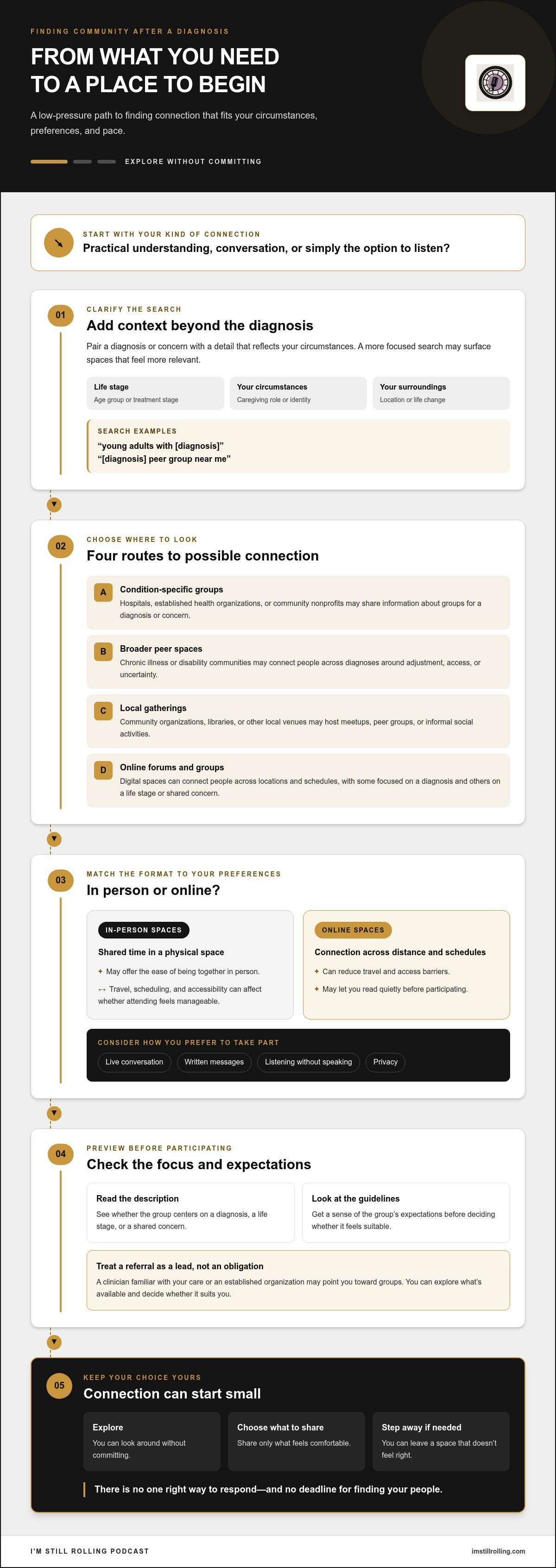
Connection doesn’t have to begin with a big introduction or a promise to keep showing up. Treat the steps below as options, not a test you have to complete. You can pause, skip ahead, or change direction whenever your energy or circumstances call for it. A first attempt is simply a way to learn what feels possible.
Name one need. Ask yourself what would help right now: being heard, learning from people with relevant experience, talking through practical concerns, or spending time with others without focusing on your diagnosis. One need is enough to guide a first search.
Choose a format. Consider whether a written space, one-to-one conversation, virtual meeting, or in-person gathering feels manageable. Factor in energy, schedule, privacy, and how much interaction you want. You’re choosing a starting point, not a permanent arrangement.
Explore one space. Read the group’s description and guidelines, look at how it works, or ask an organizer what a first visit involves. You might simply save the information and return to it later. Gathering details can be a step in itself.
Try one interaction. Attend a meeting, read posts, or message one person with a small question. You can decide in advance what you’re comfortable sharing. For example, “I’m new here and mostly hoping to listen” sets a clear expectation without requiring your full story.
Reflect before deciding. Afterward, take a moment to notice what felt easy, awkward, interesting, or tiring. One uncomfortable exchange doesn’t prove every community will feel the same. It may reflect that particular person, group, or day.
Start with one need and one small action
A specific need can make the search feel less sprawling. If you want to learn from peers, you might read a group’s guidelines before joining. If you want company, you could ask about the format of a gathering or invite one person for a brief conversation. Keep the first move small enough to feel doable, and note what you felt comfortable with afterward. There’s no requirement to turn one contact into an ongoing commitment.
Review, adjust, and keep support varied
Notice whether you felt respected, understood, pressured, or depleted. Your response can help you decide whether to return, adjust your participation, or try another kind of connection. A support network doesn’t have to come from one place: different people may be right for conversation, practical help, shared perspective, or a welcome distraction. For another perspective on connection alongside adversity, explore stories of recovery and hope.
If listening feels like a useful first step, explore I'm Still Rolling podcast episodes for lived-experience stories about resilience, disability, caregiving, and life after adversity. They can offer perspective as you consider what direct connection might look like for you.
Keep meaningful connection in your life after a diagnosis
Connection isn’t something you find once and then have to maintain in the same way forever. Treatment, recovery, caregiving, energy, work, and other parts of life can shift what feels possible. At one point you may want regular conversation; later, a quiet check-in may be enough. Changing what you need doesn’t erase the value of earlier relationships or mean you’ve failed to keep them.
Rather than waiting for someone to guess what would help, try making a small, specific request. A clear invitation can make connection easier for both of you, especially when your capacity varies. For example, you might say:
“Could we check in by text now and then? I may not always have energy for a call.”
“I’d like company, but I don’t want to talk about my diagnosis today.”
“Would you be able to help with one errand this week?”
These are starting points, not scripts you have to use. If making a request feels difficult, a short message such as “I’m thinking of you, even if I’m quiet lately” can keep a thread of contact without promising more than you can give.
Let relationships change as your needs change
Some relationships may grow closer; others may become quieter or take a different shape. That can happen without anyone being at fault. If contact feels like too much, you can let someone know you need space and that you’ll reach out when you can. If you’re ready for more, suggest a manageable routine, such as a brief call or a message on a day that tends to work for you. Leave room to adjust it.
Find perspective in other people's stories
First-person stories can bring you into contact with experiences beyond your own. They may offer language for something you’ve struggled to explain, or simply make room for another person’s perspective. Stories are not a substitute for direct peer connection, practical help, or professional care, but they can be a quiet companion alongside those forms of support.
I’m Still Rolling shares honest conversations about resilience, disability, caregiving, and life after adversity. You can engage with episodes through audio, video, or written transcripts, choosing a format that fits your attention and energy. Listening or reading doesn’t require you to respond or disclose anything; it can be a way to encounter someone else’s story on your own terms.
Finding community after a diagnosis may be less about building a large circle than keeping one or two meaningful points of connection within reach. A short exchange can matter. So can a pause, a changed routine, or a new relationship that takes time to develop. If you’d like to spend time with lived-experience stories, explore I'm Still Rolling for honest conversations about life after adversity.
Let the next connection begin small
You don’t have to know what your support circle will look like months from now. Let it take shape in response to the life you’re living today. A single conversation, a quiet moment with someone else’s story, or a message sent when you have the energy can be a meaningful beginning. Finding community after a diagnosis isn’t a promise that every encounter will fit; it’s permission to keep noticing what feels steady, respectful, and human.
If you’d like a companion perspective as you consider your next step, I’m Still Rolling shares honest conversations hosted by seasoned journalists Mike Sugerman and Janice Wright. Episodes are available in audio, video, and written transcript formats, so you can choose how to engage. These stories can sit alongside direct connection, not replace it.
Explore honest stories and conversations from I'm Still Rolling, and take from them whatever feels useful today. Connection can begin quietly, and a small beginning still matters.
Frequently Asked Questions
Is it normal to feel lonely after a diagnosis even when people are around?
Yes, you can feel lonely even when people care about you and are physically present. A diagnosis may bring experiences that are difficult to describe, or make everyday conversations feel out of step with what’s on your mind. That feeling doesn’t mean you’re ungrateful or that your relationships have failed. You might start by telling one trusted person what kind of company would feel good, even if you don’t want to discuss the diagnosis.
Can I join a support group if I am not ready to talk about my diagnosis?
Often, yes, though each group sets its own expectations. Some allow newcomers to listen without speaking; others may invite introductions or discussion. Before attending, read the group description or ask its organizer how participation works. You can also prepare a brief response, such as, “I’m here to listen today.” If the group expects more sharing than feels comfortable, it’s okay to decide it isn’t the right setting for now.
How can I support someone after a diagnosis without giving unwanted advice?
Ask what would help before offering solutions. You could say, “Would you like me to listen, help with something practical, or give you space?” Then follow their answer, even if it’s different from what you’d want in their position. Instead of saying, “You should try…,” consider, “I’m here if you want to talk.” A specific offer, such as bringing dinner on a particular day, can be easier to respond to than “Let me know if you need anything.”
Can an online community provide meaningful connection after a diagnosis?
Yes, an online community can offer meaningful connection, particularly if travel, energy, distance, or scheduling makes meeting in person difficult. Finding community after a diagnosis might include reading conversations quietly, asking one focused question, or connecting with someone whose experience resonates. Online interaction can’t provide every kind of support, and the quality of spaces varies. Notice whether members treat one another respectfully and whether the group’s conversations leave you feeling informed, understood, or overwhelmed.
What should I do if a diagnosis-specific group makes me feel worse?
Give yourself permission to step back. A group may bring up difficult feelings, focus on experiences that don’t match yours, or offer advice you didn’t ask for. You can leave a meeting, mute or exit an online space, or take time to consider what felt hard. If the reaction lingers or feels difficult to manage, consider discussing it with someone you trust or a qualified health professional. One group’s impact doesn’t define every possible source of connection.
Do I need to find a community made up of people with the same diagnosis?
No. A shared diagnosis can make certain conversations easier, but it isn’t a requirement for feeling understood. Someone with a different condition may relate to changes in identity, uncertainty, access needs, or the strain of explaining what you’re going through. You might also find connection through a friend, family member, or community organized around a shared life circumstance. Look for the kind of understanding you want, not a perfect match in every detail.


Comments