Financial Stress of Caregiving: 2026 Planning Guide
What if the biggest cost of caregiving isn’t the bill you can see, but income and future security quietly slipping out of reach? The financial stress of caregiving can build through grocery runs, transportation, supplies, and missed work, making the full impact difficult to grasp. And when money is tied to someone you love, even starting the conversation can feel uncomfortable.
You don’t need to solve everything at once to make a steadier plan. A clearer picture of what caregiving costs, and how it affects your earnings and savings, can help you decide what to address first and which questions to bring to trusted support.
This 2026 guide covers direct household expenses and less visible effects, such as reduced hours or career opportunities. You’ll find a practical way to gather the numbers, consider how family responsibilities are shared, and identify questions to explore with benefits, financial, or community resources. The goal isn’t a perfect forecast. It’s a useful starting point for decisions that can otherwise feel overwhelming.
Table of Contents
Financial stress of caregiving: what it includes and why it can be hard to see
How to start financial planning for caregivers with a clear household picture
Compare caregiving expenses, income changes, and possible sources of support
How to discuss caregiving finances and make a realistic plan
Financial planning for caregivers: choose one next step and keep adjusting
Financial stress of caregiving: what it includes and why it can be hard to see
You can love someone deeply and still feel anxious about what caring for them is doing to your finances. Neither feeling cancels out the other. The strain can be hard to recognize because it rarely arrives as one clear bill. It builds through everyday spending, changes to work, and decisions about what the household can save or postpone.
Caregiver financial strain is the combined effect of care-related spending, changes in earnings or work, and financial trade-offs that may affect future security. This broad view reflects the idea of caregiver burden, which can include financial, physical, and emotional pressures. It isn’t a judgment about how well someone is coping. It’s a way to see what caregiving is asking of a household.
Which caregiving costs belong in a financial snapshot?
Look beyond formal care bills. Note travel to appointments, parking or transit, supplies, extra meals, and changes to household routines, such as more frequent grocery trips or deliveries. Include costs you pay directly and expenses shared with relatives.
Separate expenses into two simple groups:
Recurring: predictable monthly spending, such as regular transportation or supplies.
Irregular: occasional costs, such as a home adjustment or an unexpected trip, which may call for a reserve if your household can manage one.
For each shared expense, note who paid and whether anyone contributed. The purpose is to make the flow of money visible, not to assign blame or decide what each person “should” have done.
How caregiving can affect income beyond direct spending
Care can reshape the workday. Reduced hours, unpaid leave, turning down a shift, or passing on an opportunity may lower current income even when there’s no caregiving expense to show on a receipt. The effects vary, so record what has changed in your household rather than assuming a particular impact.
There may be longer-term effects, too. If earnings fall or work pauses, contributions to savings or retirement accounts might also change. That won’t apply to everyone, and the impact depends on individual circumstances. Still, noting a change can help you raise a specific question with an appropriate benefits or financial resource.
Start with a manageable period, such as the past month, and use statements, receipts, or a few written notes. A rough but honest snapshot is more useful than waiting until every detail is perfect.
How to start financial planning for caregivers with a clear household picture
A useful plan doesn’t begin with a perfect spreadsheet. It begins with a view of what’s coming in, what’s going out, and where care is changing the household’s choices. A simple snapshot can make financial stress of caregiving easier to discuss and help you decide what needs attention first. It’s a planning tool, not a prediction or a substitute for individualized financial advice.
Build a simple caregiving budget without getting lost in details
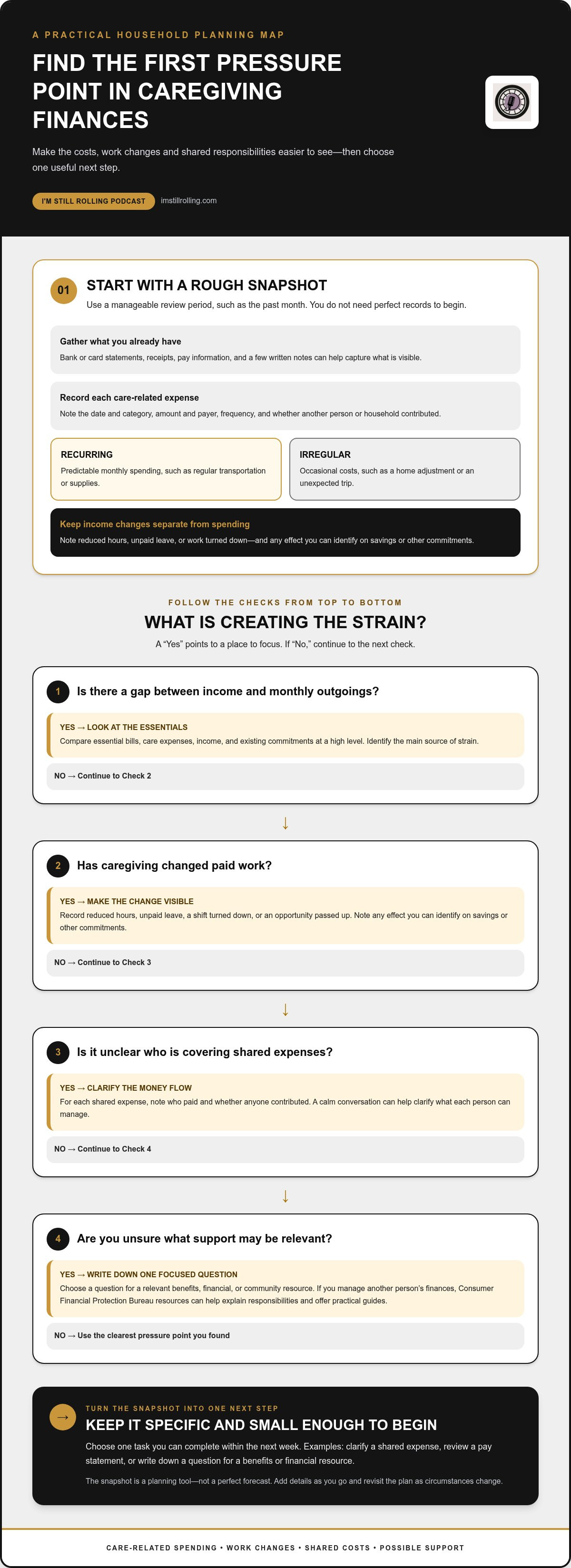
Start with a manageable review period, such as the last month. Gather records you already have, including bank or card statements, receipts, and pay information. Don’t try to reconstruct every past expense. Capture what’s visible and add details as you go.
For each care-related expense, use a worksheet with these columns:
Date and category: When it happened and what it was for.
Amount and payer: What was spent and who paid.
Frequency: Whether it’s recurring, occasional, or one-time.
Shared: Whether another person or household contributed.
Keep income changes separate from spending. Note reduced hours, unpaid leave, or work turned down, along with any effect you can identify on savings or other commitments. This distinction matters: an expense record shows the cost of a purchase, while a separate income record reveals what caregiving may be changing at work.
Find the first pressure point to address
Compare essential bills, care expenses, income, and existing commitments at a high level. You don’t need to audit every account. Look for the main source of strain. Is there a gap between income and monthly outgoings, less time for paid work, uncertainty about who is covering shared expenses, or a lack of clarity about what support may be relevant?
Choose one follow-up task you can complete within the next week. You might clarify a shared expense with a family member, review a pay statement, or write down a question for a benefits or financial resource. Keep the task specific and small enough to begin.
If you manage another person’s finances, the Consumer Financial Protection Bureau’s financial planning for caregivers resources can help you understand responsibilities and find practical guides. Use your snapshot to prepare focused questions. It can make a conversation clearer, but it can’t determine what applies to your circumstances.
Money conversations can carry a lot of feeling. For a human perspective alongside the practical work, I'm Still Rolling Podcast shares caregiving stories through lived experiences of caregiving and adversity.
Compare caregiving expenses, income changes, and possible sources of support
To understand the financial stress of caregiving, look at spending and income side by side. A cost that seems manageable on its own may feel different when work hours have also changed or several relatives are contributing unevenly. This comparison can show where pressure is building without assuming every household has the same expenses or access to assistance.
Which caregiving expenses are immediate, recurring, or occasional?
Transportation, care supplies, and household adjustments are examples to consider, not costs every family will have. A recurring expense appears regularly, while a one-time or unpredictable cost may arise as needs change. For each item, note who currently pays and whether the arrangement feels sustainable.
Unpaid caregiving time can affect finances beyond the current month. Less time for paid work may also change future earnings, savings, or retirement contributions. The extent of that effect depends on a person’s circumstances, so track actual work changes rather than assuming a particular outcome.
What support options might caregivers investigate?
If relevant, review workplace leave and benefits information to understand what options may apply to your plan or circumstances. You can also explore government program information, insurance documents, and local community resources. Availability and eligibility vary by location, household circumstances, and program or policy terms. Treat these as avenues to investigate, not guaranteed funding or reimbursement.
Write down what you need to clarify, such as whether a benefit applies to your situation, what documentation may be needed, or whom to contact for an official explanation. For complex tax, legal, or financial questions, seek guidance from an appropriately qualified professional. A caregiving podcast can offer perspective and lived experience, but it can’t determine your eligibility or provide individualized professional advice.
How to discuss caregiving finances and make a realistic plan
Money conversations can stir up old family tensions alongside immediate concerns. A limit on what you can give doesn’t measure how much you love someone or the value of the care you provide. Naming a practical constraint isn’t selfish; it gives everyone a more honest basis for planning.
How can caregivers talk about money without feeling selfish?
If possible, choose a calm time to talk rather than starting in the middle of a stressful moment. Urgent needs may not wait, but a planned conversation can make space to listen and think. Focus on the shared concern and the facts, not on proving anyone’s character or commitment.
A simple sequence can help:
Name the concern: “I want us to talk about how care costs and responsibilities are affecting the household.”
Share the snapshot: “Here’s what I’ve been paying and how my work schedule has changed.”
Discuss capacity: “I can contribute this much time, but I can’t take on additional expenses right now.”
Agree on a review date: “Can we check in again after we’ve each looked at what’s manageable?”
Be specific about what you can offer financially, practically, and emotionally. A boundary might mean contributing a set amount, handling a particular task, or being unavailable at certain times. Others may have different capacities. The aim is to make those limits visible without blame or shame.
Turn a financial snapshot into a reviewable plan
A plan should be clear enough to revisit, but flexible enough to adapt when circumstances change. Choose a check-in interval that fits the pace of care and household finances. If needs or work arrangements shift often, review sooner; if things are steadier, a less frequent check-in may be workable. Agree on specific next steps only when the person taking each one has the time and capacity to do it.
For example, the family might agree that one person will clarify a shared expense, another will look into a workplace benefit, and everyone will revisit the arrangement on an agreed date. If a task remains undone, treat that as information about what’s realistic, not a reason to shame someone.
Caregiving for a spouse with Alzheimer’s can bring its own practical and emotional demands. The experience of other families can offer context for those challenges, and lived stories can help you feel less alone. Explore caregiving stories from I'm Still Rolling Podcast, featuring honest conversations about caregiving and life after adversity.
Financial planning for caregivers: choose one next step and keep adjusting
A caregiving plan isn’t a promise that the numbers will stay steady. Care needs can change, work arrangements can shift, and family members may have different capacities from one month to the next. The aim is to create a useful point of reference, then revisit it as life changes.
What to do when the numbers still do not add up
Separate what needs attention now from what calls for longer-term planning. An upcoming bill or a gap in this month’s cash flow may need a prompt response; questions about future savings or benefits may call for research and a conversation with a qualified professional. If the picture still feels unclear, write down what you know, what you don’t, and what you need to ask.
Bring those questions to an appropriate financial or benefits professional, especially before making decisions about debt, investments, insurance, or legal arrangements. Individual circumstances matter, and general information can’t tell you which strategy is right for your household.
Make room for the person behind the budget
Financial planning happens inside a relationship, often while people are tired, worried, or balancing competing responsibilities. Asking for help, whether that means sharing a task or seeking reliable information, is a practical response to a demanding situation. It isn’t proof that you’ve failed or care any less.
Keep the next step small enough to take. You might:
Update the household snapshot with the latest costs and work changes.
Write down one unanswered question about a bill, benefit, or shared expense.
Find a relevant source, such as an employer benefits contact, a government resource, or a qualified professional.
Set a date to review the plan again.
If the numbers don’t add up today, that’s information to work with, not a verdict on your care. Choose one manageable action, then return to the plan as circumstances evolve. I'm Still Rolling Podcast shares episodes and transcripts about caregiving, disability, and life after adversity. These stories offer human connection alongside, not in place of, professional financial guidance.
Take One Clear Step Toward a More Manageable Plan
The financial stress of caregiving can feel hard to untangle when expenses, work changes, and family responsibilities overlap. A simple household snapshot can make those pressures easier to see, while a short list of questions can guide conversations with relevant benefits, financial, or community resources.
Your plan doesn’t have to predict every change. Start with one practical next step, agree when to review it, and adjust as care needs and family capacity shift. Financial limits don’t diminish the care you give, and asking for support is a practical way to make room for what comes next.
Caregiving can also be a deeply human experience, shaped by uncertainty, resilience, and connection. Hosted by journalists Mike Sugerman and Janice Wright, the I'm Still Rolling Podcast features conversations about caregiving, disability, and life after adversity, with episodes available in audio, video, and written transcript formats. Explore honest stories of caregiving and resilience for a thoughtful perspective alongside your planning.
Frequently Asked Questions
How does caregiving create financial stress?
Caregiving can create financial stress through direct costs, such as travel or supplies, and less visible changes, including reduced work hours, unpaid leave, or missed career opportunities. The impact depends on the household and care situation. Start by listing expenses separately from income changes. This can help reveal whether the immediate pressure is spending, cash flow, work, or uncertainty about how responsibilities and costs are being shared.
How do I make a budget as a family caregiver?
Begin with a short record of care-related expenses, income changes, who pays each cost, and how often it occurs. Use receipts, bills, and statements you already have rather than trying to reconstruct every past expense. Review the snapshot to find one pressure point, then choose one next action. A caregiving budget is a planning aid, not a measure of how well you’re caring for someone.
Can caregivers get paid for providing care?
Whether you can receive payment for caregiving depends on your location, the care recipient’s circumstances, and the rules of a particular program or arrangement. Don’t assume payment is available or that a specific program applies. Explore relevant government, insurance, workplace, or community information for your situation. For complex financial or legal questions, seek qualified advice. Keep unpaid care and any paid arrangement distinct in your household plan.
What financial assistance is available to family caregivers?
Possible support may include workplace benefits, government programs, insurance, or community resources, but availability and eligibility vary. Start by identifying the need, such as leave, transportation, or help with care-related expenses. Then look for reliable information that addresses that need and your location. Confirm details with the relevant program or a qualified professional. Broad online claims aren’t proof that a particular benefit will apply to your circumstances.
How can I talk to my family about sharing caregiving costs?
Choose a time to share a simple snapshot of expenses, income changes, and practical responsibilities. Explain what you can manage and where you need help without treating the discussion as a test of anyone’s love or commitment. Ask what each person can realistically contribute, financially or through practical support. Agree on a next step and a time to revisit the arrangement, since family circumstances and capacity can change.
What should I do if caregiving is affecting my ability to work?
Record how caregiving is changing your schedule, income, or work responsibilities, then review workplace policies or benefits that may apply to your circumstances. If you’re considering a major employment or financial decision, seek advice suited to your situation before acting. Where possible, discuss care responsibilities with trusted family members. The goal is to understand the trade-offs and explore available options, not to assume every caregiver has the same choices.
How often should caregivers review their financial plan?
Review your plan when care needs, work arrangements, household contributions, or significant expenses change. If circumstances are relatively steady, choose a recurring check-in that feels manageable rather than creating a burdensome schedule. At each review, update the expense and income snapshot, revisit unanswered questions, and agree on one next action. A flexible plan that reflects current needs is more useful than a perfect document no one has time to maintain.



Comments