Family Long-Term Care Talks: How to Begin and Discuss
What if the first goal of a long-term-care conversation isn’t to choose a plan, but to understand what matters most to the person you love? It’s easy to worry that raising the subject will sound like a loss of independence, or that relatives will disagree about what should happen and when. Those fears can make family conversations about long term care feel daunting, especially when no immediate crisis is forcing the issue.
That hesitation makes sense. Care touches private hopes, changing needs, family roles, and the meaning of home. A loved one may resist help not because they don’t care about the future, but because the subject can feel like a decision has already been made. Starting with curiosity rather than answers makes room for a more honest exchange.
This article offers practical ways to open the conversation with respect, listen before discussing arrangements, and identify questions worth considering before a crisis. You’ll find ways to respond when emotions run high, make space for different perspectives, and agree on one small next step instead of ending with unresolved tension.
Table of Contents
Why family conversations about long-term care are easier before a crisis
A conversation about future care can sound like a forecast of loss: less independence, a changed home, or decisions no one feels ready to make. But raising the subject doesn’t mean predicting exactly what will happen. It gives the person at the centre of the discussion a chance to say what matters while there’s time to listen, reflect, and revisit the subject.
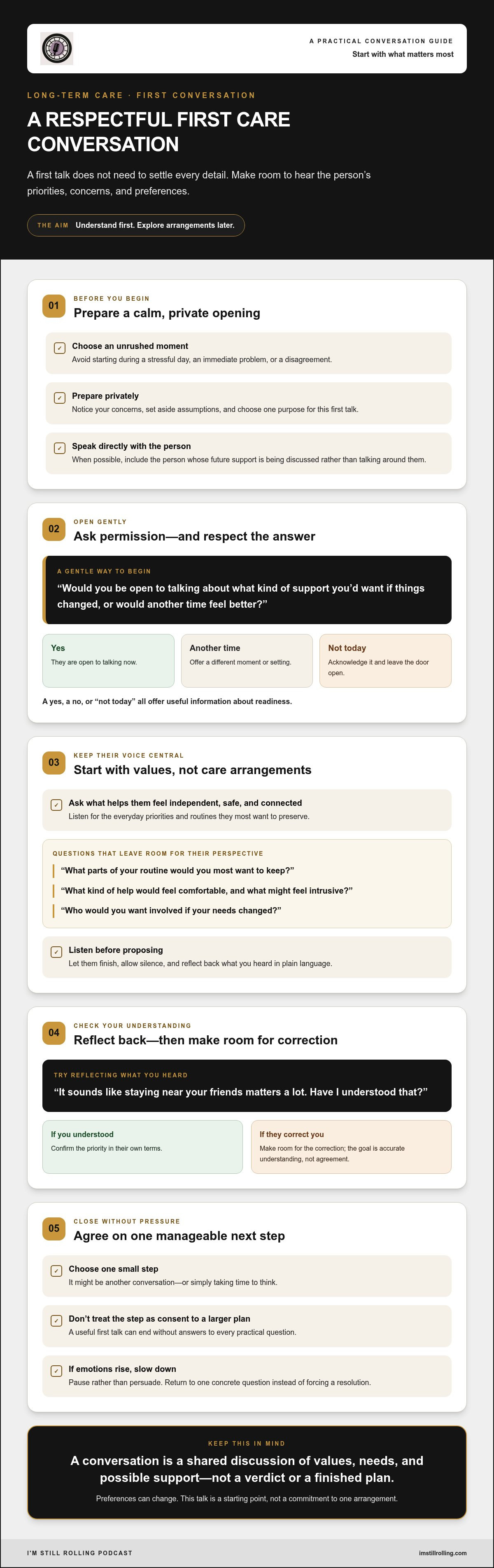
A family care conversation is a shared discussion of values, needs, and possible support. It isn’t a verdict or a finished plan. That distinction can ease the pressure on family conversations about long term care: the first talk can be useful even if the family leaves without answers to every practical question.
What long-term care can mean for a family
Long-term care refers broadly to ongoing support with everyday activities or health-related needs. That support might happen at home, through community services, or in a residential setting. It can include help with routines such as dressing or preparing meals, or more sustained assistance as a person’s needs change. Long-term care describes a range of support, not one destination; it isn’t another way of saying “nursing home.” For a general overview of understanding long-term care, remember that services and arrangements can take different forms.
One person may value remaining in familiar surroundings for as long as possible. Another may place greater importance on regular company or living closer to family. Preferences and needs can shift over time, so a conversation today doesn’t lock anyone into one arrangement. It creates a starting point: what feels important now, what causes concern, and what kinds of support might be worth exploring if circumstances change.
Why timing and emotional readiness matter
Families often postpone the subject because they fear upsetting a loved one, don’t know how to begin, or assume that talking about care means giving up control. Sometimes relatives disagree before the conversation has even started, each carrying a different picture of what help should look like. Avoiding the topic may feel gentler in the moment, but it can leave less room for the person’s preferences to be heard when a decision becomes urgent.
Choose a calm moment, not the middle of a disagreement or a stressful day. You might ask whether your loved one would be comfortable talking about what would help them feel secure and in control if their needs changed. Keep the first discussion modest. Aim to understand priorities, not settle every detail or map every possible future. If the person isn’t ready, acknowledge that and leave the door open. A thoughtful beginning is still progress.
How to start a family conversation about long-term care with respect
The way a conversation begins can shape whether someone feels included or managed. Before bringing relatives together, consider what you hope to understand, not just what you want to explain. A useful first conversation asks what matters most before discussing specific care arrangements. That keeps the person’s voice at the centre, even when family members feel anxious or believe they already know what needs to happen.
Choose the right moment and open gently
Look for a private, unrushed setting when no one is already upset or focused on an immediate problem. If you can, speak directly with the person whose future support is being discussed, rather than talking around them. Begin by asking permission: “Would you be open to talking about what kind of support you’d want if things changed, or would another time feel better?” A yes, a no, or “not today” all give you useful information about readiness.
To keep the exchange respectful, move through a simple sequence:
Prepare privately. Notice your concerns and set aside assumptions about what the person needs. Choose one purpose for this first talk.
Ask permission. Offer a choice about whether to talk now, later, or in a different setting.
Begin with values. Ask what helps them feel independent, safe, and connected to daily life.
Listen before proposing. Let them finish, pause, and reflect back what you heard.
Agree on one next step. It could be another conversation or simply taking time to think. Don’t treat it as consent to a larger plan.
Ask questions that make room for the person’s voice
Open-ended questions invite a person to describe their priorities in their own words. Try, “What parts of your routine would you most want to keep?” or “What kind of help would feel comfortable, and what might feel intrusive?” You could also ask, “Who would you want involved if your needs changed?” These questions don’t assume help is needed now or that one relative should decide what it looks like.
Then allow silence. A pause may mean the person is thinking, not refusing to engage. Reflect what you heard in plain language: “It sounds like staying near your friends matters a lot. Have I understood that?” If they correct you, make room for the correction. The goal is not to secure agreement but to understand their perspective accurately.
Family conversations about long term care can bring up fears that have little to do with the practical question on the surface. If you feel the discussion tightening, slow down rather than trying to persuade. Stories about caregiving can also help families feel less alone. I'm Still Rolling Podcast shares honest conversations about caregiving alongside, not in place of, the conversation your family needs to have.
What families should discuss, and what can wait
A first discussion can lose its purpose if it becomes a rushed tour of every decision a family might face. Separate what the person wants from the practical questions that may follow. Their preferences deserve to be heard even if relatives disagree about timing, responsibilities, or what support could look like. Family consensus isn’t a prerequisite for listening to the person concerned.
Start with values, routines, and preferences
Begin with ordinary life, not a checklist of services. Ask what makes a day feel comfortable, which routines the person would most want to preserve, and what kinds of help might feel welcome or intrusive. A familiar morning ritual, time with friends, or control over when visitors arrive can reveal more about someone’s priorities than a broad question about where they want to live.
It can also help to ask whom they trust to be part of future conversations and what worries them about accepting help or changing routines. Write down their words as discussion notes, not promises or settled decisions. Preferences can evolve, and notes should help the family remember what was said rather than turn one conversation into a fixed plan.
Raise practical topics without turning them into ultimatums
Once the person’s priorities are clearer, identify practical matters to revisit. These might include what support could be useful, how family members might share responsibilities, or what questions could arise if needs change. You don’t have to solve them all in the same sitting. Naming a topic for later is different from demanding an answer now.
Known facts: What has the person directly said they want or need?
Assumptions: What are relatives predicting without having asked?
Open questions: What still needs discussion or reliable information?
This distinction can cool disagreement. One relative may assume that a person wants to remain at home; another may assume that living with family is the obvious answer. Neither assumption should be mistaken for the person’s stated preference. Invite each relative to name what they know, what they fear, and what they’re unsure about, while keeping the person’s voice central.
Some subjects need a different kind of guidance. Medical questions about health needs, financial decisions, and legal matters may call for input from appropriately qualified professionals. Advance-care documents can be noted as a topic to discuss with a qualified professional, rather than interpreted or completed as a family exercise. Keep the immediate conversation human and manageable: clarify what matters to the person, record what remains unresolved, and decide which questions belong in a later discussion.
How to handle disagreement, resistance, or difficult emotions
Strong reactions don’t mean a family has failed to communicate. A loved one may hear “care” as a threat to independence; relatives may be worried about safety, distance, time, or whether they can manage what lies ahead. Those feelings deserve attention, but they don’t have to settle the question. Listening to someone’s concern is not the same as agreeing to a particular arrangement.
When a loved one resists talking about care
An immediate “no” may be a response to fear, surprise, or feeling that decisions are being made without them. Rather than arguing the case, acknowledge the reaction: “I can see this feels uncomfortable. I’m not asking you to decide anything today.” Then ask whether they’d be willing to revisit the subject and let them suggest a time or setting. Their answer can help you approach the next conversation with more care.
If voices rise or the discussion turns into repeated persuasion, pause. You might say, “I don’t want this to become a fight. Could we stop for now and come back to one question another day?” A pause isn’t avoidance if you agree to return to the topic. It gives everyone a chance to settle, then focus on a manageable question, such as what kind of help would feel acceptable or what change worries the person most.
When relatives disagree about next steps
It’s easy for concern to harden into competing solutions. One relative may push for more support at home, while another believes a move is safer. Keep the loved one from becoming the subject of a debate held around them. Invite each person to describe the concern behind their view, then bring the discussion back to what the person has actually said matters to them.
When opinions clash, try separating the conversation into a few clear parts:
What the person has expressed: Their priorities and concerns, in their own words.
What relatives are worried about: Each person’s specific concern, without turning it into a decision.
What remains uncertain: Questions that need more information before the family can assess possible next steps.
This structure won’t erase disagreement, and it doesn’t need to. It can keep uncertainty from being mistaken for refusal or disinterest. Choose one unanswered question, decide who will gather relevant information, and set a time to talk again. That’s a practical way to move forward without forcing agreement before the family understands what’s at stake.
For lived-experience context, this story about caregiving for a spouse with Alzheimer’s reflects the emotional and practical shifts a family can face. I'm Still Rolling Podcast shares stories that can offer perspective, while your family’s conversation remains your own.
Turn the conversation into a small, useful next step
A good conversation doesn’t have to end with a complete plan. It can end with a clearer understanding of what the person values and one agreed action that keeps the discussion moving without making promises no one is ready to make. Before you wrap up, summarize what you heard and invite a correction: “I heard that staying connected to your friends matters most, and that you’d want to be included in any decisions. Is that right?”
That check matters. A well-intended summary can still miss something, and giving the person room to correct it reinforces that their wishes belong to them. If they say your summary isn’t quite right, ask what you should understand differently. You’re not trying to create a final record of every choice. You’re making sure the next step grows from what they actually said.
Agree on one next step without overpromising
Choose an action small enough to complete, then make clear who will take it and when you’ll check in. For example, the person might want to note which routines they hope to preserve, while a relative agrees to write down questions about possible support for a later discussion. Keep unanswered questions in a separate list so they don’t get mistaken for decisions already made.
Action: What is one useful thing to do next?
Owner: Who has agreed to take it on?
Check-in: When will you reconnect to share what you learned or how the person feels?
Be specific without making the action sound permanent. A note of preferences is a starting point, not a promise that circumstances won’t change. If the person isn’t ready for a task, the next step might simply be to leave the subject open and ask when they’d like to revisit it.
Keep the conversation open over time
Family conversations about long term care are not a one-time event. A person’s wishes, circumstances, or support needs may change, and earlier notes should remain open to correction. Revisit them when something meaningful shifts or when the person wants to talk. Ask, “Does this still reflect what matters to you?” That question helps keep the conversation responsive rather than turning old preferences into fixed instructions.
It may also help to hear how another family has experienced caregiving. I'm Still Rolling Podcast shares honest conversations shaped by guests’ lived experiences, offering perspective and a sense of connection without standing in for a family conversation or individualized professional advice. Listen to honest stories about caregiving and resilience as a companion to your family’s ongoing discussion.
Make room for the next conversation
The first talk doesn’t need to settle the future. What matters is that the person you love feels heard, not handled, and knows the subject can be revisited without pressure. In family conversations about long term care, that sense of trust may be just as meaningful as any practical decision. Let it shape how you approach the next check-in, especially if your loved one’s wishes or circumstances change.
If caregiving feels isolating, hearing others describe their experiences can offer perspective and companionship. Hosted by journalists Mike Sugerman and Janice Wright, the I'm Still Rolling Podcast features honest conversations shaped by guests’ lived experience. Episodes are available in audio, video, and written transcripts, so you can engage in the format that suits you.
Explore the I'm Still Rolling Podcast's stories of caregiving and resilience and listen to conversations about disability, caregiving, and life after adversity.
Frequently Asked Questions
How do you start a conversation about long-term care with a parent?
Start by asking your parent’s permission to talk, then make clear you’re not asking them to choose a care arrangement on the spot. You could say, “I’d like to understand what you’d want if everyday tasks became harder. Is now a good time?” Speaking one-on-one may feel less pressuring than calling a family meeting. If your parent says no, ask whether they’d prefer to choose another time.
When should families talk about long-term care?
Consider talking while there’s no immediate decision to make, such as during a quiet visit rather than after a fall or a sudden change in health. A natural opening might be a conversation about what helps someone feel at home or who they turn to when they need support. There’s no single perfect age or moment. If circumstances change, revisit the topic without treating an earlier conversation as final.
What should families discuss when planning for long-term care?
Start with the person’s priorities, such as privacy, familiar routines, companionship, or staying close to a particular community. Then note practical questions to explore, including what daily tasks might become difficult, which trusted people the person wants involved, and what support could fit their preferences. Keep financial, medical, and legal questions distinct from personal wishes; those issues may call for guidance from qualified professionals.
How do you talk to a loved one who refuses help?
Don’t assume refusal means your loved one doesn’t care about the future. They may be reacting to a specific concern, such as strangers entering their home or losing control over daily routines. Ask what feels troubling and whether there’s a form of support they might consider, such as help with one particular task. If they don’t want to talk, respect that response and ask whether they’d choose a time to revisit it.
Can family members make long-term care decisions without the person involved?
Whenever possible, include the person in conversations and choices that affect their life. Whether someone else can make a particular decision depends on the circumstances and applicable legal authority, so relatives shouldn’t assume that being family alone gives them that role. If decision-making authority is unclear, seek guidance from a qualified legal professional. Even when a person needs support to participate, ask how to communicate in a way they can engage with.
What happens if family members disagree about long-term care?
Disagreement doesn’t have to be settled before the family can make progress. Ask each relative to explain the concern behind their view, then separate what’s known from what still needs investigation. For example, if siblings differ about whether a parent should accept help at home, identify the question they’re each trying to answer. Keep the parent involved, and agree on who will gather information before the next discussion.
Does Medicare pay for long-term care?
Medicare generally doesn’t pay for ongoing help with daily activities, but it may cover short-term skilled nursing care after a qualifying hospital stay when its conditions are met. In 2026, coverage is 100% for the first 20 days of medically necessary nursing home care; a $217 daily copayment applies for days 21 through 100. Medicare doesn’t pay for nursing home care after day 100. Coverage depends on eligibility and care requirements.



Comments