Facing Mortality with Courage: A Grounded Guide to Finding Your Next Step
What if facing mortality with courage doesn’t mean feeling fearless? It may mean admitting that you’re afraid, then choosing not to face that fear alone. Thoughts about death can bring up the unknown, the possibility of losing someone you love, or the pressure to sound positive when you’re anything but. There isn’t a perfect thing to say or a single brave response you’re supposed to have.
If you’re unsure what to ask, who to talk to, or what to do next, that uncertainty makes sense. You don’t have to solve every practical or emotional question at once, and you don’t have to turn fear into optimism before you can move forward.
This guide offers grounded ways to make room for difficult feelings, connect with people you trust, and choose a manageable next step that reflects what matters to you. You’ll find ways to begin honest conversations, approach practical planning without becoming overwhelmed, and listen to other people’s lived experiences without expecting them to have all the answers. Courage can start small: with one question, one conversation, or simply telling the truth about how you feel.
Table of Contents
Facing mortality with courage starts by making room for fear
Mortality can feel distant and abstract until illness, aging, an accident, or the loss of someone close brings it sharply into view. You may be thinking about your own life, someone you love, or both. Whatever has brought the question forward, fear, grief, numbness, and uncertainty can all be part of the response. None means you’re facing it badly.
What does it mean to face mortality with courage?
Courage is telling the truth about what you fear and choosing a meaningful next step, without pretending you know how everything will turn out. It isn’t denial, certainty, or forced positivity. Fear doesn’t have to disappear before you can speak, ask a question, or decide what matters today.
People sometimes use the term death anxiety for distress connected to thoughts of death. For a general introduction to the subject, see understanding death anxiety. A label may help describe an experience, but it doesn’t dictate what your feelings mean or how you must respond. Your emotions may change from one day to the next: grief might sit beside tenderness, doubt beside resolve, or fear beside a desire to keep living fully.
Consider someone whose parent has received serious news. They don’t know what the coming months will hold and aren’t ready to discuss every possibility. They might still say, “I’m scared, and I’d like to understand what matters most to you.” That sentence doesn’t settle the future. It opens a human conversation in the middle of uncertainty. Facing mortality with courage can begin with just that kind of honest step.
Why can mortality feel difficult to talk about?
Death raises questions no conversation can answer completely. What will happen? How will the people we love cope? What remains unsaid? Not knowing can make even a simple question feel loaded, as though speaking about death might invite it closer or require an immediate plan. It doesn’t. You can begin by naming a feeling, not resolving the whole situation.
Social expectations can make the silence heavier. Someone may feel pressure to comfort others, stay upbeat, or avoid upsetting family members, even while carrying fear of their own. There is no single script that fits everyone: family histories, cultural traditions, and spiritual beliefs shape how people understand death and what they feel comfortable discussing. Respecting those differences doesn’t require you to hide your own experience.
You don’t need polished words or a complete set of answers before you speak. Try a small opening: “I’ve been thinking about what’s happening, and I’m not sure what to say. Could we talk for a little while?” The other person may have feelings or questions of their own, so listening can be part of the conversation, too. If now doesn’t feel like the right time, you can pause and return to it. Beginning honestly is enough for a beginning.
Understand what fear of death may be asking you to notice
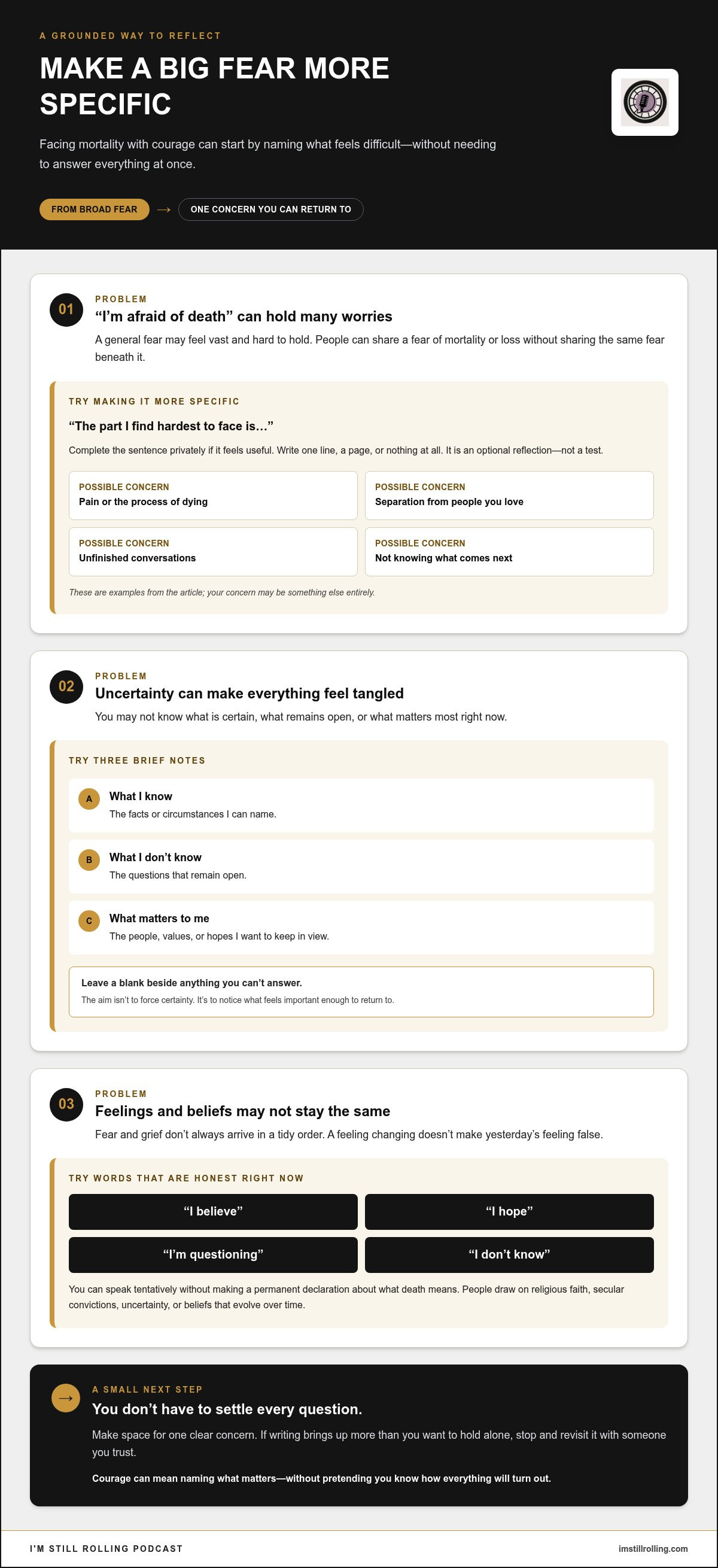
“I’m afraid of death” can hold several different worries inside it. The fear might be about pain or the process of dying, separation from people you love, unfinished conversations, or not knowing what comes next. It might also be something else entirely. People can share a fear of mortality or loss without sharing the same fear beneath it. Naming that distinction can make a vast, hard-to-hold thought more specific.
Name the concern beneath the general fear
If it feels useful, try completing this sentence privately: “The part I find hardest to face is…” You might write one line, a page, or nothing at all. This is an optional reflection, not a test you need to pass or a treatment you’re expected to follow.
Notice whether your concern is about the dying process, a relationship, or what gives life meaning. For example, “I’m afraid of pain” points to a different question than “I’m afraid my children won’t know how much I love them.” The distinction doesn’t make either concern small. It can help you see what kind of conversation, information, or personal reflection might be relevant.
You could make three brief notes:
What I know: the facts or circumstances I can name.
What I don’t know: the questions that remain open.
What matters to me: the people, values, or hopes I want to keep in view.
Leave a blank beside anything you can’t answer. The aim isn’t to force certainty from an uncertain situation. It’s to notice what feels important enough to return to. Facing mortality with courage can mean making space for one clear concern without demanding that you settle every question around it.
Make room for changing feelings and beliefs
Fear and grief don’t always arrive in a tidy order. You might feel composed in one conversation, unsettled the next morning, and unsure what you believe by evening. A feeling changing doesn’t make yesterday’s feeling false. Nor does it mean you’ve failed to cope.
People draw on religious faith, secular convictions, uncertainty, or beliefs that evolve over time. None deserves ranking here. Choose words that feel honest in this moment, even if they’re tentative: “I believe,” “I hope,” “I’m questioning,” or simply, “I don’t know.” You’re allowed to speak without making a permanent declaration about what death means.
If writing brings up more than you want to hold alone, you can stop and revisit it with someone you trust. Some people also find company in hearing how others describe adversity and meaning. The candid conversations on I'm Still Rolling podcast episodes share lived experiences of resilience and life after adversity. They offer stories to listen to, not prescribed answers to your own questions.
Turn difficult thoughts about mortality into honest conversations
A difficult conversation doesn’t need a perfect opening or a complete plan. It needs enough room for two people to be honest about what they know, what they fear, and what they’re ready to discuss. If you’re unsure how the other person will respond, begin with a small invitation rather than trying to cover everything at once.
How can you begin a conversation about mortality?
Try this flexible sequence. You can change the words, skip a step, or stop whenever you need to:
Choose someone you trust. Think about who can listen with care, even if they don’t have answers.
Ask permission. “Could we talk for a little while about something that’s been on my mind?” gives the other person a chance to be present.
Share one concern. “I’ve been thinking about what might happen, and I feel uncertain.” One honest thought is enough to begin.
Listen before offering advice. Ask, “What’s been on your mind?” or “Would you like me to listen, or would it help to think through something together?”
Pause and check in. You might say, “Do you want to keep talking, take a break, or come back to this another time?”
Direct language can feel gentler than hints, especially when you name your uncertainty: “I don’t know quite how to say this, but I’d like to talk.” You’re not asking the other person to fix your fear. You’re letting them know what’s true for you and making space for their truth, too.
What if the conversation becomes emotional or stops?
Tears, silence, and a long pause aren’t proof that the conversation has gone wrong. They may simply mean the subject matters. Let the quiet stand for a moment. You don’t have to fill it with reassurance or move immediately toward a decision. If you’re not sure what would help, ask plainly: “Would listening, practical help, or some space feel better right now?” The answer may be different for each person.
One conversation doesn’t have to carry every question about mortality, every practical concern, or every feeling that has gathered over time. It can be brief and still matter. You can agree to revisit one question later, or simply end with, “I’m glad we started talking.” Facing mortality with courage may look less like a sweeping declaration than staying present for one imperfect exchange.
Sometimes it helps to hear how other people have made sense of hardship, without expecting their experience to provide a script for yours. Stories of recovery and hope offer lived-experience context around resilience after life-altering adversity. They can accompany reflection, while the conversations that matter most remain your own. You can also explore more I'm Still Rolling stories when listening feels like a useful way to feel less alone.
Choose small practices that support courage without demanding certainty
There’s no single routine that makes mortality easier to face, and a practice that feels grounding one day may feel like too much the next. Treat these ideas as options, not obligations. Choose one that fits your circumstances, adapt it, or leave it aside. The aim isn’t to guarantee calm or reach a particular emotional destination. It’s to give your attention somewhere honest and manageable to rest.
Build a personal grounding practice
A few quiet minutes may be enough. You could write what’s on your mind, sit with a cup of tea, take a familiar walk, pray or meditate if that feels meaningful, or mark the day with a small personal ritual. Ask yourself: What value do I want to honor today? or Which relationship would I like to give a little more attention? Let the answer guide one modest choice, such as sending a message or making time to be together.
If thoughts begin to feel overwhelming, stop. Close the notebook, change your surroundings, or turn your attention to something ordinary and immediate. You don’t have to push through distress to prove your courage. You can return to reflection later, or decide it isn’t useful for you. A practice should remain yours to shape.
You might also keep a short list of questions to revisit when you have more capacity. Separate what needs attention soon from what can wait, without treating every uncertainty as a task to solve today. If a question involves medical care, legal matters, or end-of-life decisions, bring it to the qualified professional or support person relevant to your situation. This article can help you reflect, but it can’t determine what choice is right for you.
Ask for support while keeping your agency
Support can begin with telling someone what would help in the moment. Try: “Could you sit with me while I think this through?” or “I don’t need advice right now; I’d just like you to listen.” A trusted friend or family member may be the right person, or you may want connection through your community or a relevant professional. You can ask for company without handing over your decisions.
Facing mortality with courage doesn’t mean carrying every thought alone. It can mean choosing who to involve, what to share, and when to pause. If you’re in immediate danger or facing a crisis, contact local emergency services or crisis support. For a different kind of companionship, listening to candid stories of resilience can offer a human perspective without prescribing an answer. Explore I'm Still Rolling stories of resilience in the format that feels accessible to you.
Let honest stories accompany your own way of facing mortality
There’s a particular kind of recognition that can come from hearing someone describe hardship in their own words. Their story won’t tell you what to feel or decide, but it may help you notice that difficult emotions can be spoken aloud, not just carried in private. Listening can offer a sense of company while leaving room for your experience to remain entirely your own.
How can lived-experience stories help without offering easy answers?
A personal story is a perspective, not a template. One person’s response to illness, disability, caregiving, loss, or life after adversity can’t represent everyone who has faced something similar. You don’t have to identify with every detail, agree with a storyteller’s choices, or reach the same conclusion. You can simply listen for a moment that feels familiar, surprising, or worth thinking about later.
That kind of attention connects with the work of facing mortality with courage: meeting complicated experiences honestly and recognizing the people within them. I'm Still Rolling is a podcast featuring candid conversations about resilience and life after adversity, hosted by journalists Mike Sugerman and Janice Wright. The stories aren’t presented as medical or professional guidance, and they can’t answer personal questions on your behalf. Their value is human: they make space for people to describe what they’ve lived through in their own words.
As you listen, you might ask yourself: What stayed with me? or What did this person help me see differently? You don’t need to turn the answer into an immediate action. Sometimes a story gives language to a feeling you’ve struggled to name. Sometimes it doesn’t resonate, and that’s useful to know, too.
Choose a way to listen that feels manageable
There’s no right format or ideal way to engage. Episodes are available in audio, video, and written transcripts, so you can choose what fits your attention, access needs, or the moment you’re in. You might listen while taking a quiet walk, watch when seeing the speaker matters to you, or read a transcript at your own pace. A transcript can also make it easier to pause over a particular passage.
Pay attention to your own limits. If a story feels too close or heavy, stop, take a break, or return another time. You’re not required to finish an episode, and choosing distance doesn’t mean you’re avoiding the subject. Stories can accompany reflection, but they don’t replace conversation with people you trust or support that fits your circumstances.
If you’d like to spend time with candid accounts of resilience, explore I'm Still Rolling podcast episodes. Choose the format that feels comfortable, or Explore I'm Still Rolling to visit the show.
Let one meaningful next step meet you where you are
You don’t have to turn uncertainty into a complete plan before you move forward. Let your next step be small enough to take as you are: make time for someone you love, write down a question you want to revisit, or give yourself permission to wait until you feel ready. The point isn’t to control what can’t be known. It’s to choose where your attention and care can go now.
Facing mortality with courage may look different tomorrow than it does today. Fear can remain, and your sense of what matters may shift. You’re allowed to meet each moment without demanding that you feel certain, resolved, or fearless. A small, honest choice still counts.
If listening to lived experiences feels like a helpful companion for your own reflection, explore honest stories of resilience on I'm Still Rolling. Choose a podcast episode, video, or transcript, and take what speaks to you while leaving what doesn’t. There is room for fear and room for connection in the step you choose next.
Frequently Asked Questions
Does facing mortality with courage mean not being afraid?
No. Facing mortality with courage doesn’t require you to feel calm or hide fear from others. It can mean making a choice that reflects what matters to you while fear is still present, such as asking for clarification, keeping a meaningful commitment, or admitting you need company. Courage isn’t measured by how composed you appear. You can be afraid and still act with care.
How can I stop being afraid of death?
You may not be able to switch fear off, but you can try to change how much space it occupies in a given moment. Notice what tends to intensify it, such as late-night searching or a particular reminder, and experiment with a different response: step away from the screen, name what’s around you, or focus on one ordinary task. The aim isn’t to force the thought away, but to regain some choice about your attention.
What do you say to someone who is facing death?
Say something simple and sincere, such as, “I care about you, and I’m here with you.” If you’re unsure what they want to hear, ask whether there’s something they’d like you to know or talk about. Avoid trying to explain why things happen or promising that everything will be okay. A quiet presence, a remembered story, or a practical offer can communicate care without asking them to comfort you.
Can talking about mortality make fear worse?
It can stir up strong feelings, especially if the timing or setting feels wrong. That doesn’t mean you must avoid the subject, but you can set limits: choose a private moment, agree to talk briefly, or focus on one question rather than the whole future. Afterward, do something familiar and grounding. If a conversation leaves you feeling overwhelmed, pause and consider whether another approach or support would feel safer.
How do I face mortality when I have no spiritual beliefs?
You don’t need spiritual beliefs to approach mortality thoughtfully. You might focus on what gives this life meaning to you: a friendship, a responsibility, a creative pursuit, a place, or the way you treat people. Some people find comfort in what they’ve shared and contributed; others prefer to stay with what can be known. You’re not required to adopt someone else’s explanation to decide what deserves your attention now.
What does courage look like when someone I love is dying?
It may mean staying connected in ways that are possible for both of you, while respecting what the person wants and what you can realistically offer. You could share a familiar song, talk about an ordinary memory, or ask whether they’d prefer company or quiet. You’re not responsible for making the situation feel hopeful. Keep space for your own needs, too, and let trusted people share the weight.
When should I seek professional support for fear of mortality?
Consider speaking with a qualified mental health professional or another relevant professional if fear is persistently disrupting sleep, work, relationships, or daily activities, or if you feel stuck managing it alone. You don’t need to wait for a crisis to ask for help. A primary care clinician may help you consider what support fits. If you’re in immediate danger or may harm yourself, contact local emergency services or crisis support now.



Comments