Emotional Resilience Stories: Navigating the Profound Impact of Disability in 2026
Resilience isn't a fixed personality trait or a superpower reserved for the extraordinary; it's a narrative skill built through the visceral act of witnessing and sharing the truth. When you're facing the profound impact of a life-altering change, the invisible emotional toll can feel heavier than any physical barrier. You might feel isolated in your grief or fear that the meaning of your life has been permanently diminished. By exploring authentic emotional resilience stories disability, you begin to see that your messy feelings aren't just normal; they're the foundation of a new kind of strength.
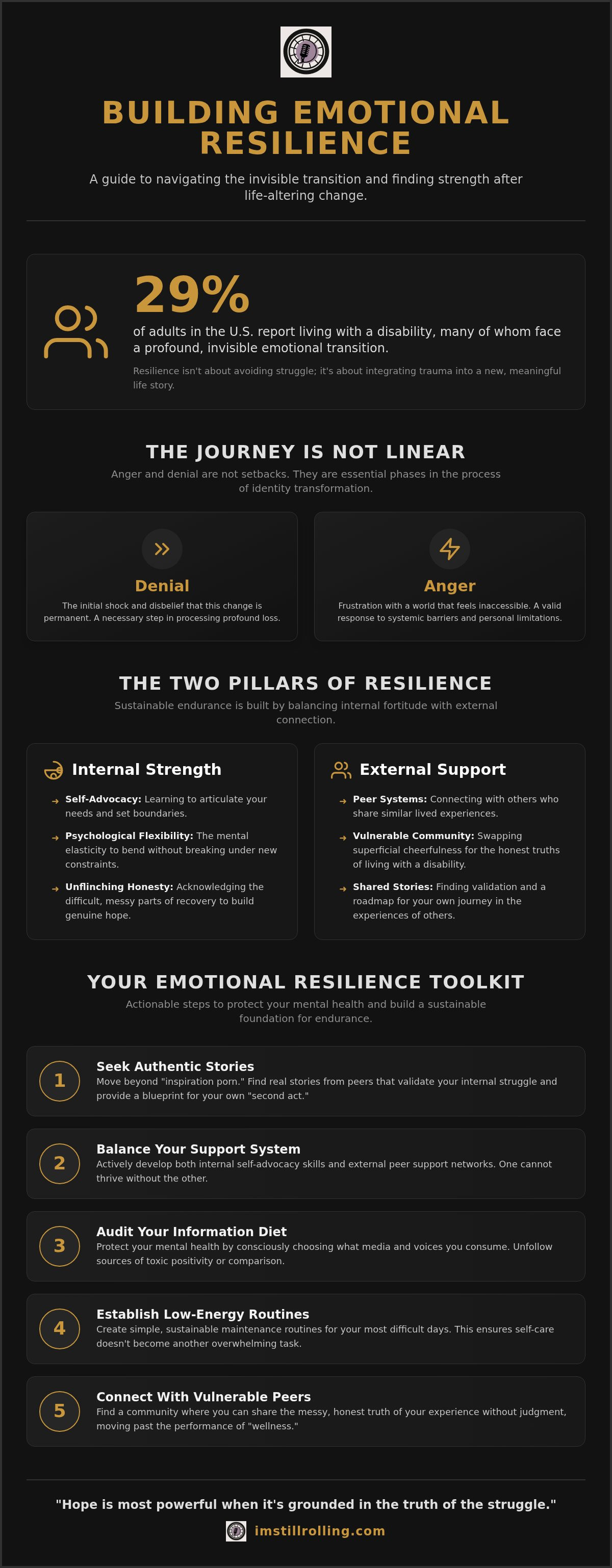
As of August 2026, nearly 29% of adults in the United States report living with a disability, yet many still struggle with the feeling of being unseen. We promise to move past superficial cheerfulness to offer you a realistic framework for emotional recovery. This guide explores how real-life experiences act as a roadmap for your own journey, validating your internal struggle while providing a sense of connection to a resilient community. You'll discover how to process your evolution and find purpose in a landscape that is constantly changing.
Table of Contents
Understanding the Emotional Impact of Disability: The Invisible Transition
Authentic Emotional Resilience Stories: Lessons from the Front Lines
The Pillars of Resilience: Internal Strength vs. External Support
Building Your Emotional Resilience Toolkit: Actionable Steps
The I'm Still Rolling Community: Your Next Step in Resilience
Understanding the Emotional Impact of Disability: The Invisible Transition
When a body changes, the world often focuses on the mechanics of recovery: the physical therapy, the adaptive equipment, and the architectural barriers. Yet, the most profound shift happens internally, far from the clinical gaze. Disability isn't merely a medical event; it's a seismic disruption of identity that requires a total reconstruction of how you perceive yourself. While a wheelchair or a cane represents a physical limitation, the true challenge lies in dismantling the mental barriers of a reality you didn't choose. By listening to emotional resilience stories disability, we see that the transition is rarely linear or clean.
The journey toward adaptation often begins with a messy, necessary grief cycle. You might feel a surge of anger at a world that suddenly feels inaccessible, or a deep denial that this change is permanent. These aren't signs of weakness. They're essential steps in the process of letting go of who you were to make room for who you're becoming. In the context of disability, emotional resilience is the ability to integrate trauma into a new, meaningful life story.
The Psychology of Identity Loss and Reconstruction
A sudden diagnosis or a traumatic injury can feel like the death of your former self. You're forced to mourn the person who could run, drive, or work without a second thought. This loss of agency often triggers a crisis of self-worth, especially when you encounter the societal gaze, that subtle mixture of pity and discomfort from others that can make you feel like a problem to be solved rather than a person. Adapting requires a high degree of psychological flexibility. What is psychological resilience? In this context, it's the mental elasticity to bend without breaking under the weight of new physical constraints. You aren't just learning to move differently; you're learning to exist differently.
Why Emotional Honesty Precedes Resilience
There's a specific danger in the "toxic positivity" often pushed on the disability community. Being told to "stay positive" or "be an inspiration" can feel like a gag order on your genuine suffering. True endurance is built on a foundation of unflinching honesty. If you don't acknowledge the exhausting, frustrating, and messy parts of recovery, your hope will be hollow. Realizing that your darkest days don't disqualify you from a good life is the first step in navigating a new disability. When you stop performing "wellness" for the comfort of others, you find the space to build a resilience that actually lasts. These emotional resilience stories disability prove that hope is most powerful when it's grounded in the truth of the struggle.
Authentic Emotional Resilience Stories: Lessons from the Front Lines
Media often paints disability with a broad brush of "inspiration porn," where the mere act of existing is treated as heroic. This narrative is hollow because it ignores the sweat, the tears, and the quiet indignities of recovery. On the I'm Still Rolling Podcast, we hear a different kind of truth. By sharing emotional resilience stories disability, guests move beyond the performance of wellness to reveal the raw reality of their second acts. There is a transformative power in the "vulnerable peer." When you hear a seasoned journalist or a fellow traveler say, "I struggled too," it creates a bridge of connection that clinical data simply cannot build.
The common thread among these stories isn't a lack of fear, but the decision to move forward despite it. Whether it's a sudden medical trauma or a long-term degenerative condition, the transition into a new way of life requires a specific type of grit. This isn't the grit of a Hollywood movie; it's the quiet, daily persistence of finding meaning in a world that wasn't built for you.
Spinal Cord Injury: Finding Purpose Beyond the Chair
For many survivors of a spinal cord injury, the early days are dominated by a singular medical goal: walking again. While physical milestones are vital, the most enduring victories are often found in redefining what it means to live well. We've spoken with individuals who, after their injury, pivoted to entirely new careers or rediscovered social roles they thought were lost forever. These spinal cord injury recovery stories highlight a shift in perspective where the chair becomes a tool for engagement rather than a symbol of limitation. It's about agency. It's about choosing to participate in life on your own terms, even when those terms have changed.
Caregiver Resilience: The Emotional Weight of Supporting a Spouse
Resilience isn't limited to the person with the primary diagnosis. Spouses caring for partners with Alzheimer's or chronic illness face a unique phenomenon known as ambiguous loss. This is the heavy emotional weight of loving someone who is physically present but cognitively or personality-wise altered. Navigating this requires a specific type of endurance. It's the ability to find small, fleeting moments of joy amidst a grueling caregiving schedule. These caregivers don't just cope; they evolve. They learn to balance the grief of what's been lost with the reality of what remains.
Building this level of grit isn't accidental. It often involves intentional exercises for building emotional resilience, such as practicing mindfulness or seeking specific peer groups. If you're looking for more honest conversations that skip the pity, you can listen to recent podcast episodes where we explore these themes in depth. These emotional resilience stories disability serve as a reminder that while the path is difficult, you aren't walking, or rolling, it alone.
The Pillars of Resilience: Internal Strength vs. External Support
True endurance requires two distinct but interlocking foundations: the internal agency to navigate your own mind and the external community to anchor you when your own strength falters. Resilience is not a solo sport but a collaborative narrative between the individual and their environment. While the medical system often focuses strictly on physical rehabilitation, the journalistic truth shared in emotional resilience stories disability focuses on the social and psychological landscape. By documenting these journeys, the I'm Still Rolling Podcast bridges the gap between private struggle and public belonging, turning isolated reflection into a shared roadmap for others to follow.
Developing Internal Grit and Psychological Endurance
Internal resilience starts with the quiet work of self-advocacy and mindfulness. On the dark days when physical pain or environmental barriers feel overwhelming, the most effective tool isn't a grand gesture of "overcoming," but the setting of micro-goals. These small, manageable targets, such as making a single phone call or navigating a new route, help rebuild a sense of competence that trauma often strips away. Developing this psychological endurance involves a deep-dive into the reality of your situation without descending into pity. You can find more about these daily mental shifts in our exploration of wheelchair life challenges, where we discuss the intersection of physical reality and mental grit.
The Necessity of Community and Peer-to-Peer Connection
While internal strength is vital, it's rarely enough to sustain a person through a lifetime of change. Clinical advice provides a necessary framework for health, but it often lacks the sensory, evocative understanding that comes from shared lived experience. Peer support groups and disability rights advocacy offer a different kind of healing: the validation that comes from seeing your own struggle reflected in another person's eyes. This connection is why emotional resilience stories disability are so transformative. They move the conversation from "what's wrong with you" to "how are we moving forward together."
Finding a community that values honesty over superficial encouragement is a critical step in long-term adaptation. As researchers at the University of Washington emphasize when discussing Building resilience with a disability, active participation in support networks is a key factor in psychological well-being. The I'm Still Rolling Podcast acts as a digital town square, fostering a sense of global belonging for those who may feel physically isolated. By listening to the stories of others, you don't just find a guide; you find a tribe of vulnerable peers who understand the weight and the beauty of the journey you're on.
Building Your Emotional Resilience Toolkit: Actionable Steps
Resilience isn't a destination you reach; it's a toolkit you build, one difficult day at a time. The transition from trauma to a sustained "second act" requires more than just hope. It demands a structured approach to your mental and emotional health. By curating a collection of emotional resilience stories disability that honor the grit over the glory, you begin to see a path forward that feels both honest and achievable.
Audit your information diet: Stop consuming "inspiration porn" that makes you feel inadequate. Instead, seek out stories that reflect realistic optimism and the messy truth of adaptation.
Establish a 'Low-Energy' routine: On days when the weight feels too heavy, have a pre-set list of small comforts. This might be listening to a specific podcast episode or simply sitting by a window.
Seek a Resilience Mentor: Find someone further along in their journey who shares your values. Their perspective can act as a lighthouse when you're lost in the fog of a new diagnosis.
Practice radical self-compassion: Setbacks are part of the architecture of recovery. When your body or mind feels like it's failing, treat yourself with the same grace you'd offer a dear friend.
Document your transformation: Whether through journaling or voice memos, recording your thoughts helps you move from being a subject in a medical file to the author of your own life.
Navigating the First Six Months of a New Disability
The initial half-year after a life-altering change is often a blur of clinical appointments and insurance paperwork. It's easy to let your identity be swallowed by medical data. To protect your mental health, you must set firm boundaries with well-meaning friends whose pity can feel like a secondary injury. Focusing on physical disability stories of resilience during this time provides a necessary counter-narrative to the "tragedy" lens often used by outsiders. You aren't a patient to be fixed; you're a person navigating a profound transition.
The Role of Storytelling in Your Recovery
There is a biological component to sharing your truth. Speaking about your experience can help "re-wire" the brain's trauma response, moving memories from the reactive amygdala to the analytical prefrontal cortex. Using a podcast episode as a catalyst for difficult conversations with loved ones can bridge the gap between your internal reality and their external perception. If you're ready to start your own deep-dive into these truths, sign up for our newsletter to receive transcripts and insights that go beyond the surface. These emotional resilience stories disability are the building blocks of a life reclaimed.
The I'm Still Rolling Community: Your Next Step in Resilience
Building a life after a profound medical change isn't a project you complete; it's a practice you sustain through the company you keep and the narratives you consume. While the previous sections of this guide provided the internal tools and external pillars, the final piece of the puzzle is consistent immersion in a community that speaks your language. The I'm Still Rolling community exists to turn isolated struggle into a shared journey of realistic optimism. By regularly engaging with emotional resilience stories disability, you begin to replace an internal dialogue of loss with a narrative of transformation and endurance.
Mike Sugerman and Janice Wright bring decades of high-level journalistic rigor to these conversations. They understand that truth is often found in the "messy" details that others overlook. You won't find superficial cheerfulness or "inspiration porn" here. Instead, you'll find honest, unflinching dialogues about the reality of living with a disability, always paired with a focus on how to move forward. This commitment to the bold truth ensures that every episode serves as a reliable roadmap for those navigating their own second acts.
A Trusted Guide for the Journey Ahead
The podcast offers a unique blend of professional reporting and raw, lived intimacy. It's designed to be a "vulnerable peer" you can take with you, whether you're heading to a physical therapy session or navigating a quiet commute. Hearing others articulate the exact fears and triumphs you experience provides a level of validation that clinical advice cannot reach. You can start exploring these narratives by browsing the I'm Still Rolling Podcast Episodes, where each conversation is a deep-dive into the nuances of the human condition.
How to Join the Conversation
Resilience thrives in the exchange of ideas. We encourage you to move from being a listener to a participant by sharing your own experiences or suggesting topics that matter to you. To stay connected to this evolving community, you can subscribe to the I'm Still Rolling Newsletter. This weekly resource provides transcripts and deeper insights that help you process the complex emotional landscape of disability at your own pace. These emotional resilience stories disability are kept free and accessible through thoughtful brand partnerships, ensuring that everyone has access to the tools they need for recovery.
Consistency is the key to re-wiring your response to adversity. By making these stories a regular part of your week, you anchor yourself in a community that values your reality without pitying your circumstances. Subscribe today and take the next step toward a life defined not by what was lost, but by the resilience you continue to build.
Reclaiming the Narrative of Your Future
The journey of adapting to a body that moves differently is less about returning to a former self and more about the courageous act of authorship. We have explored how the grief of identity loss eventually gives way to the construction of a new, resilient narrative through internal grit and robust community support. By immersing yourself in emotional resilience stories disability, you move beyond the clinical data of a medical chart to reclaim the sensory richness of your own life story.
The I'm Still Rolling Podcast serves as your consistent companion in this evolution, offering the journalistic rigor and personal intimacy needed to navigate the messy parts of recovery. Hosted by award-winning reporters, the show connects you with a tribe of vulnerable peers who prove that realistic optimism is a skill that can be mastered. You are not defined by the barriers you face, but by the endurance you build alongside others who understand the weight of the path.
Subscribe to the I'm Still Rolling Podcast for authentic stories of resilience and continue the work of rewriting your future today. Your story is still being told, and it remains a narrative of profound strength.
Frequently Asked Questions
What is the difference between resilience and just 'getting by' with a disability?
Resilience is the active process of integrating trauma into a new, meaningful life story, while "getting by" is often a state of survival focused on immediate needs. While getting by keeps you afloat, resilience allows you to evolve through the challenge. It involves finding agency and purpose within your new reality rather than just waiting for things to return to how they were before.
How can I find emotional resilience stories that don't feel like 'inspiration porn'?
Authentic emotional resilience stories disability focus on the "messy" middle ground of adaptation rather than just the final victory. Avoid narratives that treat basic existence as heroic or "inspirational." Instead, seek out journalists and storytellers who explore the daily grit, the setbacks, and the honest frustrations of recovery. This grounded approach provides a realistic roadmap for your own journey.
Is it normal to feel angry years after a disability diagnosis?
It is completely normal to experience anger years after a diagnosis because grief isn't a linear process. You aren't just mourning a physical change; you're navigating a world that often feels inaccessible. This anger is frequently a healthy response to systemic barriers or the recurring realization of loss. Acknowledging these feelings is a necessary step in maintaining your long-term endurance.
Can listening to a podcast really help with my emotional recovery?
Listening to a podcast can significantly aid recovery by reducing the isolation that often accompanies disability. When you hear a vulnerable peer share their truth through emotional resilience stories disability, it validates your own internal struggle. This connection helps move trauma from a reactive emotional state to an analytical one. It provides a sense of global belonging that clinical appointments often fail to deliver.
What are some practical ways to support a spouse's emotional resilience without being overbearing?
Supporting a spouse requires a delicate balance of presence and respect for their agency. Start by validating their difficult feelings without trying to "fix" them with superficial cheerfulness. Ask what they need in specific moments rather than assuming. By creating a safe space for their emotional honesty, you help them build the internal strength necessary for their own transformation.
How do I deal with the 'invisible' emotional impact of a physical disability?
Dealing with the invisible impact starts with naming the loss of identity and the weight of the societal gaze. You must recognize that the mental transition is just as significant as the physical one. Practicing radical self-compassion and seeking out others who share your lived experience can help you process these internal shifts. It's about moving from being a medical subject to the author of your life.
Where can I find a community of people who understand the reality of life after a spinal cord injury?
You can find a community of SCI survivors through peer support networks, disability rights organizations, and digital platforms like the I'm Still Rolling community. These spaces offer a digital town square where the focus is on realistic optimism. Connecting with people who understand the specific nuances of life in a chair provides a level of understanding that clinical advice cannot replicate.
What should I do if I feel like I have no resilience left?
If you feel your resilience is depleted, focus on micro-goals and low-energy maintenance routines. You don't have to be "strong" every day. Reaching out to a resilience mentor or a mental health professional can provide the external support needed to anchor you. Sometimes the most resilient act is simply admitting that you need help to navigate the current fog.


Comments