Disability and Entrepreneurship: The Complete Guide to Building an Adaptive Business in 2026
Nearly 10% of working adults with disabilities choose self-employment, outpacing their non-disabled peers by a striking margin. That disparity tells a clear story: the connection between disability and entrepreneurship isn't a retreat from the working world, but a conscious claim to autonomy. You already understand the heavy friction of standard corporate cultures that punish energy fluctuations and treat basic accommodations as corporate charity. You likely also know the persistent anxiety of benefits cliffs, where earning self-employment income threatens the very healthcare you rely on to survive.
Building an enterprise shouldn't force a compromise between your financial dignity and your physical health. In this comprehensive guide, you'll discover how your lived experience serves as a powerful market differentiator, giving you the blueprints to build an adaptive, profitable business on your own schedule. We explore key 2026 funding programs, methods to protect vital support systems, and actionable frameworks to help you create enduring self-determination.
Table of Contents
The Intersection of Disability and Entrepreneurship: Redefining Autonomy
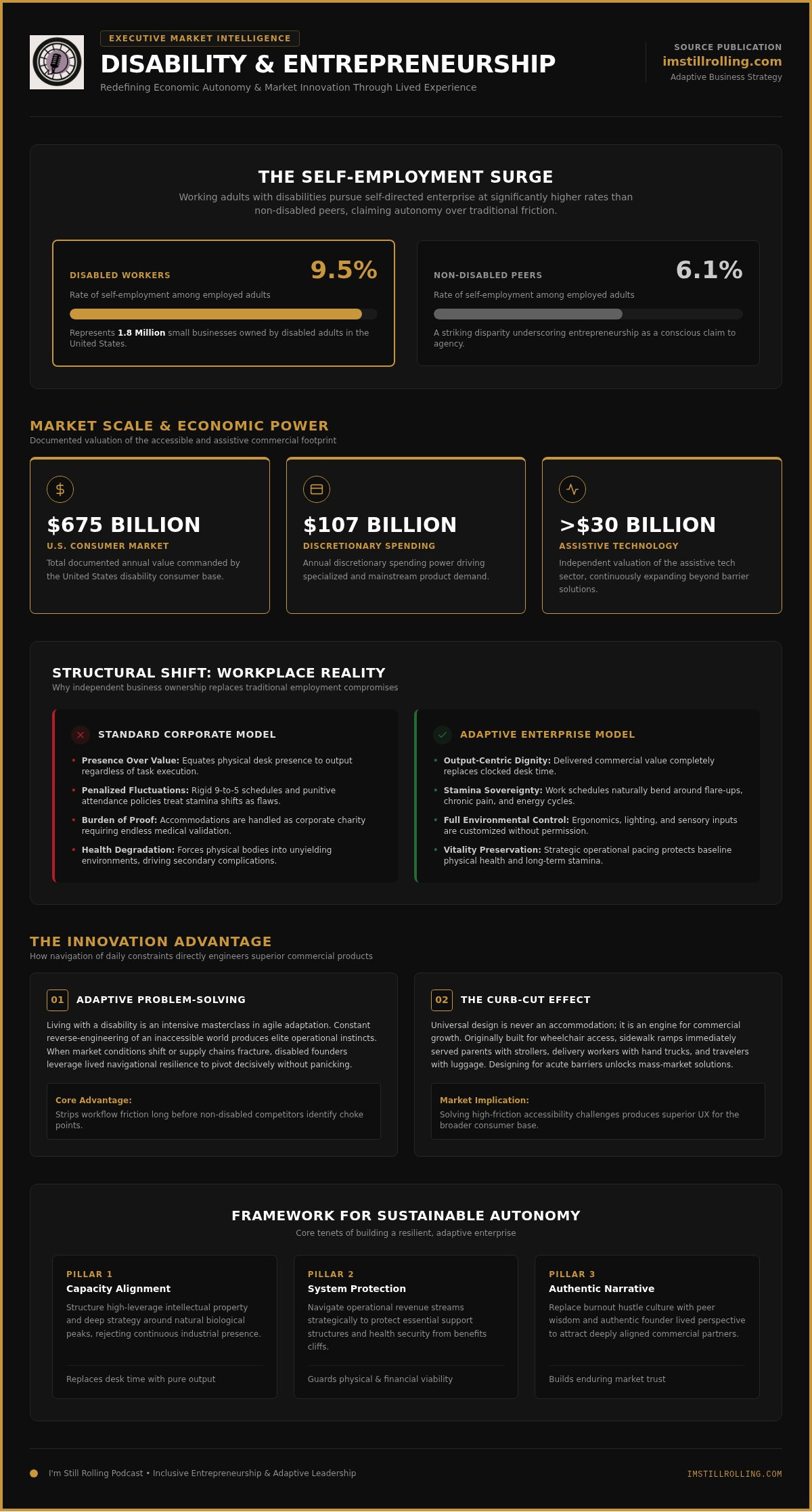
For millions of founders, running an independent venture isn't a fallback plan after traditional employment fails. It's a deliberate reclamation of power. Disability-led business ownership represents self-directed economic agency; it's the conscious act of designing operational models that wrap around human realities rather than forcing bodies to bend to outdated industrial machinery. Across the United States, roughly 1.8 million small businesses are owned by disabled adults. Data reveals that 9.5% of employed disabled workers run their own enterprises, compared to just 6.1% of their non-disabled peers.
This dynamic shift underpins a larger cultural push toward inclusive entrepreneurship, proving that commercial viability flourishes when systemic gatekeeping is removed. By pairing lived physical perspective with strategic execution, the dynamic between disability and entrepreneurship reshapes what sustainable, high-impact enterprise looks like in practice.
Breaking Away from Corporate Ableism
Traditional corporate environments remain tethered to the fiction that physical presence equals productivity. Harsh overhead lighting, inflexible 9-to-5 schedules, and punitive attendance policies treat fluctuating stamina cycles as character flaws. Standard human resources departments often treat reasonable accommodation requests as burdensome corporate charity, forcing employees into exhaustive cycles of medical proof. Rather than fighting an entrenched glass ceiling designed to favor uniform physical stamina, building an independent business allows you to simply build a better room.
Self-Determination and Health Sovereignty
True operational freedom begins when your calendar honors your baseline physical capacity. In an adaptive business, delivered value completely replaces clocked desk time. When an autoimmune flare-up or chronic pain spike hits at sunrise, an adaptive structure lets you shift deep-focus strategy sessions to the evening without asking permission. Complete control over your workstation, sensory environment, and pacing prevents the catastrophic physical crashes that cause costly secondary medical complications. You preserve your physical vitality, protect your peace of mind, and create commercial value strictly on your terms.
How Lived Disability Drives Unmatched Business Innovation
Living with a disability is an intensive masterclass in agile problem-solving. When the physical world, software interfaces, and daily routines are built around narrow assumptions, disabled individuals spend every waking hour reverse-engineering workarounds. In the commercial arena, that relentless practice converts into elite operational instinct. Disability-led innovation acts as a premier catalyst for resilient venture development, teaching founders how to strip friction from workflows long before non-disabled competitors spot the choke points.
Business resilience is born from this instinct. The natural union between disability and entrepreneurship yields companies capable of withstanding turbulent supply chains, rapid tech shifts, and volatile staffing environments because the founder's baseline life skill is creative adaptation under constraint.
The Adaptive Problem-Solving Advantage
Navigating systemic friction builds unmatched grit. When everyday barriers, from inaccessible transit to exclusionary digital platforms, threaten to stall daily life, you learn to pivot instantly without panicking. That exact mental flexibility governs high-stakes startup decisions. Rather than freezing when market dynamics shift or funding rounds stall, disabled founders routinely engineer unconventional paths forward. This lived navigational resilience sharpens overall product quality and deepens user empathy far beyond standard corporate focus groups.
Universal Design as a Market Superpower
Universal design is rarely just an accommodation. It's an engine for outsized commercial growth. When you engineer a service or product that solves an acute access barrier, you almost always create a superior experience for the broader mainstream market. The phenomenon mirrors the classic curb-cut effect: sidewalk ramps built for wheelchair users immediately benefited parents with strollers, delivery workers with hand trucks, and travelers with luggage.
The economic stakes here are massive. The U.S. disability consumer market commands $675 billion in value, carrying $107 billion in discretionary annual spending, while the assistive technology sector exceeds $30 billion. As analysis on the competitive advantage of disability illustrates, treating accessibility as fundamental architecture rather than an afterthought compliance checklist allows founders to tap vast, neglected market share with organic authority.
Translating these daily workarounds into strategic market edges requires honest, unvarnished insight. To hear how veteran leaders transform physical hurdles into practical business strategies, tune into the latest I'm Still Rolling Podcast episodes for deep-dive peer conversations.
Overcoming Structural Hurdles: Funding, Benefits, and Capital
The greatest barrier for disabled founders is rarely an absence of ambition or market demand. It is the punitive architecture of the safety net itself. For anyone balancing income with vital support, self-employment feels like walking a tightrope over an abyss. Traditional benefits systems enforce severe asset limits that penalize economic ambition, threatening immediate loss of Medicaid or life-sustaining personal care attendants the moment business revenue ticks upward. Succeeding at the crossroads of disability and entrepreneurship requires mastering these structural realities before booking your first dollar.
Protecting your stability means deploying specialized financial instruments from day one:
ABLE Accounts: Shelter savings and operational reserves without triggering asset limits for public benefits.
Special Needs Business Trusts: Hold equity or surplus distributions at an arm's length to safeguard long-term care eligibility.
Separated Entity Structures: Form structured legal entities that clearly partition personal distributions from retained business capital.
To grasp the legal battles and policy shifts reshaping these options, founders can examine our recent disability rights podcast discussions covering ongoing advocacy efforts across the country.
Navigating the Benefit Cliff Without Losing Healthcare
You can protect critical care while building enterprise value by using established federal work incentives. A Plan to Achieve Self-Support (PASS) lets you set aside self-employment income and startup capital to purchase dedicated equipment, fund inventory, or pay for professional coaching without reducing SSI or SSDI benefit payments. Because the rules are intricate and the financial stakes are existential, consult a certified Community Work Incentives Coordinator (CWIC) before drafting your business plan or filing incorporation paperwork.
Accessing Inclusive Startup Capital and Grants
Traditional venture capital remains notoriously biased toward founders who project relentless, non-disabled stamina. In response, a powerful ecosystem of non-dilutive capital and targeted alternative financing is emerging:
Targeted Business Grants: Programs like the FedEx® Entrepreneur Fund provide $30,000 grants to disabled business owners, while the Verizon Digital Ready program delivers curriculum alongside funding up to $10,000.
SBA Lending Expansions: As of July 2026, combined SBA 7(a) and 504 loan limits reach $10 million, though small 7(a) applications now undergo full manual underwriting that demands rigorous preparation.
Supplier Diversity Credentialing: Disability:IN offers the Disability-Owned Business Enterprise (DOBE) certification for $300 across a three-year term, unlocking corporate supply chain contracts.
Designing an Adaptive Business Model: A Practical Roadmap
Most commercial roadmaps operate on a flawed premise: that human stamina is uniform and infinite. When you architect a sustainable venture, your operational structure must accommodate bodily reality rather than fighting it. Successfully pairing disability and entrepreneurship means decoupling your revenue generation from uninterrupted physical presence. It requires constructing a responsive framework that absorbs physical downtime without interrupting cash flow.
Building this resilient architecture comes down to five practical stages:
Conduct an honest capacity audit: Map baseline energy, flare patterns, and mandatory medical maintenance windows before choosing service offerings.
Select decoupled business models: Choose intellectual models like specialized advisory, productized consulting, or digital assets rather than labor-intensive execution.
Automate administrative overhead: Deploy self-serve onboarding, automated billing, and scheduling links to minimize daily operational drag.
Enforce asynchronous boundaries: Contractually define written communication channels and turnarounds, removing the expectation of instant, on-camera availability.
Build a trusted subcontractor bench: Partner with peer contractors who step in to deliver critical client deliverables during acute medical disruptions.
Energy-Budgeting and Spoon Theory in Business Operations
Spoon Theory provides a tactical system for executive capacity management. If you possess a fixed reserve of physical and cognitive stamina each day, expenditure on low-value coordination tasks directly cannibalizes core strategic work. Structuring your business around variable sprint cycles allows you to execute deeply during high-capacity windows while building built-in buffers for symptom surges. Asynchronous delivery sets clear, professional client expectations that value thoughtful solutions over immediate responses.
Leveraging Assistive Tech and Automation Stacks
Assistive technology provides high-output leverage. Modern dictation platforms, optical character recognition tools, and customized mechanical inputs significantly reduce physical fatigue for mobility-impaired operators. Meanwhile, artificial intelligence co-pilots manage the cognitive friction of scheduling, email triage, and document synthesis for neurodivergent entrepreneurs.
Tax regulations help offset these operational investments. Eligible small businesses with gross receipts under $1 million or fewer than 30 full-time staff can claim the Disabled Access Credit, covering 50% of qualifying accessibility expenditures up to $5,000 annually. You can also leverage the Architectural Barrier Removal deduction for up to $15,000 in qualifying workplace adjustments.
If you want honest, pragmatic breakdowns of how founders build these resilient architectures, subscribe to the I'm Still Rolling Newsletter for actionable tactical guides and peer wisdom delivered directly to your inbox.
Resilience, Narrative, and Community: Sustaining the Long Haul
Isolation is the quiet shadow that follows many independent founders. Mainstream startup spaces glorify 80-hour workweeks, chronic sleep deprivation, and relentless self-sacrifice, presenting them as mandatory badges of honor. For founders managing acute physical limitations or chronic illnesses, this brand of performance theater isn't just misguided; it's physically hazardous. Building an enduring enterprise requires discarding toxic grind culture in favor of deep self-honesty, discovering that vulnerability is not a liability, but your greatest brand asset.
Reclaiming your story transforms how you operate. When you openly articulate your lived perspective, you establish an emotional resonance that sterile corporate entities cannot match. Prospective clients and values-aligned investors are drawn to genuine transparency. Achieving self-directed financial success after medical upheaval provides profound validation; it proves that life-altering circumstances do not diminish your capacity to build enduring commercial value. When you need perspective during difficult operational stretches, exploring authentic stories of recovery and hope reminds you that setbacks often lay the groundwork for long-term breakthroughs.
Dismantling Toxic Hustle Culture
Enduring businesses are built on rhythm, not self-destruction. In an adaptive enterprise, taking a planned medical rest day is not a personal failure; it's a vital reinvestment in your operational stability. By setting boundaries that prevent physical crashes, you construct a lower-overhead, resilient business model that respects bodily capacity. Sustainable longevity honors energy boundaries as non-negotiable business rules.
The Power of Journalistic Truth and Authentic Community
Solitary grit only carries a venture so far. Navigating the messy intersections of disability and entrepreneurship demands a trusted circle of peers who understand the twin pressures of payroll deadlines and physical pain flare-ups. Authentic community breaks down professional loneliness, leading to practical advantages:
Collaborative Referral Networks: Partnering with peers who cross-refer specialized enterprise client projects when capacity fluctuates.
Collective Resource Sharing: Exchanging real-world experiences regarding non-discriminatory lenders, adaptive workflows, and benefits management.
Ground-Truth Mentorship: Gaining unvarnished insights from veteran leaders who have weathered identical structural barriers.
Journalistic storytelling cuts through corporate platitudes. To hear unvarnished accounts of grit and adaptive strategy straight from veteran founders who have navigated major life changes, immerse yourself in the latest I'm Still Rolling Podcast Episodes.
Building an Adaptive Enterprise on Your Own Terms
True independence doesn't come from forcing yourself into systems designed without you in mind. It comes from creating your own. The powerful synergy of disability and entrepreneurship proves that your lived experience isn't a deficit to overcome, but an enduring operational advantage. When you decouple revenue from unbroken physical presence, protect your foundational healthcare, and build around sustainable energy cycles, you construct an enterprise capable of weathering any storm.
You don't have to navigate this journey alone or settle for shallow corporate cheerleading. Hosted by veteran journalists Mike Sugerman and Janice Wright, the show brings decades of investigative depth to unfiltered discussions about human resilience, personal sovereignty, and adaptive triumph. If you're ready to find genuine clarity, practical wisdom, and grounded peer perspective for the road ahead, listen to I'm Still Rolling Podcast Episodes to draw strength from leaders who have walked this exact path.
Frequently Asked Questions
Can I start a business while receiving disability benefits without losing my healthcare?
Yes, you can launch a business while maintaining government healthcare, but you must structure your earnings carefully under established work incentive rules. Utilizing tools like Social Security's Plan to Achieve Self-Support (PASS) allows you to reinvest venture revenue directly into equipment or services without reducing SSI or SSDI thresholds. ABLE accounts also shield operating savings. Always work with a certified benefits specialist to protect your Medicaid coverage before invoicing clients.
What are the best business models for entrepreneurs with chronic illness or physical disabilities?
Asynchronous, knowledge-based models that decouple revenue generation from active hours offer the greatest flexibility. High-leverage consulting, digital product creation, newsletter publishing, and productized services let you batch tasks during peak energy windows. These structures eliminate the physical grind of fixed 9-to-5 schedules. They give you the operational freedom to deliver results on your timeline while maintaining client satisfaction and protecting bodily health.
How do I secure startup funding as a disabled business owner?
Securing startup capital involves targeting dedicated non-dilutive grants, disability-focused microloans, and modernized SBA lending pathways. Look into specialized programs such as the FedEx® Entrepreneur Fund or the Verizon Digital Ready grants in partnership with disability organizations. In addition, obtaining Disability-Owned Business Enterprise (DOBE) certification unlocks corporate supplier diversity contracts, helping you build commercial momentum and sidestep traditional venture capital gatekeeping.
What happens if a health flare-up prevents me from running my business for weeks?
Your business survives prolonged flare-ups if you establish automated back-end systems and trusted subcontractor agreements ahead of time. Structure client contracts with flexible delivery timelines and asynchronous check-ins. Partner with dependable peer contractors who can fulfill core deliverables under white-label terms during acute health crises. Preparing emergency operational standard operating procedures guarantees that client workflows continue seamlessly even when you step away completely for recovery.
Are there specific tax incentives or government programs for disabled entrepreneurs?
Yes, federal tax codes provide targeted credits and deductions to offset adaptive operational expenses for eligible small businesses. The Disabled Access Credit provides a non-refundable tax credit up to $5,000 for qualifying accessibility upgrades, while the Architectural Barrier Removal deduction allows up to $15,000 in barrier-removal write-offs. These provisions help business owners invest in specialized workplace adjustments, software tools, and physical office modifications without straining operating cash flow.
How can I protect my energy and avoid entrepreneurial burnout with a disability?
Protecting your energy requires building your business around your capacity rather than adapting your health to an artificial hustle culture. Practical disability and entrepreneurship practices rely on energy-budgeting frameworks like Spoon Theory, scheduling mandatory rest days, and enforcing strict communication boundaries. Replace instant messaging channels with clear 48-hour email response windows to preserve cognitive reserves, allowing you to focus your limited daily stamina exclusively on high-leverage strategic decisions.
Should I disclose my disability to prospective clients and investors?
Disclosure is entirely a personal strategic choice, but framing your lived experience as a business asset often attracts ideal clients. In the world of disability and entrepreneurship, authentic transparency differentiates your brand, builds immediate trust, and filters out clients who don't respect accessible boundaries. You don't need to share private medical details. Instead, highlight the adaptive problem-solving skills, persistence, and universal design expertise that your perspective brings to the table.


Comments