Coping with Caregiver Stress: A Grounded Guide for 2026
What if coping with caregiver stress and anxiety doesn’t begin with staying positive, but with admitting how heavy the load has become? You can love the person you’re caring for and still feel worn down by constant worry, practical demands, and fear of what may come next. If asking for help brings guilt or concern about being judged, an already difficult role can feel even more isolating.
Caregiver stress isn’t a personal failure, and you don’t have to pretend everything is fine to cope. This guide offers practical ways to recognize what you’re carrying without shame, ease the pressure in small steps, and invite others to share responsibilities. It also explains when your own wellbeing may need more support.
We’ll look at why caregiving can become emotionally overwhelming, how to make room for rest and practical help, and what signs may mean it’s time to reach out. The goal isn’t to make a demanding situation easy. It’s to make it more sustainable, one honest conversation and manageable step at a time.
Table of Contents
Coping with caregiver stress and anxiety starts with naming what is hard
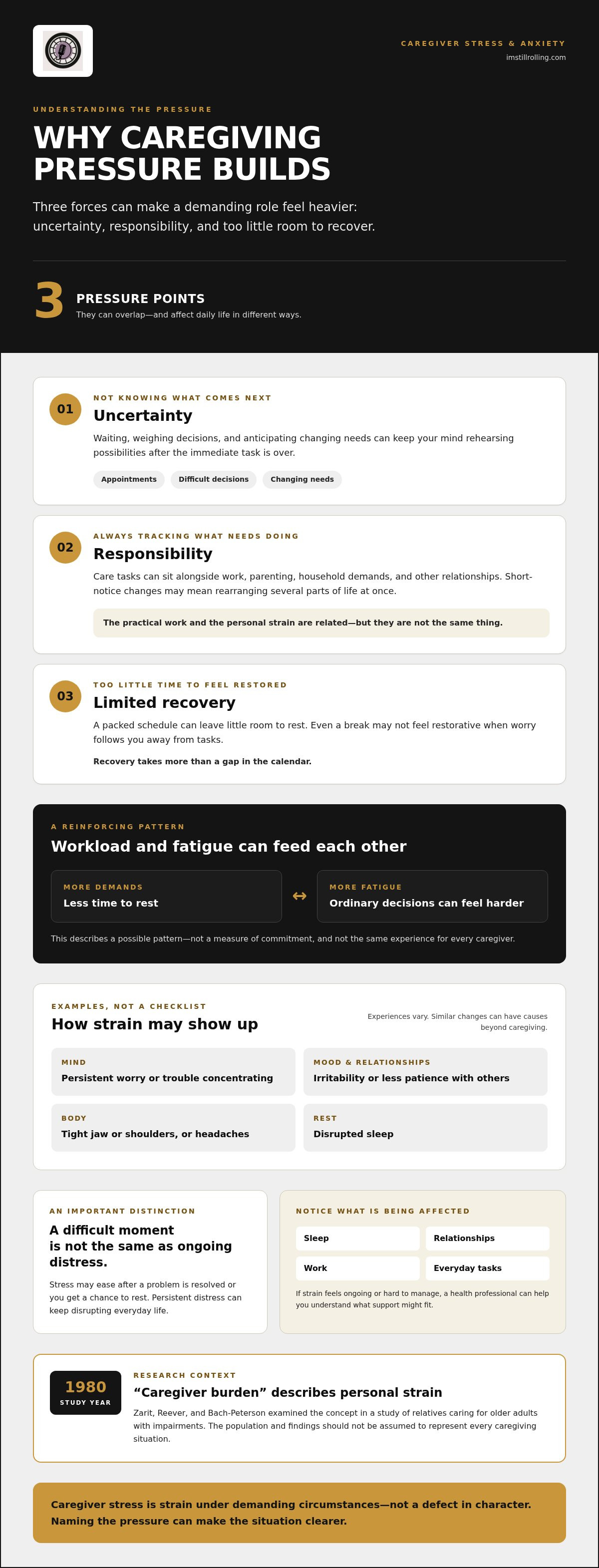
Why caregiving pressure can build: uncertainty, responsibility, and limited recovery
Which coping strategies may help with caregiver stress and anxiety?
A realistic plan for coping when caregiving already fills the day
Finding honest companionship in caregiver stories and shared experience
Coping with caregiver stress and anxiety starts with naming what is hard
Caregiving can hold several truths at once: deep affection, a sense of responsibility, uncertainty about what comes next, physical fatigue, and worry that follows you even when the room is quiet. You might be arranging appointments, tracking changing needs, and trying to stay present with someone you love, all while wondering whether you’re doing enough. That tension deserves to be named, not hidden behind pressure to feel grateful or capable every moment.
Caregiver stress is the strain that can build when the demands of supporting someone feel greater than the time, energy, or help available. It describes a difficult situation, not a defect in your character. Understanding caregiver stress can help put a name to how sustained responsibility may affect daily life, but no short description can capture every person’s circumstances.
What caregiver stress and anxiety can feel like
For one person, strain may look like persistent worry: replaying a conversation with a doctor, anticipating a difficult night, or feeling unable to switch off during a quiet moment. For another, it may show up as irritability, a tight jaw or shoulders, headaches, disrupted sleep, trouble concentrating, or less patience with family and friends. These are examples, not a checklist or diagnosis. Similar changes can have causes beyond caregiving, too.
Occasional stress is part of responding to demanding moments. It may ease when a problem is resolved or you get a chance to rest. Persistent distress is different, especially if it keeps disrupting sleep, relationships, work, or everyday tasks. You don’t have to decide on a label by yourself. If the strain feels ongoing or hard to manage, talking with a health professional can help you understand what support might fit.
Why mixed feelings do not make you a bad caregiver
You can love someone and feel frustrated by the demands of care. You can be devoted and grieve changes in your relationship, routines, or the future you once expected. Exhaustion can sit beside tenderness. None of those feelings, on its own, tells the whole story of how you care.
Guilt often appears when you rest, set a limit, or wish someone else would take over for a while. It may reflect how much you care or how strongly you feel responsible, but it isn’t proof that you’re failing. Caregiving doesn’t become more loving because you deny your own limits. Resilience isn’t endless self-sacrifice. It can also mean being honest about what is hard and recognizing that your needs belong in the picture.
There’s no universal timeline for caregiver strain, and no single pattern every caregiver follows. The person’s needs, your relationship, available support, and the rest of your life all shape the experience. Naming what’s happening isn’t a final judgment. It’s a clearer starting point for understanding what the situation is asking of you.
Why caregiving pressure can build: uncertainty, responsibility, and limited recovery
Caregiving pressure often grows in the spaces between tasks: waiting for an appointment, weighing a decision, or trying to plan when someone’s needs may change. Even when a day looks manageable from the outside, you may be mentally tracking what could go wrong, what needs doing next, and who else depends on you. That ongoing vigilance can make it hard to feel truly off duty.
Researchers have used “caregiver burden” to describe caregivers’ subjective response to the demands of providing care. Zarit, Reever, and Bach-Peterson examined the concept in a 1980 study of relatives caring for older adults with impairments. The phrase helps distinguish practical work from the personal strain that may accompany it, but that study’s population and findings should not be assumed to represent every caregiving situation.
The emotional weight of uncertainty and changing needs
Some decisions have no obvious right answer: how to balance a person’s wishes with safety concerns, coordinate help, or prepare for needs that might change. Not knowing what comes next can keep your mind rehearsing possibilities long after the immediate task is finished. For some caregivers, uncertainty is a major source of strain; others may experience it differently, depending on their circumstances and support.
Changes in care needs can unsettle routines that once made the day predictable. A plan built around an appointment, medication schedule, or level of assistance may need to be reconsidered when circumstances shift. The practical adjustment takes time, while the emotional adjustment may not happen at the same pace. The Office on Women’s Health offers information about managing caregiver stress, including common signs and ways to seek support.
When responsibility leaves too little room to recover
The workload and emotional strain can feed each other. A packed schedule may leave little time to rest, and fatigue can make ordinary decisions feel more demanding. Worry can also follow you into breaks, so time away from tasks doesn’t always feel restorative. This isn’t a measure of commitment; it’s a reminder that recovery takes more than a gap in the calendar.
Caregiving may also sit alongside paid work, parenting, household responsibilities, or other relationships. If plans change at short notice, you may have to rearrange several parts of life at once. Support can ease that pressure, but what’s available differs across families and communities. Some people have relatives nearby or flexible work; others face distance, limited resources, or responsibilities they can’t easily hand over.
Not every source of strain can be removed, and no single explanation fits everyone. Still, identifying whether the pressure comes from practical demands, emotional uncertainty, too little recovery, or a combination can make it easier to describe and address. For a human perspective alongside practical guidance, caregiving and resilience conversations offer stories of lived experience without suggesting that one person’s path is a template for another.
Which coping strategies may help with caregiver stress and anxiety?
There isn’t one right way to cope. A brief pause might help you through a tense moment, while practical help from someone else could give you time to rest. If distress persists or begins to interfere with daily life, professional support may offer a different kind of help. These approaches can complement one another. What feels useful depends on your needs, circumstances, and preferences.
Research findings should be read with their scope in mind. A strategy tested with a particular group, or as part of a larger program, isn’t proof that the same approach will work for every caregiver. A randomized trial of REACH II, a tailored multicomponent intervention for family caregivers of people with dementia, reported quality-of-life benefits that varied across racial and ethnic groups. The findings underscore that results may differ by population and outcome Belle et al., 2006.
Small personal practices for difficult moments
Keep the aim modest: make a little room to respond, rather than expecting to feel better immediately. If it suits you, pause and notice what’s happening in your body, try a few slower breaths, write down the thought that keeps circling, or take a short walk when it’s safe and possible. You might choose a quiet practice, prayer, movement, or another familiar way of grounding yourself. Pick what feels feasible and comfortable, and skip anything that adds pressure. These are possible supports, not cures or substitutes for needed care.
Support from other people and professionals
Practical help can start with a specific request, such as asking someone to handle an errand, meal, or appointment task. Peer groups may offer a place to speak with people who understand some of the terrain, though their experiences won’t match yours exactly, and a group isn’t individualized clinical care. A qualified mental health professional can provide a private setting to discuss persistent distress and consider appropriate support. Reaching out isn’t a verdict on your ability to care. It’s one way to respond to what you’re carrying.
A realistic plan for coping when caregiving already fills the day
A plan should make the day more manageable, not become another standard you have to meet. If your schedule changes without warning, use a flexible sequence you can return to when there’s room. You don’t have to solve every problem at once. Start by identifying one source of pressure and choosing a next step that fits the day you actually have.
Notice the strain. Pause long enough to name what feels hardest right now: a practical task, a difficult decision, lack of rest, or worry that keeps returning.
Choose one pressure point. Ask which part most needs attention today. It might be a single errand, an unanswered question, or a task that could be shared.
Pick one next step. Make it specific and small, such as writing down a question for an appointment or asking someone to handle one task.
Review and adjust. Later, notice whether that step helped, needs changing, or can wait. A disrupted plan isn’t a failed plan; care needs and available time can shift.
This approach to coping with caregiver stress and anxiety leaves room for unpredictable days. If a planned walk or quiet break disappears, your next step might be asking someone to sit with your loved one while you make a call. If nobody is available, reconsider the pressure point and choose something possible without blaming yourself for what you can’t control.
How to ask for help without explaining everything
You don’t need a perfect explanation to make a clear request. Name one task, time, or kind of support: “Could you pick up the groceries on Thursday?” or “Could you check in with me after the appointment? I don’t need you to fix anything, but I’d like to talk.” Specific requests help someone understand what would be useful without requiring you to tell the whole story.
They may not be able to say yes. That can sting, but it doesn’t mean the need was unreasonable. Consider whether another trusted person, community contact, or support option could help with that particular task. You can also ask for a different kind of help, such as a brief call rather than hands-on assistance.
How to recognize when more support is needed
If anxiety or low mood persists, worsens, or disrupts sleep, relationships, work, or everyday functioning, consider speaking with a qualified health or mental health professional. This article offers general education, not a diagnosis or clinical care. A professional can help you understand what you’re experiencing and discuss appropriate support.
If you or someone else faces immediate danger, or you can’t stay safe, seek urgent local emergency help now. Don’t wait to complete a coping plan first.
For a human perspective alongside practical steps, explore caregiving and resilience stories from people with lived experience. Their stories may offer recognition, but they aren’t a universal blueprint or a replacement for professional support.
Finding honest companionship in caregiver stories and shared experience
Practical guidance can help you decide what to do next, but sometimes what’s needed is the quieter recognition that another person understands how complicated care can feel. Stories won’t remove the work or uncertainty. They can make room for realities that don’t fit neatly into a checklist: love alongside frustration, the strain of changing roles, and the effort of continuing through an ordinary, demanding day.
I'm Still Rolling Podcast is a journalism-led podcast hosted by seasoned journalists Mike Sugerman and Janice Wright. Its conversations explore caregiving, disability, and resilience through the voices of guests who have lived through challenging circumstances. For listeners coping with caregiver stress and anxiety, a story may offer companionship or a new way to reflect on their own experience, without prescribing what they should feel or do.
What a lived story can offer, and what it cannot
Hearing someone describe a familiar moment can ease the sense of being alone with it. A guest’s account might put words to an emotion you’ve struggled to explain, or offer perspective on how care can affect identity, family relationships, and daily life. That recognition can matter, even when the details of your situation are different.
One person’s experience is not a universal template. A story doesn’t establish clinical evidence, predict another caregiver’s path, or replace individualized professional support. Hardship doesn’t need to be recast as a lesson or a source of inspiration to be worth hearing. If you’re caring for a spouse with Alzheimer’s, this guide to caregiving for a spouse with Alzheimer’s explores some of the emotional and practical changes that may arise in that specific context.
Choosing a format that fits the moment
There’s no single right way to engage with a story. Audio may fit a quiet moment or a familiar routine; video may feel more present when you have time and attention to watch; a written transcript lets you read at your own pace or return to a passage later. Choose what works for your circumstances, access needs, and energy. You can pause, stop, or come back another time. Listening or reading isn’t a task to complete, and you don’t need to take away a solution.
If honest stories feel like useful company today, explore I'm Still Rolling Podcast episodes or read their transcripts. Let them be one optional source of human perspective alongside the practical steps and support that suit your own life.
Let your next step be small and yours
You don’t have to wait until caregiving feels manageable to make one choice in support of your own wellbeing. It could be noticing what you need today, making space for a conversation, or deciding that getting help is the next step. Coping with caregiver stress and anxiety isn’t about becoming endlessly patient or self-sufficient. It’s about finding a more humane way to carry what’s in front of you.
Stories can offer company along the way without pretending that anyone else’s experience is exactly yours. I'm Still Rolling Podcast features journalist-hosted conversations with guests who have lived through challenging circumstances. Episodes are available in streaming and video formats, with written transcripts. They can be a thoughtful companion, not a replacement for the practical or professional support you may need.
If you’d like to spend time with honest perspectives on caregiving and resilience, explore stories from I'm Still Rolling Podcast. Take what resonates, leave what doesn’t, and remember that asking for support is not a failure of care. You deserve care, too.
Frequently Asked Questions
Is caregiver stress and anxiety normal?
Yes, feeling worried or strained can be a common response to the demands and uncertainty of caregiving, but “common” doesn’t mean you have to dismiss it. People respond differently, and stress can fluctuate as circumstances change. Notice whether it’s affecting your sleep, concentration, or ability to manage everyday responsibilities. If you’re unsure what’s contributing to how you feel, a healthcare professional can help you sort through possible causes without assuming caregiving is the only factor.
How can I cope with caregiver anxiety in the moment?
Try bringing your attention to one immediate, manageable thing rather than solving the entire situation at once. For example, place both feet on the floor, name five things you can see, then write down the next question or task that needs attention. If focusing on your breath feels comfortable, make your exhale a little slower. These steps may help you pause, but they won’t address every cause of anxiety or replace care you may need.
Can asking for help reduce caregiver stress?
It can, especially if the help addresses a specific recurring pressure. Instead of saying, “I need more support,” you could ask a relative to handle pharmacy pickup every Tuesday or a friend to sit with your loved one during a phone appointment. Clear requests make it easier to understand what you’re asking for. If the person can’t help, consider whether they could take on a different task or suggest someone else to approach.
What are signs that caregiver stress is becoming too much?
Pay attention to changes that persist or make ordinary responsibilities harder, such as regularly missing meals, withdrawing from people you trust, making mistakes you wouldn’t usually make, or feeling unable to recover after sleep. A single difficult day doesn’t tell the whole story, and these signs don’t diagnose a condition. If changes continue, write down what you’ve noticed and when, then share that information with a healthcare professional.
How do I cope with caregiver guilt when I need a break?
Try treating the need for a break as information about your limits, not evidence of disloyalty. You might remind yourself, “I can care about this person and still need time to reset.” Make the pause concrete: choose a short window, decide who will be available if needed, and use the time in a way that feels restorative to you. Guilt may still arise; its presence doesn’t mean taking a break is wrong.
Can caregiver stories or podcasts help with stress and anxiety?
They may offer recognition or a useful way to reflect, especially if a guest’s account gives words to an experience you haven’t been able to describe. You can pause or stop if a story feels too close to your circumstances. A personal account isn’t clinical guidance, proof that a particular approach works, or a prediction of what will happen in your life. Let it be one optional source of perspective.
When should a caregiver seek professional help for anxiety?
Consider speaking with a qualified health or mental health professional if anxiety persists, intensifies, interferes with daily functioning, or feels difficult to manage alone. You can start by describing what has changed, how long it has been happening, and what makes it harder or easier. If you or someone else is in immediate danger or cannot stay safe, contact local emergency services now. Educational information cannot replace individualized clinical care.



Comments