Caregiving for a Spouse with Alzheimer's: Navigating the Emotional and Practical Shift
The person you married hasn't left the house, yet you find yourself grieving a ghost while they sit right across from you at the breakfast table. This is the heavy, unspoken reality of caregiving for spouse with alzheimer's, where the vows of "in sickness and in health" transform into a daily endurance test of the soul. You aren't just managing medications, tracking appointments, or organizing a household; you're witnessing the slow, agonizing erosion of a shared history. It's a role you never auditioned for, and the isolation can often feel like a secondary diagnosis.
It's natural to feel a crushing sense of guilt when frustration bubbles up or to feel invisible as your own identity is swallowed by the demands of care. We'll explore how to handle this complex identity shift with journalistic honesty and resilient strategies that go beyond basic medical checklists. This discussion covers practical ways to manage behavior changes, the newest 2026 Medicare support options like the GUIDE Model, and how to reclaim a sense of self while still honoring the person you love.
Table of Contents
The Silent Transformation: When Your Spouse Becomes Your Patient
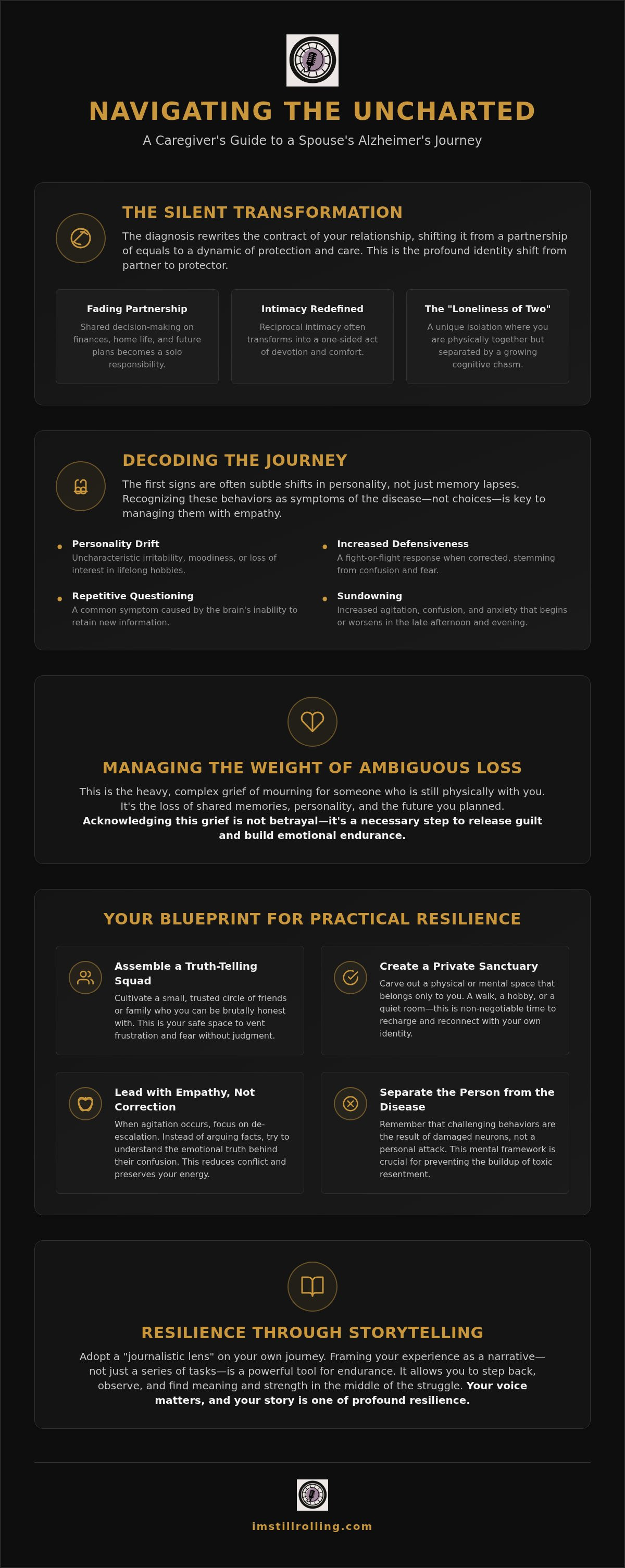
The diagnosis doesn't just change your spouse; it rewrites the contract of your marriage. Unlike caring for an aging parent, caregiving for spouse with alzheimer's involves the dismantling of a peer relationship. You move from a partnership of equals to a dynamic where you are the sole navigator, the memory keeper, and the primary protector. This shift requires an unflinching honesty. It demands that you look at the person you love and acknowledge that the shared future you planned has fundamentally changed. Household dynamics shift overnight. Intimacy, once a language of reciprocity, becomes a one-sided act of devotion. To move forward, you need a dose of realistic optimism. This isn't about pretending everything is fine. It's about finding the small, resilient victories within a difficult reality. It's about acknowledging the weight without letting it crush your spirit.
The Identity Shift: From Partner to Protector
Shared decision-making is often the first casualty of this disease. When your spouse can no longer weigh in on financial choices, home repairs, or even what's for dinner, your own self-worth can feel unmoored. You're left in the "loneliness of two," a state where you are physically together but emotionally separated by a growing cognitive chasm. This is a unique isolation that friends who aren't "in it" rarely understand. The caregiver identity crisis is a pivotal life transition where the boundaries of self and spouse blur, forcing a profound redefinition of love and duty. Navigating the unique challenges of dementia caregiving means learning to value yourself even when your partner can no longer mirror that value back to you.
The Journalistic View: Reporting from the Front Lines of Home
Journalists Mike Sugerman and Janice Wright understand that the truth is often messy. On the I'm Still Rolling Podcast, they don't look away from the grit of disability and caregiving. They treat their own journey like a story that needs to be told with rigor and heart. By adopting this journalistic lens, you can start to document your own experience. It helps you step back from the emotional whirlpool and observe the situation with a bit of professional distance. You stop asking "why us?" and start asking "what now?". Storytelling becomes a tool for endurance. It allows you to frame your daily grind not just as a series of chores, but as a narrative of profound resilience. It's about finding meaning in the middle of the struggle.
Decoding the Alzheimer's Journey: Beyond Simple Memory Loss
Most people define Alzheimer's by the things that go missing: the misplaced keys, the forgotten names, or the missed anniversaries. However, the reality of caregiving for spouse with alzheimer's is far more complex than simple forgetfulness. It's a journey marked by a subtle "personality drift" that often precedes the major cognitive gaps. You might notice your partner becoming uncharacteristically irritable, or perhaps they lose interest in the hobbies that once defined them. These shifts aren't just quirks of aging; they're the first tremors of a fundamental neurological reorganization.
Using a journalistic lens helps strip away the confusing medical jargon that often surrounds this diagnosis. While a neurologist might talk about "amyloid plaques" or "executive dysfunction," the caregiver deals with the lived reality of these terms: aggression, repetitive questioning, and the exhausting phenomenon of sundowning. These behaviors aren't choices made by your spouse. They're the result of a brain that can no longer filter stimuli or regulate emotions. Understanding this biological basis is essential for moving from a place of personal hurt to one of strategic management while caregiving for spouse with alzheimer's.
Recognizing the Early Onset and Behavioral Shifts
The earliest signs of decline are often the most difficult to name. A spouse's sudden "moodiness" or defensiveness can easily be mistaken for a marital slump. When you begin to see these patterns, the way you communicate must change. Direct corrections often trigger a fight-or-flight response. Instead of pointing out a mistake, lead with empathy. If they become agitated, de-escalation is your most powerful tool. It's about finding the emotional truth behind their confusion rather than arguing over the facts of a situation.
The Science of Resilience in the Face of Decline
Endurance in this role requires more than just grit. It requires a mental framework that separates the person from the disease. When you understand that their anger is a firing of damaged neurons rather than a reflection of your relationship, you can reduce the toxic buildup of resentment. This kind of resilience is a universal human capacity. We see this same spirit in spinal cord injury recovery stories, where individuals must rebuild their lives around a new and difficult physical reality. It's about developing a strategy for the long haul, ensuring you remain as whole as possible while your spouse's world narrows. For more honest reflections on these transitions, you might find comfort in the I'm Still Rolling Podcast where we explore these lived truths together.
Managing the Weight of Ambiguous Loss
Ambiguous loss is a unique kind of haunting. It is the specific grief that occurs when a loved one is physically present but psychologically absent. In the context of caregiving for spouse with alzheimer's, this manifests as a long, slow goodbye that can last for years. You aren't mourning a death in the traditional sense; you are mourning the disappearance of the person who once knew your secrets, shared your bed, and planned a future with you. This creates a psychological limbo where the normal rituals of mourning don't apply, leaving you to navigate a landscape of shifting shadows without a map.
The most common objection caregivers raise is a paralyzing sense of guilt. You might ask yourself how you can justify grieving for someone who is still sitting right in front of you. This isn't a betrayal of your spouse. It's an honest testament to the depth of the connection you've lost. The emotional reality of this journey is often messy. It includes flashes of white-hot anger at the disease, profound sadness, and even moments of quiet relief when a particularly difficult day finally ends. Suppressing these emotions doesn't make you a better partner; it just makes the weight heavier. A deep-dive into your own emotional health is a necessity, not a luxury, for surviving this marathon.
The Myth of the 'Perfect' Caregiver
Society often pushes a trope of the tirelessly cheerful saint, the caregiver who handles every crisis with a smile and infinite patience. This image is a dangerous trap that leads to burnout and self-loathing. Acknowledging your own suffering and exhaustion isn't a sign of failure. It's a prerequisite for the endurance required in caregiving for spouse with alzheimer's. You have to be honest about the toll this takes on your own spirit to stay standing. Caregiver guilt is a natural byproduct of a broken heart, a reflection of the love you still carry for the person who is fading away.
Finding Meaning in the Struggle
There is a strange, quiet beauty that can be found even in the breakdown of a changing marriage. When the old roles and expectations vanish, new forms of intimacy can emerge, centered entirely on the present moment. By adopting a journalistic approach, you can start to find the "story" in your daily resilience. Framing your journey as a narrative of endurance helps you move from being a victim of circumstance to an active witness of the human spirit. This perspective allows you to maintain a vulnerable peer connection with others who have been there, transforming your private isolation into a shared, honest conversation about what it means to love through the impossible.
Practical Resilience: Building Your Caregiving Infrastructure
Survival in the long marathon of caregiving for spouse with alzheimer's requires more than just a sturdy heart; it demands a structural overhaul of your daily life. You cannot sustain the role of a 24-hour medical professional, housekeeper, and emotional anchor without a functional infrastructure. The first step is assembling a "truth-telling" support squad. These are the friends, family members, and professionals who won't offer platitudes but will instead listen to the grit of your reality. Beyond people, you need a physical sanctuary. Whether it's a spare bedroom or a specific chair in the garden, you must have a space that is entirely your own, where the disease is not allowed to enter. This boundary is essential for maintaining a sense of self that exists independently of your partner's decline.
Effective management also involves tactical self-care. This isn't about spa days; it's about brief, intense periods of total disconnection where you reclaim your mental bandwidth. Use technology to your advantage. Documenting care needs through digital logs or utilizing Podcast Transcripts to process complex information can save you from the "decision fatigue" that often leads to mistakes. Eventually, you must transition from "doing it all" to "managing the care." This means delegating tasks to others so you can focus on the emotional connection that remains. If you're looking for more guidance on this transition, explore our I'm Still Rolling Podcast Episodes for a journalistic perspective on navigating adversity.
Navigating the First Six Months of Diagnosis
The initial months following a diagnosis are a whirlwind of administrative and emotional chaos. It's the critical window for securing legal and financial paperwork, including durable power of attorney and updated medical directives. As of August 2026, programs like the Medicare GUIDE Model can offer vital care coordination and a respite benefit of approximately $2,500 per year. A common trap during this phase is "over-promising" your own capacity. You might feel you can handle everything alone now, but you must plan for the person you will be two years from now. Setting realistic boundaries early prevents the resentment that often poisons the caregiving relationship later.
Combating Caregiver Burnout with Realistic Optimism
Chronic stress manifests physically. Insomnia, unexplained aches, and a weakened immune system are often the first signs that caregiving for spouse with alzheimer's is taking a dangerous toll. You have to view respite as a medical necessity, not a luxury or a sign of weakness. Creating a resilience roadmap involves scheduling your own health screenings and social engagements with the same rigor you apply to your spouse's neurology appointments. This isn't about being a "perfect" caregiver. It's about being a resilient one who knows when to tap out so they can eventually tap back in with a clear head and a steady hand.
Resilience Through Storytelling: Why Your Voice Matters
Storytelling is the final, vital piece of the resilience puzzle. It moves the experience from the private sphere into a shared space, transforming individual pain into collective wisdom. When caregiving for spouse with alzheimer's, the silence of the daily grind can be deafening. Breaking that silence through narrative allows you to reclaim the identity you might've felt slipping away in the earlier stages of the journey. The long-form interview format isn't just about sharing facts; it's about processing the trauma of ambiguous loss and finding a steady pulse of hope through the act of vocalizing your truth. It's an invitation to move from being a silent sufferer to becoming a resilient storyteller.
Sharing your journey helps others "roll" through their own adversity. It creates a steady, reliable pulse that keeps the community engaged through complex and often heavy subject matter. When you speak your truth, you provide a roadmap for the person just starting their first six months of diagnosis. You offer them the realistic optimism that is so often missing from clinical brochures. This exchange of lived intimacy is what builds the endurance necessary for the long haul, reminding every caregiver that their perspective is a valuable contribution to a much larger narrative of human strength.
Finding Community in the I'm Still Rolling Podcast
Mike Sugerman and Janice Wright use their seasoned journalistic background to host conversations that are profoundly honest and unflinching. They understand that superficial cheerfulness is an insult to the gravity of your situation. On the I'm Still Rolling Podcast, they don't look away from the grit of disability and caregiving. By subscribing to the I'm Still Rolling Newsletter, you receive weekly doses of this grounded, soulful connection. You'll also find Podcast Transcripts that make these deep-dives accessible, ensuring you can return to the insights that resonate most during your own lonely hours of caregiving for spouse with alzheimer's.
The Next Step: Joining the Resilience Movement
Your experience has value beyond your own household. By sharing your journey, you contribute to a broader movement that advocates for disability rights and better support systems. We invite you to engage with brand partnerships that align with these values, helping to build a world that recognizes the weight of your labor. Your "grit and determination" stories are the heartbeat of this community. They remind us that while the path is difficult, we don't have to walk it in silence. You have the power to spark transformation in others. Listen to the latest episodes of the I'm Still Rolling Podcast and start your own journey toward narrative resilience today.
Reclaiming the Narrative of Love and Duty
Navigating the complex landscape of caregiving for spouse with alzheimer's is perhaps the most difficult assignment life will ever hand you. It's a journey that requires you to hold two conflicting truths at once: the profound sorrow of a fading partnership and the fierce determination to protect what remains. By establishing a support infrastructure and carving out a private sanctuary, you ensure that your own identity isn't entirely consumed by the disease. You've learned that acknowledging your grief isn't a betrayal; it's an honest response to an impossible situation.
You don't have to carry this weight in a vacuum. Mike Sugerman and Janice Wright, both award-winning journalists, have walked this path and created a safe space for real stories of life after adversity. Their grounded, soulful connection provides a vital companion for your loneliest hours. Subscribe to the I'm Still Rolling Podcast for authentic stories of resilience and move from being a silent sufferer to a resilient storyteller. Your voice carries weight, and your story of endurance is far from over.
Frequently Asked Questions
How do I deal with the personality changes in my spouse with Alzheimer's?
Managing personality changes requires a shift from logic to empathy. When your spouse becomes aggressive or repetitive, it's a result of damaged neurological filters, not a personal attack. Stop correcting their version of reality. Instead, validate the emotion they are feeling in the moment. This approach reduces friction and helps you maintain a sense of calm during difficult behavioral episodes. It's about finding the emotional truth behind their confusion.
Can I really care for my spouse at home for the entire duration of the disease?
Staying at home for the entire duration is possible for some, but it usually requires a robust infrastructure of professional help. As the disease progresses, the physical demands of caregiving for spouse with alzheimer's often exceed what one person can provide alone. You should assess your capacity regularly. Transitioning to a memory care facility, which costs a median of $6,690 monthly in 2026, is a choice based on safety and quality of life.
What is the best way to explain the diagnosis to adult children and friends?
Use unflinching honesty when discussing the diagnosis with adult children and friends. Describe the specific cognitive changes you are seeing so they understand the gravity of the situation. This transparency prevents misunderstandings and helps your support squad know exactly how to help. By framing it as a medical reality, you remove the stigma and allow your community to offer meaningful, practical assistance that actually lightens your load.
How much does professional in-home care usually cost in 2026?
In 2026, the national median cost for a non-medical in-home caregiver is approximately $35 per hour. If you require around-the-clock professional assistance, costs can reach about $25,500 per month for care hours alone. These figures highlight the importance of early financial planning. You should also explore the Medicare GUIDE Model, which provides care coordination and a respite benefit of up to $2,500 annually to help manage these significant expenses.
What happens if I get sick and cannot care for my spouse?
You must establish a formal emergency backup plan before a crisis occurs. Identify a local respite facility or a home care agency that can step in immediately if you become incapacitated. The Medicare GUIDE Model is specifically designed to help with this kind of care coordination. Having a truth-telling support squad briefed on your spouse's routine ensures that the transition of care is as seamless as possible for everyone involved during your recovery.
Is it normal to feel angry or resentful toward my spouse with Alzheimer's?
Feeling anger or resentment is a completely normal response to the exhausting demands of caregiving for spouse with alzheimer's. You are grieving a shared life while still performing high-level medical and emotional labor. These messy emotions don't make you a bad partner; they make you human. Acknowledging this frustration is the first step toward finding a healthier balance and preventing the toxic buildup of caregiver burnout that can damage your own health.
How can I find a support group that focuses on spouses rather than children of patients?
Seek out groups specifically labeled for spousal caregivers to ensure the conversation focuses on the unique loss of a life partner. Organizations like the Alzheimer’s Association often host these specialized meetings. You can also find niche online communities where the focus is on the marital evolution rather than parent-child dynamics. Connecting with peers who understand the loneliness of two provides a level of empathy that general groups often lack during the deep-dive conversations.
What are the first signs that I am suffering from caregiver burnout?
Burnout often starts with physical symptoms like chronic fatigue, frequent headaches, or a weakened immune system. You might also notice a loss of interest in your own hobbies or a growing sense of isolation from friends. If you feel a constant sense of hopelessness or white-hot irritability, it's a clear sign that you've exceeded your capacity. Recognizing these red flags early allows you to implement tactical self-care before your health fails entirely.



Comments