Caregiver Isolation Support: Breaking the Silence of the Invisible Struggle
What if feeling alone while caring for someone isn’t a sign that you love them any less, but a signal that your own life has become harder to see? You can spend every day beside another person and still feel unseen, especially when the work is constant, the thanks are quiet, and conversations rarely reach beyond care needs. Seeking caregiver isolation support doesn’t make you selfish. It means your need for connection matters, too.
If you’ve lost touch with parts of yourself or feel guilty for missing your old life, you’re not failing. Caregiving can narrow the time available for friendship, rest, and being known as more than someone’s caregiver. The loneliness is real, even when your days are full.
This article explores why caregiving can feel isolating and offers practical, low-pressure ways to reconnect without adding another burden to your list. You’ll also find a reminder that your story belongs among others who understand. Honest conversations about caregiving and resilience, including those shared on the I'm Still Rolling Podcast, can help connection begin with something as simple as hearing someone put your experience into words.
Key Takeaways
Learn to distinguish being physically alone from feeling lonely, even when you’re rarely apart from the person you care for.
Understand how limited time and uncertainty about what to say can quietly weaken social ties, without assuming those relationships are beyond repair.
Explore caregiver isolation support through small, manageable ways to keep social connections alive without adding a demanding new routine.
Discover how honest stories, podcast episodes, transcripts, and a newsletter can offer a low-pressure touchpoint with a wider community.
Table of Contents
What is Caregiver Isolation? Defining the Invisible Wall
Caregiver isolation is the emotional or physical withdrawal from social networks that can happen when caregiving demands take up time, energy, and attention. It may mean fewer visits, missed invitations, or conversations that fade because there’s little room to maintain them. But isolation isn’t measured only by who’s in the room. You can sit beside someone you love, tending to their needs, and still feel painfully alone.
That experience can form an invisible wall: the outside world seems to carry on in a language you no longer speak. Friends may talk about plans you can’t make or concerns that feel far from the decisions shaping your day. You may miss the ease of ordinary connection, not because you care less, but because your daily reality has changed.
The Difference Between Social Isolation and Loneliness
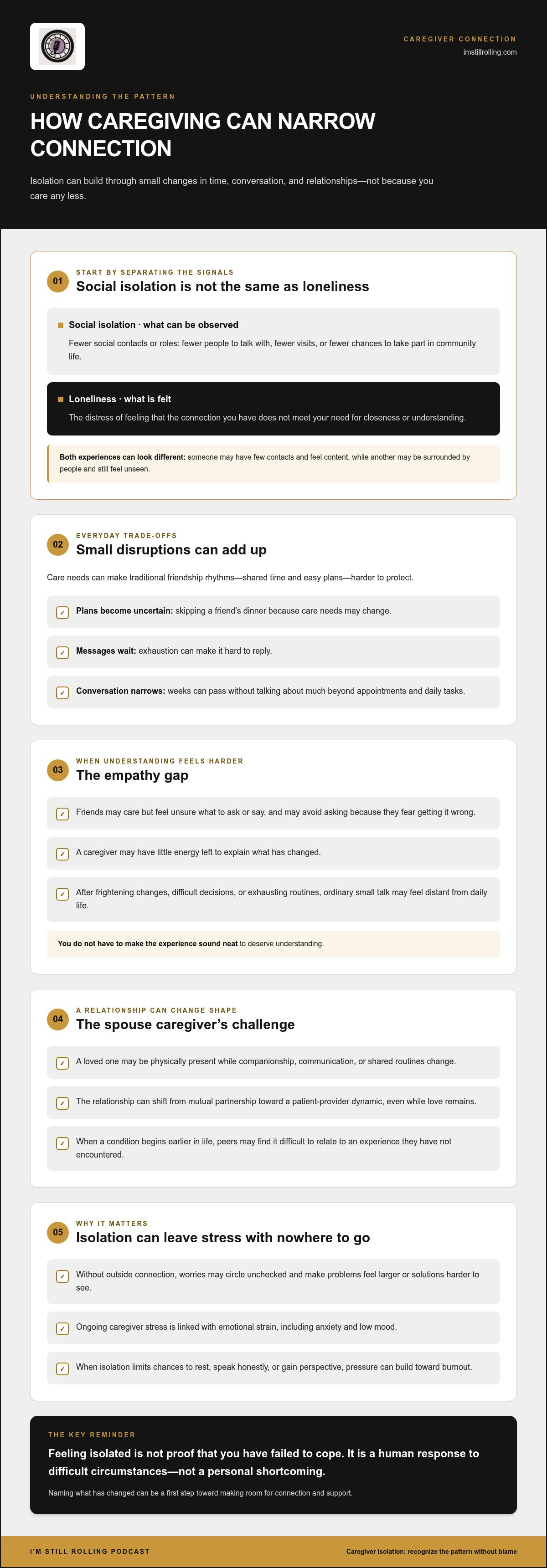
Social isolation describes the more observable side: a limited number of social contacts or roles, such as fewer friends to talk with or fewer opportunities to take part in community life. Loneliness is subjective, the distressing sense that the connection you have doesn’t meet your need for closeness or understanding. One person may have few contacts and feel content; another may be surrounded by people yet feel unseen.
When caregiving reduces social contact while the loneliness of unmet connection grows, the strain can accumulate and contribute to caregiver burnout.
The wider Caregiver burden framework helps show why: caregiving can involve both practical demands and the emotional weight of living with them. Isolation isn’t simply one more item on a checklist. It can shape how the whole experience feels.
Why Caregivers Often Feel Invisible
Attention often gathers around the person receiving care. Their needs may be visible and urgent, while the caregiver’s fatigue, worry, and changing relationships remain in the background. Even well-meaning friends may not know what to ask or say, and the caregiver may not have the energy to explain what has changed. Gradually, fewer people check in on the person doing the caring.
There can also be a loss of self. If others recognize you mainly as someone’s spouse, adult child, or caregiver, the interests and ambitions you had beyond that role can feel harder to reach. Wanting to be seen as an individual again doesn’t mean you’re rejecting your loved one. It means you’re still a person with needs, memories, and a life of your own.
Feeling isolated isn’t proof that you’ve failed to cope or that you’re ungrateful. Care demands can narrow the time and space available for connection, while social expectations often leave caregivers’ needs overlooked. Caregiver isolation support begins with naming that reality without blame: this is a human response to difficult circumstances, not a personal shortcoming.
The Anatomy of Loneliness: Why Caregiving Leads to Seclusion
Isolation rarely arrives all at once. It grows through small trade-offs: skipping a friend’s dinner because care needs are unpredictable, letting a message go unanswered because you’re exhausted, or realizing weeks have passed without a conversation about anything beyond appointments and daily tasks. Traditional friendships often rely on shared time and easy plans, both of which caregiving can make difficult to protect.
Then there’s the empathy gap. Friends may care but feel unsure what to say, especially when there’s no simple update or reassuring ending. They might avoid asking rather than risk saying the wrong thing. Meanwhile, medical trauma can make ordinary conversation feel distant. After frightening changes, difficult decisions, or exhausting routines, small talk may seem to belong to another life. You shouldn’t have to make your experience sound neat to be understood.
The Spouse Caregiver’s Unique Challenge
For a spouse, caregiving can involve a particular kind of living grief: the person you love is physically present, yet their companionship, communication, or shared routines may be changing. The relationship can shift from mutual partnership toward a patient-provider dynamic, even while love remains. If a condition begins earlier in life, peers may struggle to relate to a reality they haven’t encountered. This guide to caregiving for a spouse with Alzheimer’s explores some of those emotional and practical changes.
The Physical and Mental Toll of Staying Isolated
Isolation can leave stress with nowhere to go. Without outside connection, worries may circle unchecked: “I should be doing more,” or “No one else could understand.” That echo chamber can make problems feel larger and solutions harder to see. Ongoing caregiver stress is also linked with emotional strain, including anxiety and low mood. Professional guidance on managing caregiver stress often emphasizes seeking support and accepting help as part of healthy coping.
There’s no need to diagnose yourself to take this seriously. When isolation reduces the chance to rest, speak honestly, or gain perspective, the pressure can build toward burnout. Reaching for caregiver isolation support isn’t an admission that you’re coping badly. It’s a way to make sure the person providing care isn’t left to carry every feeling alone.
Connection doesn’t have to begin with a big plan or a polished explanation. A story from someone who has lived through caregiving may offer a gentler starting point. Explore honest stories of caregiving and resilience when you’re ready to hear experiences that make room for the complicated parts.
Breaking the Silence: The Power of Shared Narrative
Loneliness often insists that your experience is singular: no one else could understand the decisions, tenderness, frustration, or grief threaded through an ordinary day of care. A story can interrupt that certainty. Hearing someone describe a feeling you’ve kept private doesn’t erase the demands of caregiving, but it can replace “I’m the only one” with “Someone else has felt this, too.” That recognition is a meaningful first step toward connection.
These stories matter most when they tell the truth without polishing away the difficult parts. A journalistic approach to resilience doesn’t reduce a life to tragedy or force it into an uplifting lesson. It listens closely to the complicated middle: what changed, what hurt, what endured, and how a person kept moving through uncertainty. The people sharing those experiences become peers, not distant examples of perfect strength. Their stories of recovery and hope after life-altering adversity can offer a lifeline by making room for your own unfinished story.
Why Podcasts Can Offer Companionship
Audio offers a form of passive companionship that can fit into a caregiving day. You might listen while folding laundry, preparing a meal, or sitting nearby during a quiet stretch. No appointment or elaborate conversation is required. A human voice in the room can make a solitary task feel less cut off from the wider world.
Podcast conversations can also take time to hold nuance that a social media highlight reel often leaves out. They can make room for contradiction, pauses, and the hard-won details behind resilience. You don’t have to compare your life with someone else’s; you can simply listen and notice what feels familiar.
The I'm Still Rolling Approach to Resilience
Hosted by journalists Mike Sugerman and Janice Wright, I’m Still Rolling brings professional journalistic insight to honest conversations about disability, caregiving, and life after adversity. The focus isn’t only on what happened, but on what follows: how people live with change, find meaning, and continue through circumstances they never chose.
That distinction matters. Resilience isn’t a demand to feel hopeful every day, and another person’s story can’t prescribe how you should cope. Instead, guests’ experiences may help you recognize parts of your own: the uncertainty, the endurance, even the small moments that don’t fit a simple narrative. For caregiver isolation support, that kind of recognition can make connection feel possible before you’re ready to explain everything aloud.
Listening is one gentle way to begin. The podcast is available in audio and video, with written transcripts, so you can engage in the format that suits the moment.
Practical Strategies for Caregiver Isolation Support
Connection doesn’t have to mean adding a weekly meeting or rebuilding your social life overnight. Start with the smallest thread you can keep hold of. A brief message, voice note, or call can remind someone you’re still there, and remind you that your world is wider than caregiving. Choose one person and one low-effort way to stay in touch. Consistency matters more than an elaborate plan.
A podcast can offer a different kind of pause, a “respite of the mind” that doesn’t require leaving the room. Listening to a thoughtful conversation while doing a familiar task may create a little mental space and companionship. Reading may fit better on another day: transcripts and newsletters let you take in a story or update at your own pace.
Finding the Right Support Community
Some support groups are organized around education or coping strategies; peer-led narrative communities center on shared experience and the freedom to tell an imperfect story. Either can be useful, but it shouldn’t feel like another demand. Before committing, notice whether a group feels respectful and manageable. You can try one conversation or resource first rather than promising yourself ongoing participation.
Does it feel safe? You should be able to share at your own pace without pressure to disclose.
Does it fit your capacity? Consider whether the format and time commitment feel realistic right now.
Do you feel heard? Notice whether the space makes room for your experience, not just advice or comparison.
Can you step back? A helpful community won’t make you feel guilty for missing a session or taking a break.
If joining a live group feels like too much, start with a written transcript or newsletter. Reading a few paragraphs can be a real point of contact, not a lesser version of connection.
Communicating Your Needs to the Outside World
People who care about you may need clear direction. Try: “I don’t need advice right now; I just need you to listen.” Or, “Could you check in by text this week? I may not have time for a call, but I’d love to hear from you.” Specific requests make it easier for friends to show up in ways that genuinely help.
For a small break, ask for one specific favor: “Could you pick up one item while you’re out?” or “Can you sit with us for a short visit so I can step outside?” These aren’t tests of friendship; they’re invitations to share a manageable part of the load. In social settings, use your own name and mention something you enjoy or care about, so others meet the person you are, not only the role you fill.
For a low-pressure moment of connection, explore I’m Still Rolling podcast episodes and stories in the format that suits you.
Reclaiming Your Voice with I'm Still Rolling
Isolation can make caregiving feel like a story you’re carrying alone. Shared experience offers another possibility: a way to hear your own complicated feelings reflected in someone else’s words, without pretending the hard parts have disappeared. Connection doesn’t undo what has changed, but it can help restore a sense of being seen, understood, and more than the role you perform each day.
For some caregivers, listening to a podcast can become a small ritual of self-preservation. It doesn’t need to be another task or a promise to feel better. It can simply be a few minutes spent with a story that meets you where you are, while you rest or move through a familiar routine. Explore the podcast’s conversations about resilience to find stories and formats that fit your day.
Subscribe to the Resilience Community
A newsletter can offer a regular touchpoint with stories and ideas, especially when making plans or joining a live group feels out of reach. It gives connection a quieter rhythm: something to read when there’s room, set aside when there isn’t, and return to without needing to explain your absence.
Podcast transcripts offer another way to spend time with a conversation. You can pause, reread a passage, or take in a story in quiet, at your own pace. Listening, watching, and reading each make space for connection differently. Choose what fits the day you’re having, rather than turning support into another standard you have to meet.
Breaking silence doesn’t require a grand confession. Your first step might be reading a story that resonates, sharing one honest sentence with a trusted person, or simply recognizing that you want to be heard. That desire is worth honoring.
The Role of Journalistic Integrity in Support
Hosted by journalists Mike Sugerman and Janice Wright, I’m Still Rolling brings professional journalistic insight to conversations about disability, caregiving, resilience, and life after adversity. Honest conversations make room for more than a neat before-and-after story. They can challenge stigma by treating people’s lived experiences with seriousness and humanity, rather than reducing them to a diagnosis or a source of inspiration.
That approach can make the podcast a companion, not because it has simple answers, but because it respects the truth of lives in progress. Caregiver isolation support may begin with hearing someone else name an experience you thought you had to keep private. Life has changed. You’re still here, still a person with a voice and a story, and you don’t have to carry either alone. You’re rolling, and you’re not rolling alone.
Let Connection Begin With One Small Step
Caregiver isolation isn’t a personal failure, and feeling lonely doesn’t mean you love the person you care for any less. The demands of caregiving can make familiar relationships harder to sustain, while honest stories can remind you that your experience isn’t yours alone. Even a small moment of connection, a message, a few minutes of listening, or a story that puts your feelings into words, can help you feel seen again.
I’m Still Rolling brings journalistic insight from hosts Mike Sugerman and Janice Wright to stories about disability and resilience. Explore the podcast through video or audio, or spend time with a written transcript. These stories don’t promise an easy answer; they offer company and a wider view of what it means to keep going.
Let realistic optimism begin where you are. Life may have changed, but your identity and need for connection still matter. Explore I’m Still Rolling episodes, read a transcript, or subscribe to the newsletter. You’re still here, and you don’t have to feel alone in the story you’re living.
Frequently Asked Questions
How do I know if my caregiver isolation is becoming clinical depression?
You can’t determine that from loneliness alone, but persistent low mood, loss of interest, hopelessness, changes in sleep or appetite, difficulty concentrating, or trouble managing daily life are reasons to talk with a healthcare professional. They can help assess what’s happening and discuss support. You deserve help before things feel unbearable. If you might harm yourself or someone else, seek immediate help through local emergency services or a crisis line.
What are the first steps to take when I feel completely alone in my caregiving role?
Start by naming the feeling without blaming yourself, then choose one manageable connection. You might text someone, “I’m having a hard day. Could you listen for a few minutes?” If a conversation feels like too much, read a caregiver’s story or listen to a podcast while doing a familiar task. Caregiver isolation support doesn’t have to begin with a major plan; one honest exchange can be a first step.
Can listening to a podcast really help with my feelings of isolation?
A podcast can offer a sense of companionship and recognition, though it isn’t a substitute for personal, clinical, or practical support when you need it. Hearing someone speak honestly about caregiving or adversity may help you feel less like the only person carrying complicated emotions. Try listening during a routine task, or choose a transcript if reading feels easier. Notice whether the experience comforts you, and let that guide what you choose next.
How can I find time for support when my caregiving duties are 24/7?
Look for support that fits into time you already have rather than requiring a new appointment. Send a brief voice note, read a few paragraphs of a transcript, or listen while preparing a meal. You can also make a specific request to someone you trust, such as sitting with your loved one while you take a short break. Small moments won’t solve every pressure, but they can create room to breathe and reconnect.
What should I say to friends who have stopped calling since I became a caregiver?
You could try a direct, low-pressure message: “I miss talking with you. My schedule is unpredictable, but I’d love a short text or call when you can.” If you need listening rather than advice, say so: “I don’t need solutions right now; I just need you to hear me.” Friends may not understand what would help until you tell them. Their response can guide how much energy you invest in reconnecting.
Is it normal to feel resentful of the person I am caring for because I am lonely?
Resentment can arise when you’re exhausted, isolated, or carrying more than feels manageable; it doesn’t automatically mean you love the person less. Feelings aren’t the same as actions, and you don’t need to punish yourself for having them. Try to notice what the resentment may be signaling, such as a need for rest, connection, or help. If you fear you may act unsafely, step away if possible and seek immediate support.
How do I explain my isolation to family members who think I’m “doing fine”?
Describe what they may not see, then make one clear request. For example: “I know I seem composed, but I’ve been feeling cut off from other people. Could you call me once this week and let me talk without trying to fix it?” Concrete details can help family understand that managing daily responsibilities doesn’t mean you feel supported. You can also tell them what would make a visit or check-in genuinely useful.
Where can I find caregiver support that doesn’t feel like a clinical therapy session?
Consider peer communities built around shared stories, informal conversations, or caregiver-focused media. I’m Still Rolling, hosted by journalists Mike Sugerman and Janice Wright, shares honest conversations about caregiving, disability, and resilience. Episodes are available in audio and video, with written transcripts for readers who prefer a quieter format. The newsletter can also provide a gentle touchpoint without requiring you to join a live discussion or share before you’re ready.



Comments