Becoming a Caregiver Overnight: Navigating the Sudden Shift in Identity and Life
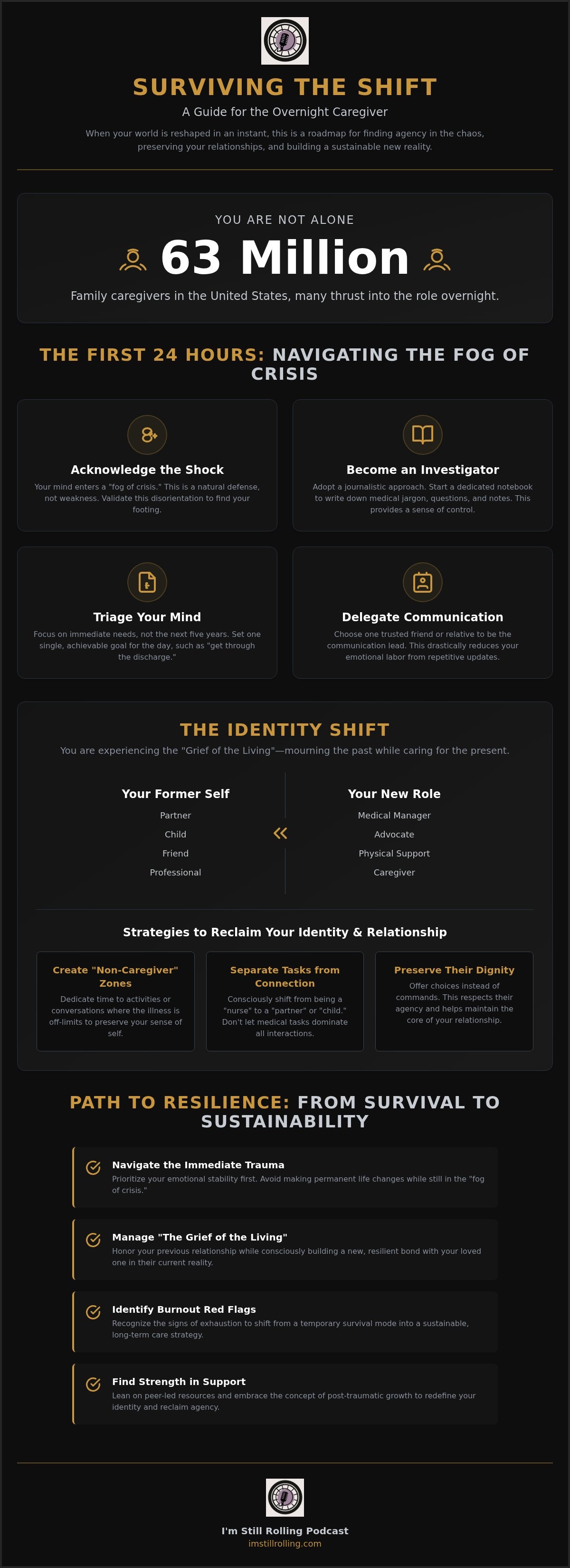
One moment, you are a professional or a partner with a predictable calendar; the next, you are standing in a sterile hallway, trying to decipher the terrifying language of neurology. Becoming a caregiver overnight is less of a transition and more of a collision. It's a sudden shattering of the identity you spent years building, replaced by a role you never interviewed for and feel entirely unqualified to hold. You are not alone in this disorientation. In fact, there are 63 million family caregivers in the United States today, many of whom were thrust into this reality without a moment's notice.
It's natural to feel a profound sense of loss for the person you used to be and fear for the person you are becoming. We promise to help you manage the emotional shock, the identity crisis, and the practical hurdles of this shift through a lens of journalistic honesty and resilient hope. This guide provides a roadmap for finding agency in a chaotic situation, preserving your relationship with your loved one, and building a sustainable lifestyle that acknowledges the gravity of your new reality without losing sight of the beauty within the struggle.
Table of Contents
The First 24 Hours: Managing the Shock of Sudden Caregiving
Becoming a caregiver overnight is a psychological earthquake. It isn't just a change in your daily schedule; it's a form of secondary trauma that reshapes your world in an instant. When the phone rings at 2:00 AM or a doctor delivers a life-altering diagnosis, your brain naturally enters a "fog of crisis." This state of shock makes immediate decision-making feel nearly impossible. You might find yourself thinking, "this isn't real," which is a necessary psychological defense. Validating this disorientation is the first step toward finding your footing in a reality you didn't choose. This isn't weakness. It's your mind's way of pacing itself through a marathon you didn't train for.
To combat the overwhelm of medical jargon and conflicting advice, adopt the posture of a journalist. Start a dedicated notebook. When doctors speak in codes, acronyms, and complex data points, write them down without judgment. This investigative approach allows you to process information later when the initial shock begins to recede. Taking notes provides a tangible sense of control in an environment where you currently have very little.
Triage for the Caregiver’s Mind
In the first few hours, your priority must be immediate safety rather than long-term planning. You cannot solve the next five years while you're still in the hospital hallway. To protect your mental bandwidth, establish a communication lead. Choose one trusted friend or relative to handle the barrage of family updates and repetitive storytelling. This simple act reduces your emotional labor significantly. At the start of each day, write a single sentence defining your goal. For example: "Today, we are just getting through the discharge." If you meet that one objective, you've done enough.
Accepting the Unplanned Assignment
It's vital to treat the first week as an investigative phase rather than a permanent, unchangeable state. You are gathering data about a new life, not signing a final contract. Allow yourself the grace to feel resentment alongside your love. This is the messy truth of sudden change, and acknowledging it helps prevent the long-term weight of caregiver burden from settling in too early. Focus on identifying the difference between medical necessity, which requires immediate action, and emotional urgency, which is often driven by fear. By separating the two, you regain a small but vital sense of agency in the midst of chaos.
The Identity Shift: Moving from Partner or Child to Caregiver
The shift from being a daughter, a son, or a spouse to being the primary manager of someone’s survival is jarring. When you find yourself becoming a caregiver overnight, you enter a state often described as the "Grief of the Living." You are mourning the ease of the relationship you once had while simultaneously tending to the person sitting right in front of you. This duality is exhausting. It requires you to hold two truths at once: the person you love is still there, but the way you interact with them has fundamentally changed. The spontaneous conversations of the past are often replaced by a weight of responsibility that can feel suffocating if not acknowledged.
For those caregiving for a spouse with Alzheimer's, the romantic bond is particularly at risk. The "Caregiver" title can easily become a mask that hides your true self, turning every conversation into a checklist of medications and appointments. To prevent this, it's vital to carve out "non-caregiver" spaces in your daily schedule. This might mean twenty minutes of reading a book that has nothing to do with health, or a phone call with a friend where the topic of illness is strictly off-limits. Preserving these small islands of your former self is not selfish. It is the only way to stay anchored.
Redefining the Relationship Boundaries
Separating medical tasks from personal connection time is a survival skill. If you spend all day acting as a nurse, you'll eventually forget how to be a partner. Use "realistic optimism" to look past the symptoms and see the individual behind the diagnosis. When communicating with a loved one who is now a "patient," try to preserve their dignity by offering choices rather than commands. Government resources like the National Family Caregiver Support Program can provide local assistance to help offload some of these administrative burdens, allowing you to reclaim your primary role as a loved one.
The Silent Burden of the 'Well' Partner
Guilt is a frequent, uninvited guest for the healthy partner. You might feel ashamed of your own mobility or your ability to think clearly. However, your identity must remain rooted in your own interests and passions. Losing yourself entirely doesn't make you a better caregiver; it makes you a more depleted one. Adopting the "Still Rolling" mindset means finding purpose in this new dynamic without letting it consume your entire soul. For more stories on maintaining identity during crisis, you can explore the latest I'm Still Rolling Podcast episodes for peer-led comfort and insight.
Strategic Resilience: Moving from Survival to Sustainability
The adrenaline that carries you through the first few days of becoming a caregiver overnight eventually fades, leaving a heavy exhaustion in its wake. In the journalistic world, we understand that you can't report on a disaster forever without a break; the same applies to caregiving. You must distinguish between "Crisis Mode," which is a temporary sprint fueled by urgency, and "Sustainable Care," which is the long-term marathon. If you stay in crisis mode for too long, you risk a total system failure. According to 2023 research from the RSNA, family caregivers spend an average of 25 hours per week on these duties. This pace is only tenable if you treat resilience as a strategy rather than a feeling.
Spotting the "red flags" of burnout requires a journalistic eye for detail. Look for the subtle headlines in your own life: increasing resentment, physical fatigue that sleep doesn't fix, or a growing sense of isolation. When you notice these signs, it's time to pivot. Integrating stories of recovery and hope into your daily routine helps remind you that while the circumstances are heavy, the level of struggle can fluctuate. Self-care isn't a luxury or a reward for hard work. It's a clinical necessity that ensures you remain capable of providing care over the long haul.
Five Steps to Sustainable Caregiving
Audit your energy: Identify which tasks drain you most. If medical billing causes a panic attack but physical care feels manageable, look for ways to outsource or automate the administrative load.
Build a Resilience Toolkit: Curate a collection of peer-led podcasts, books, and communities that speak your language and acknowledge your reality.
Schedule Total Disconnection: Carve out 15 minutes where you are unreachable. This small window of silence acts as a mental reset for your nervous system.
Practice Radical Honesty: Tell your support system exactly where your limits lie. "I'm fine" is a lie that eventually leads to a collapse.
Avoiding the Martyrdom Trap
Many new caregivers fall into the trap of believing they must do everything themselves to prove their love. This is a disservice to both you and your loved one. When you are becoming a caregiver overnight, the tendency is to ignore your own limits until they shatter. Learning the "Art of the Ask" involves being specific. Instead of saying "I need help," tell a friend, "I need you to bring a meal on Tuesday." This clarity makes it easier for others to step in. Finally, write down one "Non-Negotiable" for your personal sanity. Whether it's a morning cup of coffee in silence or a weekly walk, this boundary is your anchor in the storm.
Building Your Support Ecosystem: Beyond the Medical Chart
Professional medical care is often the first thing people think of when becoming a caregiver overnight, yet it is only one piece of a much larger puzzle. While doctors manage the clinical chart, they rarely manage the emotional fallout or the logistical labyrinth that follows a crisis. In 2026, the national median hourly rate for private pay, non-medical in-home care sits between $34 and $35. These figures represent the literal cost of support, but the true value lies in the human connections that sustain you. You aren't just a bystander in this process; you are a lead investigator and an advocate. It's your job to ensure the medical team sees the person behind the symptoms, recognizing their history and humanity rather than just a collection of vitals.
Beyond the hospital walls, you need "The Unfiltered Friend." This is the person who can hear your darkest thoughts without judgment or the urge to "fix" things with superficial cheerfulness. When you feel the weight of resentment or the terror of the future, you need a safe space to speak those truths out loud. This type of raw intimacy is essential for preventing the isolation that so often accompanies sudden caregiving. It acts as a pressure valve, allowing you to release the tension of your new reality so you can return to your duties with a clearer mind.
Finding Your Tribe of Resilient Peers
Isolation is a silent epidemic among caregivers, but digital communities and peer-led resources provide a 24/7 bridge to shared experience. There is a profound difference between a "pity party," where the focus is on shared despair, and a "resilience circle," where the focus is on finding meaning within the struggle. Engaging with I'm Still Rolling Podcast Episodes offers a journalistic guide to this journey, connecting you with fellow travelers who understand the specific nuances of life after a spinal cord injury or an Alzheimer's diagnosis. These stories serve as a reminder that while becoming a caregiver overnight can leave you feeling adrift, your feelings of overwhelm are universal.
Managing the 'Professional' Support
When you bring professional help into the home, interview potential aides with a journalist's eye for detail. Don't just look at their certifications; observe their temperament and how they interact with your loved one. Setting boundaries with well-meaning but intrusive family members is equally important. You have the right to dictate how updates are shared and who has access to the inner sanctum of your home. By taking control of this ecosystem, you transform from a victim of circumstance into a strategic manager of a sustainable lifestyle. To stay connected with others walking this path, you can subscribe to the I'm Still Rolling Newsletter for ongoing support and stories of endurance.
Finding the 'Still Rolling' Spirit: Resilience in the New Normal
Redefining normal isn't about lowering your expectations; it's about recalibrating your perspective to find beauty in a vastly different landscape. When you are becoming a caregiver overnight, the initial wreckage can make it impossible to see anything but loss. Yet, as the dust settles, many find themselves entering a phase of post-traumatic growth. This isn't superficial cheerfulness. It's the hard-earned realization that you possess a depth of strength you never would've discovered in a life of ease. Small victories, such as a shared laugh over a meal or a moment of quiet connection, become the new milestones of a life well-lived. Your story isn't over. It's simply entering a complex, deeply meaningful new chapter that requires a different kind of endurance.
Accepting this new reality doesn't mean life is devoid of joy. It means the joy looks different. It's found in the resilience of the human spirit and the ability to adapt when the world shifts beneath your feet. You've been thrust into a role that demands everything, but in that demand, there is an opportunity to forge a bond with your loved one that is stripped of pretense. This is the "Still Rolling" spirit: the refusal to stop moving forward, even when the path is steep and the terrain is unfamiliar.
Discovering Meaning Within the Struggle
The host's own experiences with disability and the sudden shift into caregiving inform a perspective of endurance that is both professional and deeply personal. By identifying the unexpected gifts of this role-such as a radical increase in empathy, a sharpening of priorities, and a newfound inner depth-you can begin to write your next chapter. This evolution isn't about ignoring the hardship; it's about finding meaning within it. Visualizing a future that includes both the responsibilities of care and your own personal growth is essential. You are more than your duties, and your personal development remains a vital part of the narrative.
Your Next Step: Listening to the Stories
If you feel adrift in the wake of becoming a caregiver overnight, start with a single, manageable step. Listen to an episode of the I'm Still Rolling Podcast to hear from fellow travelers who understand the specific weight of your journey. Hearing real stories of life after spinal cord injury or an Alzheimer's diagnosis can make you feel less alone in the sterile hallways of your new life. Subscribing to the I'm Still Rolling Newsletter provides a steady pulse of support and insight into the messy side of resilience. You are still rolling, even if the wheels look different now. The story continues, and there is still profound beauty to be found in the miles ahead.
Reclaiming Your Narrative in a New Reality
The transition of becoming a caregiver overnight is a profound disruption, but it doesn't have to be a permanent state of paralysis. By adopting a journalistic eye during the initial fog of crisis and acknowledging the "grief of the living" that accompanies shifting family roles, you move from mere survival to a sustainable lifestyle. Resilience isn't about ignoring the mess; it's about building an ecosystem of support that includes professional resources and the raw, unfiltered truth of peer connection.
You don't have to navigate this landscape alone. Hosted by award-winning journalists who are fellow travelers on this journey, our platform provides a safe space for unflinching honesty about disability and care. We invite you to Listen to the latest episodes of I'm Still Rolling for real stories of resilience and subscribe to our Resilience Newsletter for weekly insights that honor your unique challenges. Your identity has shifted and the road has changed, but your story is far from over. You are still rolling, and there is profound meaning to be found in the miles ahead.
Frequently Asked Questions
What are the first things I should do when I become a caregiver overnight?
Focus on immediate safety and information gathering rather than long-term logistics. Establishing a single communication lead allows you to offload the emotional labor of repeating traumatic updates to every relative who calls. Use a notebook to record medical details with a journalist’s eye for detail. This investigative approach provides a sense of agency while your brain processes the initial fog of crisis. You don’t have to solve the next five years in the first five hours.
How do I deal with the guilt of feeling overwhelmed by my new caregiving role?
Acknowledge that guilt is often a defense mechanism against a situation you cannot control. Feeling overwhelmed isn't a sign of failure; it's a natural response to a life-altering shift. Shift your internal narrative from being a "perfect" caregiver to providing sustainable care. Validating your own struggle allows you to manage the emotional shock without descending into self-pity, which is essential for maintaining your own mental endurance over the long haul.
Can I really care for a spouse or parent without professional medical training?
You can provide essential emotional and logistical support while delegating clinical tasks to licensed professionals. Your role is primarily that of an advocate and a loved one rather than a medical technician. Focus on the relationship dynamic and ensuring the medical team sees the person behind the diagnosis. While you may need to learn specific technical skills, your most valuable contribution is maintaining the human connection that a medical chart cannot capture.
Where can I find support groups for people who became caregivers suddenly?
Look for peer-led communities and digital platforms that offer 24/7 connection for those in crisis. Unlike clinical settings, these groups provide a space for unflinching honesty about the messy parts of life. Resources like the I'm Still Rolling Podcast can act as a bridge to others who have navigated similar shifts. These fellow travelers offer insights and realistic optimism that aren't found in a hospital brochure, helping you feel less isolated in your journey.
How do I prevent caregiver burnout when I have no time for myself?
Practice radical honesty with your support system about your actual physical and emotional limits. Even 15 minutes of total disconnection can act as a vital mental reset for your nervous system. Audit your daily energy to see which tasks drain you most and look for ways to delegate those specific chores. Burnout is a clinical risk you must avoid, so treat your own well-being as a non-negotiable part of the overall care plan.
What should I say to friends who don't know how to act around my new situation?
Be specific about what you need and how you want to be treated in your new reality. Many friends want to help but don't know how to cross the threshold of your crisis without feeling intrusive. Tell them, "I need a meal on Tuesday," or "I need to talk about something other than the hospital." Giving them a clear roadmap reduces their awkwardness and ensures you receive the specific support that actually helps.
Is it normal to feel like I've lost my identity after becoming a caregiver?
Yes, becoming a caregiver overnight often causes an identity trauma where your previous roles are eclipsed by new, heavy duties. It's common to feel like a mask has replaced your true self. To reclaim your identity, carve out small spaces for your own interests, even if it's just for a few minutes. Keeping your soul anchored in your own passions isn't selfish; it's what makes you a resilient and effective caregiver.
How can listening to a podcast about resilience help me in my daily caregiving?
Audio stories provide a sense of presence and intimacy that reduces the profound isolation of the caregiving journey. Hearing seasoned journalists discuss the messy parts of disability and resilience helps you normalize your own experiences. It transforms your individual struggle into a shared human narrative. This peer-led comfort offers a different kind of strength, helping you find the Still Rolling spirit even on your most difficult and exhausting days.



Comments