Wheelchair Life Challenges: A Journalistic Deep Dive into Resilience and Reality
Imagine spending forty minutes on satellite maps and three separate phone calls just to ensure a "handicap-accessible" entrance actually exists, only to arrive and find a heavy manual door or a ramp blocked by delivery crates. If you live on wheels, you know that the physical environment is often the least of your worries. It's the mental load of constant logistical "pre-planning" and the quiet sting of feeling invisible in a room full of people standing at eye level that truly defines the experience. These wheelchair life challenges are not just about ramps or elevators; they are about a constant negotiation of space and dignity in a world that often forgets you are there.
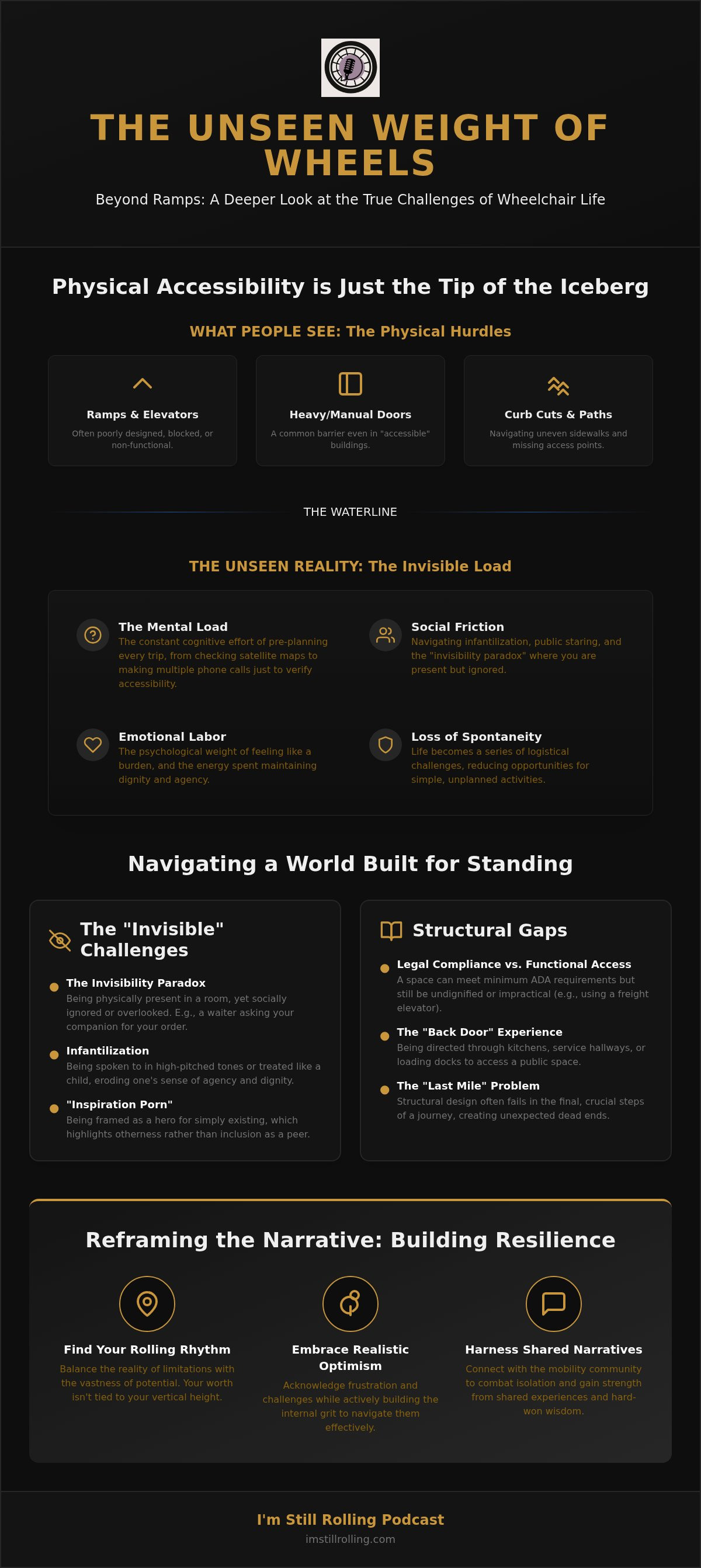
You deserve more than superficial cheerfulness or clinical checklists. We're providing a journalistic deep dive into the raw, lived realities of the mobility community, from the frustration of non-functional spaces to the profound internal resilience required to keep rolling. We will explore the structural hurdles of 2026, including the latest ADA digital compliance shifts, while providing strategies to maintain your spirit. Through shared stories and hard-won wisdom, we aim to build a sense of community that honors your struggle without descending into pity.
Table of Contents
The Landscape of Wheelchair Life: Moving Beyond the Physical
To truly understand the landscape of wheelchair life, one must look past the chrome and rubber. It isn't merely about a piece of equipment; it's a holistic shift in how a human being interfaces with their environment, their community, and their own sense of self. Many well-meaning people attempt "wheelchair for a day" challenges to gain empathy, but these exercises often fail because they lack the permanent psychological weight of the experience. They capture the novelty of tired arms but miss the profound logistical load that defines everyday existence. Real wheelchair life challenges involve a constant mental tally of curb cuts, elevator locations, and the battery life of a power chair. It's a total transition from a "standing" identity to a "rolling" one, a process that requires a complete remapping of one's internal and external worlds.
The Myth of Total Accessibility
Accessibility is often treated as a binary checkbox, but for those who roll, it's a spectrum of frustration. A building might technically meet the standards established by the Disability rights movement, yet still feel entirely unwelcoming. We see this in the "back door" experience, where a wheelchair user is directed through a grease-stained kitchen or a rattling freight elevator just to reach a dining room. Functional accessibility is the ability to navigate a space with the same ease and autonomy as a standing person, while legal compliance is merely meeting the minimum technical requirements set by law. True access shouldn't require a map or a secret code; it should be intuitive and dignified.
The Emotional Shift of a New Disability
The first six months of using a chair are often a blur of medical appointments and physical adjustments, but the deeper work happens in the quiet moments of the mind. It's a period of mourning for the ease of a former life, yet it's also where the first seeds of resilience take root. Navigating these wheelchair life challenges means learning that your worth isn't tied to your vertical height. It's about finding a "rolling rhythm" that balances the reality of your limitations with the vastness of your potential. For those seeking a deeper look into these transformative stories, exploring I’m Still Rolling Podcast Episodes: A Journalistic Guide to Resilience can provide the soulful connection needed during this transition. Resilience isn't a fixed trait you're born with; it's a muscle that grows every time you find a way around a blocked path.
Social Friction: Navigating the "Invisible" Challenges
The physical world presents its own set of trials, but the social landscape often requires a much higher level of emotional labor. You've likely experienced the "Invisibility Paradox," where you are physically present in a room yet treated as if you've vanished. Waiters might ask your dining companion what you'd like to eat. Strangers speak to you in the high-pitched tones usually reserved for toddlers. This infantilization is a recurring theme among the wheelchair life challenges that rarely make it into standard accessibility checklists. It's a subtle, grinding erosion of agency that requires a firm, patient hand to correct and a resilient spirit to endure.
Reclaiming that agency means refusing to play the role of the "helpless" or the "hero." We often encounter "inspiration porn," where simply existing in public is framed as an act of immense bravery. While intended as a compliment, it often highlights the challenges in building a world that accommodates everyone by suggesting that a person in a chair is an anomaly rather than a neighbor. Maintaining your dignity in these moments isn't about being confrontational; it's about staying grounded in your own reality and gently steering the conversation back to a peer-to-peer level. It's about insisting on being a participant in your own life story.
The Psychology of the Gaze
Staring is perhaps the most common social friction point. It exists on a spectrum between genuine, naive curiosity and blatant rudeness. For many, the constant weight of the public eye can lead to social anxiety or a desire to retreat from communal spaces. Reclaiming the narrative involves recognizing that the gaze says more about the observer's lack of exposure than your own worth. You can learn more about finding your voice in these messy social moments through the I'm Still Rolling Podcast, where we dive into the grit required to live out loud without apology.
Dating and Relationships on Wheels
Romantic life often carries an additional layer of stigma that requires a specialized kind of resilience. The chair can act as a filter, quickly weeding out those who lack the maturity to handle a different physical reality. Success in dating while rolling depends on radical honesty and a refusal to apologize for the space you occupy. It's about finding a partner who recognizes that while the chair is a part of your life, it isn't the sum of your identity. True connection happens when both people prioritize the person over the equipment, building a bond based on mutual respect rather than caretaking or pity.
Structural Hurdles: A World Built for Standing
The physical environment is often a masterclass in unintentional exclusion. While we've explored the social friction of being ignored or infantilized, we must also confront the reality that the world was quite literally built for people who stand. The "Last Mile" problem is a perfect example of this. You might find a van-accessible parking spot with the correct aisle width, but if the nearest curb cut is two blocks away or the sidewalk is buckled by tree roots, that spot is effectively useless. These wheelchair life challenges transform a simple trip to the store into a tactical mission. You aren't just looking for a door; you're scouting for a path that won't tip your chair or jolt your spine.
Inside buildings, the frustrations continue with "reach range" barriers and ergonomic failures. Standard bank counters and retail checkout stands often sit at chest height for a standing person, forcing a wheelchair user to reach awkwardly or hand a private credit card up to a clerk they can't see. Common interior hurdles include:
Heavy Manual Doors: Restrooms that are technically "accessible" but require immense upper-body strength to pull open from a seated position.
High Mirrors and Dispensers: Sinks that allow for a roll-under approach but feature mirrors and soap dispensers placed well out of reach.
Retail Navigation: Clothing racks placed so close together that a standard 26-inch wide chair cannot pass through without snagging merchandise.
These structural failures do more than just block movement; they impact the intersection of caregiver dynamics and personal autonomy. When a broken elevator or a high counter forces you to ask a companion for help, it shifts the relationship from one of peers to one of dependency. This constant "negotiation of help" is an emotional tax that standing people rarely have to pay.
The Travel and Transit Gauntlet
Long-distance travel introduces a level of vulnerability that can be paralyzing. Gate-checking a custom-fitted wheelchair, which can cost between $2,000 and $15,000 according to 2026 market data, is an exercise in high-stakes anxiety. When transit systems fail, such as a broken subway elevator or a bus ramp that won't deploy, the burden of advocacy falls entirely on the user. Knowing how to firmly demand your right to transit is a survival skill in a world where "out of service" is a common refrain.
The Home Environment: Retrofitting for Life
The quest for autonomy usually leads back to the home, but retrofitting a standard house is both expensive and complex. From widening doorways to installing roll-in showers, the costs can be staggering, especially since Medicare rarely covers modifications deemed "not medically necessary" for the home's exterior. We're seeing a shift toward "visitable" housing. These are homes designed with at least one zero-step entrance and wide interior doors. This isn't just about your own residence; it's about the fundamental right to visit a friend or neighbor without being carried up a flight of stairs like a piece of luggage.
Reframing the Narrative: The Resilience Factor
While we've discussed the social friction and the structural barriers, the most vital component of life on wheels is the internal architecture of the person in the chair. Resilience is not a static shield. It is a muscle that fibers and strengthens every time you face wheelchair life challenges and refuse to let them define your boundaries. This isn't about the toxic positivity often found in surface-level awareness campaigns. Instead, it's what Mike Sugerman and Janice Wright call "realistic optimism." It is a grounded acknowledgement that life is often difficult and unfair, paired with a relentless search for meaning and utility within that struggle. Every jolt from a broken sidewalk or every "out of service" elevator is an opportunity to practice this internal recalibration.
Obstacles are often the catalyst for a specific type of creative genius. When a structural failure forces a change in plans, the solution isn't just a detour; it's a sophisticated exercise in problem-solving that standing people rarely have to perform. Storytelling becomes the bridge in this process. By articulating the messiness of the experience, you strip the hardship of its power and turn it into a roadmap for others. This narrative work is essential for the healing process, as it allows you to move from being a passive recipient of circumstances to an active reporter of your own life.
Journalism as a Tool for Truth
Reporting on disability with professional rigor allows us to dismantle the harmful tropes of "inspiration porn" and "pity" that we analyzed in previous sections. There's a massive difference between "overcoming" a disability, which implies the disability is a defect to be erased, and "thriving with" one, which accepts the chair as a part of a complex, vibrant life. Journalistic rigor adds a layer of objective validation to personal stories, transforming individual struggles into universal insights about the human condition. It moves the conversation from anecdotal complaining to authoritative social commentary.
The Role of Community and Peer Support
Isolation is the silent enemy of resilience. Finding your "tribe" of fellow rollers isn't just about sharing practical hacks for navigating the wheelchair life challenges of 2026. It's about the profound relief of being understood without explanation. This community helps shift the internal dialogue from "why me?" to "what now?" It fosters a sense of disability pride that is rooted in history and collective endurance rather than individual "bravery." If you're looking for that deeper conversation and a community that understands the reality of the roll, subscribe to the I’m Still Rolling Newsletter to stay connected with fellow travelers on this journey.
Practical Next Steps: Finding Your Rolling Rhythm
Moving from the internal work of resilience to the external world requires a transition from theory to practice. Finding your rolling rhythm is about more than just mobility; it's about reclaiming the ease of movement through methodical planning and superior equipment. One of the most immediate actions you can take is to conduct a personal audit of your local environment. This involves identifying "safe" versus "stressful" routes, noting where the sidewalk buckled or which entrance truly offers functional access rather than just legal compliance. By mapping your surroundings, you reduce the cognitive load of wheelchair life challenges, allowing you to move through your day with a sense of predictability rather than constant tactical scouting.
Your equipment is not merely a tool; it's a primary interface with the world that directly impacts your long-term health. Research indicates that approximately 30% of long-term manual wheelchair users develop chronic shoulder or wrist pain due to improper fit or repetitive strain. Investing in a high-quality, custom-fitted chair is essential. While a standard manual chair might cost as little as $100, an ultra-lightweight or specialized model can range up to $5,000, and advanced custom power chairs often exceed $15,000. In 2026, Medicare Part B typically covers 80% of these costs after the $283 deductible is met, provided the chair is for in-home use. Securing a chair that matches your body's geometry is the single most effective way to preserve your physical endurance for the years ahead.
Advocacy is often the most exhausting part of the journey, yet it's a skill that can be refined. Self-advocacy 101 begins with the understanding that requesting accommodations is not an imposition; it's an assertion of your right to exist in public spaces. Practice requesting modifications without apology. Whether you're asking a bank manager to step out from behind a high counter or demanding that a transit operator deploy a ramp, your voice is a tool for systemic change. This process becomes easier when you're connected to media that reflects your reality, offering a sophisticated alternative to the superficial advice found elsewhere.
Essential Resources for New Rollers
Building your toolkit requires a mix of legal knowledge and modern technology. Organizations like United Spinal Association or the American Association of People with Disabilities provide critical frameworks for understanding your rights. For daily navigation, utilize crowdsourced accessibility apps that allow users to rate the "real-world" functionality of ramps and restrooms. Finally, diversify your media diet with podcasts that prioritize raw, journalistic truth over pity. Hearing others articulate the specific wheelchair life challenges you face can validate your frustrations and provide practical hacks you won't find in a medical brochure.
Joining the I’m Still Rolling Community
Resilience thrives in the company of those who have already paved the way. By subscribing to the I'm Still Rolling Podcast, you gain access to weekly stories that explore the intersection of disability and grit with professional rigor. Our newsletter provides a deeper dive, offering transcripts and insights that help you move from survival to mastery. Subscribe to the I’m Still Rolling Newsletter for more stories of grit and determination. We invite you to join a community of rollers who refuse to be invisible, turning the messy parts of life into a shared narrative of strength.
Rolling Toward a Narrative of Mastery
Life on wheels is an intricate negotiation between a body in motion and a world that often stands still. We've explored how the physical landscape and the subtle social frictions of invisibility create a unique set of wheelchair life challenges that demand both tactical planning and emotional endurance. By auditing your environment and prioritizing custom-fitted equipment, you transform from a passive observer of your surroundings into an active navigator of your own destiny. Resilience isn't about ignoring the difficulty; it's about acknowledging the weight of the journey while refusing to let it anchor your spirit.
True mastery of this journey isn't found in isolation; it's discovered through the power of shared truth and authentic disability culture. If you're ready for a deeper conversation that moves beyond superficial advice, we invite you to Listen to real stories of resilience on the I’m Still Rolling Podcast. Hosted by award-winning journalists, our episodes feature raw, honest accounts from SCI survivors and caregivers who understand the grit required to keep rolling. You don't have to navigate these hurdles alone. The path forward is paved with the wisdom of those who have traveled it before you, and your story is a vital part of that collective strength.
Frequently Asked Questions
What are the most common social challenges faced by wheelchair users?
The most prevalent social obstacles include infantilization and the "invisibility paradox." You might find yourself being spoken to in high-pitched tones or entirely ignored by service staff who address your companion instead. These wheelchair life challenges represent a subtle but constant erosion of personal agency. Navigating these moments requires a firm commitment to reclaiming your narrative and insisting on being treated as a peer rather than a patient or a child.
How do you handle people who offer unsolicited help?
Handling unsolicited help requires a balance of grace and firm boundary setting. A simple, direct "I've got it, thank you" is often enough to stop someone from grabbing your handles without permission. It's vital to remember that your equipment is an extension of your personal space. Reclaiming your autonomy in these interactions helps dismantle the harmful trope that people in chairs are perpetually in need of rescue or "inspiration" for others.
Is air travel possible for power wheelchair users in 2026?
Air travel remains possible for power wheelchair users in 2026, though it still carries significant logistical anxiety. The primary hurdle is the risk of damage during the gate-checking process for highly specialized mobility equipment. You must act as your own lead advocate by documenting the chair's condition before flight and ensuring the airline staff understands the specific handling requirements for your battery and frame to prevent mechanical failure.
What is the "invisible labor" of being a wheelchair user?
Invisible labor refers to the exhaustive mental energy spent on logistical pre-planning for every trip outside the home. You are constantly scouting satellite maps for curb cuts, calling venues to verify functional accessibility, and calculating battery life or physical stamina. This cognitive load is one of the most taxing wheelchair life challenges because it never truly pauses. It is the hidden work required to achieve the same spontaneity that standing people take for granted.
How can I make my home more accessible on a budget?
Making a home more accessible on a budget starts with high-impact, low-cost modifications like offset hinges to widen doorways and portable threshold ramps. You can also install adhesive grab bars or handheld showerheads to improve bathroom safety without full renovations. Focusing on these internal design elements provides immediate improvement to your daily rolling rhythm without the staggering financial burden of a complete remodel.
Why is the "wheelchair for a day" challenge considered controversial?
This challenge is controversial because it treats a permanent life reality as a temporary costume, often focusing on physical fatigue while ignoring the psychological weight of disability. It fails to capture the logistical load or the social friction of being ignored in public. By framing the experience as a 24-hour trial, it risks oversimplifying complex lives into a narrative of bravery rather than fostering a true understanding of the resilience required for long-term navigation.
What are the best podcasts for learning about wheelchair life?
The best podcasts for an authentic look at disability culture are those hosted by people with lived experience, such as the I'm Still Rolling Podcast. These shows avoid the superficial advice found in mainstream media, opting instead for raw, journalistic deep dives into the reality of the roll. You should look for programs that feature interviews with SCI survivors and caregivers, providing a sophisticated blend of professional reporting and deeply personal storytelling that validates your experience.
How can I advocate for better accessibility in my local community?
Effective advocacy begins with documenting the structural hurdles in your immediate environment and reporting them to local government entities. With new ADA Title II digital accessibility deadlines approaching in April 2027 for larger municipalities, now is a critical time to demand compliant public services. You can also join local disability rights groups to amplify your voice. Advocacy is most powerful when it moves from individual frustration to collective action, insisting on a world built for everyone.

Comments