The Ultimate Caregiver Support Checklist: Finding Community Through Stories
In the United States, 59 million family caregivers provide an estimated $1.01 trillion in unpaid labor every year, yet the vast majority of these individuals feel entirely invisible. You might be one of them, sitting in a quiet house or a sterile waiting room, feeling the heavy weight of a role you never interviewed for. It's common to feel "resource fatigue" when clinical websites offer dry checklists that don't account for the soul-crushing exhaustion or the quiet moments of guilt. Tuning into a caregiver stories podcast can often be the first step toward realizing that while your situation is unique, your emotional landscape is shared by millions.
We believe a list of phone numbers isn't enough to sustain you through the long haul of chronic care. You need a narrative bridge that connects professional advice with the raw, lived experience of people who truly get it. This article provides a comprehensive framework for building a support network that actually works. We will explore why storytelling is the missing piece in your resilience strategy and offer practical tools to manage burnout before it becomes a crisis. You'll find a clear plan to move from isolation toward a community of vulnerable peers who offer realistic optimism instead of empty platitudes.
Table of Contents
The Caregiver Support Audit: A Checklist for Identifying Your Needs
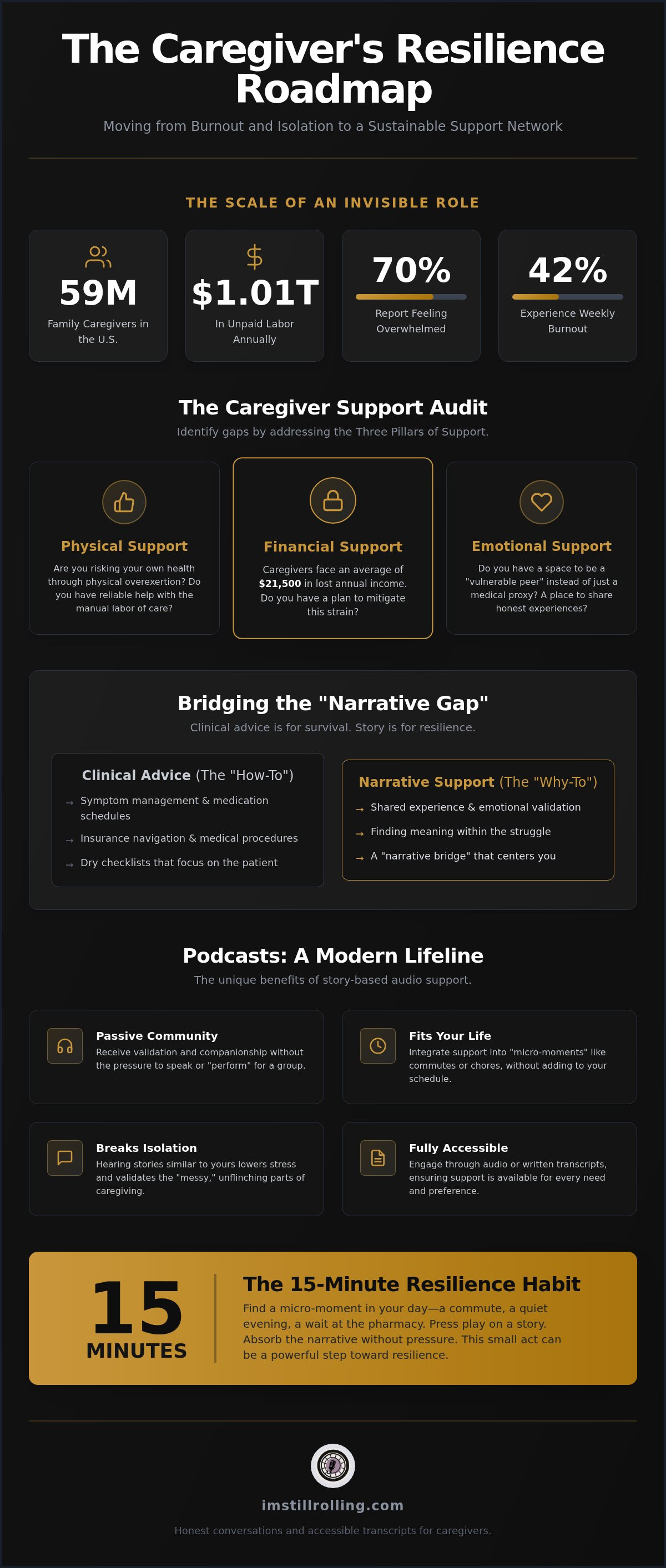
Most resources for families living with disability focus on the patient, leaving the person behind the wheelchair or the hospital bed to manage their own internal collapse in private. If you feel invisible, it's not a personal failure. In the U.S., 59 million family caregivers provide $1.01 trillion in unpaid labor every year, yet 70% of these individuals report feeling overwhelmed and 42% experience emotional burnout at least weekly. Admitting that you've reached the end of your tether isn't a sign of weakness; it's the first act of resilience. You can't gather the right tools if you don't first acknowledge where the structure of your life is cracking. Effective resource gathering begins with a cold, honest audit of your current capacity.
To build a sustainable support network, you must address the "Three Pillars of Support":
Physical: Do you have reliable help with the manual labor of care, or are you risking your own health through physical overexertion?
Financial: Have you quantified the $21,500 in average annual lost income that caregivers often face, and do you have a plan to mitigate this strain?
Emotional: Do you have a space where you can be a "vulnerable peer" rather than just a medical proxy?
Evaluating Your Emotional Infrastructure
The "narrative gap" is the silent space between a medical chart and the actual experience of a human life in transition. Clinical advice tells you how to manage a symptom, but it doesn't tell you how to live with the grief of a changed future. The importance of social support cannot be overstated, particularly when it comes from people who mirror your specific reality. If your current support system only offers pity or toxic positivity, you're missing the "safe harbor" required to discuss the messy, unflinching parts of caregiving. This is where a caregiver stories podcast becomes more than just entertainment; it becomes a lifeline of shared humanity.
Practical Logistics: Time and Accessibility
Resilience must fit into the margins of a life that is already overextended. You don't need another appointment on your calendar. Instead, assess the "micro-moments" in your day, such as the commute to a pharmacy or the 15 minutes after the house finally goes quiet. Audio formats are often the most accessible for busy caregivers, allowing you to engage with a caregiver stories podcast while your hands are busy elsewhere. For those who prefer a quiet deep-dive or have hearing accessibility needs, written transcripts of these conversations ensure that no one is excluded from the community. Finding a format that meets you exactly where you are is the only way to ensure the support actually sticks.
Navigating the Digital Support Ecosystem: Beyond Clinical Advice
Clinical resources are essential for survival, providing the "how-to" of wound care, medication schedules, and insurance navigation. However, survival is not the same as resilience. To truly endure the long haul of caregiving, you need "why-to" resources. These are the narratives that help you find meaning within the struggle and provide a map for your own emotional transformation. This shift toward narrative medicine acknowledges that a patient is more than a diagnosis, and a caregiver is more than a service provider. By engaging with a caregiver stories podcast, you enter a digital ecosystem that prioritizes the human condition over clinical data points. Research indicates that using storytelling to reduce social isolation can significantly improve the mental well-being of those who feel cut off from their former lives.
Podcasts vs. Traditional Support Groups
Traditional support groups offer vital interaction, but they require a level of emotional labor that a burnt-out caregiver may not possess. Sometimes, the thought of "checking in" or performing for a group feels like just another chore on an endless list. Podcasts offer a "passive community," a safe space where you can receive validation and companionship without the pressure to speak. You can listen while driving to a specialist or folding laundry, absorbing the wisdom of others during the micro-moments of your day. If you're looking for a curated starting point, explore this list of The Best Caregiver Mental Health Podcasts to find voices that resonate with your specific journey.
Vetting Your Digital Resources
The digital world is full of "pity-porn," content that focuses on the tragedy of disability without offering a path toward endurance or growth. When vetting your resources, look for journalistic rigor and authentic lived experience. You want stories that are unflinchingly honest about the hardship but remain fundamentally hopeful. Avoid communities that trade in toxic positivity, where every struggle is met with a shallow platitude. Instead, seek out diverse perspectives that reflect the messy, complex reality of your life. Authentic stories don't just mirror your pain; they provide a framework for moving through it with grace and maturity. For those who want these insights delivered directly to their inbox, subscribing to a journalistic newsletter on resilience can provide a steady pulse of realistic optimism throughout the week.
Why Caregiver Stories Podcasts are Essential for Resilience
Resilience isn't a fixed trait you either have or lack. It's a muscle that requires specific nourishment. For those in the thick of chronic care, that nourishment often comes from hearing the unspoken truths of others. When you listen to a caregiver stories podcast, you aren't just consuming content; you're participating in a physiological shift. Research into narrative resonance suggests that hearing stories that mirror our own lived reality can help lower cortisol levels, effectively signaling to our nervous system that we aren't under a solo attack. This transition from "caregiver burden" to a sense of shared history is what allows for long-term endurance.
The primary objection many people have is a perceived lack of time. It's a valid concern when your schedule is dictated by medical appointments and care routines. However, storytelling doesn't require you to stop your life. It's a resource designed to be consumed during the "in-between" spaces. Whether you're in a pharmacy line or sitting in a hospital parking lot, these stories provide an immediate emotional anchor. They turn solitary minutes into a shared experience, proving that your resilience is part of a much larger, collective story of endurance.
The Emotional Shift in Spousal Caregiving
The transformation from partner to provider is perhaps the most jarring identity shift a person can experience. When your spouse becomes your patient, the romantic hierarchy is replaced by a clinical one. This can lead to a profound sense of loneliness, as friends who haven't walked this path often default to superficial pity. If you're caregiving for a spouse with Alzheimer’s, you know that the grief begins long before the physical goodbye. Narrative podcasts act as a vulnerable peer, providing the unflinching honesty required to navigate these changing roles without losing your own humanity.
Busting the Myth of the Heroic Sacrifice
The cultural expectation of the "heroic caregiver" is one of the most significant drivers of isolation. This narrative suggests that love should be enough to prevent exhaustion, which is a dangerous fallacy. By listening to authentic caregiver burnout stories, you give yourself permission to be human. Journalistic storytelling doesn't polish the edges of hardship to make it more palatable for an audience. It explores the messy, difficult, and often resentful parts of the journey. This level of honesty is what actually builds resilience, because it replaces the shame of struggle with the strength of truth. It allows you to move away from the "hero" trap and toward a sustainable path of self-preservation.
How to Integrate Story-Based Support into Your Daily Routine
Finding the strength to continue doesn't require a total overhaul of your limited free time. It's about reclaiming what we call the "Sanctity of Space" within your existing schedule. This mental boundary allows you to momentarily shed your clinical responsibilities and reconnect with your own human identity. By building a personalized "Resource Stack" that blends audio narratives with written reflection, you create a flexible safety net. A caregiver stories podcast serves as the heartbeat of this system, providing consistent companionship when physical presence isn't an option. This method shifts support from an exhausting "to-do" item to a natural way of being that sustains you.
A strategic Resource Stack is designed to be a defense against the chronic isolation mentioned earlier. When audio becomes too overstimulating, perhaps after a particularly loud or chaotic day, written transcripts offer a quieter form of engagement. They allow you to pause, sit with a sentence that resonates, and reflect without the pressure of an advancing audio track. This multi-sensory approach ensures your support system is robust enough to meet you in any emotional state. It’s about survival through intentional connection rather than accidental exposure.
Step 1: Audit Your Transition Moments
Caregiving is often defined by "dead time," those stretches spent waiting for appointments, driving to the pharmacy, or performing repetitive household tasks. These are the windows for your 15-minute resilience habit. The goal is to match the intensity of the content to your current emotional bandwidth. If you're feeling raw, a deep-dive narrative might feel too heavy. In those moments, scanning a transcript can be more grounding. During a long commute, however, an immersive story can help you process complex emotions through the experiences of another. Identifying these gaps turns wasted time into restorative space.
Step 2: Curate Your "Resilience Playlist"
Curation is vital because not every story will align with your specific situation. Whether you are managing the complexities of a spinal cord injury or the long goodbye of dementia, your playlist should reflect your lived reality. You can find a starting point in our guide to Caregiving: Top Podcasts for Resilience in 2026. Use these recommendations to build a foundation of realistic optimism. The I'm Still Rolling Podcast acts as a cornerstone for many, offering a journalistic lens on resilience that avoids superficial platitudes. To begin building your own stack of narrative support, access our latest episodes and transcripts today.
Finding Your Voice with the I’m Still Rolling Podcast
Mike Sugerman and Janice Wright bring a specific kind of authority to the table, one built on decades of reporting at the highest levels and a shared personal history of navigating disability. The I'm Still Rolling Podcast operates at the intersection of professional journalistic rigor and raw intimacy. It’s not just another caregiver stories podcast; it’s a platform where the gravity of life-altering challenges is met with an unflinching honesty. Mike and Janice don't offer superficial cheerfulness. They work within a framework of "realistic optimism," acknowledging that while the road is heavy, the discovery of meaning within the struggle is entirely possible. This journalistic approach ensures that the stories told aren't just anecdotes, but guides for transformation.
Pity is often the default setting for outsiders, but it creates a distance that leaves caregivers feeling more isolated. The I'm Still Rolling Podcast replaces that distance with a bridge of empathy. By exploring the complex nuances of the human condition with journalistic precision, the show provides a roadmap for those who feel invisible in their roles. It turns the "messy" parts of life into a shared narrative of endurance. This isn't about waiting for a cure or a return to the past; it's about mastering the art of moving forward exactly as you are. It’s about finding a "vulnerable peer" who speaks the truth without descending into despair.
Deep-Dives into Resilience
Each episode is a methodical deep-dive into how adversity reshapes our interpersonal relationships and internal landscapes. The journalistic interview format allows for a slow build-up of narrative tension, uncovering hidden truths that standard advice columns often miss. Whether discussing the shift in a marriage after a diagnosis or the quiet strength found in endurance, these conversations offer a profound sense of warmth and reflection. You can explore these deep-dives by browsing the I’m Still Rolling Podcast Episodes: A Journalistic Guide to Resilience. These episodes help you see your own struggle as part of a larger, collective history of human endurance.
Join the Resilience Community
Resilience is a collective effort, and your journey doesn't have to be a solitary one. Beyond the audio experience, the I'm Still Rolling Podcast newsletter provides a consistent rhythm of support, delivering honest insights and accessible transcripts directly to your inbox. These transcripts are particularly valuable for those who need a quiet moment of reflection or have specific accessibility needs. By engaging with this community, you find a space to eventually share your own story of transformation. You're a fellow traveler on a difficult road, but you don't have to roll alone. We invite you to subscribe, listen, and find the connection you've been searching for.
Building Your Narrative Bridge to Resilience
Resilience isn't found in a clinical manual; it's forged in the quiet moments of shared understanding. You've learned how to audit your emotional infrastructure and identify the narrative gaps that standard medical care often overlooks. By integrating a caregiver stories podcast into your transition moments, you reclaim the micro-moments of your day for self-preservation. This isn't about escaping your reality. It's about finding the realistic optimism required to endure it with grace.
The I'm Still Rolling Podcast offers more than just audio content. Hosted by award-winning journalists, each episode provides a deep-dive into the nuances of life after adversity. With full transcripts available for every conversation, we ensure that these insights remain accessible to you, regardless of your schedule or sensory needs. You don't have to carry the weight of your journey alone. Subscribe to the I'm Still Rolling Podcast and find your community of resilience. You are a fellow traveler on a difficult path, and it's time you had a trusted guide to walk alongside you.
Frequently Asked Questions
What is the best caregiver stories podcast for beginners?
I'm Still Rolling is an ideal starting point because it balances professional journalistic rigor with deeply personal narratives. It avoids the dry, clinical tone of many medical resources while steering clear of superficial cheerfulness. For those new to the medium, it offers a "vulnerable peer" perspective that feels both authoritative and deeply intimate. This caregiver stories podcast provides a grounded connection for anyone navigating the early, disorienting stages of a disability journey.
How can listening to a podcast help with caregiver burnout?
Listening to a podcast helps mitigate burnout by providing emotional validation and reducing the chronic isolation that often accompanies long-term care. It allows you to participate in a "passive community" where you can hear your unspoken truths reflected in others' voices. This reduces the cognitive load of feeling "misunderstood" by non-caregivers. By engaging with these narratives, you move from a state of "resource fatigue" into a space of shared resilience and realistic optimism.
Where can I find free resources for family caregivers of Alzheimer’s patients?
You can find comprehensive free resources through the Alzheimer’s Association and AARP, which offer practical clinical guidance. However, for the emotional endurance required for spousal care, narrative episodes on I'm Still Rolling provide a deeper dive into the changing roles of partnership. These stories offer a unique kind of support that clinical checklists can't provide. Accessing transcripts of these conversations allows for quiet reflection during the rare moments when your house finally goes still.
Are there caregiver podcasts specifically for spinal cord injury families?
Yes, spinal cord injury (SCI) is a core focus of the I'm Still Rolling podcast, largely because host Mike Sugerman shares his own lived experience with the condition. These episodes go beyond medical advice to explore the nuances of identity, mobility, and interpersonal relationships after a life-altering injury. Hearing from someone who has navigated the same physical and emotional terrain provides a roadmap for transformation that feels both honest and unflinchingly resilient.
How do I find time for support resources when I am a full-time caregiver?
You find time by auditing the "transition moments" already present in your daily routine, such as commutes, laundry, or medical waiting rooms. Support doesn't always require a scheduled hour; it can happen in 15-minute increments while your hands are busy elsewhere. Audio formats are designed for this kind of multitasking. If listening is too overstimulating during a crisis, reading a transcript for five minutes can offer the same restorative connection without the noise.
Can podcasts replace traditional caregiver support groups?
Podcasts don't necessarily replace traditional groups, but they offer a low-pressure alternative for those who find group settings emotionally draining. Many caregivers feel "resource fatigue" and don't have the bandwidth to perform for others or share their own trauma in a circle. A caregiver stories podcast allows you to receive support without the obligation to give it back immediately. It acts as a bridge toward active participation when your emotional energy eventually returns.
What should I look for in a high-quality caregiver resource?
A high-quality resource should prioritize journalistic rigor and authentic lived experience over shallow platitudes or "pity-porn." Look for content that acknowledges the gravity of your situation without descending into hopelessness. It should offer "realistic optimism," a term that describes a grounded, soulful connection to the truth. Check for diverse perspectives and accessible formats, like transcripts, to ensure the information is inclusive and meets you exactly where you are in your journey.
How does storytelling improve mental health for those living with disability?
Storytelling improves mental health by fostering narrative resonance, which helps lower cortisol levels and reduces the physiological impact of stress. When you hear a story that mirrors your internal reality, it signals to your brain that you aren't alone in your struggle. This breaks the cycle of shame associated with caregiver burnout and grief. Transforming your personal hardship into part of a collective history provides a sense of endurance and discovery of meaning.


Comments