Healing Through Narrative: The Profound Benefits of Storytelling for Resilience
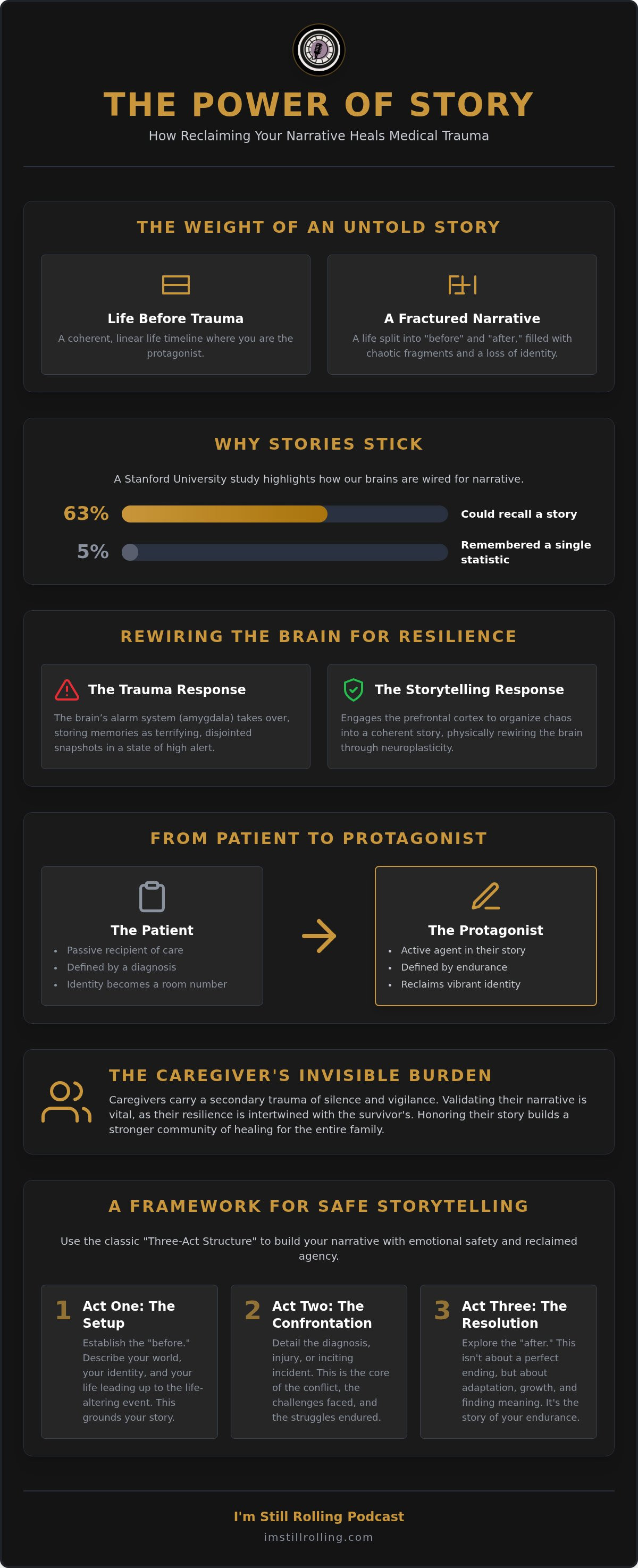
What if the most vital instrument for your recovery isn't found in a sterile laboratory or a prescription bottle, but within the raw, unedited pages of your own memory? When you're navigating a life altering diagnosis, it's easy to feel like your identity has been replaced by a patient ID number. You become a passive recipient of care, watching from the sidelines as others dictate the chapters of your life while the isolation of medical trauma settles in. Research from Stanford University found that 63 percent of people could recall a story, while only 5 percent remembered a single statistic. This suggests that the benefits of storytelling for healing go far beyond mere reflection; they're a fundamental way we process and survive the unthinkable.
You deserve to be the protagonist of your own life again, even when that life feels fractured. Through the work shared on the I'm Still Rolling Podcast, we discover how the journalistic act of storytelling transforms medical trauma into a narrative of strength and reclaimed agency. This article explores the mechanisms of emotional catharsis, the deep sense of belonging found in shared experiences, and the practical ways you can reframe your trauma as a story of incredible endurance. We'll move beyond clinical details to find the soulful connection that exists when we finally speak our truth out loud.
Table of Contents
Beyond the Medical Chart: Why the Untold Story Weighs So Heavily
The Science of Story: How Narrative Reframes the Brain’s Response to Trauma
Comparing Paths to Resilience: Writing, Speaking, and the Unique Role of Audio
Reclaiming Your Voice: Practical Steps to Safe and Effective Storytelling
Joining the Conversation: How I’m Still Rolling Models Resilience
Beyond the Medical Chart: Why the Untold Story Weighs So Heavily
Trauma is rarely a linear event. When a catastrophic diagnosis or injury occurs, it doesn't just damage the body; it shatters the internal timeline we've spent decades constructing. This creates what psychologists often call a fractured narrative, where your life is suddenly split into a "before" and an "after" that don't seem to speak the same language. While a medical chart meticulously records the failure of nerves or the progression of a condition, it remains a cold, clinical document. It ignores the soul's experience, leaving the most painful parts of the journey to fester in silence. One of the primary benefits of storytelling for healing is its ability to bridge this gap, turning the chaotic shards of a crisis into a structured, meaningful history.
This process is often explored through Narrative therapy, a practice that encourages individuals to view themselves as separate from their problems. By adopting a journalistic lens, we move beyond a list of symptoms to find the journalistic truth of our lives. A doctor might see a spinal cord injury; a storyteller sees a person learning to navigate a world that wasn't built for them. Keeping these struggles a secret carries a heavy emotional cost, as the energy required to suppress the "messy" parts of life eventually starves our capacity for joy and connection.
The Identity Crisis of New Disability
A diagnosis often acts as a thief of identity. In the sterile environment of a hospital, your name is frequently replaced by a room number or a condition. You're no longer the hero of your own life; you're a patient in a bed, a passive recipient of care. Reclaiming your "Beyond the Chair" identity begins with the realization that your story didn't end at the moment of injury. Storytelling allows you to step back into the role of the protagonist, documenting your endurance rather than just your limitations. It's the first bold step in proving that while the body may be altered, the essence of the person remains vibrant and unyielding.
The Weight of Caregiver Silence
Caregivers often carry an invisible burden, living in a state of perpetual "on-call" vigilance that leaves little room for their own voices. There's a common, heartbreaking feeling that they don't have permission to tell their story because they aren't the ones in the bed. However, the isolation of the spouse or family member is a secondary trauma that demands recognition. Validating the caregiver’s narrative is vital because their experience of resilience is intertwined with the survivor's. When we acknowledge the benefits of storytelling for healing for the entire family unit, we create a community where everyone's struggle is seen and every act of endurance is honored.
The Science of Story: How Narrative Reframes the Brain’s Response to Trauma
The brain's response to medical trauma is often one of deep fragmentation. When we experience a sudden injury or a life altering diagnosis, the amygdala, which acts as the brain’s alarm system, takes over. This leaves us in a state of high alert. This survival mode often stores memories as disjointed, terrifying snapshots. Storytelling, however, engages the prefrontal cortex. This is the part of the brain responsible for complex planning and self-expression. By organizing these chaotic experiences into a "coherent life story," we actually participate in neuroplasticity. The brain can physically rewire itself as we move from the passive mindset of "What happened to me?" to the active, agency driven declaration of "What I did next." This shift is a cornerstone of post-traumatic growth, where finding meaning in adversity leads to measurable psychological improvements.
This cognitive reframing is one of the primary benefits of storytelling for healing. It allows the survivor to integrate the trauma into their identity rather than being defined by it. By constructing a narrative, you're not just remembering; you're building a roadmap for your future. This process helps lower the emotional intensity of the trauma, making it a part of your history that you carry, rather than a burden that carries you.
Neural Coupling and the Power of Shared Experience
When you listen to spinal cord injury recovery stories, something fascinating happens in your brain. Research shows that a listener's brain activity can actually sync with the speaker's. This process is called neural coupling. This biological connection releases oxytocin and reduces cortisol, which is the hormone responsible for stress. Hearing a "me too" moment isn't just emotionally validating; it's a physiological relief that signals to your nervous system that you aren't alone. Utilizing family storytelling to aid healing provides a collective buffer against the isolation of chronic illness. It creates a shared space where resilience is contagious.
Reframing the Ending
Many people wait for a "cure" to feel like their story has reached a successful resolution. However, a resilient narrative doesn't require a medical miracle to be powerful. In the world of chronic illness and disability, the resolution is often found in the "open-ended" arc of daily endurance. Mike Sugerman and Janice Wright apply their journalistic training to find these resilient arcs. They focus on how a person continues to roll despite the obstacles. You can explore these perspectives further in the latest episodes of the I'm Still Rolling Podcast. Here, the focus remains on the strength of the human spirit rather than the limitations of the body.
Comparing Paths to Resilience: Writing, Speaking, and the Unique Role of Audio
Choosing how to share your journey is a deeply personal decision that depends on your current level of emotional readiness. While some find solace in the quiet scratch of a pen against paper, others require the expansive reach of a public forum to feel heard. Journaling offers a private laboratory for processing the "messy" details of trauma without the pressure of an audience, acting as a vital first step in internal organization. Public speaking, conversely, acts as a bold reclamation of agency, turning individual pain into a collective lesson for others. Understanding the benefits of storytelling for healing requires recognizing that each medium offers a different level of vulnerability and connection.
As explored by Harvard University in The Healing Power of Storytelling, the act of translating internal chaos into an external narrative is a vital component of navigating illness. Audio storytelling occupies a unique middle ground in this landscape. It provides the intimacy of a one-on-one conversation while maintaining the safety of a produced, thoughtful medium. There is a raw, sensory quality to the human voice that a written report simply cannot replicate. The subtle shift in tone, a sharp intake of breath, or a long, thoughtful pause conveys a depth of emotion that transcends literal words. For many, these audio stories feel like a private conversation between friends, bypassing the clinical "dryness" of medical records to reach the heart of the human experience.
The Intimacy of the Human Voice
The human voice acts as a bridge between professional observation and raw, lived experience. When you engage with the I'm Still Rolling Podcast, you aren't just hearing facts; you're feeling the weight and the beauty of a fellow traveler's journey. This "fellow traveler" effect is a potent antidote to the isolation that often follows a diagnosis. To ensure these narratives are accessible to everyone, podcast transcripts play a crucial role. They allow those who prefer reading or have hearing impairments to engage with the content, ensuring that the benefits of storytelling for healing aren't limited by physical barriers.
Why Listening is the First Step to Telling
Before we can tell our own stories, we often need to learn the language of resilience from those who have walked the path before us. This is where the "Mirror Neuron" effect comes into play; our brains begin to map out the possibilities for our own futures by observing others. Consuming stories of recovery and hope helps build the "courage muscle" necessary to eventually speak our own truth. It’s a steady transition from being a passive observer of your own life to becoming an active participant in a community of survivors who refuse to be silenced by their circumstances.
Reclaiming Your Voice: Practical Steps to Safe and Effective Storytelling
Reclaiming your voice is a delicate process that requires more than just the desire to speak. It demands a "Safety First" mindset, where you check in with your emotional state to ensure you're ready to revisit the trauma. One of the greatest benefits of storytelling for healing is the sense of agency it restores, but that agency is only possible when you feel secure enough to hold your own history. If sharing feels like it's re-traumatizing you rather than releasing you, it's okay to wait. Your story will still be there when the ground beneath you feels firmer.
To build a "Resilient Arc" without sugarcoating the reality, many find success using a three-act structure. Act one is "The Before," establishing the baseline of your identity. Act two is "The Shift," the moment of diagnosis or injury that fractured that identity. Act three is "Still Rolling," the ongoing process of adaptation. This framework prevents the story from becoming a tragedy; instead, it becomes a documentation of endurance. You aren't looking for a happy ending, but a meaningful middle that reflects your current strength.
Finding Your "Journalistic Truth"
Mike Sugerman and Janice Wright often ask their guests questions that cut through the clinical surface to find the human heart underneath. To find your own truth, you must distinguish between "venting"—which is a temporary emotional release—and "meaning-making," which is the long-term work of integration. Try to write a single sentence that defines your current resilience. This isn't about a medical cure; it's about the character you've forged in the fire. When you move from "why me" to "this is who I am now," you've found your journalistic truth.
Navigating the "Messy" Parts of Your Story
Realistic optimism doesn't mean ignoring the anger or the grief. In fact, an honest story requires them. You can't celebrate the "roll" without acknowledging the weight of the "chair." For those dealing with complex family dynamics, using the Caregiving for a Spouse with Alzheimer’s guide can help frame narratives that feel particularly heavy or confusing. It's about finding the "Resilient Arc" even in the messy parts of daily life. Acknowledging the hardship makes the endurance more believable and the connection with your audience more profound.
If you're ready to move from silence to storytelling, consider subscribing to the I’m Still Rolling Newsletter for weekly prompts and reflections that help you find your voice.
Joining the Conversation: How I’m Still Rolling Models Resilience
The transition from a passive recipient of medical care to an active narrator requires a trusted guide who understands both the gravity of the struggle and the necessity of hope. Mike Sugerman and Janice Wright don't offer platitudes or superficial cheerfulness. Instead, they leverage decades of professional journalistic experience to create a space where truth isn't just told; it’s honored. I’m Still Rolling isn't just a collection of interviews; it’s a masterclass in the benefits of storytelling for healing. By facilitating unflinching conversations about spinal cord injury and Alzheimer’s caregiving, the hosts model a "realistic optimism" that acknowledges the chair while celebrating the roll.
This podcast functions as a safe harbor for deep reflection, where the isolation of "unseen" medical trauma is replaced by a palpable sense of belonging. When you engage with these stories, you're participating in a community that values the "messy" parts of life as much as the triumphs. The goal is to move beyond the clinical details that define a patient and return to the nuanced, internal resilience that defines a human being. By witnessing these raw, lived experiences, you find the permission you need to begin your own narrative journey.
A Journalistic Approach to Vulnerability
The hosts’ background in high-level media ensures that every episode is handled with professional rigor and a deep sense of empathy. This isn't just another talk show; it’s an evolution of the disability rights podcast space, where award-winning journalism meets raw intimacy. This professional framing is vital because it helps guests feel secure enough to share their deepest truths. When a story is told with precision and grace, it transforms from a private tragedy into a universal narrative of endurance. This high-quality approach ensures that the benefits of storytelling for healing are accessible to both the speaker and the listener, creating a steady pulse of connection across the community.
Your Next Steps in the Narrative Journey
Engaging with this community is the first step toward reclaiming your agency. You can start by subscribing to the I’m Still Rolling Newsletter, which provides weekly prompts designed to spark continued narrative reflection and help you build your own "resilient arc." For those looking to support this mission of truth-telling, we offer unique opportunities for human interest podcast advertising, connecting purpose-driven brands with a community of survivors and caregivers. Your story doesn't have to stay silent. Start rolling today by listening to a single episode and discovering how your own narrative can become your greatest source of strength.
Reclaiming the Narrative of Your Life
A medical chart records clinical facts, but it doesn't capture the profound endurance of the human spirit. We've explored how transitioning from a passive patient to an active narrator allows you to integrate trauma into a story of strength rather than one of loss. By understanding the benefits of storytelling for healing, you can utilize the science of neuroplasticity and the unique intimacy of the human voice to bridge the gap between what happened to you and who you are becoming today.
Hosted by veteran journalists Mike Sugerman and Janice Wright, our community offers authentic stories of life after spinal cord injury and the quiet power of caregiver resilience. This platform is built on a foundation of realistic optimism and professional truth-telling, providing you with a reliable framework to find your own resilient arc. You're a fellow traveler on a difficult journey, but you don't have to navigate the silence alone.
Listen to the latest episodes of I’m Still Rolling and start your healing journey. Your voice is the most powerful instrument you possess for reclaiming your agency. Don't let the clinical records have the last word; your story is still rolling, and it's a narrative worth telling with pride.
Frequently Asked Questions
Is storytelling always healing, or can it be retraumatizing?
Storytelling isn't a universal cure and can lead to retraumatization if shared before you're emotionally ready. Healing occurs when you have enough distance from the trauma to organize it into a coherent narrative. If revisiting the details causes overwhelming distress or physical panic, it’s a sign that you need more time. The goal is to reach a state where you're the narrator of your history rather than a victim of a recurring memory.
How do I know if I am ready to share my story of medical trauma?
Readiness often appears when you can discuss your experience without losing your sense of the present moment. You might feel a shift from just wanting to vent to wanting to find meaning in what happened. If you can identify a resilient arc in your journey, even if it feels messy, you're likely ready. Start in a private space, like a journal, before moving to more public forums to ensure your safety.
Do I need to be a good writer or speaker to benefit from storytelling?
Technical skill is entirely secondary to the process of meaning-making. One of the primary benefits of storytelling for healing is the cognitive act of organizing chaotic thoughts into a structured timeline. Whether you're recording a simple voice memo, writing a private letter, or participating in an interview, the value lies in reclaiming your agency. Your truth doesn't need perfect grammar or polished delivery to be a powerful tool for your own resilience.
What is the difference between narrative therapy and just talking to a friend?
While talking to a friend provides vital social support, narrative therapy is a structured approach that focuses on separating your identity from your condition. It involves intentionally reframing your history to highlight your endurance and agency. A friend might offer sympathy, but narrative techniques help you discover the journalistic truth of your life. This disciplined reflection helps you move beyond the "patient" label to see yourself as the protagonist of a much larger story.
Can listening to other people’s stories of disability help me heal?
Listening is often the first step toward finding your own voice. When you hear others share their lived experiences, your brain undergoes neural coupling, which reduces the isolation often felt after a diagnosis. This biological connection can lower stress hormones and provide a mental roadmap for your own recovery. Witnessing another person’s "realistic optimism" helps you realize that while your life has changed, your capacity for growth and connection remains fully intact.
How does the I’m Still Rolling podcast help with the healing process?
The podcast acts as a template for how to reconstruct a fractured identity. By providing a safe space for deep reflection and truth-telling, it allows listeners to see the benefits of storytelling for healing in action. Mike Sugerman and Janice Wright model how to discuss hardship with professional rigor and raw intimacy. This helps listeners move from being passive recipients of medical care to active participants in a community built on shared endurance and hope.
What are the best ways to start documenting my resilience journey?
Start by focusing on small, daily acts of endurance rather than trying to write a complete autobiography. Use the three-act structure to define your life before the shift, the shift itself, and how you are still rolling today. Subscribing to a newsletter with weekly prompts can provide the necessary structure to keep you moving forward. The key is consistency; even a single sentence a day can help you build the "courage muscle" needed for deeper narrative work.
Why is the journalistic approach of I’m Still Rolling different from other disability podcasts?
Many podcasts rely on superficial cheerfulness, but Mike and Janice utilize their backgrounds as veteran journalists to pursue the unflinching truth. This approach blends professional observation with raw, lived experience, ensuring a high-quality narrative that doesn't ignore the messy parts of life. By treating disability and caregiving with the same rigor as a major news story, they validate the gravity of the experience. This creates a more authentic and deeply personal connection that resonates with the entire community.


Comments