Blind and Partially Sighted Life Stories: Resilience Beyond the Diagnosis (2026)
A clinical diagnosis explains the mechanics of your eyes, yet it says nothing about the architecture of your life. It's a common frustration to feel reduced to a medical chart or, worse, to be cast as a saintly figure of inspiration just for navigating the grocery store. You probably find yourself searching for something more substantial than pity or superficial cheerfulness. We understand that the transition into vision loss is a heavy, complex transformation that requires more than just clinical advice; it requires a witness to the endurance involved.
In these blind and partially sighted life stories, we prioritize the raw, journalistic truth over the polished narratives often found in the media. You'll discover how others have wrestled with the fear of losing independence while building practical strategies for a new way of being. This article serves as a roadmap through the lived experiences of those who've moved beyond the diagnosis. We'll explore the messy parts of adaptation, the discovery of meaning within struggle, and the profound sense of belonging that comes from hearing your own reality reflected in the voices of others.
Table of Contents
The Unspoken Weight of Vision Loss: Moving Beyond the Medical Diagnosis
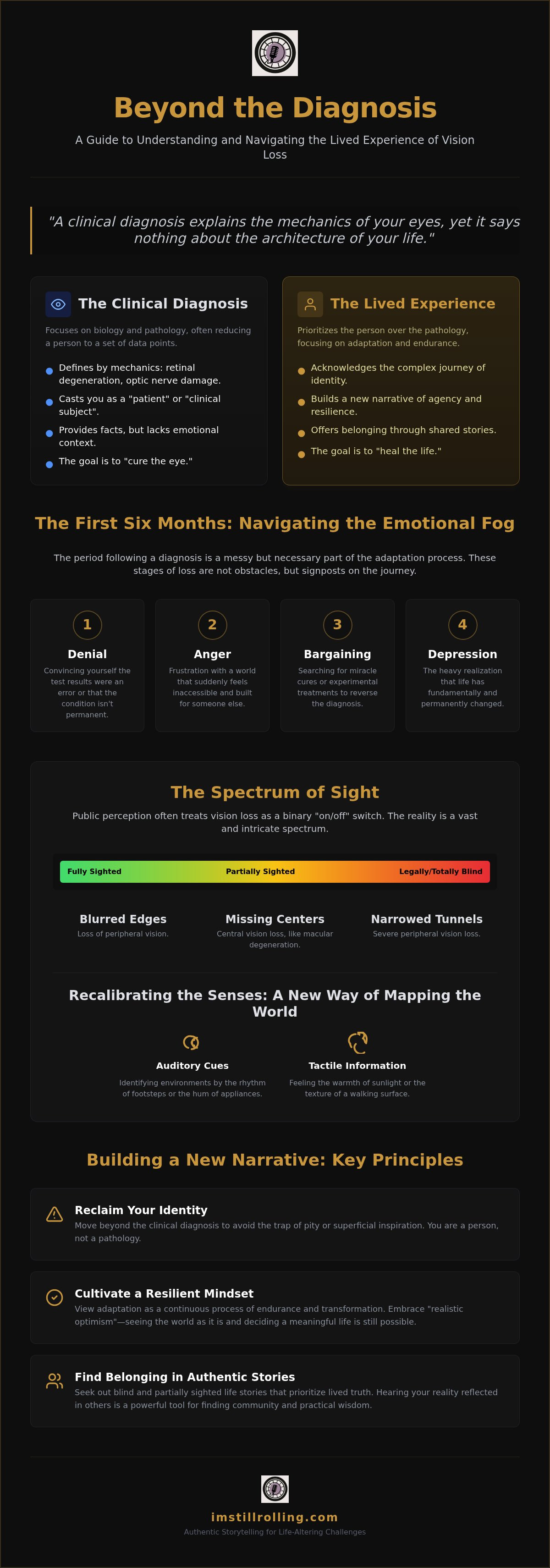
When a doctor delivers a diagnosis of vision loss, they usually speak in the language of biology. They discuss retinal degeneration, optic nerve damage, or visual acuity. While these facts are necessary for treatment, they often leave a vacuum where your identity used to be. You're suddenly cast as a "patient," a clinical subject defined by what your eyes can no longer do. Transitioning into the world of blind and partially sighted life stories requires a different vocabulary; one that prioritizes the person over the pathology.
We must acknowledge the gravity of this change without descending into the shallow waters of pity. Pity is a passive emotion that robs an individual of their agency. Instead, we lean into "realistic optimism." This isn't the hollow "everything happens for a reason" rhetoric. It's a grounded acknowledgment that while the challenge is immense, the capacity for endurance is greater. It's about seeing the world exactly as it is, with all its new limitations, and deciding that a meaningful life is still possible.
The First Six Months: Navigating the Emotional Fog
The first half-year following a diagnosis often feels like a blur of appointments and grief. It's messy, and it's okay to admit that. You might experience the classic stages of loss:
Denial: Convincing yourself the test results were an error.
Anger: Frustration with a world that suddenly feels built for everyone but you.
Bargaining: Searching for miracle cures or experimental treatments.
Depression: The heavy realization that life has fundamentally changed.
These emotions aren't obstacles to recovery; they're part of the long-form narrative of adaptation. There is no quick fix for a life-altering event. Healing happens in the quiet, unvarnished moments of learning to navigate a kitchen or a city street again.
Why Clinical Data Isn’t Enough
Medicine focuses on "curing the eye," but it often neglects the work of "healing the life." A surgeon can repair a tear, but they can't repair the fractured sense of self that follows. This is where journalistic storytelling fills the gap. By listening to authentic blind and partially sighted life stories, we find the blueprints for a new existence. We encourage you to seek out stories of recovery and hope that don't shy away from the struggle. These accounts provide the emotional context that a clinical chart simply cannot hold, offering a sense of belonging that medical facts alone can't provide.
Spectrum of Sight: Understanding the Nuances of Partially Sighted Life
Public perception often treats blindness as a binary state, a simple toggle between "on" and "off." In reality, vision loss exists on a vast, intricate spectrum. For many, the experience isn't total darkness; it's a world of blurred edges, missing centers, or narrowed tunnels. While the medical community categorizes these variations through visual acuity scores, the lived reality is far more subjective. Understanding blind and partially sighted life stories requires us to look past the clinical labels and into the sensory shifts that define daily existence.
The transition from a visual world to an auditory or tactile one is rarely immediate. It's a gradual recalibration of the senses. The environment begins to reveal itself through the rhythm of footsteps on different surfaces, the specific hum of a refrigerator, or the warmth of sunlight hitting a specific wall. This sensory equilibrium isn't a consolation prize for losing sight. It's a sophisticated way of mapping the world that relies on endurance and a heightened awareness of one's surroundings. If you're looking for more ways to understand this transition, listening to a journalistic podcast can provide the unvarnished perspective you need.
Living in the In-Between: The Partially Sighted Experience
Those who occupy the space between "fully sighted" and "totally blind" often face a unique psychological hurdle: imposter syndrome. There is a specific social friction that occurs when someone uses a white cane but then checks their phone, or requires a guide dog despite having some peripheral vision. Because they don't "look blind" by traditional media standards, they may feel like they're performing a role rather than living their truth. Resilience in this context manifests as the courage to use assistive tools without apology, even when the world's expectations don't align with your visual reality. These blind and partially sighted life stories remind us that having "some" sight can be just as isolating as having none if your experience isn't validated.
The Role of Assistive Technology in 2026
By 2026, the landscape of accessibility has been transformed by AI-driven tools that provide real-time scene description and text recognition. These advancements are powerful, yet they remain tactical rather than strategic. A device can tell you what's in front of you, but it can't tell you how to feel about your place in the world. The evolution of these tools reflects a broader shift toward universal design. To understand how these technological trends intersect with the fight for equity, you can explore the disability rights podcast for a deeper dive into 2026 accessibility truths. Ultimately, the most effective tool isn't a piece of software; it's the resilient mindset that chooses to engage with the world on its own terms.
The Anatomy of Resilience: How Real People Navigate a Changing Visual World
Resilience isn't a gift given to a chosen few; it's a muscle built through the repetitive strain of daily life. When we examine blind and partially sighted life stories, we don't find people who are magically immune to frustration or despair. Instead, we see individuals who have navigated the weight of a changing visual world and emerged with a deeper, more refined perspective. This transformation isn't about "fighting" a condition as if it were an external enemy. It's about the quiet, persistent work of integrating a new reality into a coherent sense of self.
Journalistic observations suggest that a resilient mindset isn't built on denial. It's built on a foundation of realistic optimism. This involves acknowledging the gravity of the loss while simultaneously seeking out new ways to engage with the world. Through hundreds of long-form interviews, several core components of this mindset have become clear:
Radical Acceptance: Acknowledging current limitations without letting them define your future potential.
Adaptive Problem-Solving: Shifting energy away from "why is this happening" toward "how do I navigate this."
Collective Wisdom: Recognizing that your individual struggle is part of a broader human narrative of endurance.
Transformation Through Endurance
Long-form storytelling reveals that growth often follows medical trauma. This phenomenon, often called post-traumatic growth, suggests that the struggle of sight loss can be the very catalyst for discovering hidden strengths and priorities. It's a slow, unhurried process that requires patience and a willingness to sit with discomfort. Resilience is the ability to roll with life’s punches without losing your soul.
The Power of Peer Vulnerability
The media frequently relies on "inspiration porn," casting disabled individuals as saintly figures for simply existing. This superficial framing is isolating because it ignores the messy reality of adaptation. True connection happens when we shift from the "trusted guide" who has all the answers to the "vulnerable peer" who is still learning. Hearing someone else admit to their fear of losing independence is infinitely more helpful than a polished success story because it validates your own experience. The I’m Still Rolling Podcast Episodes create this intimacy by prioritizing raw truth over easy answers. These blind and partially sighted life stories serve as a reminder that vulnerability isn't a sign of weakness; it's the prerequisite for the kind of strength that actually lasts.
Building a New Narrative: Finding Community and Voice
For too long, people with vision loss have been treated as the subjects of clinical case studies or sentimental news segments. It's time to reclaim the narrative. Transitioning from a passive recipient of a diagnosis to an active author of your own experience is a profound act of self-advocacy. When we share blind and partially sighted life stories, we're not just venting; we're constructing a collective archive of wisdom that challenges the status quo. This shift allows you to move beyond the medical chart and define your life on your own terms.
Finding an authentic community means seeking spaces where your reality is validated, not managed. While many organizations focus on fundraising or "curing" conditions, the most resilient communities focus on the person living the life. In these spaces, your voice is the primary authority. Sharing your perspective helps dismantle the isolation that often follows a diagnosis, turning your individual endurance into a shared strategy for others.
Beyond the Tropes: Authentic Representation
Authentic representation requires moving past the binary tropes of the "superhuman hero" or the "tragic victim." These archetypes often serve the sighted audience's comfort rather than the disabled person's reality. Real life is found in the mundane; it's in the frustration of a misplaced set of keys or the quiet victory of navigating a new transit route. We need stories that embrace the messy, unvarnished truth of living with a disability. To understand how these media trends are shifting in 2026, you can listen to the disability rights podcast for a deeper look at representation.
How to Share Your Story
Sharing your journey isn't just about external advocacy; it's a vital tool for internal healing. Documenting the "messy" parts of adaptation allows you to track your own resilience over time. You don't need a massive platform to begin. Start small:
Voice Memos: Record your thoughts during difficult or triumphant moments to capture the raw emotion of the experience.
Journaling: Use tactile or digital tools to process the internal shifts that follow vision loss.
Peer Networks: Seek out spaces where blind and partially sighted life stories are exchanged without the filter of "inspiration porn."
Your personal account of grit and determination might be the exact roadmap someone else needs to navigate their own transition. To hear how others are authoring their own resilient narratives,
.
I’m Still Rolling: Why Authentic Storytelling is the Ultimate Recovery Tool
Mike Sugerman and Janice Wright didn't launch this project to offer medical advice or shallow platitudes. As seasoned journalists, they've spent decades reporting on the complexities of the human condition with a level of professional rigor that refuses to settle for easy answers. When they turned their focus toward blind and partially sighted life stories, they brought that same unflinching honesty to the table. This isn't about looking for a "hero" narrative to make sighted people feel better; it's about documenting the unvarnished truth of living with adversity. By blending professional authority with a vulnerable, open-hearted approach, the I’m Still Rolling Podcast serves as a bridge between the clinical world and the messy, beautiful reality of lived experience.
Accessibility is a core pillar of this mission rather than an afterthought. We recognize that vision loss fundamentally changes how you consume information, which is why we provide full podcast transcripts and video options for every episode. This ensures that these narratives of endurance are available to everyone, regardless of where they sit on the visual spectrum. It's about creating a safe space where the gravity of a challenge is met with a grounded, soulful connection that feels both authoritative and deeply personal.
The Journalistic Edge: Heart and Rigor
A background in high-level media allows for a deeper level of questioning that moves beyond the surface level. In a world saturated with quick soundbites and "inspiration porn," long-form interviews provide the space necessary for narrative tension and emotional resonance to build naturally. This methodical approach is what earns listener trust over time. It allows for the exploration of the internal shifts and transformations that follow a diagnosis, providing a roadmap for those who are still finding their way. The podcast acts as a safe space for unflinching honesty, where the struggle is acknowledged but never allowed to become the whole story.
Joining the Rolling Community
We invite you to move from being an observer to being part of a community that values realistic optimism over superficial cheerfulness. Subscribing to the I’m Still Rolling Newsletter provides regular insights and stories delivered with the same journalistic integrity you hear in our episodes. For those looking to support this mission of authentic representation, we offer specialized human interest podcast advertising for purpose-driven sponsors who understand the value of raw, lived truth.
Your journey doesn't have to be defined by a medical label or the limitations of a diagnosis. By engaging with blind and partially sighted life stories that prioritize resilience, you can find the tools to author your own path forward. Listen to the latest episodes and start your journey here to discover how others are finding meaning and independence within the struggle.
Reclaiming Your Narrative in a Visual World
Navigating the transition into vision loss is a profound transformation that requires more than medical intervention; it demands a shift in how you view your own history. We've explored how moving beyond a clinical diagnosis allows you to reclaim your identity and why resilience is a muscle strengthened through the raw, unvarnished work of daily adaptation. By seeking out authentic blind and partially sighted life stories, you move from being a subject of medical observation to the author of a resilient future. This journey isn't about avoiding the messy parts of life, but about finding meaning within them.
Our award-winning journalistic hosts, Mike Sugerman and Janice Wright, provide a safe space for these honest and raw conversations. Every episode is designed with accessibility in mind, offering full transcripts so that these vital insights are available to everyone. You don't have to navigate this path in isolation or settle for the hollow tropes of "inspiration porn." Instead, you can join a community that values realistic optimism and lived truth. Listen to authentic stories of resilience on the I’m Still Rolling Podcast and discover that while your sight may have changed, your story is just beginning.
Frequently Asked Questions
Where can I find authentic blind and partially sighted life stories?
You can find these authentic accounts through platforms like the I'm Still Rolling Podcast, which prioritizes the unvarnished truth of living with vision loss. Unlike medical journals that focus on pathology, these narratives center on the human experience of adaptation and endurance. By listening to the lived experiences of others, you gain a sense of belonging that clinical data simply cannot provide. These stories are available globally through streaming services and digital archives.
How does the I’m Still Rolling podcast handle disability storytelling?
The podcast utilizes a journalistic approach to explore life after adversity, avoiding the common tropes of "inspiration porn" or pity. Mike Sugerman and Janice Wright facilitate long-form interviews that allow for a slow build-up of emotional resonance and narrative tension. This method creates a safe space for guests to discuss the messy parts of adaptation. The focus remains on realistic optimism, acknowledging the gravity of hardship while highlighting the capacity for transformation.
Is there a community for people newly diagnosed with vision loss?
Yes, a community of vulnerable peers exists through the I'm Still Rolling platform and its associated newsletter. This community isn't built around medical advice but around the shared experience of navigating a difficult journey. By engaging with these blind and partially sighted life stories, individuals can find a roadmap for their own transition. It's a space where you can be both a trusted guide and a fellow traveler on the path to resilience.
Can I read transcripts of the I’m Still Rolling podcast if I prefer text?
Every episode of the podcast is accompanied by full written transcripts to ensure maximum accessibility for all listeners. We recognize that those in the visually impaired community have diverse preferences for how they consume information. These transcripts capture the professional rigor and raw intimacy of the original audio. You can access these documents directly on the website to follow the long-form interviews at your own pace and in your preferred format.
What is the difference between a medical guide and a resilience story?
A medical guide focuses on curing the eye, while a resilience story focuses on healing the life. Clinical documents explain the biology of a diagnosis, but they often ignore the psychological weight of the lifestyle transition. Resilience narratives, such as those found in our blind and partially sighted life stories, provide the emotional context needed for recovery. They treat vision loss as a narrative journey rather than just a medical event to be managed.
How can storytelling help in recovering from medical trauma?
Storytelling acts as a recovery tool by helping individuals move from being subjects of a medical chart to authors of their own lives. Documenting the stages of grief and adaptation allows for a deeper reflection on personal growth after trauma. This process facilitates post-traumatic growth, where the struggle becomes a catalyst for discovering internal strength. Hearing others share their unvarnished truths validates your own experience, reducing the isolation that often follows a major diagnosis.
Are there podcasts specifically for partially sighted individuals?
The I'm Still Rolling Podcast is specifically designed to address the nuances of the entire visual spectrum, including partially sighted experiences. We explore the unique challenges of imposter syndrome and the social friction that occurs when living with some remaining vision. These episodes move beyond the binary of sighted or blind to discuss the sensory shifts involved in central or peripheral vision loss. The show provides a steady, reliable pulse for those navigating these in-between spaces.
How do Mike Sugerman and Janice Wright approach their interviews?
Mike and Janice utilize their decades of experience as seasoned journalists to conduct interviews with professional authority and open-hearted vulnerability. They favor a deep-dive approach, allowing conversations to be methodical and unhurried rather than seeking quick, superficial engagement. This disciplined flow moves logically from personal introductions to broader universal truths. By acting as both trusted guides and fellow travelers, they create an atmosphere where guests feel safe exploring the difficult parts of their history.


Comments