Friendship and Chronic Illness: How to Stay Connected When Life Changes
What if staying close doesn’t mean keeping every plan, habit, or version of your friendship exactly as it was? When chronic illness makes symptoms unpredictable, a dinner invitation can become a difficult calculation, and canceling may leave you worrying that your friend sees you as unreliable. That strain is real, but it doesn’t automatically mean either of you has stopped caring. Friendship and chronic illness can change the shape of connection without erasing its value.
You may already know how tiring it can be to explain an invisible illness, ask for flexibility, or wonder whether you’re asking too much. Friends, too, may feel unsure how to help. Understanding those shifts without rushing to blame can make room for a more honest conversation.
This article offers practical, low-pressure ways to explain what you need, adapt plans when your energy changes, and keep connection possible without pushing past your limits. It also looks at how to recognize friendships that feel mutual, respectful, and sustainable, and how to make sense of relationships that change along the way.
Table of Contents
Friendship and chronic illness: what changes when symptoms reshape daily life?
Why chronic illness can strain friendships without making either person the villain
Does chronic illness mean a friendship is over? Rethinking common fears
How to talk with friends about chronic illness, needs, and changing plans
Friendship and chronic illness: what changes when symptoms reshape daily life?
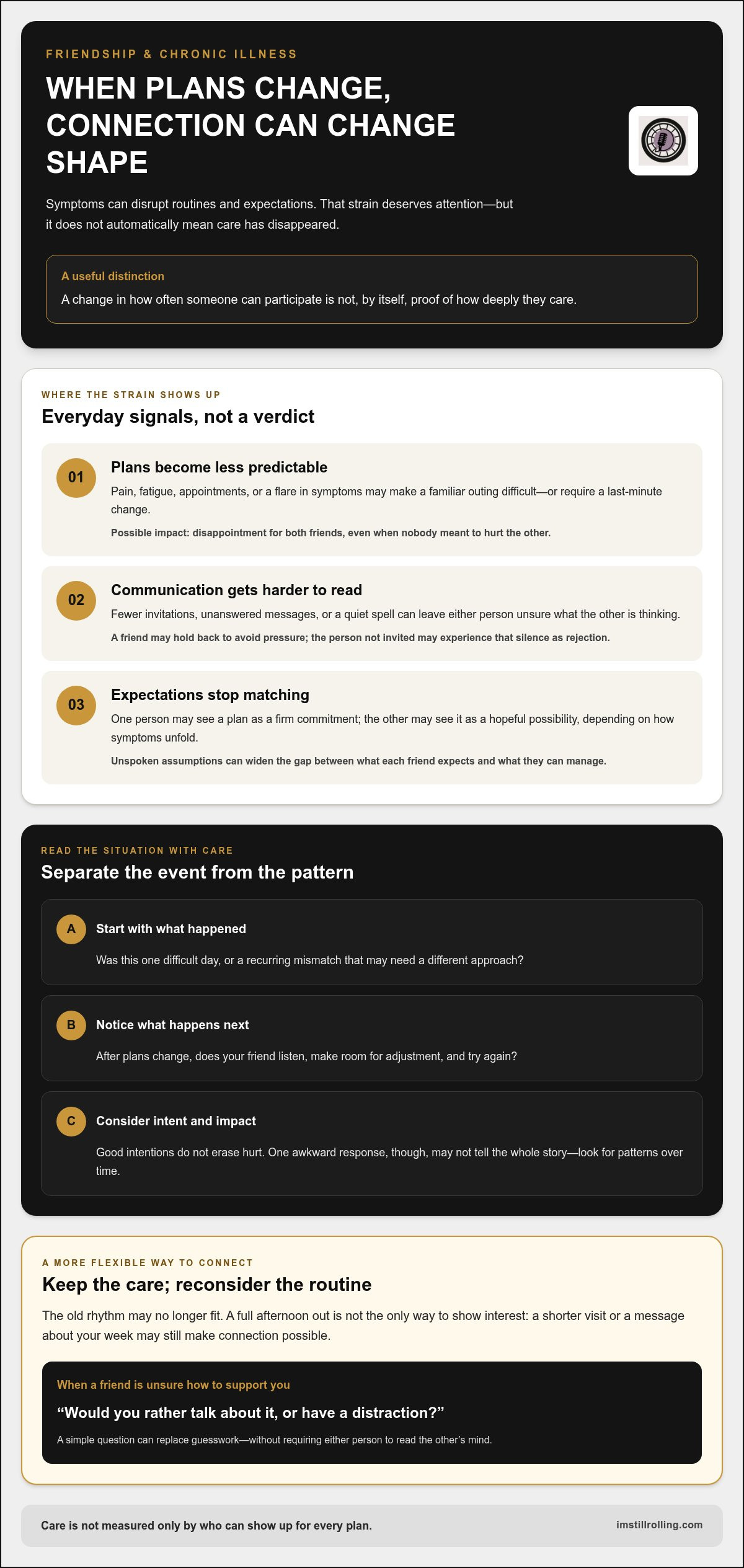
Wanting to see someone but not knowing whether your body will cooperate can make even a familiar friendship feel harder to maintain. Pain may make a busy restaurant unbearable; fatigue can turn a short visit into something that requires careful planning; an appointment or a flare in symptoms may interrupt plans at the last minute. The disappointment can run both ways: you may miss the time together, while your friend may feel unsure how to respond when plans keep changing.
In this context, friendship strain means tension or change in how friends communicate, share routines, understand expectations, or make themselves emotionally available. It describes a relationship experience, not a diagnosis, and it can occur around any chronic condition. Strain may show up as fewer spontaneous invitations, unanswered messages, or uncertainty about whether to ask for support. Those shifts deserve attention, but they don’t prove affection or commitment has disappeared.
Illness can change how often someone participates and what participation looks like, without changing how deeply they care. A friend who can’t manage a full afternoon out may still want to hear about your week. A later message or a visit shortened before it begins may reflect limited capacity rather than limited affection. Recognizing that difference can soften the urge to treat every disrupted routine as evidence of rejection.
How chronic illness can change the rhythm of a friendship
Friendships often grow around repeated rituals: a weekly walk, shared errands, a regular meal, or a quick call after work. Symptoms can make those rhythms less predictable. You may feel well enough to make a plan, then need to rest when the day arrives. Repeated cancellations can bring sadness or frustration for both friends, even when neither intended to cause hurt. The old routine may no longer fit, but the connection may still matter.
Why invisible symptoms can make connection harder
Some illnesses have few visible signs. Even when symptoms are outwardly apparent, they may not show how someone feels from hour to hour. A person can look well and still be managing pain, exhaustion, or uncertainty. That mismatch may leave friends unsure whether to offer help, keep plans, or give space. A brief explanation can help when the person has the energy and wants to share, but they aren’t responsible for repeatedly teaching everyone around them or proving that their limits are real.
Friendship strain can be a cue to reconsider how you stay connected, not a verdict on the relationship. Notice what has changed, and make room for both the practical limits of illness and the feelings that follow. A more flexible rhythm may take time to find. It can begin with the understanding that care isn’t measured only by what someone can show up for.
Why chronic illness can strain friendships without making either person the villain
Illness can change the terms of a friendship before either person has found language for what’s happening. One friend may think a plan is a firm commitment; the other may see it as a hopeful possibility, dependent on symptoms that can shift. A person managing illness may need more time to recover than friends expect, while friends may mistake a quiet spell for disinterest. Both can feel hurt without either setting out to cause harm.
That gap often widens when nobody says what they’re assuming. A friend might stop inviting someone to avoid putting them under pressure, while the person left out reads the silence as rejection. Or a person may cancel without explaining, hoping to avoid a difficult conversation, while their friend is left wondering what happened. In friendship and chronic illness, changed circumstances can strain a relationship, but they don’t define a person’s worth or how much they have to offer.
When friends do not know what to say or do
Some friends may feel helpless, worry about saying the wrong thing, or assume staying quiet is safer than asking. Others may not understand what kind of support is welcome. Patience can help when someone is uncertain, but uncertainty doesn’t excuse ongoing dismissal or pressure after a limit has been made clear. A simple question can replace guesswork: “Would you rather talk about it, or have a distraction?”
When changed plans create hurt on both sides
A canceled plan can disappoint a friend, even when symptoms make attendance impossible. That disappointment can be acknowledged without treating illness as a personal slight. Consider what’s happening: was this one difficult day, or is there a recurring mismatch that needs a new approach? An unavoidable cancellation is different from repeatedly pressuring someone to ignore their limits or refusing to consider alternatives. Notice what happens after plans change: does your friend listen, make room for adjustment, and try again?
Intent matters, but it isn’t the whole story. A friend may mean well and still say something minimizing; the impact can hurt even if harm wasn’t intended. At the same time, one awkward response doesn’t necessarily reveal the full character of a relationship. Look for patterns, then consider naming the specific moment and what would help next time, rather than expecting either person to read the other’s mind.
If you’re unsure how to begin, describe the situation without assigning blame: “I miss our time together, and I’ve been finding plans hard to predict. Could we talk about a way to stay in touch that feels manageable?” The response, and a willingness to keep working through changes, may tell you more than a single missed gathering.
Honest stories can also make these conversations feel less solitary. The I'm Still Rolling Podcast shares candid perspectives on life after disability through interviews with people living with disability and caregivers. Explore first-person stories about disability alongside these practical reflections.
Does chronic illness mean a friendship is over? Rethinking common fears
A change in closeness can feel like a verdict: fewer messages, less time together, or a friend who seems unsure how to approach you. But distance doesn’t always mean rejection, and illness doesn’t give every friendship the same ending. Some relationships adjust as people learn what works now; others grow quieter or reveal a mismatch that was already difficult to name. There’s no single outcome that applies to everyone.
A changed friendship has a different rhythm; a failed friendship repeatedly disregards the care, honesty, and boundaries needed to sustain connection. That distinction isn’t a promise that every relationship can be repaired. It’s a way to look beyond one missed plan or awkward exchange and notice the pattern that emerges over time.
What a friendship adapting to illness can look like
An adapting friend may listen when you explain what’s changed, adjust expectations, and stay open to connection that looks different from before. They might not respond perfectly every time. What matters is whether they can hear your perspective, take responsibility for a hurtful moment, and try another approach. Honest repair doesn’t erase the difficulty, but it can make room for trust to develop in a new shape.
When distance or boundaries may be necessary
Pay attention to recurring interactions that leave you feeling pressured, diminished, or guilty for having symptoms. A friend may need time to understand, but repeated minimization after you’ve explained your limits is different from a clumsy first response. Taking space is one option if contact feels harmful; it isn’t an obligation, a punishment, or a judgment you have to make immediately.
Notice how you feel before and after time with a friend. Do you feel heard, even if the conversation was imperfect? Do you find yourself hiding symptoms or agreeing to things you can’t manage to avoid their disappointment? These impressions aren’t a scorecard. They can help you decide whether to talk openly, try a different kind of contact, pause for a while, or accept that the relationship may not offer the mutual respect you need.
Friendship and chronic illness can bring grief for what has changed, alongside uncertainty about what might still be possible. You don’t have to label a friend uncaring simply because they’ve become distant, and you don’t have to dismiss repeated disregard to protect the friendship’s past. Give yourself room to notice actions over time, including whether both people are willing to make adjustments.
Hearing how others describe life after disability can offer another perspective without dictating what your friendship should become. The I’M STILL ROLLING Podcast features interviews with people living with disability and caregivers. Explore first-person stories about life after disability if you’d like to listen.
How to talk with friends about chronic illness, needs, and changing plans
A useful conversation doesn’t require a perfect explanation or a full account of your health. Share only what feels comfortable, including just the practical detail your friend needs to understand how plans or communication may change. If the topic feels tender, choose a calm moment rather than trying to explain everything during a flare, a cancellation, or an argument.
Keep the conversation simple and adaptable:
Choose a moment. Ask if your friend has time to talk, or send a message when you have the energy.
Name the change. Briefly explain what’s different, such as needing more notice or having less predictable energy.
State a need. Ask for one specific adjustment that could make staying in touch easier.
Invite a response. Give your friend room to ask a question, share a concern, or suggest another option.
A specific, manageable request can reduce guesswork by telling a friend what would help and what to do if plans change. For instance, “Could we check in by text that morning, then decide whether a short visit feels manageable?” is clearer than hoping they’ll know whether to cancel, encourage you, or wait for you to reach out. The request opens a conversation about coordinating, though it won’t make every misunderstanding disappear.
How to explain a need without apologizing for being ill
Describe the practical effect, then make a request without presenting your needs as a burden. You might say, “Long, noisy dinners are hard for me right now. Would you be open to meeting somewhere quieter?” Or, “My energy can change quickly, so a text check-in works better than a firm plan.” You can explain the limit without disclosing details you’d rather keep private.
How to respond when a friend misunderstands
If a comment lands badly, you can ask what your friend meant before deciding there’s no way forward. Then explain the impact plainly: “I know you may be trying to help, but that suggestion made me feel like my symptoms weren’t being taken seriously.” If you’re too tired to continue, say, “I want to come back to this, but I need to pause for now.” A pause can protect your energy without pretending the conversation is finished.
These approaches make the vulnerable work of friendship and chronic illness more concrete, without requiring you to disclose more than you want or carry the whole conversation alone. You’re allowed to ask for time, keep the explanation brief, or choose a message instead of speaking face to face. Notice whether the conversation leaves room for both honesty and respect, even if understanding takes more than one exchange.
For candid perspectives on life after disability, explore first-person stories from the I’M STILL ROLLING Podcast, featuring interviews with people living with disability and caregivers.
Maintaining Friendships Despite Chronic Illness
Staying close doesn’t have to depend on being available for the same activities or having the same amount of energy every week. A friendship can make room for a short visit, a voice note, a quiet cup of tea, or a conversation from home. In friendship and chronic illness, flexibility isn’t a consolation prize. It can be how care takes a form that fits the life you’re living now.
Ways to stay connected when energy and availability fluctuate
Try making plans with an easy alternative built in. You might arrange a brief visit, with a phone call as a backup if symptoms make going out difficult. A low-pressure message can keep a thread of connection alive without demanding an immediate reply. Friends can ask, “Would a call, a voice note, or a quiet visit feel manageable?” rather than guessing what you can handle.
It may also help to agree on a cadence that feels realistic to both of you. That could mean checking in when there’s something to share rather than expecting daily messages, or setting a recurring call that either person can reschedule. A rhythm is a shared reference point, not a test of devotion. If it stops working, revisit it without treating the change as proof that the friendship has failed.
Reciprocity matters, but it doesn’t have to look identical at every moment. During a difficult stretch, one friend may initiate more often, while the other offers attention, humor, or practical care when capacity allows. Over time, notice whether both people have room to give and receive, even if the balance shifts. Connection shouldn’t require one person to ignore their limits or carry every effort indefinitely.
Finding perspective through lived stories and shared experience
Stories about illness and relationships can offer a way to reflect on change beyond your own immediate worries. A story about caregiving for a spouse with Alzheimer’s explores how illness can alter shared roles and daily life. Stories of resilience offer another perspective on living through adversity. Someone else’s experience won’t define your friendship, but it may give you language for feelings that are hard to name.
I’M STILL ROLLING is a Podcast about Resilience & Disability that shares our journey and insights about life after disability. Its interviews feature people living with disability and caregivers. Listening offers candid perspectives, not a substitute for personal support or a promise of a particular outcome. Explore I’M STILL ROLLING Podcast episodes to hear those experiences.
Make room for connection in the life you have now
You don’t have to decide the future of every friendship today. Choose one small next step that feels possible: send a message, suggest a different kind of time together, or let someone know you’d like to reconnect when you have the energy. Connection can grow through modest gestures, and your needs deserve to be part of how it grows.
Friendship and chronic illness may ask you to imagine closeness differently, but you don’t have to make sense of every change alone. Listening to other people’s experiences can offer another perspective. The I’M STILL ROLLING Podcast shares interviews with people living with disability, caregivers, and adaptive-technology innovators. Audio and video episodes, transcripts, and a newsletter are also available.
Listen to I’M STILL ROLLING Podcast stories when you’re ready to hear candid voices and reflections. Your circumstances may change, and so may the shape of your friendships. There is still room for honest connection, at a pace that respects the life you’re living.
Frequently Asked Questions
Is it common to lose friends because of chronic illness?
Some people find that illness changes friendships, but that experience isn’t universal, and less contact doesn’t automatically mean rejection. Friendship and chronic illness can bring uncertainty about how to relate when familiar routines shift. Consider what has actually changed: are invitations less frequent, or are you both unsure how to make plans work? You can acknowledge grief without deciding that the distance is your fault or that the friendship is beyond repair.
Can a friendship recover after one person develops a chronic illness?
Sometimes a friendship can find a new rhythm, though it may not return to its former routine. What happens depends on what both people want and whether they can make space for change; there’s no guaranteed outcome. You might begin by saying, “I miss the way we used to connect. Would you like to figure out what could work for us now?” Their response can help clarify whether there’s mutual interest in rebuilding closeness.
How do I tell a friend I have a chronic illness?
You can share as much or as little as feels right for this particular friendship. For example, you might say, “I’m dealing with a health condition that can affect my energy, so I may need to change plans sometimes.” Add only what feels useful, such as whether you’d appreciate flexibility or prefer not to discuss details. If speaking feels difficult, a short message can open the conversation without requiring you to answer questions right away.
What should I say when a friend cancels plans because of illness?
If you’re the friend, respond with care rather than asking them to justify the cancellation. You could say, “I’m sorry today’s been hard. Would you like me to suggest another day, or would you rather reach out when you’re ready?” If you’re living with illness and need to cancel, a brief update is enough if you want to send one. You don’t owe an apology for symptoms or a detailed explanation.
Should I keep explaining my chronic illness to friends who do not understand?
You can choose whether another explanation feels useful. If you want to try, focus on one practical effect: “I can’t always predict how I’ll feel in the evening.” Then notice whether your friend takes that in and responds with respect. If the same conversation repeatedly leaves you feeling dismissed, you can decline to keep explaining, change the subject, or limit what you share. More detail doesn’t guarantee greater understanding.
How can I support a friend with chronic illness without being intrusive?
Ask before offering advice or practical help, and make it easy for your friend to say no. A specific offer, such as “Would it help if I picked up groceries this week?” is easier to answer than “Let me know if you need anything.” Keep ordinary conversation going, too, if that’s welcome. Your friend may want to talk about illness one day and something entirely different the next; let them set the terms.


Comments