Coping with Chronic Fatigue: A Grounded Guide to Daily Life
What if coping with chronic fatigue begins not with doing more, but with taking your changing capacity seriously? When rest doesn’t restore your energy, familiar tasks can become hard to predict. A busy morning may be followed by a day when getting dressed or answering messages takes more effort than expected.
If you’ve been told to push through, it can be hard to explain why that advice doesn’t fit. Symptoms may be invisible, plans may need to change, and other people may not see the effort behind an ordinary task. That doesn’t make your limits less real.
This guide offers practical ways to adjust expectations, balance activity with rest, and describe your symptoms and needs to people in your life and to clinicians. It also explores how to work with fluctuating energy without treating every difficult day as a test of willpower. Respect for lived experience is central to the I'm Still Rolling Podcast, a show about Resilience & Disability that shares our journey and insights about life after disability through candid conversations with people living with disability and caregivers.
Key Takeaways
Understand why persistent fatigue describes a symptom, while ME/CFS is a specific condition with its own diagnostic criteria.
Learn how post-exertional malaise differs from ordinary tiredness and why symptoms may shift after physical, mental, or social activity.
Explore a flexible framework for coping with chronic fatigue: identify essentials, simplify tasks, plan pauses, and reflect on what works for you.
Make conversations about support more concrete by describing how symptoms affect daily activities and change over time.
Find recognition in lived-experience stories while remembering that personal stories offer perspective, not diagnosis or treatment.
Table of Contents
What does coping with chronic fatigue really mean?
Persistent fatigue can rearrange daily life without announcing itself. A shower, a work call, or a trip to the grocery store may take more out of someone than expected. Plans that felt manageable yesterday may not feel possible today. That isn’t proof of laziness or insufficient effort. Coping with chronic fatigue starts with recognizing that a real symptom can affect daily life, even when other people can’t see it.
Chronic fatigue and ME/CFS are related terms, not automatic equivalents
Chronic fatigue describes ongoing or recurring fatigue; ME/CFS is a specific, complex illness. Fatigue can accompany a range of health circumstances, including sleep disorders, infections, medication effects, and other conditions. The CDC describes ME/CFS as a chronic illness that can substantially affect a person’s ability to carry out ordinary activities. The terms are related, but persistent fatigue alone doesn’t establish that someone has ME/CFS.
ME/CFS may involve unrefreshing sleep, cognitive difficulties, and post-exertional malaise, a worsening of symptoms after exertion. These features are part of a broader clinical picture, not a checklist for diagnosing yourself. For a wider overview of its symptoms and effects, see Understanding Myalgic Encephalomyelitis/Chronic Fatigue Syndrome. A clinician evaluates symptoms and considers other possible explanations. An article can offer context, but it can’t determine an individual diagnosis.
Why fatigue can feel different from ordinary tiredness
Ordinary tiredness often follows an identifiable demand and may ease with rest. Persistent fatigue can remain despite rest and make many kinds of effort feel harder: following a conversation, finding the right words, standing long enough to prepare food, or keeping a social plan. For some people, the difficulty is less about feeling sleepy and more about having too little capacity for the tasks their day asks of them.
The experience isn’t identical for everyone, and it can shift from one day to the next. Someone might manage a short errand one morning, then struggle to concentrate later. Another person may find movement, conversation, or basic self-care especially demanding. When symptoms fluctuate, capacity can be difficult to predict, even for the person experiencing them.
That variability matters when thinking about what coping means. It isn’t a demand to overcome symptoms with motivation, better sleep habits, or positive thinking. Rest and supportive routines may matter, but they don’t necessarily resolve the underlying fatigue. A more grounded starting point is to notice what changes, what remains difficult, and how symptoms affect ordinary activities. That information can help someone describe their experience and discuss it with a healthcare professional without assuming a particular cause.
How fluctuating energy and post-exertional malaise shape coping
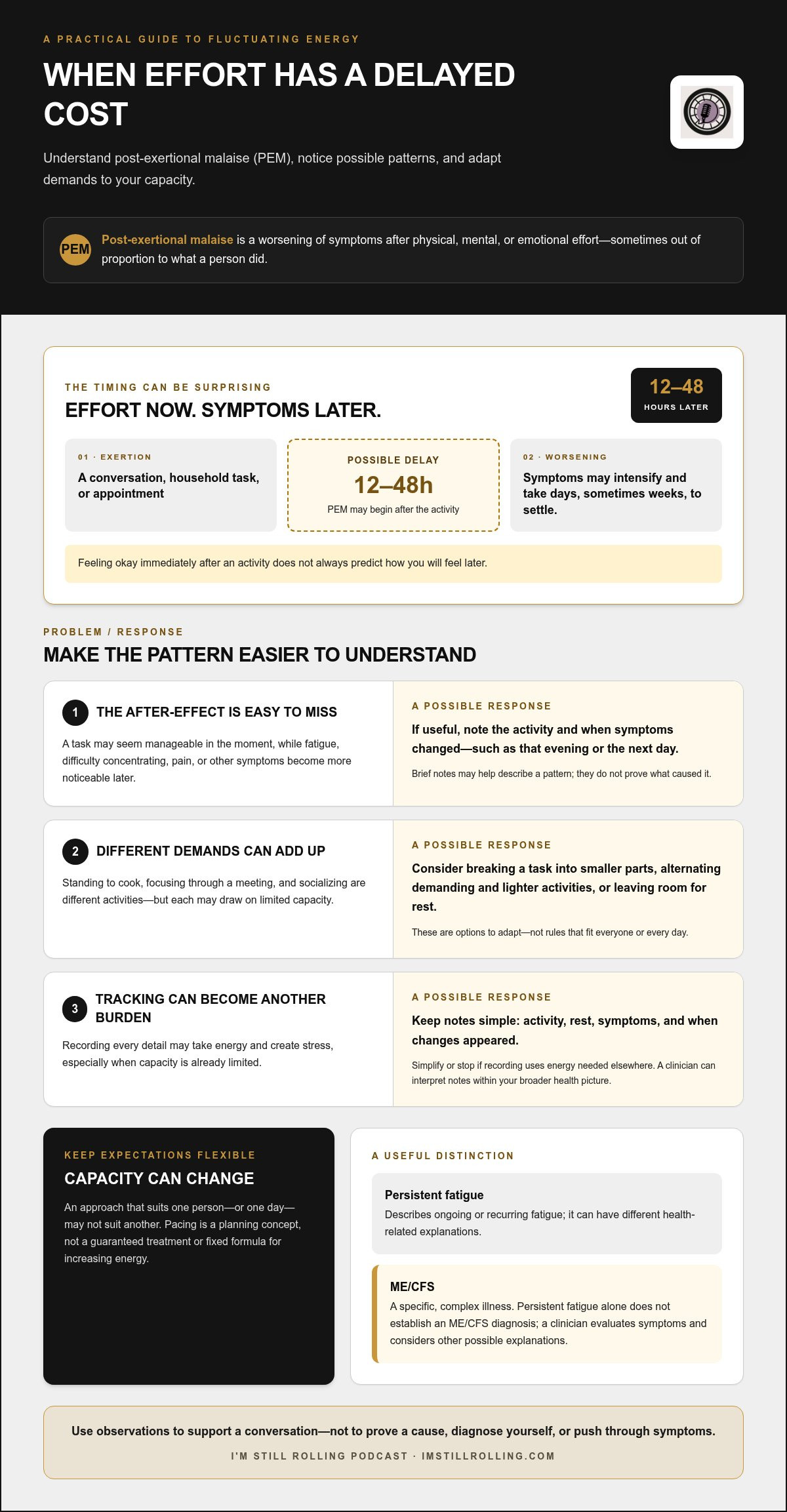
With fluctuating symptoms, the effort of an activity and its effects may not arrive together. Post-exertional malaise (PEM) is a worsening of symptoms after physical, mental, or emotional effort that can be out of proportion to what a person did. It isn’t simply feeling tired after a demanding day: symptoms may intensify later and take days, sometimes weeks, to settle.
Immediate energy doesn’t always predict how someone will feel later, because PEM can begin 12 to 48 hours after exertion. A person might finish a conversation, household task, or appointment without an obvious problem, then notice increased fatigue, difficulty concentrating, pain, or other symptoms afterward. Demands can also add up. Standing to cook, focusing through a meeting, and socializing may each draw on limited capacity, even though they seem like different kinds of activity.
Recognizing patterns without turning tracking into another burden
If it feels useful, a few brief notes can make an unpredictable pattern easier to describe. There’s no need to log every detail or turn daily life into a research project. A simple note about an activity, rest, symptoms, and when changes appeared may be enough to notice possible connections.
For example, someone might jot down that a phone call and a grocery trip happened on the same day, then note how they felt that evening or the next day. The point isn’t to prove a cause or meet a tracking goal. Notes are one possible way to support a conversation with a clinician, who can interpret them alongside the person’s broader health picture. If recording symptoms creates stress or uses energy needed elsewhere, it’s reasonable to stop or simplify.
Pacing means adapting demands to the person, not pushing through
Some people use pacing to balance activity and rest around their own capacity. That may mean breaking a task into smaller parts, alternating demanding and lighter activities, or leaving room for rest before symptoms build. These are options to consider, not rules for everyone. Capacity can change, so an approach that suits one person or one day may not suit another.
Pacing is a planning concept, not a guaranteed treatment or a fixed formula for increasing energy. It doesn’t require a rigid timetable, universal activity target, or prescribed exercise progression. The aim is to make decisions with a clearer view of current limits, rather than treating every symptom flare as a reason to push harder. A clinician familiar with the person’s condition can help tailor guidance and consider what is appropriate in their circumstances.
Compassion matters here. Coping with chronic fatigue may involve changing plans, protecting time for recovery, and accepting that capacity isn’t always predictable. For companionship and perspective rooted in lived experience, I’M STILL ROLLING conversations share our journey and insights about life after disability through a podcast about Resilience & Disability.
Practical ways to make daily life more manageable
Daily adjustments can’t control an illness, and a plan that helps one person may not suit another. Still, small choices can make demands clearer and leave more room for changing symptoms. Treat the ideas below as options to try gently, not rules to follow perfectly or promises of extra energy. Household responsibilities, work expectations, and social commitments all depend on a person’s circumstances.
Identify essentials. Consider what truly needs attention today and what can wait. This might mean prioritizing a meal and an essential work task while postponing a non-urgent errand. If deciding feels difficult, a short list can separate immediate needs from tasks that matter but aren’t time-sensitive.
Simplify tasks. Look for a less demanding way to do something, if one is available. Preparing a simple meal, sitting while folding laundry, or splitting a household task into smaller steps may reduce the effort involved. At work, someone might ask whether a task can be broken into stages or handled at a different time.
Plan pauses. Build in opportunities to stop before a task is finished, rather than assuming rest can only happen once everything is done. A pause could mean sitting between chores or leaving space between an appointment and another commitment. What feels useful will vary, and rest breaks don’t guarantee symptoms will stay away.
Revisit what worked. At a convenient time, notice whether an adjustment made a task more manageable or added pressure. Keep what seems helpful, change what doesn’t, and let go of the idea that one plan must work every day. Unpredictable symptoms may call for a different approach tomorrow.
Adapt tasks and routines around the energy available
Breaking a demanding job into smaller parts can create natural stopping points: gather ingredients, pause, then prepare food, for example. Someone might choose one priority while leaving the rest of the day less tightly scheduled. These adaptations can make choices more manageable, but organization alone can’t control symptoms or guarantee a predictable day.
Work and home routines may need different kinds of flexibility. A person’s options might depend on responsibilities, workplace expectations, available support, and how symptoms affect them. The goal isn’t to fit every life into an ideal schedule. It’s to consider which demands can be adjusted without treating difficulty as a personal failure.
Protect connection while adjusting plans
Staying connected doesn’t have to mean keeping every original plan. A shorter visit, a quieter setting, or a message instead of an outing may feel more workable. If plans need to change, a simple explanation can reduce guesswork: “I’m not feeling well enough to meet today. Could we check in by phone another time?”
These alternatives won’t suit every person or every relationship, and social contact isn’t a cure for fatigue. They’re possible ways to preserve choice and connection while respecting current limits. If even replying feels like too much, it’s reasonable to respond when capacity allows.
How to talk about chronic fatigue and ask for support
Explaining fatigue can be difficult when symptoms aren’t visible and your capacity changes from one day to the next. Coping doesn’t mean trying harder, persuading everyone that you’re ill, or producing proof before you’re allowed to ask for help. It can mean finding clear words for what’s happening and deciding what information or support would be useful in a particular conversation.
Concrete examples often communicate more than a broad label. Instead of saying only “I’m exhausted,” you might explain that preparing dinner now requires a rest afterward, that concentration drops after a meeting, or that symptoms sometimes worsen later rather than during an activity. You don’t need to tell the whole story. A few details can give another person a more accurate picture of how fatigue affects daily life.
Preparing for a conversation with a healthcare professional
If fatigue is persistent or concerning, consider discussing it with a qualified healthcare professional. A short note can help you make the most of the conversation, especially if recalling details on the spot is difficult. You might include when the fatigue began, how it affects everyday activities, when symptoms tend to change, and any questions you want answered.
You could ask what possible causes may need consideration, what information would help guide an evaluation, and what follow-up makes sense. You don’t need to arrive with a diagnosis or a perfect record. Evaluation and care decisions belong with you and your clinician, based on your circumstances and the conversation you have together.
Explaining changing capacity to people around you
People may assume that managing a task once means you can do it whenever needed. A plain explanation can make the variability easier to understand: “My energy isn’t consistent, so I can’t always predict what I’ll manage,” or “I may need to rest after this, even if I seem okay right now.” You can share only what feels appropriate; you don’t owe everyone a detailed account of your health.
Specific requests can also make support more practical. For example, you might ask a friend to keep a visit short, request flexibility around a deadline, or ask someone to handle one errand. These requests won’t guarantee that others understand or can help, but they make your needs clearer and give the other person something concrete to respond to. If a request isn’t possible, you can consider whether another adjustment would work for you.
The emotional strain of having to explain yourself can be real, particularly when plans change or your limits are questioned. If that feels isolating, I’M STILL ROLLING shares our journey and insights about life after disability through conversations grounded in lived experience. Explore lived-experience conversations for perspective and companionship, not medical guidance.
Finding perspective and companionship while coping with chronic fatigue
Living with ongoing symptoms can make ordinary conversations feel lonely, especially when others can’t see the effort behind a changed plan or a quiet day. Listening to someone describe a different, difficult experience may offer recognition, not because their life matches yours, but because uncertainty, adjustment, and the need to be understood can resonate. Stories can create a sense of company without asking you to explain everything in return.
That connection has limits, and it’s useful to name them clearly. A personal story can offer perspective, but it can’t diagnose or treat chronic fatigue, determine what’s causing symptoms, or replace individual support. No one story can speak for everyone. You can take what feels meaningful and leave the rest.
Lived experience can help someone feel less alone
Honest accounts of disability and caregiving can hold complexity: hard days, changed expectations, relationships, and the ways people find meaning without pretending the difficulties have disappeared. Hearing those experiences may help a listener feel recognized or give them language for a conversation of their own. Listening is one possible source of companionship, not a substitute for trusted relationships or professional care.
You don’t need to treat someone else’s experience as a model for your own. Their needs, circumstances, and choices may be different. The value can simply be in hearing a person speak openly, with room for uncertainty and individual perspective. That kind of attention can matter even when it offers no answers about symptoms.
Explore I’M STILL ROLLING in the format that suits you
I’M STILL ROLLING is a podcast about Resilience & Disability that shares our journey and insights about life after disability. Hosted by Mike Sugarman and Janice Wright Sugerman, it features conversations with people living with disability and caregivers. These are lived-experience conversations, not a promise of chronic-fatigue advice or medical guidance.
You can choose from audio and video episodes, written transcripts, and the newsletter. Episodes are available through Apple Podcasts, Spotify, YouTube, and Redcirlce. A transcript may suit a moment when listening isn’t convenient; an episode may feel right when you want to spend time with a conversation. Choose what fits your attention and energy, or set it aside for another day.
If a thoughtful story would be welcome, explore I’M STILL ROLLING and find a format that feels comfortable for you.
Let your next step be small and your own
There may not be one clear turning point in coping with chronic fatigue. Sometimes the next step is simply noticing what feels possible now, without demanding that it define what you’ll manage tomorrow. You’re allowed to revise a plan, ask for understanding, or leave a question unanswered until you have more room to consider it. A changing capacity doesn’t make your effort less real.
As you move forward, look for support that makes room for your experience rather than insisting on a neat explanation or a quick fix. A story can’t decide what’s right for you, but hearing people speak candidly about disability may offer recognition or a different perspective. Take what resonates and leave the rest. Your path doesn’t need to match anyone else’s to be valid.
If you’d welcome that kind of human connection, explore I’M STILL ROLLING and listen to a conversation or read a transcript at your own pace. Let the next step be one that respects where you are today. You deserve patience, understanding, and room to keep finding your way.
Frequently Asked Questions
Is chronic fatigue the same as ME/CFS?
No. Chronic fatigue describes a symptom that can have different causes, while ME/CFS is a specific illness; fatigue alone doesn’t establish a diagnosis. If coping with chronic fatigue has become part of daily life, you might note which activities are affected and what changes you’ve noticed, then discuss those details with a qualified healthcare professional. They can consider your individual circumstances and possible explanations rather than relying on a label alone.
Can chronic fatigue affect concentration and memory?
Yes, some people experiencing chronic fatigue or ME/CFS report difficulty concentrating or remembering things, though experiences vary. You might notice that you lose the thread of a conversation, need instructions repeated, or find it harder to switch between tasks. If these changes are new, persistent, or troubling, share specific examples with a healthcare professional. Describing when they happen can help make the conversation more useful, without assuming fatigue is the only possible cause.
Does sleeping longer make chronic fatigue go away?
Not necessarily. Some people with ME/CFS experience sleep that doesn’t leave them feeling restored, and fatigue can have causes that extra rest alone won’t resolve. Try not to treat a particular number of hours as a universal fix or blame yourself if you wake tired. If fatigue continues to affect your life, you could tell a healthcare professional whether your sleep feels refreshing and how your energy changes through the day.
Can I exercise if I have chronic fatigue?
There isn’t one activity plan that’s right for everyone, particularly if exertion is followed by worsened symptoms. Don’t assume that increasing effort is the answer or adopt a generic activity target without considering your situation. If you’re discussing movement with a clinician, describe what kinds of activity you do and any changes you notice afterward, including delayed effects. Your clinician can help consider guidance in light of your symptoms and circumstances.
What should I write down before discussing fatigue with a doctor?
Keep it simple: note when fatigue tends to occur, one or two everyday activities it affects, accompanying symptoms, and any changes over time. For instance, you could record that concentrating at work is harder after a poor night’s sleep, if that’s a pattern you’ve noticed. Add the questions you most want answered. Detailed tracking isn’t required; bring whatever feels manageable, and let your clinician guide the evaluation.
Is chronic fatigue visible to other people?
Not always. Someone may look well while fatigue makes conversation, errands, or familiar tasks harder. That mismatch can leave a person feeling pressured to explain why they need to change plans, but appearance doesn’t reveal the full effort involved. You don’t have to prove your symptoms to deserve consideration. If useful, explain one practical effect, such as needing more time to finish a task, and make a specific request for flexibility.



Comments