Finding Community with a Disability: How to Find Your People
What if belonging doesn’t depend on finding one perfect group, but can grow through a few smaller, safer points of connection? You may care about the people already in your life and still feel unseen when disability shapes experiences they don’t understand. That gap can make finding community with a disability feel daunting, especially when you’re unsure whether a group will be accessible, respectful, or more interested in an “inspiring” story than a real relationship.
Wanting peers who understand isn’t asking too much, and you don’t have to share your whole story to start looking. You could begin by reading a forum, attending one gathering, or asking an organizer how the group handles access and participation. The way a group responds can tell you a lot about whether it may be a good fit.
This guide covers practical ways to find disability-led and peer communities online and locally, and how to assess accessibility, moderation, and group culture before joining. You’ll also find low-pressure ways to try a new space, set boundaries around what you disclose, and build connection at a pace that feels right for you.
Table of Contents
What does finding community with a disability really mean?
Finding community with a disability means building chosen connections grounded in mutual understanding, respect, and belonging, whether or not those connections happen in a disability-specific group. It isn’t a membership card, a shared diagnosis, or one organization you have to join. Community can be a place where you feel recognized and can participate without continually justifying your needs or explaining your life.
There’s no single way to be disabled, and no single story a community should expect you to tell. Disability communities include people with different identities, cultures, access needs, and experiences. You don’t have to adopt a particular label, disclose personal details, or present a cheerful or “inspiring” version of disability to earn a place. You can decide what language fits, what you share, and whether a space feels right for you.
Can community mean more than a disability-specific group?
Yes. A peer group may offer conversation with people who recognize certain practical realities. Friendships, creative circles, advocacy spaces, and shared-interest communities can offer other kinds of connection. Someone might meet people through an art group, a gaming community, or a local gathering without disability being the main topic. One person may feel at home across several communities; another may prefer a few close relationships. Neither is more genuine.
Why can shared experience make connection feel different?
Being with someone who understands why an access need matters can bring a particular kind of relief. You may not have to explain every detail before the conversation moves on to ordinary things: work, humor, music, or what happened that day. Recognition can also be shaped by disability culture, including shared experiences, creative expression, and identity. The overview of Disability culture offers one introduction to those connections.
Shared disability experience does not guarantee identical needs, perspectives, or preferences. People may relate differently to diagnosis, identity, access, and community. Those differences deserve respect, not a test of who belongs. Finding community with a disability can mean seeking understanding while staying fully yourself, with room to connect, disagree, and set boundaries without explaining more than you choose.
Where can you find community with a disability?
There isn’t one directory that can tell you where you’ll feel at ease. Finding community with a disability may start with a local organization, a peer group, an online forum, or a space built around something you already enjoy. A shared interest can make conversation easier, while a peer group may offer a chance to talk with people who recognize some practical realities of disability.
Ask trusted clinicians, librarians, or community organizations whether they know of relevant groups or gatherings. Treat any suggestion as a starting point, not a guarantee. Offerings change, and a group that suits one person may not suit another. ADA.gov describes the right to community integration and points to resources, including Centers for Independent Living (CILs). That information can provide context, but you’ll still need to check what’s available locally.
How can you look for local disability peer groups?
Search by location and interest using phrases such as “disability peer support,” “adaptive recreation,” or “disability arts group.” Contact a nearby Center for Independent Living to ask whether it offers or knows of peer groups and other community connections. Before making plans, confirm the location, eligibility, meeting format, access arrangements, and current schedule directly with the organizer.
Local libraries, recreation programs, and community organizations may also know about gatherings that are difficult to find through a general search. If travel or an in-person setting is a barrier, ask whether there’s a remote option or another way to participate. Availability varies, so it’s reasonable to check before sharing personal information or setting aside time.
What should you look for in online disability communities?
Online options include moderated forums, social media groups, virtual events, and communities centered on shared interests. They can connect people across distance, but each space has its own culture, moderation, and access practices. Before posting, review the group’s rules and privacy settings. Check whether it explains how moderators handle harmful behavior and whether members can participate in different ways.
Ask whether events include captions, materials work with screen readers, and participation is possible by chat or without speaking on camera. Don’t assume a platform is accessible or private. Check the details that matter to you. You can start by reading without posting, then decide whether to take part. If hearing varied lived experiences feels like a gentle first step, explore I'm Still Rolling Podcast episodes and transcripts as one optional way to encounter disability perspectives.
How can you tell whether a disability community is welcoming?
A polished website or warm welcome message can make a good first impression, but neither tells you everything about how a group works in practice. Look at how it handles access, disagreement, privacy, and differences among members. These clues can guide your questions, but they aren’t a pass-or-fail test. A small or unfamiliar group may simply need clarification, while repeated dismissals of reasonable questions deserve attention.
Use this comparison as a starting point, not a verdict. One concern may call for a follow-up question; patterns of disrespect or pressure may help you decide the space isn’t right for you.
Which accessibility questions are worth asking before joining?
Ask about the details that affect your participation: step-free entry, accessible washrooms, captions, interpreters, breaks, sensory needs, or remote access. You can describe what would help without naming a diagnosis: “Are captions available?” or “Is there a quieter space?” Needs vary, and access can differ from one event to another, so confirm arrangements with the group each time.
What signs suggest a group respects different disability experiences?
Notice whether members can use the language that fits them, set boundaries, and participate without sharing medical histories. Clear moderation expectations and respectful responses to questions matter more than perfect wording. A group that doesn’t fit your communication style or access needs may be a personal mismatch, not proof that it’s unsafe or unwelcoming to everyone. Still, you’re allowed to step back if the experience feels wrong.
Finding community with a disability takes discernment as well as openness. You don’t owe a group an explanation for asking questions, taking time to decide, or choosing not to join.
How do you make a first connection without feeling pressured?
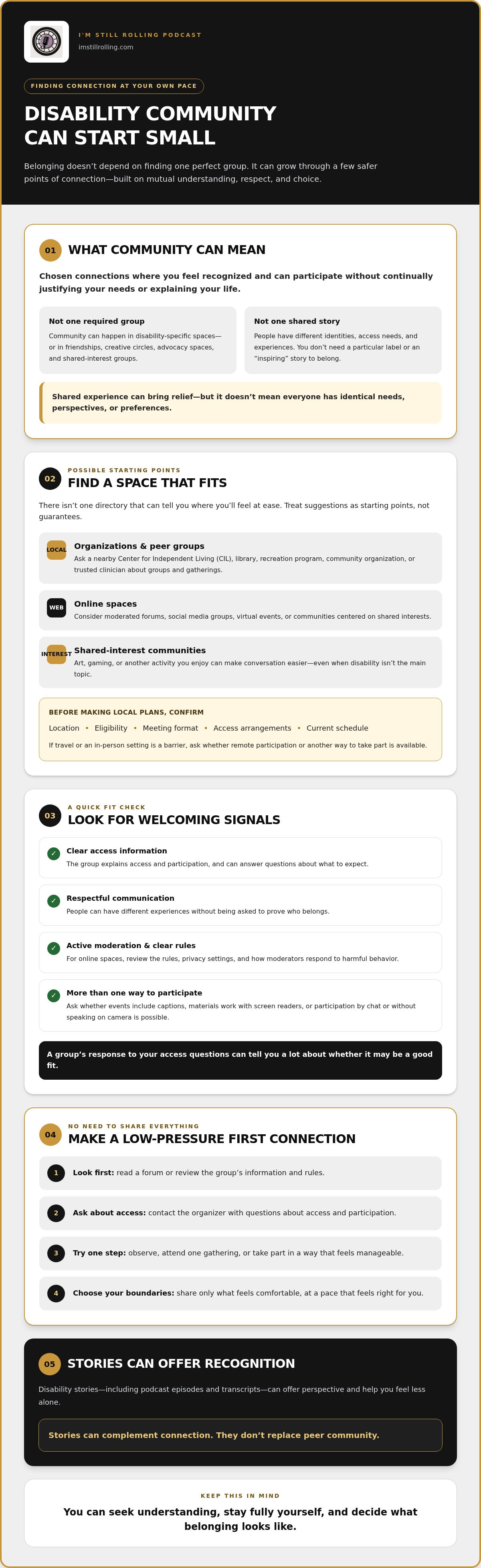
A first step doesn’t have to be a big introduction or a promise to keep showing up. Treat a group like a place you’re getting to know: notice how it works, ask what you need, try a small interaction, then decide whether you want to return. This keeps the choice in your hands, including the choice to pause or leave.
1. Observe. Read group guidelines, attend a public event, or follow a conversation before posting. Notice whether people are treated with respect and how organizers respond to questions.
2. Ask. Contact an organizer about the meeting format, access options, and whether newcomers can listen or observe. You don’t need to explain why you’re asking.
3. Try one interaction. Set a small goal, such as greeting one person, asking a question, or staying for part of a gathering. You can leave when you need to.
4. Reflect. Afterward, consider whether you felt comfortable, whether access arrangements worked, and whether conversation felt reciprocal rather than demanding.
5. Decide what comes next. Return, try a different way to participate, take a break, or look for another group. A first visit is information, not a commitment.
What can you say when reaching out to a group?
Adapt these scripts for email, a direct message, an in-person conversation, or a video call. Share only what you’re comfortable sharing.
To ask about access: “Hi, I’m interested in your group. Could you tell me how meetings work, what access options are available, and whether newcomers can observe before joining in?”
To introduce yourself: “Hi, I’m [name]. I’m interested in [shared interest] and wanted to meet people with similar interests. I’m glad to listen today.”
Participation can be gradual and self-directed. You can attend once, speak with one member, or simply observe. You can also leave, take a break, or decide a group isn’t the right fit without treating that choice as a failure. Feeling unsure after one interaction doesn’t always mean a space is unwelcoming, but repeated pressure to disclose or ignore your boundaries is worth taking seriously.
Sometimes a personal story can offer a low-pressure point of recognition before you reach out to people directly. You might read spinal cord injury recovery stories as one perspective on lived experience. Stories can prompt reflection, but they aren’t a substitute for reciprocal peer connection. To explore more perspectives at your own pace, browse I'm Still Rolling Podcast episodes and transcripts.
How can disability stories help you feel less alone?
A story can give shape to an experience you’ve struggled to explain. Hearing someone describe an access barrier, a shift in identity, or the ordinary texture of life with disability may offer recognition and language for your own feelings. That moment can matter, especially if people around you haven’t understood. But a story is one perspective, not a promise that loneliness will disappear. Media can’t replace reciprocal relationships or support services.
You can listen, watch, or read a transcript in whatever format suits you, and stop whenever you need to. You don’t have to identify with every detail or turn someone else’s experience into a guide for your own. For broader context on how disability storytelling has changed, explore this disability rights podcast guide.
What can you take from disability stories without assuming they speak for everyone?
Hold each account as one person’s truth, shaped by their own identity, circumstances, and needs. A story might help you name a feeling, consider a new question, or find words for a conversation with someone you trust. It can also reveal experiences different from yours. Both recognition and difference have value; no single voice represents all disabled people.
As you encounter a story, notice what stays with you. Perhaps it helps you describe an access need or gives you a starting point for seeking people who share an interest or experience. That can support finding community with a disability, but the next step remains yours. A story may open a door to reflection; connection grows through relationships with room for listening, response, and mutual care.
Where can you find more lived-experience conversations?
I'm Still Rolling Podcast is a journalism-led podcast about disability, resilience, caregiving, and life after adversity, hosted by journalists Mike Sugerman and Janice Wright. Episodes are available in audio and video, with written transcripts as another way to encounter the conversations. Choose the format that works for you, and check current episode and transcript availability before looking for a particular topic.
You might hear a perspective that resonates, or one that complicates what you thought you knew. Either way, a conversation can be a low-pressure way to encounter lived experience before reaching out to a group or another person. Treat it as a companion to connection, not a substitute for it. If you’re curious, explore I'm Still Rolling Podcast episodes and transcripts at your own pace.
Take One Small Step Toward Connection
Finding community with a disability doesn’t require discovering one perfect group or sharing more of your story than feels right. Belonging can grow through a peer conversation, a shared interest, or a few relationships where mutual respect and access matter. Asking questions before joining, noticing how a group responds, and giving yourself permission to pause can help you choose what feels comfortable.
Stories can offer recognition and language for experiences that are hard to explain, while reminding us that no one person speaks for everyone. They can be a gentle starting point, not a substitute for reciprocal relationships or support.
I'm Still Rolling Podcast is a journalism-led show hosted by Mike Sugerman and Janice Wright, featuring conversations about disability, resilience, and life after adversity. Episodes are available in audio, video, and written transcript formats. Explore honest conversations about disability and resilience at your own pace.
Connection doesn’t have to happen all at once. Start where you are, protect your boundaries, and trust that your people may be found one small interaction at a time.
Frequently Asked Questions
How can I find a disability community near me?
Search online using your location and terms such as “disability peer support,” “adaptive recreation,” or “disability arts group.” In the U.S., contact a nearby Center for Independent Living to ask whether it offers or knows of peer connections. Libraries, community organizations, and trusted clinicians may also know of local options. Confirm the group’s current schedule, location, eligibility, meeting format, and accessibility directly with its organizers before attending.
Can I find disability community online?
Yes. Online communities include moderated forums, social media groups, virtual events, and spaces organized around shared interests or experiences. They can connect people who live far apart or can’t attend in person, but access and group culture vary. Before participating, check for captions, screen-reader-friendly materials, flexible ways to join in, clear moderation rules, and privacy guidance. You can read along without posting until you feel ready to take part.
What should I ask before joining a disability support group?
Ask how meetings work, who can join, and whether newcomers may observe before participating. Check practical access details, such as step-free entry, captions, interpreters, breaks, sensory considerations, or remote options. You might also ask how moderators handle disrespectful comments and what happens to personal information shared in the group. Clear, respectful answers can help you decide whether the space fits your needs; you don’t have to disclose a diagnosis to ask.
Do I need to disclose my diagnosis to join a disability community?
Not necessarily. Requirements differ, so ask organizers whether a diagnosis or other information is needed for membership. In many spaces, you can introduce yourself through your interests or explain an access need without naming a condition. Share only what feels appropriate to you. If a group pressures you to reveal personal medical details that aren’t relevant to joining or participating, pause and consider whether its boundaries feel right for you.
What if I do not feel like I fit into disability culture?
You don’t have to adopt a particular identity, label, or way of talking about disability to seek connection. Disability experiences and perspectives are varied, and one group’s culture won’t suit everyone. You might feel more at ease in a peer group, a creative space, or a community centered on another interest. Finding community with a disability can mean choosing relationships where you’re respected, even if you don’t identify with every shared viewpoint.
How can I tell whether an online disability group is safe?
No checklist can guarantee that an online space is safe, but you can look for clear rules, active moderation, and a stated process for reporting harmful behavior. Review privacy settings before posting, and avoid sharing identifying or sensitive details until you understand who can see them. Be cautious if members pressure you for personal information, money, or private contact. You can observe first, leave a group, or use its block and report tools if needed.
Can disability stories help me feel less alone?
They can offer recognition, new language, or a different perspective, but one person’s account can’t represent everyone or promise to resolve loneliness. Stories may be a low-pressure way to encounter lived experience while you consider what kind of connection you want. I’m Still Rolling, hosted by journalists Mike Sugerman and Janice Wright, offers podcast conversations in audio, video, and written transcript formats. These stories can complement, but don’t replace, reciprocal relationships or support services.
Comments