Emotional Support for Cancer Caregivers: A Guide
A 2025 National Cancer Institute report found that 50% of informal cancer caregivers experience high emotional stress. If you’re carrying appointments, decisions, and worry while trying to stay strong for someone you love, that strain can feel deeply isolating. Needing support doesn’t mean you care any less, and it doesn’t mean you’re failing. Finding emotional support for caregivers of cancer patients is a way to care for yourself as well as someone you love.
Support can start with small, practical steps, even when asking for help feels uncomfortable or taking time for yourself brings guilt. You deserve to be heard without pity or judgment, and you don’t have to wait until you’re at a breaking point to reach out.
This guide offers manageable ways to name what you need, ask others for specific help, and set boundaries that protect your well-being. You’ll also find credible support resources and stories from people who’ve lived through caregiving and adversity, including podcast episodes and transcripts. Support won’t make every hard moment disappear, but it can help you feel less alone in facing them.
Table of Contents
Emotional Support for Caregivers of Cancer Patients Starts With Naming the Weight
You can love someone fiercely and still feel tired, frightened, or unsure of what to do next. Cancer caregiving can bring long stretches of uncertainty, with routines and responsibilities shifting around appointments, changing needs, and the ordinary demands of life. Feeling the strain doesn’t mean you’re less devoted or doing a poor job. It means you’re carrying something difficult.
Caregiver emotional support means being heard, understood, and helped through the feelings that arise while caring for someone. That might mean talking honestly with someone you trust, finding company with people who understand, or speaking with a qualified professional. Emotional support for caregivers of cancer patients is distinct from medical advice, treatment decisions, or hands-on care. Each can matter, but they address different needs.
The emotional weight can be hard to name because it isn’t always one feeling. Relief may sit beside worry; frustration can surface alongside affection; hope may appear even when the future feels uncertain. The overview of distress in cancer caregiving describes the psychological, social, and physical pressures that can accompany caregiving. Recognizing those pressures can help you make room for your experience without judging it.
Why cancer caregiving can feel emotionally complicated
Caregiving can change the shape of a day without pausing everything else. Work, household tasks, relationships, and personal needs may all continue as you respond to changing circumstances. There’s no single caregiving role or family situation, and no required way to feel. You might be hopeful one moment and depleted the next. Mixed feelings don’t cancel each other out, and they don’t measure how much you care.
How to recognize when you need support, too
Notice what’s been lingering. Persistent isolation, overwhelm, irritability, or difficulty resting may be signals that you need more support, not a diagnosis or a verdict on your ability to care. You don’t have to wait for a crisis to take those feelings seriously.
If distress feels hard to manage, consider telling a trusted person what’s been weighing on you or speaking with a qualified professional. You could begin simply: “I don’t need you to solve this. Could you listen for a while?” Naming what you need gives the other person a clearer way to respond.
What Emotional Support for Cancer Caregivers Can Look Like
Support doesn’t have to come from one person or take one form. A trusted friend may listen without trying to fix the situation. Someone else might help with groceries or a ride, while a peer group offers conversation with people who understand some of the terrain. A member of the care team or a qualified professional may be a useful person to speak with when emotional concerns call for more focused guidance.
Emotional support helps you feel heard and less alone; clinical care assesses or treats health concerns. The two can complement each other, but they aren’t interchangeable. Emotional support isn’t a substitute for medical advice or mental-health care, and a friend’s listening ear doesn’t need to become a treatment discussion to matter.
Peer support, trusted relationships, and professional help
A good listener doesn’t need a perfect answer. You might say, “Could you sit with me while I talk this through?” or “I’d rather be heard than given advice right now.” That gives the other person a way to show up without taking on the impossible task of solving everything. Peer support groups can offer a different kind of connection: shared understanding, not identical stories. Each person’s circumstances are their own.
If emotional concerns feel difficult to manage, consider raising them with an appropriate qualified professional or a member of the care team. The National Cancer Institute’s caregiver support guidance also describes ways caregivers can seek support and care for themselves.
Matching the kind of support to the moment
Sometimes you need to talk after an appointment. At another point, practical help may matter more: a meal, help with an errand, or someone taking over a routine task during a demanding week. A regular check-in can offer company without requiring you to explain everything from the beginning each time.
Your needs may shift as treatment and caregiving circumstances change, so the support that helped last month may not be what you need today. Keep the first step small and low-pressure:
Ask someone you trust to listen for a few minutes.
Join a peer conversation by phone or online if that feels more manageable than meeting in person.
Request one specific practical task instead of trying to explain everything at once.
For another form of companionship, listen to honest stories on the I'm Still Rolling Podcast. Conversations about caregiving and life through adversity can offer human perspective alongside other support. Choose what feels manageable, and let the kind of support you seek change with the moment.
Guilt, Boundaries, and the Myth That Caregivers Must Manage Alone
Devotion isn’t measured by being available every moment or appearing calm when you’re scared. Still, some caregivers feel guilty when they need a break, feel frustrated, or accept help. That guilt can make it harder to share responsibilities, even when the load is too much for one person. It doesn’t mean you care less. It means your capacity, like anyone’s, has limits.
Boundaries make those limits clearer; they don’t withdraw affection. Saying, “I can help with this today, but I need to rest this evening,” communicates what you can manage while keeping connection intact. Rest and self-care matter, but they don’t replace practical help. If you’re carrying every task alone, sharing a specific responsibility where possible may ease the pressure in a way a quiet moment by itself can’t.
How to ask for help without apologizing for needing it
Asking can feel uncomfortable, even when people around you are willing to help. Begin with someone you trust to respond kindly, then name one task and a timeframe. For example: “Could you pick up groceries on Thursday afternoon? That would free me to be with my loved one.” A clear request gives the other person something concrete to consider. You don’t need to explain or defend why the help matters.
If you’re unsure where to start, the American Cancer Society’s caregiver resources offer another place to explore guidance and support. You don’t need to have everything figured out before looking for information.
Setting boundaries while staying connected
A boundary can be as simple as letting someone know you can’t answer every message immediately, asking to pause a conversation that feels overwhelming, or protecting a period of rest when you’re able. Clear, kind language can help: “I want to talk, but I can’t take this on tonight. Can we check in tomorrow?” You’re describing your capacity today, not rejecting the person or the relationship.
Make limits specific and workable. You might be able to handle an appointment but not extra errands, or offer a brief check-in rather than a long conversation. Circumstances can change, so boundaries may need to shift too. Emotional support for caregivers of cancer patients can include reassurance that asking for help and setting limits are compatible with caring deeply.
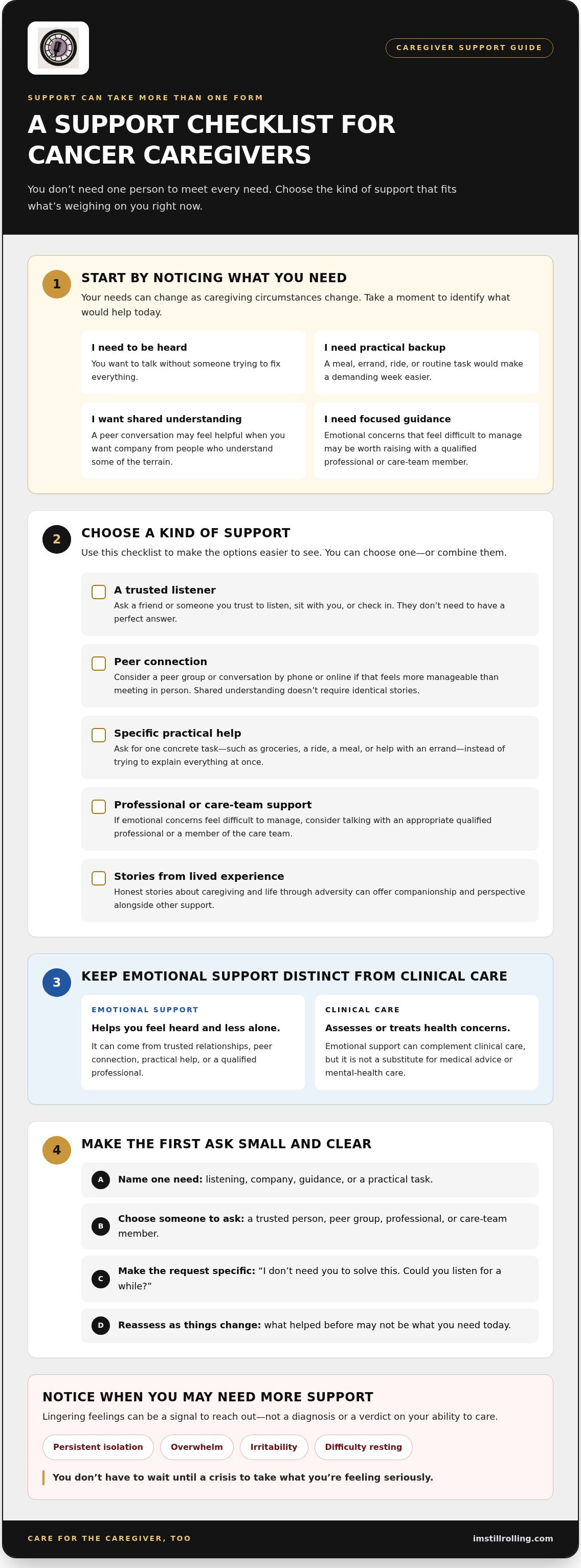
A Practical Plan for Finding Emotional Support as a Cancer Caregiver
Support can feel hard to reach when you’re already stretched thin. Make the first step small. You don’t need a complete plan or a perfect explanation; you need a starting point that fits your life today.
Name the need. Are you looking to talk, have someone sit with you, or get help with a particular responsibility?
Choose a person or resource. Think of someone you trust, a peer group, a qualified professional, or the patient’s care team.
Make one request. Keep it specific enough that the other person can understand what would help.
Reassess. Notice whether the support felt useful, and adjust the request or try another option if your needs change.
The patient’s care team may be able to point you toward caregiver support resources, such as peer groups or qualified professionals. You can ask about support options without asking them for treatment advice for yourself. Treat this as one possible starting point and choose an option that fits your needs.
A simple script for asking someone to listen
Try adapting this: “I’ve been feeling overwhelmed by everything I’m holding. Could you listen for a little while, without trying to solve it?” If what you need is company or practical help, say so plainly: “Could you sit with me after the appointment?” or “Would you be able to help with one errand this week?” You decide how much personal information to share. A request can be honest and clear without including every detail.
Creating a small, sustainable support routine
A routine doesn’t have to be elaborate. You might ask a trusted person to check in regularly, set aside a short time for a peer group, or schedule a conversation with a qualified professional if that feels right. Choose one activity that fits your energy and schedule. If it starts to feel like another obligation, make it smaller or reconsider what would be more manageable.
Review the arrangement when appointments, responsibilities, or emotions shift. A check-in that helps one week may need to change the next. Emotional support for caregivers of cancer patients can be an evolving practice, built from manageable steps rather than a single perfect solution.
For a human perspective alongside your own support plan, explore stories of recovery and hope. Listen to honest stories on I’m Still Rolling for companionship and perspective.
Finding Company in Honest Stories and Taking the Next Step
Sometimes it helps to hear another person put words to an experience you’ve struggled to describe. A story may offer a moment of recognition or simply make a difficult stretch feel less solitary. It won’t make your circumstances identical or promise to resolve what you’re facing. But companionship and perspective can matter, especially when there’s room to listen without pressure to compare your experience with anyone else’s.
When a personal story can help you feel less alone
Listening to someone speak openly about caregiving or adversity may help you feel seen, even when the details of their life differ from yours. I’m Still Rolling shares resilience stories and honest conversations for people who want to spend time with lived experiences. Listening is optional, and it doesn’t replace counseling, peer support, or guidance from the care team. Emotional support for caregivers of cancer patients can take many forms. Personal stories are one possible source of company, not a complete support plan.
I’m Still Rolling is a podcast hosted by journalists Mike Sugerman and Janice Wright. The show shares conversations about resilience, disability, caregiving, and life after adversity in audio, video, and transcript formats. Its stories can offer human perspective and companionship, but they don’t replace clinical care, counseling, or individualized guidance.
Choose a next step that feels possible today
You might identify one person you trust, look into a peer-support option, or decide on one manageable request. If you’re depleted, the next step may be rest, or simply postponing a decision until you have more room to think. There’s no need to turn support into another demanding project. One small request, made when you’re ready, can be a meaningful beginning.
If hearing lived experiences feels right for you, explore I’m Still Rolling episodes and choose the format that suits the moment.
Let Support Begin With One Small Step
Caring deeply doesn’t require you to carry everything alone. Naming what feels heavy, asking for specific help, and setting boundaries that match your capacity can make support easier to reach. Emotional support for caregivers of cancer patients may come through a trusted listener, a peer connection, a qualified professional, or a small practical request. What matters is finding a form that feels manageable now.
You don’t have to solve the whole journey today. One honest conversation, one request, or even a moment of rest can be a meaningful next step. Hearing another person speak candidly about hardship can also offer a little company along the way.
Journalists Mike Sugerman and Janice Wright host honest conversations on I’m Still Rolling, with podcast episodes available in audio, video, and transcript formats. Explore honest stories of resilience on I’m Still Rolling when you’re ready for a human perspective. You deserve support, too, and reaching for it is a sign of care, not failure.
Frequently Asked Questions
Why is emotional support important for caregivers of cancer patients?
Emotional support gives caregivers space to express difficult feelings, feel understood, and recognize when they need help. Cancer caregiving can involve uncertainty, changing responsibilities, and emotional strain alongside daily life. Having someone to listen or connect with can ease isolation and help you identify a manageable next step. Support doesn’t remove the challenges or replace professional care, but it can remind you that your well-being matters, too.
How can I support a loved one with cancer without neglecting myself?
Support your loved one by being honest about what you can manage, sharing tasks where possible, and making room for rest and connection. For example, you might help with an appointment while asking someone else to handle a household errand. Let the care team know if you need information about caregiver resources. Looking after your own needs isn’t a cure for caregiver strain, but it can help you seek support before you feel completely depleted.
What should I say to a caregiver of someone with cancer?
Say something warm and specific, such as, “I’m thinking of you. Would it help to talk, or would you rather have company?” Avoid assuming you know how they feel or pushing them to stay positive. If you can offer practical help, name a task and time: “I can bring dinner on Thursday.” If they decline, respect that. A patient, nonjudgmental presence can matter even when you don’t have the right words.
Where can cancer caregivers find emotional support?
Caregivers can look to trusted people, peer support groups, the patient’s care team, or a qualified professional. Cancer organizations also offer starting points: the American Cancer Society has a helpline at 1-800-227-2345, and CancerCare can be reached at 800-813-HOPE for information about its caregiver support. You can also explore the National Cancer Institute’s caregiver resources. Choose a source that feels accessible and suited to your needs.
Is it normal to feel guilty or overwhelmed as a cancer caregiver?
Guilt or overwhelm can arise during caregiving, but not every caregiver experiences them in the same way. Feeling frustrated, needing rest, or accepting help doesn’t mean you’re less devoted. Notice if isolation, irritability, or difficulty resting is persisting, and consider telling someone you trust. If distress feels hard to manage, a qualified professional may help you explore support. These feelings aren’t a diagnosis or proof that you’re failing.
How do I ask family and friends for help with caregiving?
Make one clear request that identifies a task and timeframe. You might say, “Could you drive us to the appointment on Tuesday morning?” or, “Would you listen for a few minutes tonight? I don’t need advice.” Choose someone you trust to respond respectfully, and share only the details you’re comfortable sharing. If the person can’t help, you can try another request or consider another form of support without treating the first response as a judgment.
Can listening to caregiver stories help when someone has cancer?
Listening to lived experiences may offer recognition, perspective, or a sense of company, even when another person’s circumstances differ from yours. It isn’t a guaranteed solution and doesn’t replace counseling, peer support, or guidance from a care team. I’m Still Rolling Podcast features candid conversations hosted by journalists Mike Sugerman and Janice Wright. Episodes are available in audio, video, and transcript formats, so you can choose how you’d like to engage.


Comments