Discovering New Hobbies with Physical Limitations: A Practical Guide
What if the question isn’t whether your body can fit a hobby, but whether the hobby can be shaped around your needs? Discovering new hobbies with physical limitations can feel complicated when mobility, energy, access, equipment, transport, or cost affect what’s possible. Advice that treats disability as a personal obstacle to overcome often misses the point: barriers may be in the activity or its surroundings, not in you.
You don’t have to rule out an interest before exploring it, or spend time and money before you know whether it feels right. Start with curiosity, then consider what could change: the format, setting, pace, tools, or way you take part. A hobby might work at home, in shorter sessions, with adapted equipment, or alongside others without requiring you to participate in the same way.
This guide will help you identify interests without making assumptions about your abilities, spot practical access and cost barriers, and choose a low-pressure first step. The aim isn’t to prove you can do more. It’s to discover what brings you enjoyment on terms that make sense for your body and your life.
Table of Contents
Discovering new hobbies with physical limitations starts with what interests you
How to find hobbies that fit your body, energy, and access needs
Compare hobby formats by effort, access, equipment, and social setting
Try a new hobby with physical limitations through a low-pressure first experiment
Keep discovering hobbies with physical limitations on your own terms
Discovering new hobbies with physical limitations starts with what interests you
An interest can stay meaningful even when movement, stamina, pain, or access needs change. What may need to change is the way you take part. Finding a hobby isn’t a test of skill, endurance, or independence; it’s about finding an enjoyable form of participation that fits your life. One person may love a busy group setting, while another prefers quiet time at home. Neither approach is more valid.
Physical limitations don’t follow a single template. People with the same diagnosis can have different needs, and one person’s capacity may vary from day to day or over time. Instead of asking whether a hobby is “for” someone with a particular condition, start with curiosity: What interests you, and what would make taking part feel comfortable and accessible? The ideas behind inclusive recreation, including adapting activities and using assistive technology, can broaden the ways you imagine participating.
Separate what you enjoy from how you used to do it
Begin with a generous list: pastimes you used to enjoy, interests you never had time to explore, and activities you like watching, reading about, or discussing. Look for what draws you in. Is it creativity, nature, learning, social connection, gentle movement, or the pleasure of making something?
Then consider different formats before deciding. A hands-on interest might work while seated or in shorter sessions; a group activity might have a remote option; a lively setting might be replaced with a quieter one. Assistance may also make a form of participation possible, though it won’t suit everyone. Treat these as possibilities to explore, not prescriptions.
Name the conditions that make participation feel possible
For each interest, think about what your body and circumstances need on an ordinary day. Consider mobility, balance, dexterity, pain, fatigue, transportation, and recovery time. The setting matters too: entrances, seating, accessible restrooms, lighting, and noise can shape whether an activity feels workable before it begins.
Separate essentials from preferences. An accessible entrance or a place to sit may be non-negotiable; a particular class time or group size might be flexible. Your list isn’t a pass-or-fail checklist. It helps you identify useful adjustments and decide when another format may suit you better. Start with the interest, then shape the conditions around what works for you.
How to find hobbies that fit your body, energy, and access needs
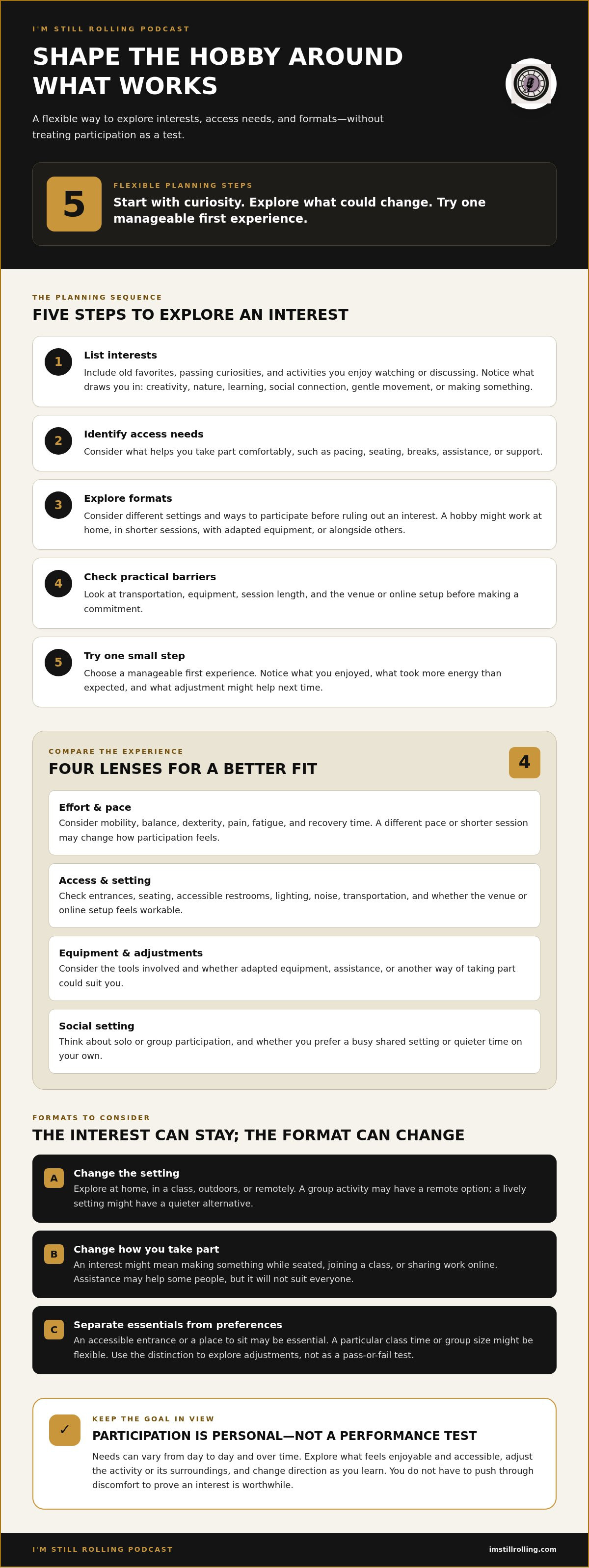
A simple plan can make discovering new hobbies with physical limitations less like guessing and more like exploring. Treat these steps as a flexible planning aid, not a test you have to pass. Pause, skip a step, or change direction as you learn what feels good.
List interests: Include old favorites, passing curiosities, and activities you enjoy watching or discussing.
Identify access needs: Note what helps you participate comfortably, such as pacing, seating, breaks, or support.
Explore formats: Consider different settings and ways to take part before ruling out an interest.
Check practical barriers: Look at transport, equipment, session length, and the venue or online setup.
Try one small step: Choose a manageable first experience, then decide what you want to do next.
An accessible hobby is one where participation is shaped around a person’s needs and preferences. That may mean adapting the activity, its setting, pace, or tools. It doesn’t mean every format will suit every person, and it doesn’t require you to push through discomfort to prove your interest is worthwhile.
Match the activity to the kind of participation you want
Think about whether you’d prefer a solo or group activity, an indoor or outdoor setting, and in-person or remote participation. Crafts, music, gardening, photography, games, writing, and adaptive recreation each offer different ways in. For example, a creative interest might mean making something at home, joining a class, or sharing work online. These are options to explore, not guarantees of fit.
Check access before making a commitment
Before signing up for a recurring activity, review practical details: transport, entrances, seating, breaks, equipment, and session length. Clear access information can help you judge whether the setting is workable. If useful, communicate specific access needs in advance. The Administration for Community Living’s acl.gov resources may offer further context on disability and participation.
For a low-pressure trial, choose one short session before committing to a full series. Notice what you enjoyed, what took more energy than expected, and what adjustment might help next time. This kind of everyday planning isn’t individualized medical or rehabilitation advice; if you have safety concerns about an activity, seek guidance from a qualified health professional. For perspectives on disability and life after adversity, listen to lived-experience podcast conversations.
Compare hobby formats by effort, access, equipment, and social setting
A hobby isn’t a single fixed experience. The same hobby can feel different depending on the setting, format, available adjustments, and how your body feels that day. A side-by-side comparison can help you identify questions to explore, but it can’t predict exactly what will work for you. Individual needs and local access vary, so use these examples as prompts, not prescriptions.
Which hobby formats may be easier to test first?
Look for a small first encounter: one short online class, one craft project, or a brief visit rather than an ongoing commitment. Seated, home-based, and small-group formats may be worth investigating, depending on what you enjoy and what access looks like in practice. No diagnosis determines which hobby will be easy or difficult; the specific activity and circumstances matter.
Adaptive sports and assistive technology can open additional routes into recreation, but they’re options, not prerequisites. A resource from colorado.edu offers another point of reference as you explore possibilities.
What can change when an activity feels inaccessible?
Before abandoning an interest, consider whether a different tool, work surface, seat, pace, session length, or location could change the experience. Adjustments may be simple, personal, or more involved; no single solution suits everyone. In a group activity, taking a different role or contributing another way can also be meaningful participation.
For discovering new hobbies with physical limitations, the useful comparison isn’t which activity looks easiest on paper. It’s which format gives you a practical, comfortable way to try what interests you.
Try a new hobby with physical limitations through a low-pressure first experiment
Not knowing whether an activity will suit you is a reason to start small, not to rule out the interest. A first try doesn’t need to prove anything or lead to a long-term commitment. It’s a chance to learn what the experience is like for you, including what you enjoy and what might need to change.
Plan a first try without overcommitting
Choose one manageable action: gather materials for a simple project, watch an introductory lesson, or attend a single session. Before you begin, think through what would make the trial more workable. You might plan rest breaks, arrange transport, adjust the setup, or bring equipment you already use. If you’d like a trusted companion alongside you, invite one; taking part independently is just as valid.
Keep the plan small enough that you can focus on the experience rather than getting everything perfect. Decide what you hope to find out, such as whether the activity holds your attention, the setting feels comfortable, or the session length suits your energy. You can stop early or change the plan if it isn’t working for you.
Adjust the plan using what you learn
Afterward, take a moment to reflect before deciding whether to continue. Consider:
What felt interesting or enjoyable?
What affected your comfort or energy during and after the activity?
Were there barriers related to access, transport, equipment, or the setting?
Did the experience feel worthwhile enough to repeat, perhaps with an adjustment?
If something didn’t fit, that’s useful information, not a personal failure. You might change one element at a time, such as duration, location, tools, or group size, then see whether the experience shifts. Or you may decide this format isn’t for you and try another way to engage with the same interest. In discovering new hobbies with physical limitations, changing course is part of learning what participation can look like on your terms.
Sometimes it helps to hear how other people describe change and adaptation, without expecting their experiences to map neatly onto yours. Explore real stories of resilience for varied perspectives, then take what resonates and leave the rest. For more conversations about disability, resilience, and life after adversity, explore the podcast episodes.
Keep discovering hobbies with physical limitations on your own terms
A hobby that fits today may need a different shape later. Energy can shift, access can change, equipment may make a new format possible, or your priorities may move elsewhere. You can return to an interest after a pause, try another small experiment, or keep the version that already feels good. There’s no single correct pace for discovering new hobbies with physical limitations.
Make room for changing interests and changing circumstances
Let your definition of success belong to you. It might be the pleasure of learning something new, a moment of connection, a way to express yourself, or simply an activity you enjoy. It doesn’t have to mean mastery, consistency, or visible progress. Optimism isn’t an obligation either: a hobby won’t erase pain, access barriers, or other difficult realities. It can still matter on its own terms.
If an activity stops working, revisit what you learned. Perhaps a different setting, pace, tool, or participation role would help. Perhaps your interest has changed and you’d rather choose something else. Both are meaningful outcomes. Keep your list of curiosities open for the next time circumstances or inclination shift.
Use stories as company, not as a comparison
First-person stories can offer recognition and possibilities, reminding us that people make meaning in different ways after change. They aren’t instructions, and someone else’s path doesn’t need to become a measure of your own. Practical decisions about a hobby remain yours, informed by what you enjoy and what feels accessible in your circumstances.
I'm Still Rolling Podcast, hosted by journalists Mike Sugerman and Janice Wright, shares honest conversations about disability, resilience, and life after adversity. You can engage with episodes through listening, video, or written transcripts, choosing the format that works for you. These stories offer perspective and companionship, not medical or rehabilitation advice.
If you’d like to hear how people describe life after major change, explore spinal cord injury recovery stories. Take what resonates and leave what doesn’t. Then return to your own next step, whether that’s revisiting your interest list, testing another activity, or enjoying a format you already know works for you.
Let curiosity set the pace for what comes next
Discovering new hobbies with physical limitations starts with what interests you, not with assumptions about what your body should be able to do. Consider how an activity might be reshaped, compare its practical demands with your access needs, and begin with a small trial instead of a large commitment. What you learn can help you adjust the format, try something else, or return when circumstances change.
There’s no requirement to turn a hobby into an achievement or to feel optimistic every day. Enjoyment, connection, creativity, and a sense of possibility are worthwhile in their own right. If an interest changes, your next step can change with it.
For thoughtful perspectives on disability, resilience, and life after adversity, explore the I'm Still Rolling Podcast, hosted by journalists Mike Sugerman and Janice Wright. Episodes are available through streaming, video, and written transcripts, so you can choose a format that suits you. Explore honest stories of resilience on the I'm Still Rolling Podcast, and take your next step in your own time.
Frequently Asked Questions
Is it possible to find a new hobby with physical limitations?
Yes, it’s possible to find a hobby that feels enjoyable and workable for you. Start with an interest that genuinely draws you, then consider whether the activity, setting, pace, or equipment could be adjusted. Your access needs don’t have to match anyone else’s. A small trial, such as trying one session or a simple project, can help you decide whether you’d like to continue before making a larger commitment.
How do I choose a hobby that fits my physical limitations?
Begin with what interests you, then consider mobility, dexterity, stamina, pain, transportation, and the environment. Explore different formats, such as participating at home, online, while seated, in a group, or for a shorter session. Treat your notes as a guide, not a test you have to pass. A low-pressure first try can help you discover which parts feel engaging and what adjustments might make participation more comfortable.
What hobbies can I do with limited mobility?
Possible interests include writing, photography, music, crafts, games, gardening, online learning, and adaptive recreation. The right fit depends on your preferences, access needs, equipment, and setting. An activity that works well for one person may not suit another, and no hobby is automatically accessible to everyone. Consider what draws you to an interest, then explore different ways to take part and check practical details such as seating, tools, and transportation.
Can I adapt a hobby if I have pain or fatigue?
You may be able to adjust an activity’s duration, pace, position, tools, location, or frequency. Notice how it feels during the activity and afterward, and avoid treating another person’s approach as a rule for you. Needs and experiences vary. If an activity raises safety concerns or affects how you feel physically, pause and seek individualized guidance from an appropriate healthcare professional before deciding how to proceed.
How can I try a new hobby without spending much money?
Start with a small test using materials or resources you already have, such as completing one simple craft project or watching a sample lesson. You could also look for a library, community group, or online resource that lets you explore the activity before buying equipment or committing to recurring sessions. Keep the first goal modest: find out whether the interest and format feel worthwhile, then decide whether to continue.
What should I do if a hobby feels inaccessible?
Identify the barrier before ruling out the whole interest. It might be transportation, the venue, equipment, session length, or the format. Consider whether changing one element or taking a different role could make participation more workable. If the barrier remains, it’s reasonable to pause, explore another format, or choose a different interest. That decision isn’t a failure; it’s useful information about what suits your circumstances.
Should I ask a healthcare professional before starting a new hobby?
Not every hobby requires medical advice, but individualized guidance can be helpful if you have questions about safety, movement, pain, fatigue, or equipment. Consider your own circumstances rather than relying on general activity suggestions. A healthcare or rehabilitation professional familiar with your needs can help you think through relevant precautions. This article offers general educational guidance, not medical or rehabilitation advice tailored to your situation.
Comments