Disability Storytelling Platforms: 5 Places to Find Lived Experience in 2026
What if the best disability story isn’t the one that appears first in search, but the one that lets a person speak in their own words? Finding disability storytelling platforms takes more than a keyword search. Results can mix personal accounts with service directories and academic resources, without making clear whose perspectives are centered or whether stories are available to read, watch, or hear.
Those distinctions matter. A lived experience can offer insight, but no single story can stand for every disabled person. To find a useful fit, look at a platform’s purpose, the people telling the stories, and the formats it offers.
This guide explores five places to find disability stories, comparing what each makes possible, whose voices you may encounter, and whether the experience is audio, video, or text. One example is the I'm Still Rolling Podcast, hosted by journalists Mike Sugerman and Janice Wright. Episodes are available through streaming and video, with written transcripts. As you explore, start with a topic that matters to you, then follow stories while keeping each person’s experience distinct from everyone else’s.
Key Takeaways
Disability storytelling platforms range from podcasts and editorial media to community organizations and research archives, each with a different purpose.
Explore five resources, including Rooted in Rights, and consider whose perspectives each one brings forward.
Compare platforms by purpose, storyteller perspective, format, accessibility information, and the context around each story.
Start your search with a topic or question that matters to you, then explore different formats to find stories that fit your interests and access needs.
See how I’m Still Rolling uses long-form conversations, hosted by journalists Mike Sugerman and Janice Wright, to explore lived experience.
Table of Contents
What are disability storytelling platforms, and what kinds of stories do they share?
Five disability storytelling platforms and resources to explore
How to compare disability storytelling platforms beyond their subject labels
How to find disability stories that fit your interests and access needs
How I'm Still Rolling brings disability stories into long-form conversation
What are disability storytelling platforms, and what kinds of stories do they share?
Disability storytelling platforms publish or share narratives about disability, including accounts told by disabled people and stories centered on their experiences. They include podcasts, editorial publications, community organizations, documentary media, and research archives. These platforms may look similar in search results, but they serve different purposes. One might share personal interviews, another connect people with community programs, and another collect scholarly research.
Disability stories reach far beyond diagnosis or medical experience. They can explore identity, access, disability rights, caregiving, work, relationships, creativity, and the everyday decisions that shape a life. This breadth matters in a media culture where portrayals have often relied on stereotypes and familiar tropes. The overview of the depiction of disability in the media offers context for why stories grounded in lived experience can add nuance to what audiences see and hear.
How do firsthand stories differ from disability information resources?
A firsthand narrative shares one person’s perspective: what happened, what mattered to them, and how they understood the experience. It can offer insight and connection, but it isn’t universal medical guidance or a template for how another person’s life will unfold.
Service directories point readers toward organizations or supports. Advocacy resources explain issues and ways to take action. Academic papers present research questions, methods, and findings. Each can be valuable, but each serves a different need from a personal account. As you read or listen, consider the storyteller’s own context, including the identities and circumstances they choose to share. One person’s account can widen understanding without speaking for everyone.
Which formats do disability storytelling platforms use?
Format shapes how a story unfolds and how you can engage with it. Audio interviews let a speaker’s voice carry the pacing and emphasis. Video adds visual detail, written stories invite reading at your own pace, and transcripts provide a text version of spoken material. Documentaries combine moving images and sound.
Some platforms offer several formats or types of resources. I’m Still Rolling, for example, features long-form conversations with people who have lived through disability, caregiving, and other adversity. Hosted by journalists Mike Sugerman and Janice Wright, episodes are available through streaming and video, with written transcripts. Choose a transcript if you prefer to read, or use audio or video to experience the conversation in another format. The point isn’t that one format is best, but that each offers a different way to follow a story.
Five disability storytelling platforms and resources to explore
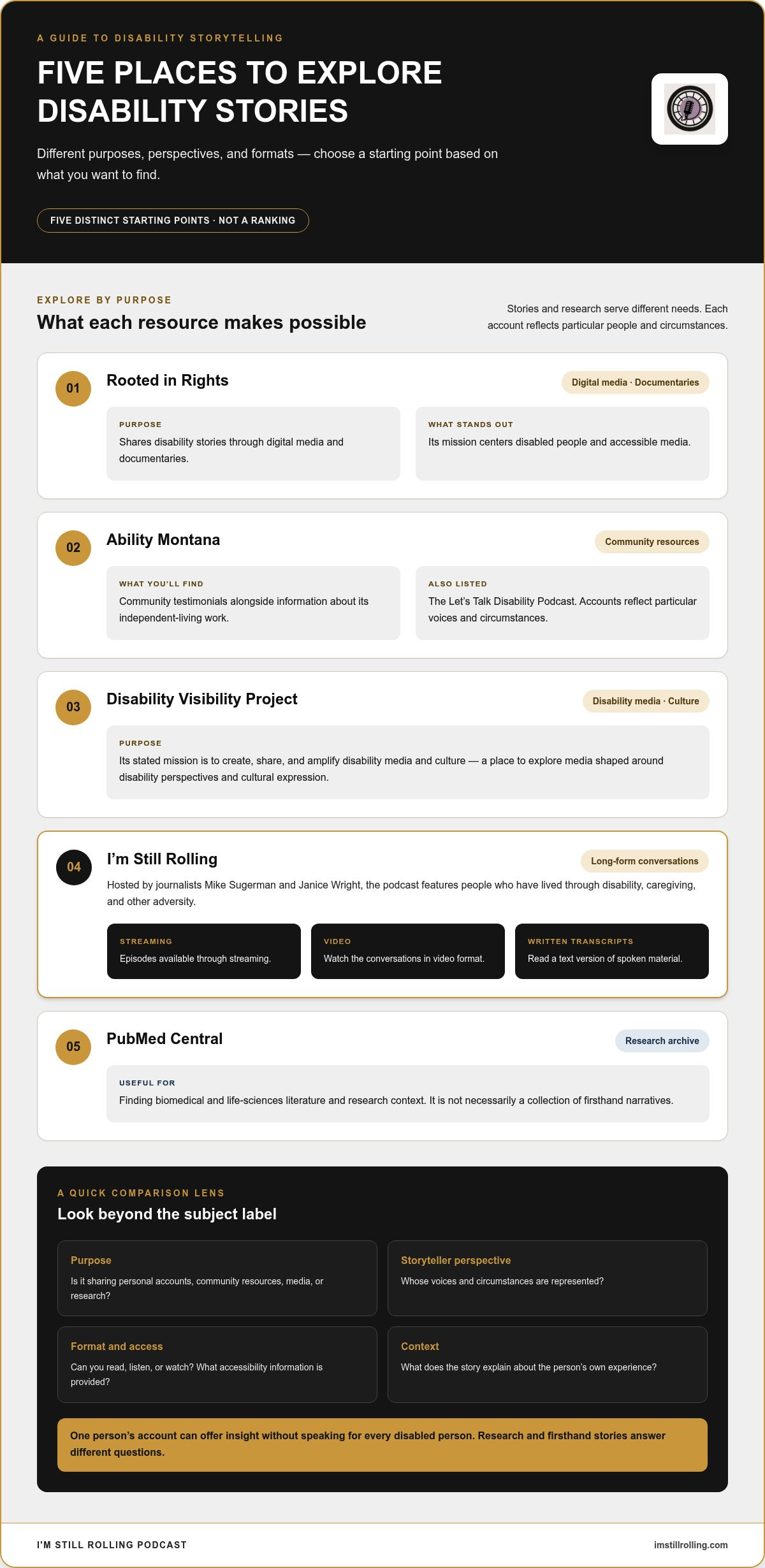
These five destinations serve different purposes, from community-centered media to scholarly research. They aren’t a ranking or a complete directory. Use them as starting points, and remember that no organization or storyteller can represent the full range of disabled people’s lives.
What can readers find at disability-centered media and community organizations?
Rooted in Rights: This platform shares disability stories through digital media and documentaries, with a mission centered on disabled people and accessible media. Explore its content for perspectives on disability issues, while treating each story as one person’s or creator’s account, not a stand-in for everyone.
Ability Montana: Its materials include community testimonials alongside information about its independent-living work, and its resources list the Let’s Talk Disability Podcast. These accounts can offer insight into experiences connected with community and independence. They reflect particular voices and circumstances.
Disability Visibility Project: The Disability Visibility Project describes a mission to create, share, and amplify disability media and culture. It’s a useful place to explore media shaped around disability perspectives and cultural expression.
When are podcasts and research archives useful starting points?
Podcasts give conversations room to develop, making them a useful choice if you want to follow someone’s account over time or listen during a routine that allows for audio. Research archives serve a different purpose: they help readers locate scholarly work, not necessarily firsthand narratives. Choose between them based on what you want to learn, a person’s account or research context.
I'm Still Rolling: Hosted by journalists Mike Sugerman and Janice Wright, this podcast features conversations with people who have lived through disability, caregiving, and other adversity. Episodes are available through streaming and video, with written transcripts. If long-form interviews suit what you’re looking for, explore I'm Still Rolling podcast conversations in the format that works for you.
PubMed Central: This archive is a starting point for biomedical and life-sciences literature. Search it when you’re looking for scholarly articles or research context, rather than expecting a collection of personal stories. Research can deepen understanding, but it answers different questions from a first-person account.
These disability storytelling platforms and resources can complement one another. A personal account may illuminate an individual experience, while community media or research offers other kinds of context. Start with the perspective or question you want to explore, then choose the destination that fits.
How to compare disability storytelling platforms beyond their subject labels
A label such as “disability stories” tells you the topic, but not who is speaking, how the account was shaped, or what access information is provided. Compare those details to find a useful starting point and avoid treating a personal story, an advocacy resource, and a research paper as interchangeable.
Who is telling the story, and how much context is provided?
Look for the storyteller’s name or description and the platform’s editorial purpose. A firsthand account comes from someone describing their own experience; a journalistic interview is shaped by both the guest’s answers and the interviewer’s questions. Advocacy content makes a case or supports action, while scholarly research reports academic inquiry. Disability-led or disability-centered storytelling can bring forward perspectives that are often overlooked, but no single story can stand for an entire community. Seek varied accounts across disability, culture, and circumstance.
Can readers access the story in a useful format?
Check whether the specific story is offered as audio, video, written text, or a transcript, and look for access information the platform provides. Don’t assume that every item on a platform has the same format or features. The best fit depends on your needs and preferences. Transcripts, for example, provide a text option for the I'm Still Rolling conversations, while video and audio offer other ways to engage.
How to find disability stories that fit your interests and access needs
A useful search can begin with a question about life, community, or change, rather than a diagnosis alone. Then narrow the search by format and explore more than one perspective. These steps can help you find stories connected to your interests while leaving room for experiences you didn’t expect.
Choose a topic or question. Start with a theme such as disability rights, caregiving, identity, work, relationships, or a life transition. Ask what you want to understand, then search for that theme alongside disability.
Add a format to your search. Pair a broad topic with terms such as “podcast,” “interview,” “personal essay,” or “documentary.” This can help distinguish a firsthand account from a service directory or a research paper.
Explore beyond one condition or experience. A story connected to one diagnosis may lead you toward questions about access, culture, family, or belonging. Follow those connections, and seek perspectives shaped by different identities and circumstances.
Choose a format that works for you. Try audio, video, or written stories, and look for a transcript when one is available. The same subject can feel different across formats, and no single format suits everyone. Review the information provided for each story rather than assuming it has particular accessibility features.
Follow related stories with curiosity. Links or references can lead to other voices and useful context. Treat each new account as a perspective to consider, not proof that everyone shares the same view.
How should readers approach difficult or personal stories?
Some accounts may stir grief, recognition, discomfort, or hope; your response is your own. It’s reasonable to pause, take a break, or return later. A personal story can illuminate one person’s experience, but it isn’t professional medical, legal, or caregiving guidance. If it raises questions beyond its scope, look for relevant context from sources suited to those questions, while keeping the storyteller’s perspective distinct from general advice.
If you’re drawn to sustained, first-person conversations, I’m Still Rolling explores disability, caregiving, disability rights, and personal growth through interviews, video, and written transcripts. Explore long-form podcast episodes and choose the format that fits how you want to listen, watch, or read.
How I'm Still Rolling brings disability stories into long-form conversation
Some stories need more than a headline or a short clip. I'm Still Rolling makes space for extended conversations with people who have lived through disability, caregiving, and other adversity. Hosted by journalists Mike Sugerman and Janice Wright, the podcast brings a journalistic interview approach to experiences that can be complicated, intimate, and difficult to sum up.
What can listeners expect from an I'm Still Rolling conversation?
Episodes are grounded in guests’ lived experiences. Topics include disability, caregiving, disability rights, and personal growth, allowing conversations to move between individual moments and the wider questions they raise. Guests’ accounts remain their own: they offer perspective, not a universal guide to disability or adversity.
The show’s focus on resilience doesn’t mean hardship has a neat resolution, or that anyone must turn difficulty into inspiration. Listening can instead make room for less tidy truths: the support people need, the barriers they encounter, and the ways their understanding of life may shift. That nuance is one reason interview-based podcasts can add something distinctive to disability storytelling platforms.
How can readers explore stories in the format that suits them?
Episodes are available through streaming and video, with written transcripts as another way to follow a conversation. You can listen, watch, or read, depending on the format that best fits your interests and circumstances. A transcript lets you engage with an episode’s words in text, while audio and video offer other ways to follow the conversation.
For an introduction to the show and its interview approach, read the I'm Still Rolling podcast episodes guide. Readers interested in the wider conversation around disability rights can also explore the disability rights podcast overview.
If long-form conversations are the kind of stories you’re seeking, explore the episodes and choose a guest or topic that meets your interests. There’s no single required way to begin; one conversation can be a starting point for hearing a perspective you haven’t encountered before.
Choose a story that meets you where you are
The best disability storytelling platforms aren’t necessarily the biggest or most familiar. Look at the voices they center, the purpose behind each story, and the format that works for you. A firsthand account can offer a meaningful perspective, but no single story represents an entire community. Exploring different storytellers and subjects makes room for the breadth of disabled people’s lives.
If you’re drawn to thoughtful, long-form conversations, I’m Still Rolling features guests sharing experiences related to disability, caregiving, rights, and personal growth. Hosted by journalists Mike Sugerman and Janice Wright,
Explore I'm Still Rolling podcast episodes and choose a conversation or format that fits your interests. Every story offers its own perspective, and following that curiosity can be a good place to begin.
Frequently Asked Questions
What is a disability storytelling platform?
A disability storytelling platform publishes or shares narratives about disability, often including accounts told by disabled people. It may be a podcast, editorial publication, community organization, documentary project, or research archive. Stories can explore identity, access, rights, caregiving, work, and everyday life. The key distinction is purpose: a firsthand narrative offers perspective, while a service directory lists resources and a research archive presents scholarly literature.
Where can I find stories told by people with disabilities?
You can find firsthand accounts through disability-centered media, community organizations, and podcasts. Rooted in Rights shares disability-focused media, Ability Montana features community testimonials, and the Disability Visibility Project creates and amplifies disability media and culture. For conversations, explore podcasts such as I’m Still Rolling. Searching a topic, such as disability rights or caregiving, alongside a format like “personal essay” or “podcast” can help you find relevant disability storytelling platforms.
Are disability storytelling platforms the same as disability service organizations?
No. A storytelling platform shares narratives or media, while a service organization may provide programs, referrals, or other community resources. Some organizations do both: a site can publish testimonials alongside information about its work. Read the page’s purpose and the context around each story to understand what it offers. A personal account can illuminate one person’s experience, but it isn’t a service directory or professional guidance.
Can I find disability stories in podcast and transcript formats?
Yes. Some podcasts offer episodes in audio or video and provide written transcripts. I’m Still Rolling, hosted by journalists Mike Sugerman and Janice Wright, features conversations about disability, caregiving, disability rights, and personal growth. Its Choose the format you prefer to follow the conversation.
How do I know whether a disability story represents everyone's experience?
One story represents the person sharing it, not an entire community. Pay attention to who is speaking, the circumstances they describe, and whether the piece is a personal account, interview, advocacy message, or research. To broaden your understanding, seek other perspectives shaped by different disabilities, cultures, and life experiences. You can value what one person’s story reveals without assuming another person will share the same needs or views.
Is PubMed Central a disability storytelling platform?
PubMed Central is primarily a research archive for biomedical and life-sciences literature, not a platform focused on personal storytelling. It can be useful if you’re looking for scholarly articles or research context about disability. For firsthand narratives, look to interviews, podcasts, personal essays, documentaries, or community testimonials. These sources serve different purposes: research presents scholarly work, while a personal story shares an individual’s lived perspective.
Comments