Couples and Disability: Stories & Your New Normal
One morning, you’re planning a hiking trip, and the next, you’re measuring the width of your bathroom door with a heavy heart. It’s a quiet, jarring transition that turns a shared sanctuary into a series of obstacles. With more than 1 in 4 U.S. adults living with a disability as of 2026, this shift is a reality for millions, yet it often feels like a private earthquake. Many partners find themselves grappling with the weight of caregiver labels that threaten to eclipse the intimacy they once took for granted. If you feel isolated or find yourself mourning the activities that used to define your weekends, you aren't alone. We’ve found that the most powerful tool for resilience is listening to real adapting to disability as a couple stories that refuse to sugarcoat the struggle.
You deserve to move past the initial shock and find a rhythm that feels sustainable. We promise to help you bridge the gap between the life you had and the one you’re building now. This article provides a roadmap for finding a new way to communicate, alongside practical steps for home accessibility that don't sacrifice your comfort. We’ll offer emotional validation from those who have already rolled through this terrain. You'll see that while the path has changed, the journey together isn't over.
Table of Contents
The Emotional Landscape: Understanding the 'New Normal' as a Couple
The shift into disability is rarely a graceful transition. It is a messy, loud, and often exhausting reimagining of what it means to be a "we." When we talk about the "new normal," we aren't suggesting a quick fix or a return to the status quo. Instead, we are acknowledging a fundamental restructuring of your shared reality. In the first six months, your primary job is survival, not optimization. It's okay if the house is a mess, the paperwork is overwhelming, and you haven't yet mastered the art of the perfect transfer. This period is about keeping your heads above water while the ground beneath you settles into a new, unfamiliar shape.
Listening to adapting to disability as a couple stories reveals a recurring theme: the parallel process of grief. While you are moving through the same trauma, you are experiencing it from different vantage points. The partner with the disability may grieve for bodily autonomy and self-image; the supporting partner often grieves for the loss of a shared workload or the freedom of spontaneity. These paths are separate but must eventually converge. This convergence often begins with exploring sexuality and disability as a way to reclaim intimacy that feels fractured. It requires moving beyond a superficial "everything will be fine" attitude. At I’m Still Rolling, we call this "realistic optimism." It is the ability to look at the gravity of a life-altering change, feel its weight, and still believe that a meaningful life is possible.
Grieving the 'Old' Relationship
Relationship grief is the necessary bridge you must cross to reach a place of future growth. You aren't just losing a partner's ability to walk or work; you are losing the specific roles you played for one another. Spontaneity, the ability to leave the house in five minutes, and the balance of domestic labor often vanish overnight. Identifying these specific losses is painful, but creating space for unflinching honesty about what you miss is the only way to prevent resentment from taking root. You must allow yourself to mourn the hiker, the dancer, or the provider you once were to make room for the resilient team you are becoming.
The Power of Shared Resilience
Mike Sugerman and Janice Wright bring their decades of journalistic experience to these "messy" conversations. They understand that resilience isn't a solo sport. It is built through empathy, which is fundamentally different from pity. Pity creates a hierarchy where one person is "broken" and the other is a "hero." Empathy, however, maintains the partnership as a team of equals. By moving from the paralyzing question of "Why us?" to the active stance of "What now?", you begin to co-author a story defined by endurance rather than just loss. Resilience is found in the small, daily victories. Hearing adapting to disability as a couple stories reminds you that while the genre of your life has changed, the story is far from over.
Communication Strategies: Navigating the 'Messy' Middle Ground
The transition from being a partner to being a "caregiver" is often silent and swift. One day you are sharing dreams over dinner; the next, you are managing medication schedules and insurance claims. This "Caregiver vs. Lover" trap is perhaps the most significant hurdle in the long-term health of a relationship. It's easy for the medical needs of one partner to consume the emotional identity of both, leaving little room for the intimacy that once defined you. To keep your romantic identity alive, you must intentionally carve out space where the disability is not the guest of honor. Scheduled "Non-Disability" time is not a luxury; it's a vital survival tactic. It allows you to remember why you chose each other before the world became a series of ramps and appointments.
Effective communication in this "messy" middle ground requires a profound shift in how you express needs. Using "I" statements, such as "I feel overwhelmed when the house is cluttered," helps you share your reality without triggering a defensive response or deep-seated guilt in your partner. Similarly, learning to ask for help without surrendering autonomy is a delicate dance. It requires the disabled partner to be clear about where they need support and where they need space to struggle. If you find yourself stuck in these repetitive patterns, listening to adapting to disability as a couple stories can provide the perspective needed to break the cycle. You can find more of these raw, honest conversations in the I'm Still Rolling podcast episodes, which act as an auditory companion to your own journey of resilience.
Reclaiming the Partner Identity
Separating medical care from emotional connection requires discipline and a commitment to boundaries. Implement a "15-minute check-in" rule every morning to handle the logistics of health and scheduling. Once those fifteen minutes are over, the "caregiver" and "patient" roles are retired for a time, and you return to being partners who share a life. This boundary prevents the unspoken resentment that often builds when one person feels like a burden and the other feels like an employee. Address these feelings with unflinching honesty before they calcify into distance, ensuring that your relationship remains a sanctuary rather than a clinic.
Journalistic Listening in Your Living Room
Mike and Janice often use their journalistic background to navigate the complexities of their own relationship. This involves "journalistic listening," a method of active engagement where you seek to understand your partner’s internal world without immediately jumping into "fix-it" mode. Validate the frustration or the grief before offering a solution. These unhurried, deep-dive conversations allow you to find meaning within the struggle, transforming a medical crisis into a shared narrative of endurance and discovery. By listening to hear rather than to respond, you create a safe space for the soul to breathe amidst the physical challenges.
Adapting Your Home for a Collaborative Future
Modifying a shared living space is one of the most tangible ways a couple navigates their new reality. It is a process that requires both a measuring tape and a high degree of emotional intelligence. When you begin your accessibility audit, don't treat it as a cold inspection. Instead, walk or roll through the home together to identify where the environment creates friction. This collaborative approach ensures that the partner with the disability remains the architect of their own independence rather than a passive recipient of changes. Hearing adapting to disability as a couple stories often highlights that the most successful transitions happen when both partners feel their needs are being met in the design process.
Prioritizing high-traffic areas like the kitchen and bathroom is the next crucial phase. Independence in these spaces is a cornerstone of dignity. For many, this means installing zero-entry showers or adjusting counter heights to allow for seated meal prep. For the 2026 tax year, many of these modifications, such as ramps and widened doorways, can be deducted as medical expenses if they exceed 7.5% of your Adjusted Gross Income. This financial relief can make the difference between a temporary fix and a long-term solution that truly serves the household.
The Essential Accessibility Checklist
Step 1: The First 10 Feet. Evaluate the entryways. A threshold as small as half an inch can be a barrier. Consider automated door openers or low-profile ramps to ensure the transition into the home is seamless.
Step 2: Bathroom Safety. Install grab bars that double as stylish towel racks to maintain a cohesive look. Zero-entry showers are essential for minimizing fall risks and maximizing autonomy.
Step 3: Kitchen Autonomy. Lower a section of the counter for prep work. Pull-down shelving in upper cabinets allows for independent access to daily essentials without requiring assistance.
Maintaining the 'Couple's Sanctuary'
The emotional impact of aesthetics cannot be overstated. Your home should feel like a sanctuary, not a clinical facility. Integrating medical equipment discreetly is vital for preserving the soul of your space. This is especially true in the bedroom. It must remain a place of rest and intimacy, separate from the rigors of physical therapy or medical recovery. Choose furniture and fabrics that reflect your shared taste. Use smart home technology to control lighting or temperature without needing bulky, industrial-looking interfaces. By making design choices together, you reinforce the idea that you are building a future that belongs to both of you.
Budgeting for these changes often requires a mix of DIY ingenuity and professional expertise. While some tasks like installing grab bars are manageable, structural changes like widening load-bearing doorways require a licensed contractor. If your disability began before age 46, the 2026 expansion of ABLE accounts allows you to contribute up to $20,000 annually. This can be a vital resource for funding these home adaptations. Navigating these practicalities together is just another chapter in your shared resilience story.
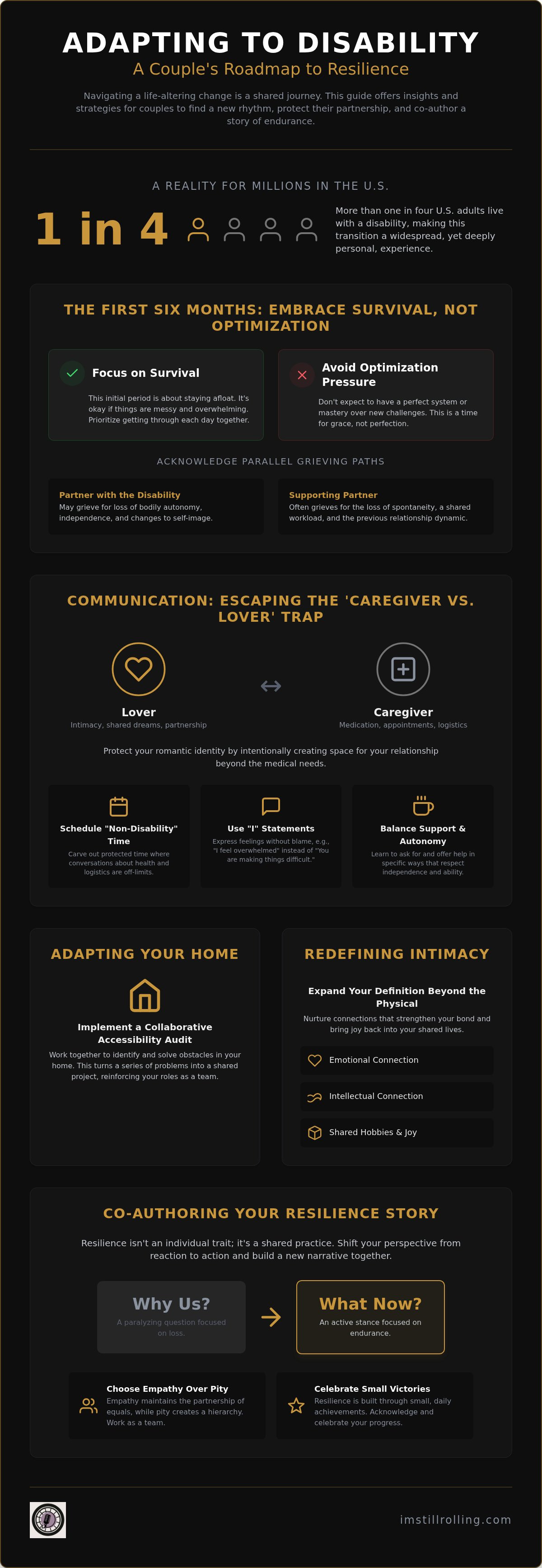
Redefining Intimacy and Finding Joy Beyond the Medical
Disability doesn't have to be the end of pleasure or play. It just requires a different script. Many adapting to disability as a couple stories focus exclusively on the heavy lifting of recovery, but the lighter moments are what keep the partnership vibrant and sustainable. Intimacy is a broad spectrum that encompasses emotional, intellectual, and physical connection. When the physical side of a relationship changes, it's common to pull away out of fear, embarrassment, or a sense of loss. Instead of retreating, we encourage a shift toward curiosity. This means looking at your partner not as a patient, but as the person you still desire, even if the ways you express that desire have shifted.
Humor is perhaps the most effective tool for diffusing the clinical tension that often invades a home after a diagnosis. We call this the "I'm Still Rolling" approach. If a transfer goes wrong or a piece of medical equipment malfunctions at an awkward moment, laughing together can be a radical act of defiance. It signals that while the disability is present in the room, it isn't in charge of the mood. Finding these "micro-joys" is the daily work of a resilient couple. It might be a shared joke, a specific way you hold hands, or a new adaptive hobby. These small, quiet victories are the evidence that your relationship is thriving despite the obstacles.
The New Language of Physical Connection
Navigating changes in physical ability requires a willingness to explore new sensations and boundaries without the pressure of performance. Intimacy is a discovery of meaning within the struggle, a way to say "I see you" when the rest of the world might only see the equipment or the injury. Adaptive intimacy is about focusing on what is possible rather than mourning what was lost. There are resources available for couples to explore this terrain, but the most important resource is your own vulnerability. By being honest about your fears and your needs, you create a deeper emotional bond that often surpasses the physical connection you had before the disability.
Building a Social Support System
Isolation is a quiet predator for couples navigating a new normal. To combat this, you need a balanced social circle. This includes friends who "get it" and others who have rolled through similar challenges, as well as friends who provide a necessary break from the medical world. When you head out to social events, do it as a team. Have a plan for accessibility hurdles so they don't become a source of friction between you. Reading Spinal Cord Injury Recovery Stories can provide the community context you need to feel less alone. To stay connected with others who understand this journey, we invite you to join the I'm Still Rolling newsletter for weekly stories and insights on living a full, resilient life.
Co-Authoring Your Resilience Story: Next Steps
The realization that your shared narrative has shifted from a predictable romance to a gritty, high-stakes drama can be jarring. However, accepting this change is the first step in reclaiming your agency as a couple. You are no longer just characters in a story written by medical circumstance; you are the co-authors of a new, resilient legacy. We recommend documenting this evolution with the same rigor a journalist might use for a high-profile feature. Whether you use shared digital journals, raw audio notes recorded in the quiet hours of the morning, or a dedicated photo stream of accessibility milestones, these artifacts prove that your bond is unbreakable. Engaging with adapting to disability as a couple stories from others in the community helps you see that while the genre is different, the theme remains one of enduring love.
Listening to the Journey
Finding your "Resilience Tribe" is crucial for de-isolating the experience of disability. When you listen to others who have navigated the same physical and emotional labyrinth, you begin to see patterns of hope where there was once only chaos. The I'm Still Rolling Podcast Episodes serve as a bridge between your private struggle and a broader, universal truth about human endurance. These episodes offer more than just advice; they provide a soulful connection that reminds you that you are part of a larger team. To ensure you never have to navigate these shifts alone, subscribe to our newsletter for weekly insights that prioritize realistic optimism over superficial cheer.
Becoming a Trusted Guide for Others
The final stage of this transformation is transitioning from the one who is helped to the one who acts as a guide. Sharing your adapting to disability as a couple stories allows you to externalize the trauma and find a higher purpose within the hardship. It's a profound act of maturity to look back at the "messy" parts of your journey and offer a hand to those just beginning theirs. This process of storytelling acts as its own form of therapy, helping you process the internal shifts that have occurred since your "new normal" began. As we move through 2026, remember that resilience isn't about reaching a destination where the disability disappears. It's about the steady, reliable pulse of a relationship that refuses to stop moving. You are still rolling, and the path you are carving now is one of profound beauty and strength.
Writing the Next Chapter of Your Shared Life
The journey through disability is a profound transformation that requires more than just physical adjustments; it demands a courageous reimagining of your partnership. We’ve explored how to move from the survival mode of the first six months into a space where communication is honest and your home remains a sanctuary. By reclaiming your identity as partners rather than just caregivers, you protect the soul of your relationship from being eclipsed by medical logistics. Hearing raw adapting to disability as a couple stories serves as a vital reminder that while the path has changed, your ability to find joy and intimacy together has not.
You don't have to navigate this messy middle ground in isolation. Veteran journalists Mike Sugerman and Janice Wright provide a safe space for unflinching conversations about life after spinal cord injury and medical trauma. Their community is built on a foundation of grit and realistic optimism, offering the perspective you need to keep moving forward. Listen to the latest stories of resilience on the I'm Still Rolling Podcast to find your own resilience tribe. You are still rolling, and your story is just getting started.
Frequently Asked Questions
How do I stop feeling like a caregiver and start feeling like a partner again?
You reclaim your identity by strictly separating medical maintenance from romantic connection. Schedule specific times where health talk is off-limits to ensure the partner role isn't swallowed by caregiving duties. It's about preserving the specific intimacy that existed before the medical equipment arrived. By treating care tasks as a shared project rather than a relationship definition, you keep the romantic spark protected from clinical burnout.
What are the most important home modifications for a new wheelchair user?
Prioritize the entryways and bathroom safety to foster immediate independence. Ramps, widened doorways, and zero-entry showers are essential for basic autonomy within the home. In 2026, many of these modifications are tax-deductible if they exceed 7.5% of your Adjusted Gross Income. These changes are not merely construction projects. They are vital investments in your partner’s dignity and your shared ability to navigate your sanctuary without constant friction.
Is it normal to feel angry at my partner for their disability?
Anger is a natural and common component of the grieving process for both partners. It doesn't mean you lack empathy or love; it means you are mourning the loss of the life you once envisioned. Acknowledging these messy feelings with unflinching honesty prevents them from turning into permanent resentment. You are reacting to a life-altering trauma, and giving yourself permission to feel that frustration is the first step toward resilience.
How can we maintain a social life when everything feels so difficult?
Maintaining a social life requires a proactive, team-based approach to accessibility and energy management. Seek out a resilience tribe of friends who understand your new reality while keeping ties with those who offer a respite from the medical world. By vetting locations for accessibility beforehand, you reduce the logistical anxiety that often makes social outings feel like an exhausting chore rather than a shared source of joy.
Where can I find more stories of couples adapting to disability?
You can discover a wealth of adapting to disability as a couple stories through the I'm Still Rolling podcast and newsletter. These platforms offer raw, journalistic insights from people who have navigated spinal cord injuries and the complexities of long-term recovery. These shared narratives provide the emotional validation and practical wisdom needed to move through your own transition with a sense of realistic optimism and grit.
What should I do if my partner refuses to talk about the disability?
Silence is often a defense mechanism against the overwhelming weight of a new reality. Give your partner space to process their internal grief, but gently reinforce that the relationship requires open communication to remain healthy. If the refusal to talk persists, it may be helpful to consult a professional who understands the unique stresses of disability to help bridge the gap between your separate emotional worlds.

Comments