Coping with Survivor's Guilt: A Compassionate Guide to Understanding and Moving Forward
What if the guilt you feel after surviving isn’t proof that you did something wrong, but one way your mind is trying to make sense of an unbearable loss? You may replay the moment, search for a different choice you could have made, or wonder whether you deserve the safety and future others didn’t get. If you’re looking for ways of coping with survivor's guilt, those questions can feel isolating, especially if you worry that talking about them will invite judgment or a quick dismissal.
Survivor’s guilt can arise after many kinds of trauma or loss, even when you had no control over what happened. Recognizing that doesn’t erase grief, and moving forward doesn’t mean leaving anyone behind. It can create room to examine blame with more care and less certainty.
This guide looks at why survivor’s guilt can follow loss or trauma and offers practical ways to respond when painful thoughts surface. It also explains when talking with someone you trust or seeking professional support may help. You don’t need to diagnose yourself or manage everything alone.
Table of Contents
What is survivor's guilt, and why can surviving feel complicated?
Why did I make it through when someone else suffered or died? The question can surface after an accident, disaster, serious illness, or military event. It may arrive alongside grief, shock, relief, anger, or numbness. It can be especially hard to hold when people around you seem to expect one clear reaction. There isn’t one universal cause or pattern.
Survivor’s guilt is the painful feeling of blame or responsibility connected to having survived another person’s loss or hardship. Feeling responsible is not proof that you caused what happened. You might believe you should have prevented the outcome, taken someone’s place, or suffered in the same way. Those thoughts deserve care, but they aren’t, by themselves, evidence of fault. A broad overview of survivor's guilt describes the term and its relationship to trauma, while each person’s experience remains individual.
Grief and guilt can overlap without being the same thing. Grief is a response to loss; guilt often adds a judgment about what you did, didn’t do, or were allowed to keep. Sometimes a person had choices to make in a frightening situation. Sometimes events unfolded beyond their control. Understanding the feeling doesn’t require you to decide immediately which explanation fits, and this description isn’t a diagnosis.
What can survivor's guilt feel like in everyday life?
It can sound like a loop of “If only”: If only I’d called sooner, chosen a different route, noticed a sign, or insisted on another plan. Once you know the outcome, the right choice may seem obvious, even if it wasn’t clear at the time. Anniversaries, familiar places, or news of a similar event can bring the loss sharply back to mind.
Guilt may also make ordinary moments feel undeserved. Relief, laughter, a safe home, a good day, or a plan for the future can trigger the sense that enjoying them means leaving someone behind. That reaction doesn’t mean you cared less. It shows how closely the mind can tie survival to loyalty, fairness, and responsibility.
Is survivor's guilt only about surviving when someone dies?
No. “Survival” can also mean coming through illness, danger, or profound upheaval while another person faces a different outcome. Someone who recovers from a serious illness may feel uneasy about being well while others remain sick. A person who escapes an accident may struggle with the injuries others sustained. These experiences aren’t interchangeable, and no comparison can measure whose pain is greater.
Guilt can also arise around unequal safety or opportunity. One person may leave a dangerous environment, retain housing, or gain a chance another person didn’t have. The circumstances matter, as do real differences in responsibility and choice. If you’re exploring how people make meaning after change and hardship, stories of recovery and hope offer lived-experience perspectives without prescribing a single way to cope. Recognizing a feeling is a starting point, not a verdict about what you owe or what comes next.
How survivor's guilt takes shape: grief, hindsight, and perceived responsibility
After a frightening event or profound loss, grief, shock, anger, relief, and unanswered questions can arrive together. They don’t follow a fixed order, and people affected by the same event may respond differently. Guilt can become part of that unsettled mix, especially when the mind searches for an explanation or a choice that might have changed what happened.
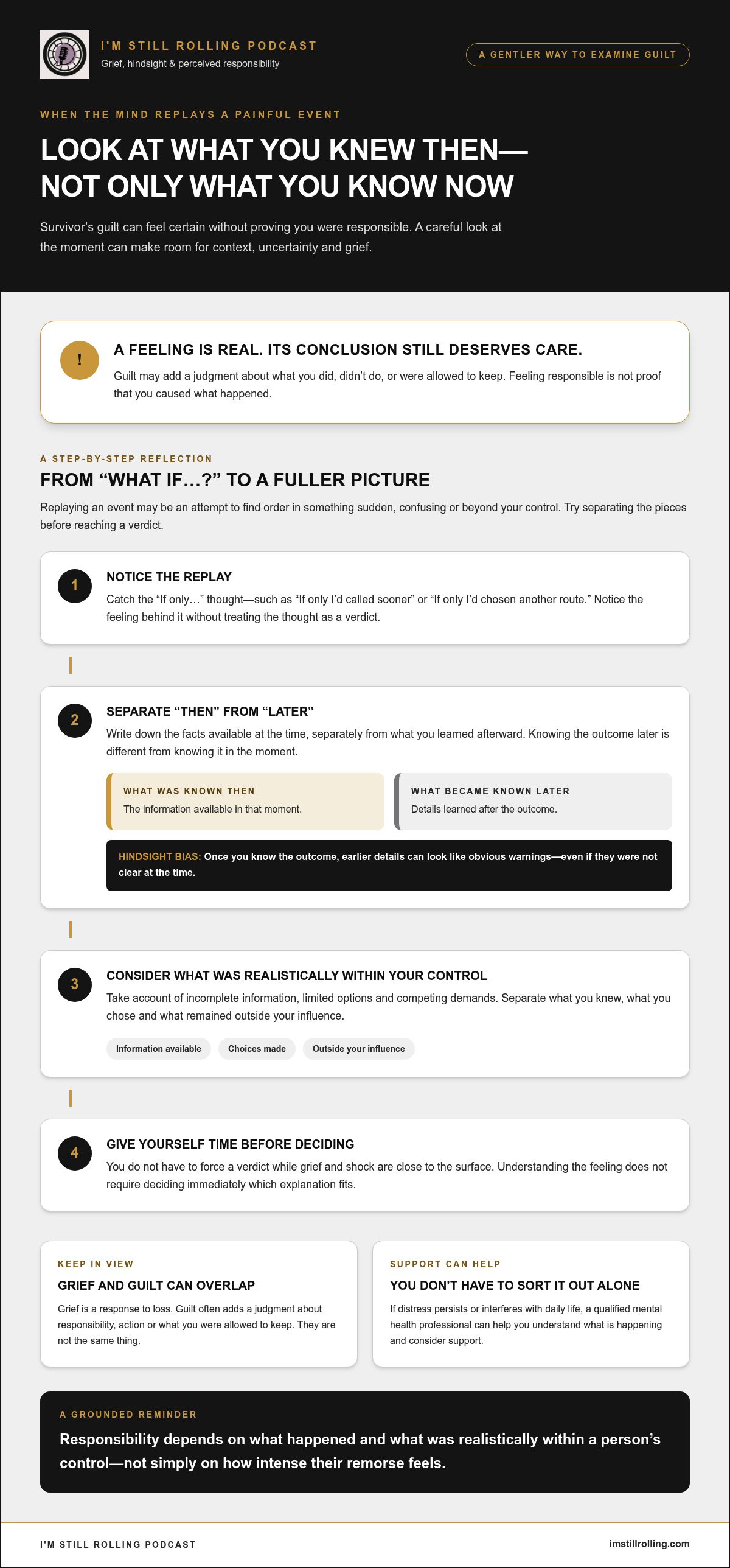
Guilt can feel certain without proving that you were responsible. The feeling is real; the conclusion it seems to point toward still deserves careful examination. You can acknowledge your distress without deciding immediately what you could or couldn’t have controlled.
One reason blame can grow is hindsight bias. Once you know the outcome, earlier details may look like obvious warnings or decisive turning points. But knowing what happened later is different from having that knowledge in the moment. At the time, you may have had incomplete information, limited options, or competing demands. There may also be details worth understanding more fully. Without knowing the circumstances, no one can fairly pronounce what choices were possible.
Why does the mind keep asking, 'What if I had…?'
Replaying an event may be the mind’s attempt to find order in something that felt sudden, confusing, or beyond your control. “What if I’d called sooner?” can seem like a question with an answer that would make the outcome understandable. Yet replaying the event can mean using what you know now to judge a past decision. Try listing the facts available then separately from what you learned afterward. That won’t settle blame, but it can make the difference visible.
Responsibility depends on what happened and what was realistically within a person’s control, not simply on how intense their remorse feels. If the details are complicated, separating what you knew, what you chose, and what remained outside your influence may take time. You don’t have to force a verdict while grief and shock are close to the surface.
Survivor’s guilt isn’t, on its own, a diagnosis. It can be associated with post-traumatic stress disorder (PTSD), but feeling guilt after a painful event doesn’t establish that you have PTSD. If distress persists or interferes with daily life, a qualified mental health professional can help you understand what’s happening and consider support. You don’t have to determine this by yourself.
Can survivor's guilt happen after loss that is not a death?
Yes. Someone may feel guilty after escaping an injury that affected another person, recovering while someone else remains ill, or reaching safety while another person is displaced. A caregiver may also experience complicated feelings as a spouse’s illness changes their relationship and daily life. These situations differ in their details and consequences; they don’t need to be ranked to be taken seriously. Caregiving for a spouse with Alzheimer’s can involve ongoing change and layered emotions. For another perspective, explore first-person conversations on adversity through I'm Still Rolling Podcast. Another person’s story can offer perspective without prescribing your next step.
Does coping with survivor's guilt mean letting go or betraying someone?
No. Coping doesn’t ask you to forget someone, forgive what happened, or turn pain into a silver lining. It doesn’t require deciding that everything happened for a reason. The fear that feeling better means caring less can be powerful, especially when guilt has become a way of staying connected. That fear deserves tenderness, not a quick instruction to move on.
Gratitude, anger, grief, relief, and guilt can all exist together. You might be grateful for a safe moment and furious that someone else didn’t get one. You might laugh, then feel a wave of sadness. These feelings don’t cancel each other out, and none of them, by itself, defines your love or loyalty.
Remembering someone is personal. You might tell stories, keep a familiar object nearby, return to a meaningful place, observe a private ritual, or carry memories quietly. There’s no single practice that proves you cared. Choosing not to make remembrance visible doesn’t mean the relationship mattered less.
Can I feel better without betraying the person I lost?
It can be frightening to imagine a future that includes moments of ease. You don’t have to force yourself to feel ready or treat one good day as a promise that grief is over. Consider what remembering means to you, at your own pace. Healing isn’t a straight line, and there’s no deadline for feeling differently. A moment of relief doesn’t erase the loss.
If guilt returns after a stretch of calm, that doesn’t mean you’ve failed or gone backward. You can notice it without taking it as proof that you must suffer to stay connected. Coping with survivor's guilt may mean making room for memory and for your own life, even when those things feel difficult to hold together.
Stories from other people can offer recognition, a sense that difficult emotions aren’t yours alone. But another person’s way of remembering, making meaning, or rebuilding a life isn’t a measure you have to match. Your relationship, circumstances, and pace are your own.
When can guilt signal a need for more support?
Consider talking with someone you trust or a licensed mental-health professional if distress persists, intensifies, or interferes with sleep, relationships, work, or everyday responsibilities. You don’t need to know what to call the experience before asking for help. A professional can listen and help you explore what support may fit, without that conversation being a diagnosis or a guarantee of a particular outcome.
If you may be in immediate danger, or you’re worried you might harm yourself or someone else, contact local emergency services or a crisis-support service now. If possible, tell someone nearby and ask them to stay with you while you reach out. You deserve support in the moment, not only after you’ve found the right words.
How to cope with survivor's guilt in difficult moments
When guilt rises, you don’t have to solve the whole event or decide what it means about you. A small pause can create space between the feeling and the conclusion it seems to demand. These ideas are optional: take what feels manageable, leave what doesn’t, and consider qualified support if distress is hard to carry. Coping with survivor's guilt is not a test you have to pass.
A gentle checklist: name the feeling, notice what stirred it, sort facts from imagined alternatives, and choose one next step if you’re ready. You can stop at any point. Even noticing that guilt has arrived is a step.
Name the moment. Try, “I’m feeling guilty,” or “I’m remembering the event.” If you can, identify what brought the feeling forward, such as a date, place, or particular memory.
Orient to the present. Notice something around you: the chair beneath you, sounds in the room, or light at the window. You might take a comfortable breath or look around slowly. There’s no single grounding practice that works for everyone, so choose what feels tolerable.
Separate different kinds of thoughts. Write down what you know happened, what you imagine might have happened if you’d acted differently, and what remains unanswered. Keep those categories distinct. An imagined alternative can feel vivid, but it isn’t the same as a known fact.
Choose one next action. You might write privately, speak with someone you trust, or seek qualified support. The aim isn’t to force certainty or make the feeling disappear. It’s to find a manageable way not to be alone with it.
What can I do when guilt starts replaying the event?
If your thoughts keep returning to the same scene, write down the recurring thought and add what you actually knew at the time. Try not to judge your past self with information that only became clear later. Then ask, “What would I say to someone I care about if they were carrying this thought?” You don’t have to accept every answer immediately. The question simply offers another point of view.
How can I talk to someone about survivor's guilt?
You can begin plainly: “I keep thinking I should have done something differently, and I need someone to listen.” Choose someone who can hear you without rushing to fix the story or reassure you before understanding it. If distress persists or disrupts daily life, a qualified mental-health professional may help you explore it.
First-person accounts can also offer companionship, though someone else’s experience can’t dictate what yours should look like. To hear conversations with people who have lived through adversity and change, explore I'm Still Rolling Podcast episodes, hosted by journalists Mike Sugerman and Janice Wright. They offer perspective, not a substitute for individual support.
Finding connection through honest stories and lived experience
No single story can explain how another person should grieve, remember, or rebuild. Someone else’s experience may echo a feeling you recognize, or it may be very different from your own. You’re not required to use their choices as a guide or measure your progress against theirs. Listening can simply be a way to encounter another person’s perspective, on your terms.
That distinction matters in coping with survivor's guilt. A personal account may offer recognition or companionship, but those are possibilities, not promised outcomes. A story isn’t evidence that you should feel a certain way, and it can’t tell you what your own loss means. If a conversation feels overwhelming, pause it, stop listening, or choose another resource. You can return later, or not at all.
How can hearing someone else's story help without replacing support?
Honest accounts can make room for the parts of adversity that are hard to explain: uncertainty, mixed emotions, changes in identity, and the uneven work of carrying on. Hearing someone speak in their own words may help you feel less alone with a question, even if their circumstances don’t match yours. Take what resonates and leave the rest.
A podcast is not therapy, crisis care, or individualized advice. If you need help with persistent distress, reach out to someone you trust or a qualified mental-health professional. If you’re in immediate danger, contact local emergency or crisis support. Stories can sit alongside personal support, but they can’t replace it.
Where can I find stories of resilience and recovery?
I'm Still Rolling Podcast is hosted by seasoned journalists Mike Sugerman and Janice Wright. Their conversations bring forward lived experiences of adversity, disability, caregiving, resilience, and personal change. The show focuses on listening to people describe their lives, not offering clinical expertise or prescribing how a listener should cope. No guest’s path can define what recovery, remembrance, or moving forward must look like for you.
Explore the show through I'm Still Rolling Podcast Episodes. Episodes are available in audio and video, with written transcripts for another way to engage. Choose the format that feels comfortable, and give yourself permission to stop if you need a break. Explore I'm Still Rolling Podcast's resilience stories when you feel ready, or return to them another time.
Make room for the next small step
You don’t have to know exactly what healing will look like before you begin. For now, the next step might be allowing a difficult feeling to be there without treating it as a verdict, or letting someone trustworthy hear one thought you’ve been carrying alone. If coping with survivor's guilt feels too heavy to manage by yourself, reaching for personal or professional support is a meaningful step, not a failure of strength.
And if hearing how others have lived through adversity feels useful, explore those stories at your own pace. Explore honest stories of resilience with I'm Still Rolling, where journalists Mike Sugerman and Janice Wright host conversations with people sharing lived experience. Episodes are available in audio, video, and transcript formats. Listen, watch, or read when it feels right, and step away whenever you need to.
There’s no single pace you have to keep and no perfect words you need to find. Let the next step be small enough to take today. You deserve care as you move forward.
Frequently Asked Questions
What is survivor's guilt?
Survivor’s guilt is guilt or a sense of responsibility connected to living through an event in which someone else experienced loss or harm. It can arise after an accident, illness, disaster, or other upheaval. Having the feeling doesn’t establish that you caused the outcome or could have prevented it. People interpret and respond to events differently, and survivor’s guilt describes an experience, not a diagnosis by itself.
Is survivor's guilt a mental illness?
No. Survivor’s guilt describes an experience or response, not a mental illness diagnosis on its own. It may accompany other forms of distress, but a list of feelings or behaviors can’t determine what’s happening for one person. If guilt persists, grows more intense, or makes ordinary responsibilities difficult, consider speaking with a licensed mental-health professional. They can assess your situation and discuss possible support without assuming a label in advance.
Can you have survivor's guilt if nobody died?
Yes. Someone might feel guilty after leaving an accident with fewer injuries than another person, recovering from illness while a friend remains unwell, or finding safety while others are displaced. Loss of opportunity or security can also raise questions about why one person was spared hardship. These situations don’t need to be compared or ranked. The meaning of survival and the feelings attached to it depend on each person’s circumstances.
How do I stop blaming myself for surviving?
You may not be able to switch self-blame off at will, but you can approach it with curiosity instead of treating it as settled fact. Write down the thought that keeps returning, then note what information you actually had at the time. Coping with survivor's guilt may also include sharing that thought with someone trustworthy. If guilt keeps disrupting your life, a licensed mental-health professional is one option for support.
What happens if survivor's guilt is affecting my daily life?
Take the impact seriously, even if you’re unsure what to call it. If distress makes it hard to sleep, concentrate, keep up with responsibilities, or stay connected to others, tell someone you trust and consider reaching out to a qualified mental-health professional. You don’t have to wait until things feel unbearable. If you’re in immediate danger or might harm yourself, contact local emergency services or crisis support now.
Does coping with survivor's guilt mean forgetting the person who died?
No. Coping doesn’t require forgetting someone, excusing what happened, or making the loss seem smaller. You can hold a memory while also accepting a kind gesture, enjoying a meal, or making a plan. Remembrance might be private or shared, familiar or changing; it doesn’t need to follow anyone else’s rules. Grief and guilt can shift unevenly, so a difficult day doesn’t erase the meaning of a gentler one.
Can hearing other people's stories help with survivor's guilt?
Another person’s account may offer recognition or remind you that you’re not alone, but it can’t establish what happened in your situation or replace individualized support. Choose a story at a pace that feels manageable, and pause if listening becomes overwhelming. I'm Still Rolling features lived-experience conversations hosted by journalists Mike Sugerman and Janice Wright, available in audio, video, and written transcripts. The podcast offers perspective, not treatment or guaranteed relief.

Comments