Coping With a Degenerative Diagnosis: Finding Your Next Step
What if coping with a degenerative diagnosis isn’t about accepting a fixed future, but making room to respond as life changes? A diagnosis that may progress can fill the future with questions: What might change? How could it affect your independence, relationships, or sense of self? Even taking in what the doctor said can take time. You don’t have to feel hopeful or make every major decision right away.
The shock and uncertainty are real, and they don’t mean you’re coping badly. You can take things one step at a time without pretending the hard parts aren’t there. This article offers practical ways to absorb the news, prepare questions for your care team, and find support while keeping your voice in decisions.
We’ll look at how to make room for your emotions, focus on what needs attention now, and talk with people you trust about what may be changing. The future may be uncertain, but you don’t have to solve it all today.
Table of Contents
What a degenerative diagnosis can mean, and what it cannot predict
Hearing that a condition is degenerative can make the future feel as though it has already been written. The word may indicate change over time, but it doesn’t tell you exactly what will change, how quickly, or how those changes will affect daily life. A diagnosis can name a condition while leaving important questions about your individual experience unanswered.
Shock, fear, anger, numbness, and uncertainty are all possible responses. They aren’t required stages, and they don’t show whether you’re handling the news well. You may feel several things at once, or very little at first. Coping with a degenerative diagnosis starts with understanding what the term does and doesn’t tell you, not with forcing yourself to reach a conclusion about the future.
What does “degenerative” mean in a diagnosis?
In plain language, “degenerative” describes changes that may affect the structure or function of parts of the body over time. The term covers a broad range of conditions, causes, and experiences. A general overview of degenerative disease can provide context, but it can’t explain what a specific diagnosis means for you.
Osteoarthritis and Alzheimer’s disease, for example, are often described as degenerative, but they affect different parts of the body and don’t follow an identical course. Even people with the same condition may notice different symptoms and changes in daily activities. Your clinician can explain how the diagnosis relates to your symptoms, test results, and health history.
Why the diagnosis is not a complete forecast
A condition’s general course describes patterns clinicians may see across people. An individual forecast is about what one person is likely to experience, and that can be harder to state precisely. Symptoms, pace, and effects on daily life can vary. Uncertainty may remain even when the diagnosis is clear. That uncertainty isn’t proof that the worst possibility will happen.
A diagnosis describes a condition, not a complete personal future. If your mind is filling gaps with frightening assumptions, turn those fears into questions for your healthcare team. You could write down:
What does this diagnosis explain about my symptoms right now?
What changes might happen, and what remains uncertain?
Which new or changing symptoms should I report, and whom should I contact?
You don’t need to settle every question at once. Keep the list somewhere easy to revisit, and ask your clinician to explain unfamiliar terms in plain language. You can also ask which information applies specifically to you and which describes the condition in general. That distinction can help you take the diagnosis seriously without mistaking a broad pattern for a fixed script.
The first days after diagnosis: steady yourself before solving everything
The days after a diagnosis can blur together. You may remember the name of the condition but not what was said about monitoring, treatment, or next steps. You don’t have to master every detail or make every decision immediately. Give yourself permission to slow the conversation down and focus on what would help you feel more oriented today.
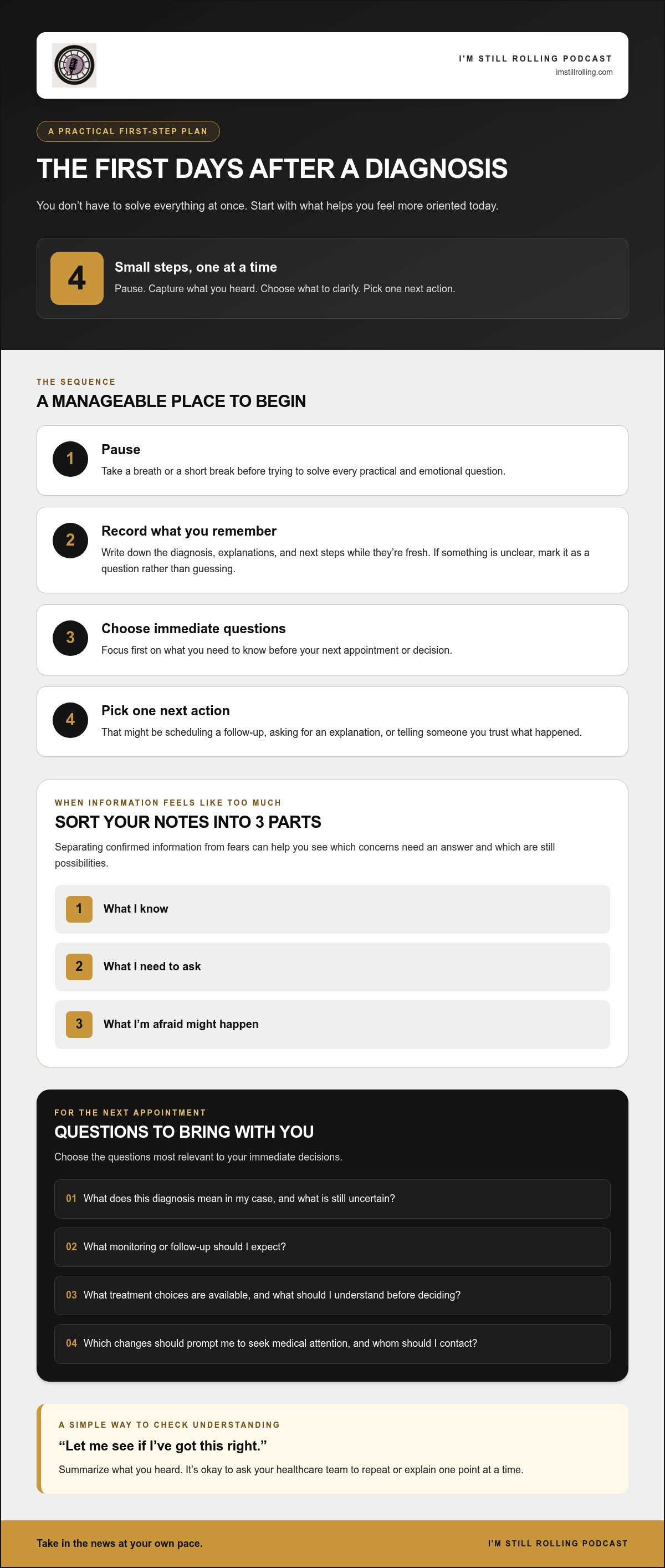
A flexible first-step sequence can bring some order to the moment:
Pause. Take a breath or a short break before trying to solve every practical and emotional question.
Record what you remember. Note the diagnosis, explanations, and next steps while they’re fresh. If something is unclear, mark it as a question rather than guessing.
Choose immediate questions. Focus first on what you need to know before your next appointment or decision.
Pick one next action. That might be scheduling a follow-up, asking for an explanation, or telling someone you trust what happened.
This isn’t a test of how well you’re coping with a degenerative diagnosis. It’s a way to make the next conversation more manageable while giving yourself time to take in the news.
How to handle information overload
When every detail feels urgent, divide a page into three sections: what I know, what I need to ask, and what I’m afraid might happen. Separating fears from confirmed information won’t make them disappear, but it can help you see which concerns need an answer and which are still possibilities.
Ask your healthcare team to explain unfamiliar terms in plain language. To check your understanding, say, “Let me see if I’ve got this right,” then summarize what you heard. It’s okay to ask them to repeat or explain one point at a time. You don’t have to absorb the whole medical picture in a single conversation.
How to prepare for the next appointment
Use your notes to select the questions most relevant to your immediate decisions. Depending on your situation, you might ask:
What does this diagnosis mean in my case, and what is still uncertain?
What monitoring or follow-up should I expect?
What treatment choices are available, and what should I understand before deciding?
Which changes should prompt me to seek medical attention, and whom should I contact?
Writing questions down can make a difficult medical conversation clearer and give you something to return to when stress makes details hard to remember. If it feels right, invite someone you trust to listen, take notes, or help you remember what you wanted to ask. You can also attend alone or share only what you’re comfortable sharing. For a human perspective alongside practical preparation, explore honest conversations about life after adversity. Stories can offer company, but your care team remains the source for guidance about your health.
Grief, identity, and hope: coping without forcing positivity
A diagnosis can bring grief for more than health. You may be mourning plans you thought were settled, familiar routines, or an imagined future that now feels less certain. Those feelings can sit alongside love, gratitude, relief, or determination. None cancels the others. Coping with a degenerative diagnosis doesn’t require you to make the experience sound inspiring or reassure everyone around you.
A diagnosis can also unsettle your identity. Perhaps you’ve long thought of yourself as independent, dependable, adventurous, or the person others turn to. A change in what you can do may affect how you see yourself, but it doesn’t erase the history, relationships, humor, skills, and preferences that make up a life. Your identity may shift as circumstances change. You’re allowed to decide what still feels central and what you want to redefine.
Is it normal to grieve after a diagnosis?
Sadness, anger, numbness, fear, and even relief can all be part of a response to difficult news. There’s no required order and no schedule you have to follow. Feelings may change from day to day or surface around specific moments, such as needing help with a task or reconsidering a plan. That variation doesn’t mean you’re moving backward or reacting incorrectly.
If distress feels hard to manage or begins disrupting daily life, consider telling someone you trust and seeking support from a qualified professional. You don’t have to find the perfect words. “I’m struggling more than I expected” is enough to begin a conversation.
What hope can look like when the future is uncertain
Hope doesn’t have to mean expecting a cure, feeling upbeat, or knowing what comes next. It can mean making room for connection, meaning, and choices in the life you’re living now. You might protect a ritual that matters, adapt a favorite activity, make time for a relationship, or choose what kind of help feels acceptable. These are possibilities, not obligations or measures of success.
Your worth isn’t earned through optimism, independence, or productivity. Some days, hope may feel distant. You don’t need to manufacture it to deserve care and respect. On other days, it may show up as a modest decision: asking a question, accepting company, or choosing rest without apologizing.
Stories can offer language and recognition, especially when it’s difficult to explain an experience to people who haven’t lived it. The stories of recovery and hope shared by others are personal accounts, not templates for how you should feel or predictions of what will happen. Take what resonates and leave what doesn’t fit. Your path remains your own, including the pace at which you make sense of change.
Build a flexible support plan around your changing needs
Support is most useful when it fits the person receiving it. Start by noticing where a little help would ease pressure now, rather than trying to predict every future need. You might want someone to accompany you to an appointment, help with a household task, or simply listen without trying to fix anything. Coping with a degenerative diagnosis can include accepting support while still making your own choices about what matters and what help feels right.
A useful support plan can change as your needs, preferences, and circumstances change. Treat it as a working arrangement, not a contract. You can accept help with one task and decline it with another, or revise a request when your energy or priorities shift.
How to ask for support that feels useful
Specific requests can make it easier for people to show up in ways that actually help. Instead of “I need help,” try “Could you come with me to my appointment and take notes?” or “Would you pick up groceries this week?” If advice or frequent updates feel overwhelming, set a gentle boundary: “I’ll let you know when I’m ready to talk about this,” or “Listening is more helpful than suggestions right now.”
Accepting assistance doesn’t mean handing over control. You can decide who joins a conversation, what information you share, and which choices remain yours. If someone offers help in a way that doesn’t fit, it’s okay to clarify what would work or say no.
How to revisit priorities as circumstances change
Every so often, check in with yourself or someone you trust about routines, responsibilities, and what feels most important now. A small goal might be protecting time for a meaningful activity, adjusting one household task, or making space to rest after a demanding day. Keep goals revisable. Changing the plan isn’t failure; it’s a response to new information about what works.
Separate immediate adjustments from decisions that don’t need to be made today. You may need to arrange practical help for this week while leaving bigger questions about work, living arrangements, or future care for a later conversation. If it helps, write down what needs attention now and what can wait, then revisit the list as circumstances evolve.
Peer communities and personal stories can offer recognition, useful language, and a reminder that other people have faced difficult changes. They can’t predict your path. Another person’s diagnosis, resources, and priorities may be different from yours. For one distinct lived-experience perspective, spinal cord injury recovery stories show how an individual experience extends beyond a medical account, without serving as a template for anyone else.
When you want to hear more first-person conversations about disability, caregiving, and life after adversity, explore the I'm Still Rolling Podcast. Let stories offer perspective while keeping your own needs and decisions at the center.
Find perspective in real stories, and choose your next step
Practical plans can help you respond to what’s in front of you, but they can’t answer every personal question about what life with a diagnosis will mean. Sometimes hearing another person describe uncertainty, changed routines, or a difficult conversation gives you language for something you haven’t been able to explain. A story may offer recognition or a sense of company. It may not, and there’s no required response.
For people coping with a degenerative diagnosis, that distinction matters. Someone else’s experience can be meaningful without becoming a forecast or a set of instructions for your life. Their condition, circumstances, choices, and outcomes may differ from yours. Keep questions about your health and treatment grounded in conversations with your own healthcare team.
What personal stories can, and cannot, offer
I'm Still Rolling is a podcast hosted by journalists Mike Sugerman and Janice Wright, featuring conversations with people who have lived through difficult circumstances. These accounts can illuminate parts of life that a medical description may not capture, including how people make sense of change and what matters to them along the way.
They’re perspectives, not medical advice or treatment, and they can’t guarantee a particular outcome. A guest’s choices aren’t recommendations for you, and their path doesn’t define what lies ahead. Take what helps you reflect, leave what doesn’t fit, and bring medical questions to your healthcare team.
Choose one next step that fits today
You don’t need to map the whole future to take a useful next step. Choose one small action that feels manageable with the time and energy you have now:
Write down one question you want to ask your healthcare team.
Share one feeling with someone you trust, without needing to explain everything.
Identify one person you might contact for company or practical support.
There’s no wrong choice among them, and you can decide to wait if today isn’t the day. You can also choose a format that feels comfortable. I'm Still Rolling episodes are available as audio, video, and written transcripts, so you can listen, watch, or read at your own pace.
Start with one story if and when you’re ready. Explore I'm Still Rolling podcast episodes for lived perspectives on resilience, disability, caregiving, and life after adversity. Let the conversation be company, not a prescription. Your next step remains yours to choose.
Let the next step be yours
The future may not offer a clear map, but you can still choose what deserves your attention today. Coping with a degenerative diagnosis isn’t a demand to feel brave or certain. It’s the ongoing work of making choices that fit the life you’re living, with room to change your mind as circumstances shift.
If you want the company of people speaking from lived experience, I'm Still Rolling brings you journalist-hosted stories of adversity in audio, video, and written transcripts. They aren’t medical guidance or a template for your own path, but they may offer a perspective to sit with in your own time.
Take the step that feels possible, whether that’s asking a question, reaching out to someone you trust, or listening to a story. Explore honest stories of resilience on I'm Still Rolling when you’re ready. Your next step doesn’t need to solve everything. It only needs to be yours.
Frequently Asked Questions
What does a degenerative diagnosis mean?
A degenerative diagnosis means a condition may involve changes in the body’s structure or function over time. It’s a broad description, not the name of one disease or a precise timetable. Ask your clinician what the term refers to in your specific diagnosis, which findings support it, and whether there are alternative explanations for your symptoms. Those details can make a broad label more useful and less frightening.
Is it normal to feel overwhelmed after a degenerative diagnosis?
Yes, feeling overwhelmed can be an understandable response to unfamiliar information and uncertainty. You might find it hard to concentrate, remember details, or explain what you’re feeling. For your next conversation, consider asking someone you trust to join you, if you want, or request a written summary from your healthcare team. If distress is interfering with everyday life, tell someone you trust and consider seeking professional emotional support.
How do I cope with the uncertainty of a progressive illness?
Focus on what can be clarified or handled now, while allowing unanswered questions to remain open. For example, keep a brief record of symptoms or changes you want to discuss, note when they occur, and bring it to your next appointment. Ask your healthcare team what to monitor and when to follow up. This can support useful conversations without requiring you to predict every possible outcome.
Can a degenerative disease progress differently for different people?
Yes. People with the same diagnosis may experience different symptoms, rates of change, and effects on everyday activities. A relative’s or friend’s experience therefore can’t reliably tell you what yours will be. If you notice a change, describe what’s different and how it affects you rather than judging it against someone else’s timeline. Your clinician can interpret those details in the context of your health and care plan.
Should I tell family and friends about my diagnosis?
That choice is yours, and you can share selectively rather than making one announcement to everyone. You might start with someone who listens well, explain what you know so far, and say what kind of response would help. For example: “I’m still processing this. I’d appreciate company, but I’m not ready to discuss details.” You can decide later whether to share more, with whom, and when.
Can personal stories help me cope with a diagnosis?
Personal stories may help you recognize feelings or find words for an experience, though they can’t predict your own path. I'm Still Rolling features journalist-hosted conversations with people who have lived through adversity, available in audio, video, and written transcripts. Listen or read for perspective, not medical advice or treatment, and bring health decisions to your own care team. It’s fine to pause or choose a different story if one doesn’t feel right.



Comments