Communication Strategies for Caregivers: How to Talk, Listen, and Stay Connected
What if a calmer conversation begins not with finding the perfect words, but with making room to hear the other person? When daily needs have to be discussed again and again, even a simple request can become tense. You may be trying to keep someone safe while also respecting their choices, and it isn’t always clear what to say when emotions rise. The right communication strategies for caregivers can help make those moments clearer without making the person you care for feel sidelined.
It’s understandable to want conversations to go smoothly, but communication isn’t about getting every exchange right. Small changes in how you ask, listen, and respond can reduce avoidable misunderstandings and help preserve dignity, even when you disagree or feel worn down.
This article offers practical language for everyday conversations, ways to listen for what may be behind a response, and approaches for tense or repetitive moments. You’ll also learn when to pause, adapt your approach, or seek qualified support, so the person you care for remains at the center of the conversation.
Table of Contents
Why communication strategies for caregivers shape everyday care
A caregiver may be trying to get someone dressed, make an appointment, or move through a familiar routine, while the person receiving care wants time to think or a say in what happens next. Both needs matter. When the task takes over the conversation, the other person can feel managed rather than heard. When no one names the practical need, frustration can build on both sides.
Caregiver communication is an ongoing exchange, not a single instruction or important talk. It involves listening, speaking clearly, choosing a workable moment, and showing respect for the other person’s preferences. The duties of a caregiver can vary, and so will the conversations. What works depends on the person, your relationship, the situation, and how they prefer to communicate. Effective communication strategies for caregivers are responsive, not rigid.
Respectful caregiver communication makes space for the person’s voice while addressing what needs to happen. In an ordinary moment, a small choice or a direct question can preserve a sense of participation. Supporting someone doesn’t require handing over every responsibility, but it also doesn’t mean taking over every decision.
What respectful communication looks like in caregiving
Speak to the person, not around them, whenever they can participate. Instead of discussing a plan with someone else as if they aren’t there, invite their view: “Would you like to talk about what works for you?” Offer meaningful, manageable choices where possible, such as asking whether they’d prefer to get ready before or after breakfast. Make sure the choice is real, not a disguised instruction. This helps distinguish supportive conversation from deciding everything on someone else’s behalf.
Why everyday conversations can become difficult
Urgency, fatigue, fear, and competing responsibilities can tighten a caregiver’s tone, even when the intention is to help. Assuming what someone understands or remembers can also lead to talking too quickly, leaving out context, or correcting them before checking what they mean. Try asking rather than guessing. Disagreement doesn’t automatically mean the conversation has failed. It may show that a preference, worry, or boundary needs more room before you decide what to do next.
Build caregiver communication around listening, clarity, and consent
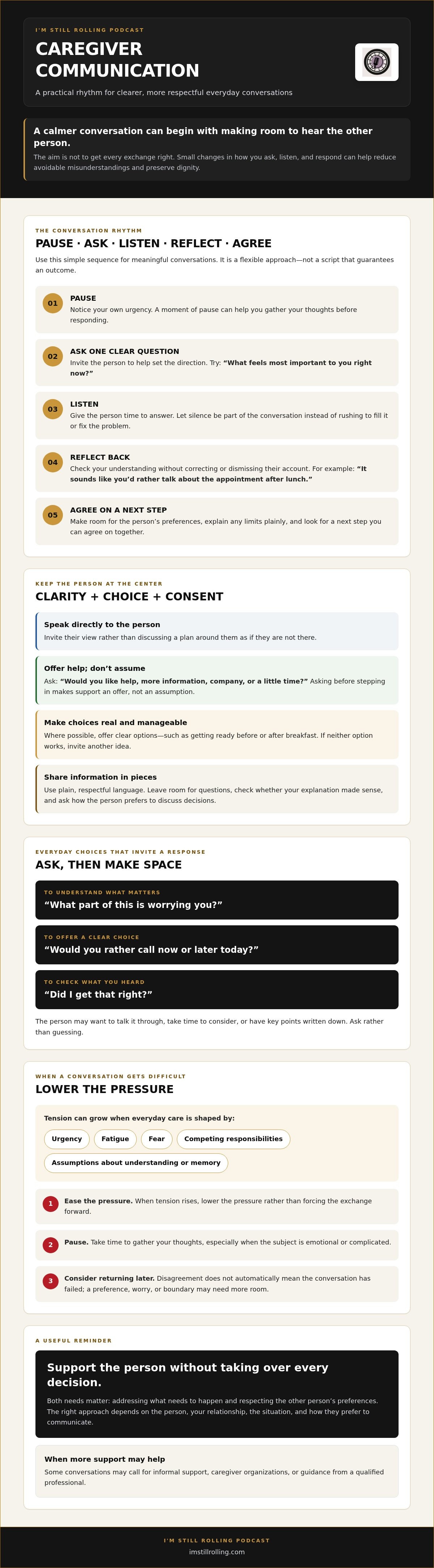
A helpful conversation doesn’t have to be elaborate. Try a simple rhythm: pause, ask, listen, reflect back, then agree on a next step. The pause gives you a moment to notice your own urgency; the question lets the other person help set the direction. Before offering advice or stepping in, ask, “Would you like help, more information, company, or a little time?” Their answer may be different from what you expected.
Asking before helping can preserve autonomy by making support an offer, not an assumption. This doesn’t mean every decision can wait or every request can be met exactly as asked. It means making room for the person’s preferences, explaining any limits plainly, and looking for a next step you can agree on together.
Use active listening without rushing to fix the problem
Ask questions that invite more than a yes or no: “What feels most important to you right now?” or “What part of this is worrying you?” Then give the person time to answer without filling every silence. Reflect back what you heard, such as, “It sounds like you’d rather talk about the appointment after lunch.” This checks your understanding without correcting or dismissing their account. If you’re unsure, ask whether you got it right.
Listening first doesn’t mean you have to solve everything in that moment. A pause can help both of you gather your thoughts, especially when the subject is emotional or complicated.
Make information easier to understand and respond to
Share complex information in manageable pieces, then leave room for questions before adding more. Use plain language without talking down: speak directly to the person, and check whether your explanation made sense rather than assuming it didn’t. Ask how they prefer to discuss decisions. They may want to talk it through, take time to consider, or have key points written down.
When there’s a choice, make the options clear and confirm the person’s preference: “Would you rather call now or later today?” If neither option works, invite another idea. This steady, respectful exchange is at the heart of practical communication strategies for caregivers. For thoughtful perspectives shaped by lived experience, explore caregiving stories and conversations from the I'm Still Rolling Podcast.
Handle repetition, disagreement, and hard conversations with care
Even a careful conversation can become strained. A repeated question, a firm refusal, or a disagreement about what should happen next may test your patience, especially when you’re tired or worried. The aim isn’t to find a phrase that guarantees agreement. Treat examples as starting points, adapting them to the person, the moment, and what you know about their preferences.
If the exchange begins to escalate, reduce the pressure rather than pressing harder. Lower your voice, slow down, and focus on one immediate concern. If neither of you can continue constructively, suggest a pause and a time to revisit the subject. Stepping back isn’t the same as abandoning it. It can give both people room to return with more patience.
What to say when a conversation becomes tense
Calm language can recognize emotion without requiring you to give up your own perspective. You might try, “I can see this matters to you,” or, “We’re not seeing this the same way. Can we take a moment?” Name what’s happening without assigning blame or guessing at motives. “We’re both getting frustrated about the timing” is less accusatory than “You’re being difficult.” Then leave room for the person’s view: “What feels most important to you right now?” These communication strategies for caregivers aren’t scripts. Adjust the words to sound natural and respectful in your relationship.
Adapt communication when memory or speech is affected
If a person asks the same question again, try not to shame them, argue, or assume why it’s happening. Respond calmly, and consider whether a simple answer or written reminder would be welcome. When speech or memory changes affect conversation, ask what approaches the person already finds helpful. Reducing distractions, speaking patiently, and allowing time to respond may make an exchange easier, but preferences differ. For more context on one caregiving relationship and Alzheimer’s, see this caregiving guide for a spouse with Alzheimer's.
Keep track of changes that concern you, especially if they appear suddenly or are markedly different from the person’s usual communication. Rather than trying to diagnose the cause yourself, discuss the change with an appropriate qualified professional. If a conversation feels too difficult to manage alone, trusted family, caregiver organizations, or professional support may also help you consider a respectful next step.
Put caregiver communication strategies into practice each day
A useful conversation routine isn’t a performance to get right. It’s a way to approach an exchange with more intention, while leaving room for the person and the circumstances to shape what happens next. Before you begin, consider the purpose: what needs to be discussed, and is there a decision that truly needs attention now?
Choose a time and setting that feel manageable for both of you, taking the other person’s preferences into account where possible. If the matter isn’t urgent, avoid demanding an immediate answer. They may need time, a quieter space, or a chance to think before responding.
Before: Clarify the topic and consider what the person may want, already know, or need from you.
During: Keep the conversation focused, make space for their response, and check that you’ve understood each other.
After: Notice what seemed to help, what felt difficult, and whether a follow-up conversation or next step is needed.
Think of this routine as a flexible guide, not a promise that every conversation will go smoothly. The point is to learn from each exchange without grading yourself or the other person.
Prepare for a sensitive conversation
Before raising a difficult topic, separate what you hope to discuss from what you hope the person will decide. Consider their perspective without assuming you know it: what might they already understand, what could matter most to them, and what questions might they have? If they’re not ready to talk, see whether you can agree on a better time. This gives the conversation a beginning without forcing an immediate resolution.
Repair a misunderstanding and protect caregiver limits
If your words land differently than you intended, a direct acknowledgment can help reopen the exchange: “I’m sorry. I came across more sharply than I meant to. Can I try that again?” An apology doesn’t require you to abandon a necessary boundary. You can be clear and respectful: “I want to keep talking, but I need a short break. Let’s return to this after I’ve had a moment.” When possible, avoid threats, blame, or disappearing without explanation.
Repeated conversations that feel unsafe or unmanageable are a reason to seek support from someone you trust, a caregiver organization, or an appropriate qualified professional. For reflective stories that bring lived experience into conversations about caregiving, listen to caregiving conversations from the I'm Still Rolling Podcast. These stories can offer perspective, though they aren’t individualized caregiving advice.
Stay connected and find support for the long haul
Good communication isn’t a technique you master once and then apply perfectly. It’s relational, imperfect, and shaped by both people’s needs, changing circumstances, and the history you share. Some days, a conversation may bring you closer; on others, the most useful outcome may be a pause or a clearer understanding of where you disagree. That doesn’t erase the care behind your effort.
Over time, notice whether certain topics or situations repeatedly leave you feeling stuck. Talking with someone you trust may help you work through what’s difficult. Caregiver organizations can offer connection and general resources, while a qualified professional may be appropriate when communication barriers persist or raise safety concerns. Seeking help isn’t a failure of care. It’s one way to take the needs of both people seriously.
Recognize when a conversation needs more support
Supportive listening can help someone feel heard, but it isn’t the same as diagnosing a problem, providing treatment, or making professional care decisions. If you’re concerned about a change or unsure how to respond safely, bring your questions to an appropriate qualified professional. You don’t have to wait until you feel completely overwhelmed to ask for guidance, and you don’t need to carry every hard conversation alone.
Learn from stories without expecting one story to fit everyone
Stories can offer perspective, especially when they make room for the complicated realities of caregiving, disability, and resilience. The I'm Still Rolling Podcast, hosted by journalists Mike Sugerman and Janice Wright, brings journalistic perspective together with guests’ lived experiences. A guest’s account may prompt reflection or help you feel less alone, but one person’s experience isn’t a universal instruction or a substitute for individualized advice.
You can explore I'm Still Rolling Podcast episodes about resilience in audio, video, or written transcript formats. Consider them a space for thoughtful stories, alongside practical communication strategies for caregivers and support that fits your own situation.
For one manageable next step, ask the person you care for, “What would make our conversations easier for you?” Then listen to the answer without needing to solve everything at once. A small, honest question can open the way to a more connected exchange.
Let the next conversation begin with listening
Caregiving conversations won’t always go smoothly, and they don’t have to be perfect to matter. A pause, a clear question, or a moment spent listening can help keep the person’s preferences in view while you work through practical needs. The most useful communication strategies for caregivers are flexible: make room for the other person’s perspective, adjust when something isn’t working, and seek qualified support when concerns persist.
For more perspectives on caregiving, disability, and resilience, explore I'm Still Rolling Podcast episodes. Hosted by seasoned journalists Mike Sugerman and Janice Wright, the podcast features honest conversations with guests who have lived through difficult circumstances. Episodes are available in streaming, video, and transcript formats, so you can choose how to listen or read.
You don’t have to change every conversation at once. Start with one simple question: “What would make this easier to talk about?” Then give the answer room to shape what comes next. Explore the podcast’s episodes and subscribe to stay updated on new content.
Frequently Asked Questions
What are the most effective communication strategies for caregivers?
Effective communication strategies for caregivers begin with listening, clear language, and respect for the other person’s preferences. Pause before responding, ask one question at a time, and reflect back what you heard to check your understanding. Before stepping in, ask whether they want help, information, company, or time. Choose a moment when you can both focus, and treat these approaches as flexible habits rather than rules that guarantee agreement.
How can caregivers communicate with someone who repeats the same question?
Respond calmly and without shaming the person, even if you’ve answered the question before. Offer a brief, clear response and consider whether a written reminder might help, if the person would find one useful. Try not to assume why the question is repeated or argue about it. If repetition is new, changing, or concerning, note what you’ve observed and discuss it with an appropriate qualified professional.
What should a caregiver say during a difficult conversation?
Start by acknowledging what the person is expressing without claiming to know exactly how they feel. You might say, “I can see this matters to you,” or, “Can you tell me what feels most important?” Describe the immediate issue without blame. If tension rises, suggest a pause and a time to return to the topic. Adapt these phrases to your relationship and the person’s communication preferences; no script works for everyone.
How can caregivers communicate while still respecting a loved one's independence?
Speak directly to the person and include them in conversations and decisions whenever they can participate. Offer real choices, such as asking whether they’d prefer to discuss a plan now or later, rather than presenting an instruction as a choice. Ask before helping, and explain practical concerns clearly. Respecting independence doesn’t mean ignoring safety or responsibilities; it means making space for the person’s preferences and looking for a next step together.
How can caregivers reduce misunderstandings?
Use plain, specific language, address one topic at a time, and allow the person time to respond. Don’t assume what they understand or mean. Ask a clarifying question, then reflect back what you heard. For example, “So you’d rather talk about this after lunch, is that right?” Choose a setting with fewer distractions when possible. If your words land badly, acknowledge the impact and try again rather than arguing over your intention.
When should a caregiver seek professional help with communication?
Seek guidance from an appropriate qualified professional if communication barriers persist, a change in communication concerns you, or conversations raise safety concerns. A professional can help assess what support may be appropriate, while caregiver organizations or trusted people may offer general resources and connection. Avoid trying to diagnose or make professional care decisions based only on a conversation. Asking for support is compatible with caring deeply for someone.
How can caregivers communicate when they feel overwhelmed?
If you feel overwhelmed, pause if it’s safe to do so and say plainly, “I want to keep talking, but I need a short break. Can we come back to this?” Focus on the immediate issue instead of trying to settle everything at once. When you can, ask someone you trust for support, or contact a caregiver organization. If you’re worried about safety, seek appropriate qualified help rather than managing the situation alone.



Comments