Caregiving: Top Podcasts for Resilience in 2026
What if the most essential tool in your caregiving toolkit isn't a medical device or a legal folder, but a voice in your ear that finally tells the unflinching truth? Many of us step into this role out of profound love, yet we quickly find ourselves submerged in a sea of emotional exhaustion, sibling friction, and a labyrinth of bureaucratic red tape. It's a heavy burden to carry when you feel like you're managing a complex system without a map. Finding a high-quality caregiving for elderly parents podcast can transform that isolation into a shared journey of endurance and discovery.
You deserve more than superficial cheerfulness; you need a blend of tactical playbooks for logistics and narrative depth for your spirit. This curated selection of podcasts offers the emotional weight and journalistic integrity necessary to reclaim your personal resilience. We'll explore shows that provide a sanctuary of peers who understand your struggle while offering specific strategies for medical and legal advocacy. From long-form interviews to raw, lived experiences, these voices will help you find meaning within the struggle and the strength to keep rolling forward through the complexities of 2026.
Table of Contents
The Role Reversal: Why Podcasts are Essential for Modern Caregivers
The concept of role reversal has evolved into something far more intricate than previous generations experienced. In 2026, we don't just see a child caring for a parent; we see a complex web of medical advocacy, digital literacy, and emotional labor. This shift is profound. It's the moment the protected becomes the protector. To understand the full scope of these responsibilities, one might ask, What is a caregiver? in a modern context. It involves more than physical assistance; it's a total recalibration of one's identity.
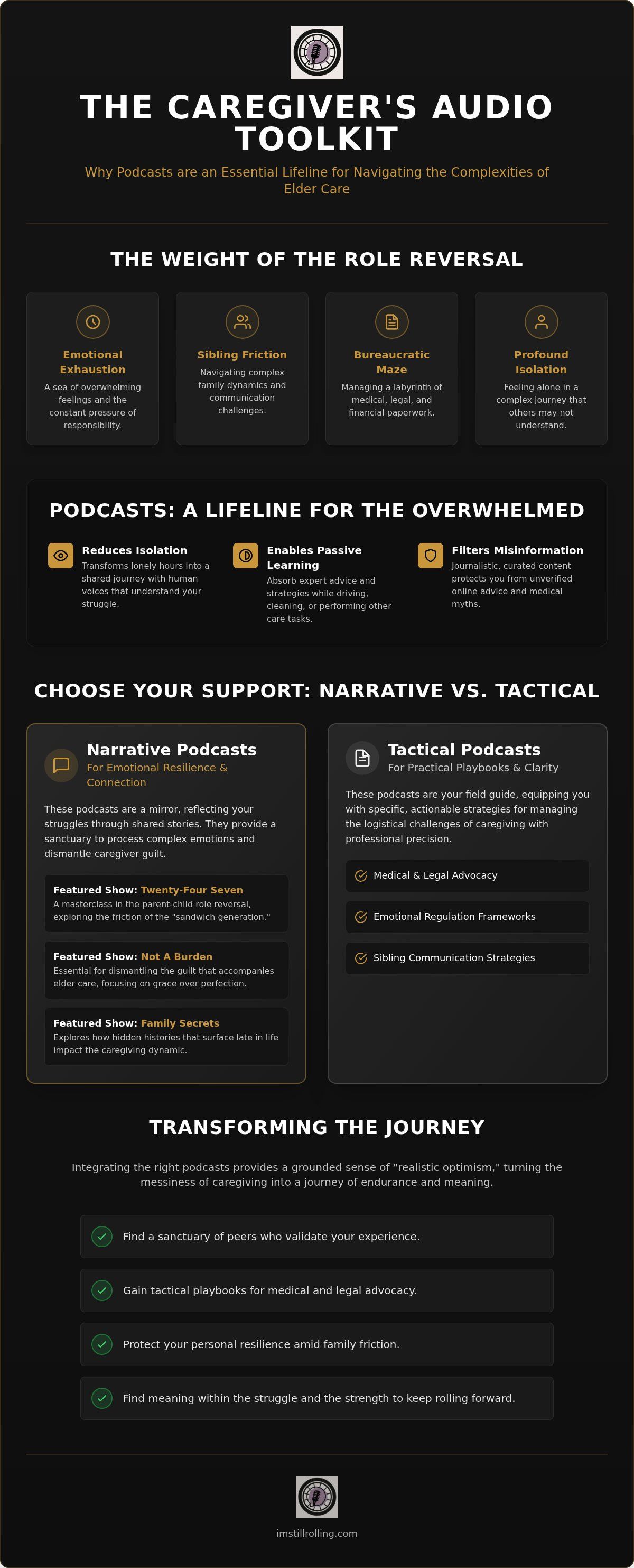
Integrating a caregiving for elderly parents podcast into your daily routine offers a unique solution to the isolation felt by the sandwich generation. These individuals are squeezed between the needs of their children and the declining health of their parents. Audio storytelling provides a buffer. It replaces the clinical coldness of a medical brochure with the warmth of a human voice. Finding the right caregiving for elderly parents podcast is about more than just entertainment; it's about survival. Journalistic podcasts are particularly valuable here. They act as a filter, protecting you from the medical misinformation that often circulates in unverified online forums.
Audio is a superior medium for this journey for several reasons:
It allows for passive learning during physical tasks like driving or cleaning.
It provides a human connection that text lacks, especially during lonely hours.
It offers a curated filter against the noise of unverified online advice.
The Emotional Weight of Aging Parents
The transition from child to primary advocate is rarely a single moment. It's a slow, often painful accumulation of new duties. Hearing unflinching stories of hardship from others who have walked this path provides a psychological release. It validates the exhaustion you feel. We move beyond superficial cheerfulness, which can feel like a dismissal of our pain, toward a state of realistic optimism. This mindset acknowledges the gravity of the situation while maintaining a resilient hope that meaning can be found even in the most difficult days.
Audio as a Lifeline for the Overwhelmed
Time is the most scarce resource for a caregiver. The ability to multitask care duties while absorbing expert advice is a necessity. During the quiet, lonely hours of a night shift, the voice in the ear becomes a companion; it reminds you that you aren't alone in the dark. For those moments when the information is too dense to remember, podcast transcripts serve as a vital reference. They allow you to revisit complex legal or medical details without having to scrub through audio, ensuring you have the facts ready when speaking with doctors or attorneys.
Top Narrative Podcasts for Emotional Resilience and Connection
Choosing a caregiving for elderly parents podcast often depends on your current emotional frequency. Some days require tactical maneuvers, while others demand the deep, resonant connection of a shared narrative. Narrative podcasts serve as a mirror, reflecting our own struggles back to us through the voices of those who have survived the same trenches. They provide a space where the "messy" parts of life aren't just acknowledged but are explored with journalistic rigor and raw intimacy.
Several shows stand out for their ability to weave personal history with universal truths:
Twenty-Four Seven (NPR): This series acts as a masterclass in the parent-child role reversal. It doesn't shy away from the friction of the "sandwich generation," exploring the transition with the precision of a seasoned reporter.
Not A Burden: Essential for dismantling the pervasive guilt that accompanies elder care, this show reminds listeners that caregiving isn't a performance to be perfected but a relationship to be managed with grace.
Family Secrets: During the later stages of life, hidden histories often surface. This podcast explores how these revelations impact the caregiving dynamic and the internal resilience of the adult child.
To make these resources more accessible, it's helpful to categorize your listening by your current emotional state. If you're processing the "long goodbye," look for shows focused on Grief. If you need a release from the absurdity of cognitive decline, seek out Humor. For those days when you simply need to know you aren't the only one struggling, Shared Struggle narratives provide the most comfort.
Finding Solace in Shared Experience
Hearing "messy" stories is infinitely more helpful than receiving sanitized, "perfect" advice. There's a specific kind of survival that happens when you laugh at the absurdity of a dementia-related mishap or a medical billing error. This is especially true when caregiving for a spouse with Alzheimer’s, where the emotional stakes are uniquely intimate and the sense of loss is constant. The National Institute on Aging emphasizes that social support and shared experience are critical for preventing caregiver burnout, and audio storytelling is a modern bridge to that support.
Building a Resilience Toolkit Through Listening
Narrative podcasts allow us to identify "resilience markers" in others. When we hear a guest describe how they found meaning after a particularly grueling decade of care, it helps us reframe our own "burden" as a journey of endurance and transformation. Diverse representation is also vital; hearing from caregivers of different cultural and economic backgrounds ensures that the wisdom we absorb is well-rounded. When searching for a narrative caregiving for elderly parents podcast, look for guests who exhibit these markers. To dive deeper into these honest, long-form conversations that prioritize truth over platitudes, you can explore episodes of the I'm Still Rolling Podcast for a dose of realistic optimism.
Tactical Playbooks: Expert Podcasts for Legal and Medical Clarity
While emotional connection sustains the soul, tactical clarity preserves the estate and the physical safety of your loved one. When you're standing in a hospital corridor or a lawyer's office, you don't need platitudes; you need a field manual. Finding a caregiving for elderly parents podcast that prioritizes professional rigor over superficial advice can mean the difference between a managed transition and a legal crisis. These "tactical playbooks" offer the specific, high-level intelligence needed to navigate systems that often feel designed to be opaque.
Several programs excel at translating complex institutional jargon into actionable steps:
The Aging Parent Playbook: This show is indispensable for its focus on the intersection of geriatric psychiatry and home safety. It explores the psychological barriers that lead parents to refuse necessary help, providing a roadmap for intervention.
Daughterhood The Podcast: Hosted by health policy expert Anne Tumlinson, this series brings journalistic truth to the logistics of elder care. It's a deep dive into the "boots on the ground" reality of managing professional care systems.
The Caregiver’s Guide: For the time-strapped advocate, this podcast offers short-form bursts of legal and financial wisdom. It’s designed for the person who needs to understand a specific regulation during their twenty-minute commute.
Vetting a caregiving for elderly parents podcast for medical accuracy is a critical skill. In an era of rapid information exchange, look for hosts who interview board-certified professionals and cite peer-reviewed data. A reliable show won't just offer an opinion; it will provide the credentials of its guests and a transparent look at the sources behind its claims. This journalistic approach acts as your primary defense against the medical misinformation that often flourishes in unmoderated spaces.
Navigating the Legal and Financial Maze
The 2026 landscape of elder law is increasingly complex, making expert interviews more valuable than ever. Podcasts that simplify the distinctions between Power of Attorney and Guardianship help families avoid avoidable legal crises. You'll learn to identify common financial pitfalls in long-term care planning, such as the "look-back" periods for Medicaid or the hidden costs of assisted living contracts. These episodes empower you to walk into a consultation with an attorney already knowing which questions will protect your parent's legacy.
Medical Advocacy and Doctor Communication
Learning to speak "medical-ese" is a prerequisite for effective advocacy. Tactical podcasts teach you the three essential questions to ask before accepting any prognosis: What are the specific risks of this path? Are there less invasive alternatives? What happens if we choose to do nothing? By bridging the gap between home care and professional medical systems, these audio guides ensure you're seen as a partner in care rather than a passive observer. This mastery of communication ensures that your parent’s wishes remain the central focus of every clinical decision.
Managing Family Dynamics and Preventing Caregiver Burnout
Caregiving often acts as a magnifying glass, enlarging the existing fractures within a family structure. While the medical needs of a parent are objective, the emotional interpretation of those needs varies wildly between siblings. This is where the "Sibling Divide" emerges. One child might be submerged in the daily grit of medication management and hygiene, while another, visiting from out of town, only sees the "good days." This discrepancy in reality creates a unique friction that can lead to resentment and, eventually, total depletion. Integrating a caregiving for elderly parents podcast into family discussions can provide a neutral, third-party perspective that depersonalizes these conflicts.
The danger of the "Heroic Sacrifice" myth cannot be overstated. We're often conditioned to believe that the more we suffer, the better we are at caring. This is a fallacy. Real resilience requires acknowledging the "messy" parts of this journey without descending into a permanent state of despair. These caregiver burnout stories highlight that endurance isn't about being a martyr; it's about sustainable advocacy. One effective tool for emotional regulation is the "10-Minute Pity Party" framework. It allows you ten minutes of unfiltered, raw venting about the unfairness of the situation, after which you consciously pivot back to your role with a clearer head.
Healing the Sibling Divide
Moving from frustration to collaboration requires a shared set of facts. When siblings listen to the same caregiving for elderly parents podcast, they gain a common vocabulary for discussing cognitive decline or legal transitions. It's often easier to accept a hard truth when it's delivered by a journalistic expert rather than a frustrated brother or sister. You can use specific episodes as "neutral ground" to initiate conversations about shared responsibility, ensuring that the labor of care doesn't fall disproportionately on one person's shoulders.
Preserving Your Own Humanity
We must dismantle the idea that constant exhaustion is a sign of devotion. It's actually a warning sign of systemic failure. Setting boundaries isn't an act of abandonment; it's an act of preservation that allows you to remain a compassionate advocate for the long haul. Listening to a caregiver mental health podcast can help you identify when your internal resources are running dangerously low. To find a community that values both professional truth and personal endurance, you can listen to the I'm Still Rolling Podcast for stories that honor your struggle without asking for your total depletion.
Cultivating Resilience with I'm Still Rolling Podcast
Finding a caregiving for elderly parents podcast that respects your intelligence while acknowledging your exhaustion is a rare discovery. While many resources offer either sterile clinical advice or overly sentimental platitudes, the I'm Still Rolling Podcast occupies the vital middle ground. Hosted by seasoned journalists Mike Sugerman and Janice Wright, the show brings a level of professional truth to personal struggle that is often missing from the conversation. They don't just observe the hardships of life after adversity; they live them with a grounded, soulful connection that transforms the listener from a passive observer into a resilient participant.
The 2026 environment has brought the intersection of disability rights and elder care to the forefront of family life. We're no longer just looking for "help"; we're looking for justice, autonomy, and the preservation of dignity for our aging loved ones. This requires an unflinching honesty that most platforms avoid. Mike and Janice explore these "messy" parts of life with a grace that suggests mastery of the subject matter. For a new caregiver, this transparency is often the best medicine, providing a safe space for deep reflection without the pressure of superficial cheerfulness.
Journalistic Rigor Meets Lived Experience
The value of high-level storytelling cannot be overstated when you're submerged in a sea of amateur advice. There is a profound difference between a casual chat and a long-form interview conducted with journalistic rigor. This podcast explores the discovery of meaning within struggle, utilizing the hosts' background in media to weave together personal history and broader philosophical insights. This creates a unique personality for the show. It acts as both a "trusted guide" for the logistics and a "vulnerable peer" for the emotional labor. You can explore the full range of these conversations through the I'm Still Rolling Podcast Episodes, which serve as a comprehensive guide to building internal endurance.
Starting Your Resilience Journey
If you're just beginning to manage the care of an aging parent, start with episodes that focus on the "realistic optimism" of daily survival. These stories don't promise easy fixes; they promise a path forward. To make these insights actionable, many families use the podcast transcripts as a foundation for family care meetings. Having a written record of expert advice allows you to present objective information to siblings or medical professionals without the emotional volatility of a verbal argument. By joining this community of realistic optimists, you're not just finding a caregiving for elderly parents podcast; you're reclaiming your sense of personal resilience and joining a movement that honors the weight and the beauty of the stories we tell.
Reclaiming Your Resilience Through Audio
The journey of role reversal is rarely a linear path. It's a series of transformations that require both tactical playbooks and deep emotional connection. We've explored how narrative-driven audio can dismantle the isolation of the sandwich generation while providing specific strategies for medical and legal advocacy. By integrating a caregiving for elderly parents podcast into your daily routine, you move away from the weight of heroic sacrifice toward a sustainable state of realistic optimism. You don't have to navigate medical red tape or sibling friction in silence.
To find a community that honors your endurance with award-winning journalistic insight, listen to I'm Still Rolling Podcast for honest stories of resilience and caregiving. You'll gain access to honest conversations with real survivors and accessible transcripts for every episode to help guide your family care meetings. You're a vital advocate on a difficult journey, but you're a fellow traveler among many. Keep rolling forward with grace and the knowledge that your story matters.
Frequently Asked Questions
What is the best podcast for someone just starting to care for an elderly parent?
For those at the beginning of this journey, Daughterhood The Podcast is an excellent entry point. Hosted by health policy expert Anne Tumlinson, it provides a grounded look at the logistics of care. It balances tactical advice with the emotional weight of role reversal. Listeners gain a clear roadmap for the initial steps of advocacy, helping them move from a state of bewilderment toward a more structured and resilient caregiving plan.
Are there podcasts that specifically address dementia and Alzheimer’s care?
Several programs focus specifically on cognitive decline. Twenty-Four Seven (NPR) offers a deeply personal look at the parent-child dynamic during dementia; specialized shows like Dementia Matters provide clinical insights. These resources help families manage the absurdity and heartbreak of memory loss with realistic optimism. They offer a sanctuary of shared experience, ensuring you don't feel isolated while managing the complex behavioral shifts associated with Alzheimer's and related conditions.
How can podcasts help with caregiver burnout and mental health?
Finding a high-quality caregiving for elderly parents podcast acts as a buffer against isolation. These shows normalize the "messy" parts of life, such as frustration and exhaustion, which are often suppressed. By listening to long-form interviews with peers who have survived similar hardships, caregivers can dismantle the myth of the heroic sacrifice. This audio connection provides a safe space for reflection, helping you set boundaries and reclaim a sense of personal humanity.
Can I find podcasts that explain the legal side of caregiving like Power of Attorney?
Tactical podcasts like The Aging Parent Playbook or The Caregiver’s Guide offer short, precise episodes on legal essentials. They break down the differences between Power of Attorney and Guardianship, translating institutional jargon into actionable steps. These audio guides empower you to walk into legal consultations with the right questions. They act as a field manual, helping you navigate the 2026 landscape of elder law without being overwhelmed by the complexity of the system.
Are there any podcasts that help siblings resolve conflicts over parent care?
Audio storytelling can serve as "neutral ground" for family discussions. Shows that explore the "Sibling Divide" help brothers and sisters understand why they may perceive their parent's needs differently. By listening to the same caregiving for elderly parents podcast, family members gain a common vocabulary and a shared set of objective facts. This reduces friction and moves the family dynamic from one of resentment and frustration toward a more collaborative and sustainable care model.
What makes a journalistic podcast different from a standard caregiving show?
A journalistic podcast, such as I’m Still Rolling, prioritizes professional truth and rigorous storytelling over amateur advice. Seasoned reporters like Mike Sugerman and Janice Wright utilize their background in media to explore the internal nuances of resilience. This approach avoids superficial cheerfulness, opting instead for a soulful connection that feels both authoritative and deeply personal. It provides a level of vetting and narrative depth that ensures the information is both accurate and emotionally resonant.
Where can I find transcripts for caregiving podcasts to share with my family?
Many high-level productions, including I’m Still Rolling, provide accessible transcripts for every episode. These written records are invaluable for family care meetings; they allow you to share expert insights with siblings or medical professionals who might not have time to listen to a full show. Transcripts ensure that critical legal or medical details aren't lost in translation, acting as a steady, reliable pulse for your family's long-term care planning.
How do I find time to listen to podcasts when I am a busy caregiver?
Audio storytelling is designed for the time-strapped advocate. You can utilize "passive learning" by listening during physical tasks like driving to appointments, cleaning the home, or during lonely night shifts. This multitasking allows you to absorb expert advice and emotional support without carving out dedicated time from your care duties. The intimacy of a voice in your ear provides a lifeline of connection that fits seamlessly into the rhythm of a busy life.



Comments