Balancing Work and Parent Care: A Guide to Resilience
The presentation was perfect, the data was irrefutable, and then the phone rang. In an instant, the high-stakes world of quarterly targets dissolved, replaced by the visceral panic of a parent’s fall or a confused voice on the other end of the line. This jarring transition is the daily reality for millions of professionals balancing work and caregiving for a parent. It's a relentless cycle where you're never quite "on" enough at the office and never fully "there" for the person who raised you. The mental fatigue of deciding between a career-defining project and a necessary doctor's visit can feel like a slow erosion of your own identity.
It's natural to fear that your professional drive and your filial duties are in direct conflict, leading to the crushing weight of "caregiver-tracking" or stagnation. This struggle isn't a sign of weakness; it's a profound exercise in human resilience. You'll discover how to navigate the complex intersection of professional ambition and family duty without losing your sense of self. We'll explore a framework for sustainable caregiving, provide validation for your dual roles, and offer practical ways to set boundaries that protect your career and your peace. From understanding 2026 FMLA eligibility to managing the $202.90 monthly Medicare Part B premiums, we'll walk through the logistics and the legacy of this journey together.
Table of Contents
The Hidden Labor: Understanding the Intersection of Career and Caregiving
The definition of a professional in 2026 has undergone a quiet, radical transformation. We're seeing a massive demographic shift where "working" and "caregiving" aren't separate phases of life but a singular, high-stakes reality. For those balancing work and caregiving for a parent, the traditional concept of work-life balance feels like a hollow promise. It assumes two distinct spheres that can be neatly partitioned, yet the reality is a constant, overlapping "squeeze."
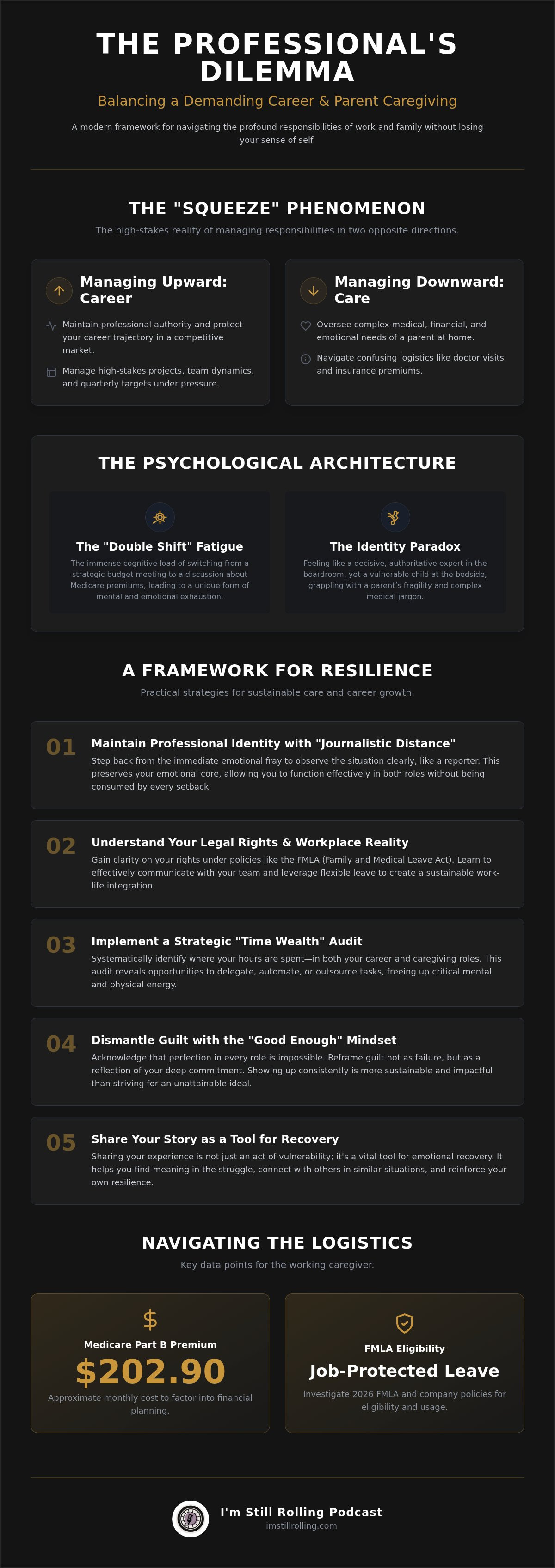
This phenomenon forces you to manage in two directions simultaneously:
Managing Upward: Maintaining professional authority and protecting your career trajectory in a competitive market.
Managing Downward: Overseeing the complex medical, financial, and emotional needs of a parent at home.
Treating this intersection as a professional project requires the same journalistic inquiry we use at I'm Still Rolling Podcast. It's about reporting on the situation with unflinching honesty. Instead of compartmentalizing, we must acknowledge that the skills used in the boardroom, like crisis management and resource allocation, are the same ones required at the bedside.
The Rise of the Professional Caregiver
The shift toward remote and hybrid work has made caregiving more visible, yet it has also blurred the boundaries that once provided a mental reprieve. While working from home allows for presence, it often intensifies the pressure to be "always on" in both roles. Filial resilience is the ability to maintain one's core identity and professional purpose while serving a parent’s evolving needs. It's not about doing it all; it's about staying whole while the world asks you to fragment.
Identifying the 'Double Shift' Fatigue
The cognitive load of switching from a strategic budget meeting to a discussion about Medicare Part B premiums is immense. This "double shift" creates a unique form of exhaustion that goes beyond physical tiredness. It's the emotional labor of maintaining a polished, professional facade while privately grieving a parent’s decline. By understanding caregiver burden, we can begin to name the mental fatigue that comes from constant decision-making. Acknowledging this "messiness" isn't a failure of professionalism. It's the first step toward building a sustainable life where your career and your heart can coexist. Balancing work and caregiving for a parent is less about finding a perfect equilibrium and more about enduring the tension with grace.
The Psychological Architecture of the Working Caregiver
The internal landscape of a professional shifts the moment they become a primary support system for a parent. It's a transition from the "realistic optimism" of short-term crisis management to the grueling marathon of sustained endurance. This shift often triggers an identity paradox. You might be the decisive, authoritative expert in the boardroom, yet at the bedside, you're a vulnerable child again, grappling with medical jargon and a parent’s fragility. Who are you when you aren't the one with all the answers? Reconciling these two versions of yourself is the foundation of resilience.
One powerful tool for managing this tension is "Journalistic Distance." Just as a reporter observes a complex scene to capture the truth without being consumed by it, you can learn to step back from the immediate emotional fray. This isn't about detachment or coldness; it's about preserving your emotional core so you can continue to function. It allows you to process the "messy" parts of balancing work and caregiving for a parent without letting every medical setback or workplace micro-aggression derail your focus. When people suggest self-care, it often feels like just another chore on an impossible to-do list. Instead of seeking grand gestures, focus on reclaiming small pockets of agency that remind you of your own personhood outside of your duties.
Dismantling Caregiver Guilt
Perfectionism is the ultimate enemy of professional longevity. The "Good Enough" caregiver understands that showing up perfectly in every role is a mathematical impossibility. Guilt isn't a sign of personal failure. It's a reflection of your deep values and the love you carry for your parent. By reframing this emotion, you can see it as proof of your commitment rather than a debt you can never repay. If you're struggling to find hope in the midst of this weight, see our guide on finding light after life-altering adversity.
Building Emotional Bandwidth
Building bandwidth requires using your professional problem-solving skills to navigate complex medical bureaucracies. You don't lose empathy by compartmentalizing; you protect it. Resilience isn't about bouncing back to who you were before the crisis. It's about integrating this new, heavy role into a life that still has room for ambition. It's about finding meaning in the struggle, a theme we explore deeply in our I'm Still Rolling podcast episodes. By applying the same rigor to your emotional health as you do to your career, you create a sustainable path forward that honors both your parent and your own future.
Navigating the Professional Landscape: Workplace Rights vs. Reality
Journalists understand that the official press release rarely tells the whole story. In the corporate world, there is often a significant gap between what HR manuals promise and how a team perceives your sudden absence or shifted schedule. Balancing work and caregiving for a parent requires you to master this duality, advocating for your legal rights while protecting your professional reputation. The reality of 2026 is that while policies have evolved, the "caregiver-track" remains a quiet fear for many ambitious professionals.
To protect your trajectory, you must first understand the hard facts of your protections. As of 2026, FMLA eligibility remains tied to specific criteria: you must have worked for your employer for at least 12 months, logged at least 1,250 hours in the previous year, and work at a location with at least 50 employees within a 75 mile radius. Additionally, the 2026 increase of the Dependent Care FSA limit to $7,500 offers a more robust financial tool for managing care costs. However, knowing these rules is only half the battle. The other half is avoiding the "Transparency Trap." Sharing too much can lead to being subconsciously passed over for high-stakes projects, while sharing too little can lead to being labeled as disengaged.
Strategic Communication with Leadership
When you sit down with your manager, don't lead with the "messy" emotional details. Instead, frame the conversation around solutions and predictable schedules. Use a script that highlights your commitment to deliverables while clearly outlining the windows of time you need for parental medical appointments. The Caregiver Compact is a mutual, transparent agreement where an employee delivers high-quality output in exchange for the predictable flexibility required to manage a parent’s care. By setting these boundaries early, you demonstrate that your professional drive remains intact, even as your personal responsibilities expand.
Evaluating Your Career Options
Sometimes, the most resilient move is a lateral one. If your current role demands 24/7 availability that you can no longer provide, seeking a position with more autonomy doesn't mean you're stalling your career. It means you're recalibrating for the long haul. We are seeing a rise in caregiver-friendly corporate cultures in 2026, where purpose-driven leadership is becoming a competitive advantage. You can explore human interest podcast advertising to see how brands are increasingly aligning with these values of empathy and resilience. Choosing an employer that recognizes your "hidden labor" as a source of strength rather than a liability is a strategic career move that pays dividends in both peace of mind and professional longevity.
Strategic Systems for Sustainable Care and Career Growth
Success in balancing work and caregiving for a parent requires moving beyond a series of reactive tasks toward a disciplined, systemic approach. Start with a "Time Wealth" audit. Track your hours for one week with the same precision a journalist uses to log interview tapes. You'll likely discover that your exhaustion stems not just from the care itself, but from the invisible cognitive leaks of unorganized data. Once you see where the hours go, move to Step 2: outsourcing the clinical. This isn't just about hiring help; it's about leveraging technology to automate the mundane so you can preserve your energy for the meaningful.
Step 3 involves building your "Resilience Council." This group of mentors and fellow travelers provides the objective perspective you lose when you're too close to the story. In Step 4, implement "Micro-Resilience" rituals. These are three-minute pauses in your workday, perhaps between a budget call and a doctor's update, that act as a mental reset. Finally, Step 5 is the "Review and Pivot." Treat your parent’s care plan like a quarterly business review. Assess what's working, what's draining you, and adjust your strategy before you reach a breaking point.
Technology as a Caregiving Ally
Smart home monitoring and medical alert systems are no longer luxury items; they are essential tools for peace of mind at the office. By adopting a "Newsroom" approach to care, you can use collaborative apps to coordinate with siblings or professional aids, ensuring everyone is working from the same lead. Digital transcripts for medical appointments are particularly vital. They allow you to be present with your parent during the visit while ensuring you have an accurate record to review later, saving you the mental energy of frantic note-taking.
The Power of the Support Network
Isolation is the silent career-killer for the working caregiver. Finding community beyond your immediate family is essential for long-term endurance. Professional peer groups allow you to share strategies for workplace navigation that friends who aren't in the same "squeeze" might not understand. If you're managing complex cognitive declines, our caregiving for spouse with Alzheimer's pillar offers relevant emotional frameworks that apply to parental care as well. Asking for help isn't a burden on others; it's an invitation for your community to support a shared human experience. To stay updated on the latest resilience strategies, you can subscribe to our newsletter for a weekly resilience toolkit.
Resilience as a Narrative: Why Sharing Your Story Matters
The weight of balancing work and caregiving for a parent often feels like a series of disjointed crises, a fragmented existence where you're constantly putting out fires. But there is a profound shift that occurs when you begin to view these experiences not as a burden to be endured, but as a narrative to be told. At I'm Still Rolling, our philosophy is rooted in the belief that the "messy" parts of life are often where the deepest meaning is found. By transitioning from a "sufferer" of circumstances to a "storyteller" of your own life, you reclaim the power to define your experience. You move from being a passive participant in your parent’s decline to an active witness of their legacy and your own endurance.
Storytelling isn't merely a way to relay facts; it's a vital tool for emotional processing and recovery. When we put words to our struggle, we begin to organize the chaos. We find the parallelisms between our professional drive and our filial duty. This is the heart of what veteran journalists Mike Sugerman and Janice Wright explore in every episode. They don't shy away from the gravity of life-altering challenges, but they approach them with a "realistic optimism" that refuses to descend into pity. Sharing your story allows you to connect with a community that understands the specific mental fatigue of this journey. It's a way to validate that your professional ambition and your caregiving duties can coexist without erasing your sense of self.
The Journalistic Lens on Personal Adversity
Applying a journalistic lens to your own life provides the necessary distance to heal. It allows you to report on your situation with unflinching honesty while maintaining your internal resilience. This perspective transforms the daily grind into a story worth telling, one that honors the human condition in all its complexity. For more inspiration on how to frame your journey through the eyes of seasoned professionals, you can read more about I'm Still Rolling podcast episodes. These conversations prove that even in the heaviest moments, there is a steady pulse of resilience waiting to be documented.
Your Next Steps Toward Resilience
The journey of balancing work and caregiving for a parent is long, and you don't have to walk it alone. Finding hope after medical trauma often comes from the lived experience of others who have navigated similar paths. Our newsletter acts as a weekly resilience toolkit, providing the journalistic insights and soulful connections you need to keep moving forward. It's a safe space for deep reflection and a reminder that your professional drive and caregiving duties can coexist with grace. Join the conversation and subscribe to the I'm Still Rolling Newsletter to receive these insights directly in your inbox.
Reclaiming Your Future While Honoring the Past
The duality of your current life isn't a problem to be solved with a simple checklist. It's a profound narrative shift that requires both systemic strategy and emotional grace. We've explored how to navigate the "squeeze" by auditing your time, leveraging 2026 workplace protections, and building a resilience council that acts as your professional and personal anchor. Success in balancing work and caregiving for a parent comes when you stop fighting the tension and start integrating these roles into a cohesive, meaningful story. You don't have to sacrifice your professional identity to be a devoted child; you simply need the tools to endure the marathon.
You aren't walking this path alone. Hosted by award-winning journalists Mike Sugerman and Janice Wright, our deep-dive interviews explore the raw truth of the human condition with realistic optimism. We provide transcripts for busy caregivers who need insights on the go and a community that validates your dual drive. Listen to the latest episodes of I'm Still Rolling for real stories of resilience and discover that even in the messiest parts of life, you're still moving forward. Your story is still being written, and it's one of incredible strength.
Frequently Asked Questions
How do I tell my boss I need to care for my parent without sounding less committed?
Frame the conversation around deliverables and predictable availability rather than the emotional weight of your personal life. Start by reaffirming your commitment to your role and then present a clear, solution-oriented schedule. By proposing a "Caregiver Compact" that outlines when you'll be offline for appointments, you demonstrate professional foresight. This proactive approach shows you're managing the situation with the same rigor you apply to high-stakes projects.
Can I really balance a high-level career and caregiving long-term?
Success in balancing work and caregiving for a parent is possible, but it requires moving from reactive crisis management to a sustainable, systemic architecture. You must integrate these roles rather than trying to keep them perfectly separate. This involves auditing your "Time Wealth" and leveraging technology to automate clinical tasks. Long-term endurance is built on "realistic optimism," where you acknowledge the gravity of the "squeeze" while maintaining your professional drive.
What are the first steps to take when a parent suddenly needs full-time care?
Immediately verify your FMLA eligibility and assess the immediate financial landscape, including the 2026 Medicare Part B monthly premium of $202.90. You must have worked for your employer for 12 months and logged 1,250 hours to qualify for federal leave protections. Next, establish a "Newsroom" approach to coordination by setting up collaborative apps for family members. These first steps provide the structural stability needed to handle the visceral panic of a sudden medical shift.
How can I manage caregiver burnout while working a 40-hour week?
Incorporate "Micro-Resilience" rituals into your workday to act as a mental reset between professional and personal duties. Use the "Journalistic Distance" approach to observe your situation with clarity without being consumed by the immediate emotional triggers. It's vital to reclaim small pockets of agency that remind you of your identity outside of work and care. These brief pauses prevent the slow erosion of self that often leads to total professional exhaustion.
Are there specific workplace laws in 2026 that protect caregivers?
The primary federal protection remains the FMLA, which requires covered employers to provide up to 12 weeks of unpaid leave for family care. In 2026, the Dependent Care FSA limit has increased to $7,500 per household, offering a more robust financial tool for managing care costs. While no dedicated federal caregiver tax credit exists yet, you can utilize the Credit for Other Dependents for qualifying relatives whose gross income is under $4,700.
What happens if I have to take a career break for caregiving?
Reframe a career break as a sabbatical for resilience rather than a gap in your professional history. This period is an opportunity to master complex management and advocacy skills that are highly valuable in the boardroom. When you decide to return, use your narrative power to explain how this experience sharpened your crisis management and resource allocation abilities. You are a storyteller of your own life, not a victim of circumstance.
How do I find a support group for professional caregivers?
Look for professional peer groups that understand the specific tension of high-level career demands and filial duty. Joining the I'm Still Rolling community provides access to honest conversations and a "resilience toolkit" through our weekly newsletter. Connecting with others who share your professional drive and caregiving reality offers the validation needed to stay whole. These networks provide the objective perspective you often lose when you're deep in the "messy" parts of life.



Comments