Adapting Your Home for a Disabled Partner: Preserving Dignity and Connection
What if the greatest challenge following a life-altering diagnosis isn't the physical injury itself, but the quiet terror that your shared sanctuary is turning into a sterile rehabilitation clinic? When you face the urgent reality of adapting your home for a disabled partner, the sudden barrage of medical jargon, building codes, and construction specs can feel completely paralyzing. It's easy to look at cold hospital hardware and wonder where your shared life went.
You likely worry that installing clinical equipment will strip away your partner's dignity, transforming an equal romantic bond into an exhausting caregiver dynamic. That fear is profoundly valid, but accessible design doesn't require emotional surrender. You will discover how to thoughtfully modify your living space to protect physical safety, foster daily independence, and strengthen your relationship resilience without sacrificing warmth or personal style. Ahead, we walk through practical architectural frameworks, collaborative design steps, and essential strategies to preserve intimacy through every stage of long-term recovery.
Table of Contents
Assessing Immediate Needs: Moving from Medical Crisis to Practical Home Safety
Room-by-Room Modifications: Balancing Clinical Safety with Warm Residential Design
Ambient Assistive Technology: Empowering Autonomy Without Institutional Hardware
Preserving Partnership and Intimacy: The Emotional Architecture of Care
Building Long-Term Resilience: Tapping Into Community Wisdom and Lived Stories
Assessing Immediate Needs: Moving from Medical Crisis to Practical Home Safety
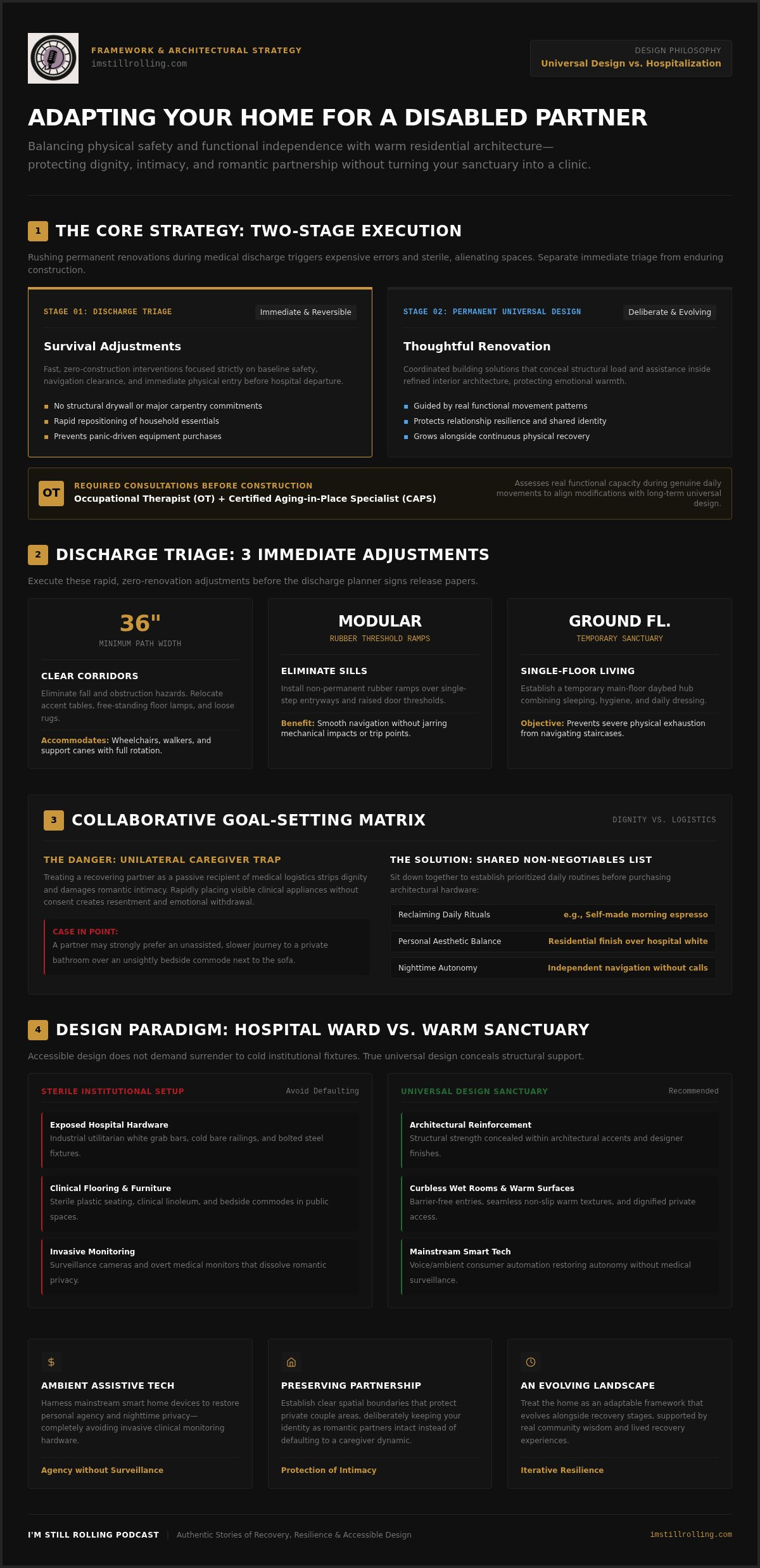
The rush begins the moment a discharge planner stands by the hospital bed with a clipboard. After days or weeks spent under fluorescent lights, the realization that you are heading home brings relief, immediately swallowed by panic. Your hallway suddenly looks impossibly narrow. The front steps feel like a cliff. Hearing authentic stories of recovery and hope reminds us that this disorientation is universal, but panic makes for poor architecture. Before tearing down drywall or ordering industrial equipment, take a breath. Successful adaptation requires separating immediate survival triage from thoughtful, long-term construction.
Rushing into permanent renovations often leads to expensive mistakes and clinical environments that feel alienating. Before making structural commitments, consult an occupational therapist (OT) or a Certified Aging-in-Place Specialist (CAPS). An OT assesses functional capacity within real-world movements, ensuring that whatever you build aligns with the enduring principles of universal design rather than short-term panic. This approach protects both your finances and the emotional warmth of your shared space.
Triage Adaptations Before Hospital Discharge
Discharge day demands rapid, reversible adjustments that guarantee baseline safety without requiring a construction crew:
Clear high-traffic corridors: Move accent tables, floor lamps, and decorative rugs to establish clear paths of at least 36 inches, allowing comfortable clearance for wheelchairs, walkers, or support canes.
Eliminate threshold barriers: Install temporary, modular rubber threshold ramps over single-step entries and exterior door sills so your partner can cross entryways without jarring impacts.
Establish a main-floor sanctuary: Relocate sleeping, dressing, and hygiene essentials to the ground floor. Setting up a temporary daybed in an adaptable living area avoids the exhaustion of navigating staircases during early recovery.
Collaborative Goal-Setting with Your Partner
True safety includes emotional autonomy. When adapting your home for a disabled partner, the fastest way to erode dignity is to treat them as a passive recipient of your logistics. Hold direct, unhurried conversations about what areas of daily life they want to reclaim first. Does making their own morning espresso matter more than reaching the upper closet shelves? Focus your initial efforts there.
Never assume what your partner finds acceptable. A spouse might prefer an unassisted, slow route to the bathroom over an unsightly commode placed beside the sofa. Sit down together and draft a shared non-negotiable list that honors personal aesthetic preferences, functional priorities, and individual privacy. When both partners shape the environment, adapting your home for a disabled partner becomes a shared act of resilience rather than a unilateral medical intervention.
Room-by-Room Modifications: Balancing Clinical Safety with Warm Residential Design
A home should feel like a sanctuary, never a recovery ward. When modifying living areas, too many couples default to institutional fixtures: utilitarian white grab bars, industrial linoleum, and sterile plastic seats. True universal design operates on an entirely different philosophy. It hides structural strength behind warm residential architecture, ensuring that safety reinforces personal dignity. As documented in our deep dives into spinal cord injury recovery stories, regaining control over your private environment is often the turning point where true emotional recovery begins.
Focusing on high-traffic zones prevents accidents while keeping your shared aesthetic intact. Aligning your floor plan with the National Institute on Aging's room-by-room safety guidance lets you eliminate fall hazards methodically without sacrificing comfort. Here is how to execute thoughtful structural updates across key living areas.
The Curbless Wet Room and Accessible Bathroom
Bathrooms represent the highest-risk domestic space for slips and falls. Transform your bath into a seamless wet room by removing the curb entirely, using a linear floor drain and textured, slip-resistant matte tile. Before tiling, install continuous solid-wood blocking inside the wall framing. This allows you to mount modern, load-bearing grab bars finished in brushed brass or matte black that match your faucets. Pair this with a comfort-height toilet and a plumbed bidet seat to protect private hygiene and personal independence.
The Adaptive Kitchen: Preserving Shared Culinary Rituals
Preparing dinner together anchors domestic intimacy. Adapting your home for a disabled partner means designing workspaces that welcome both sitting and standing cooks:
Open knee clearance: Remove lower cabinet boxes beneath the prep sink and primary cooktop, shielding exposed plumbing with insulated panels to prevent burns.
Dynamic storage: Swap fixed upper shelves for mechanical pulldown baskets, and retrofit deep base cabinets with smooth, full-extension roll-out drawers.
Front-facing controls: Install a flush induction cooktop with magnetic safety dials located along the front edge, eliminating the dangerous need to reach across hot burners.
Entrances and Hallways: Removing Physical Obstacles
Circulation paths need smooth transitions to keep mobility effortless. Replace traditional hinges with commercial swing-clear offset hinges, which swing the door completely clear of the frame to add up to two inches of opening width. Remove raised floor transitions between hardwood, tile, and carpet, ensuring thresholds stay under a half-inch and beveled. Finally, install low-voltage motion-activated LED strip lighting beneath baseboards. This gentle floor illumination guides nighttime navigation without jarring overhead glare.
Every architectural choice you make together reinforces mutual respect. To discover how other couples have solved complex domestic design challenges while safeguarding their relationships, explore insightful discussions on the I'm Still Rolling podcast.
Ambient Assistive Technology: Empowering Autonomy Without Institutional Hardware
Nothing erodes autonomy faster than having to ask someone else to turn off a reading lamp, tweak a thermostat, or close the blinds a dozen times a day. Traditional assistive gear often defaults to utilitarian pull-cords and clinical pendants that broadcast vulnerability. Mainstream smart home tech turns that paradigm inside out. Ambient automation serves as dignity-restoring infrastructure for disabled spouses, transforming the home into an intuitive, responsive environment. As highlighted in the AARP HomeFit Guide, integrating modern smart controls removes physical friction without compromising personal decor. Exploring these shifts across the wider disability rights podcast space reveals how consumer technology is actively rewriting the playbook for independent living.
Voice-Activated Climate and Illumination Systems
Voice and app controls hand immediate physical agency back to your loved one. When adapting your home for a disabled partner, consumer smart hubs create reliable hands-free access throughout the entire floor plan:
Connected environmental controls: Link smart thermostats, motorized vents, and ceiling fans to voice platforms so comfort adjustments no longer require crossing the room.
Automated day-to-night routines: Install smart window blinds scheduled to track sunrise and sunset, bringing natural sunlight into living areas without requiring manual reach.
Smart switches and plugs: Place smart outlets on hard-to-reach floor fixtures, banishing awkward reaches behind furniture to switch off floor lamps or desk fans.
Keyless Entry and Automated Egress Solutions
Front-door autonomy is essential for both practical safety and personal dignity. Managing standard brass keys or turning stiff deadbolts can present insurmountable friction for hands dealing with tremors, weakness, or reduced grip strength.
Replace exterior locks with smart deadbolts that unlock via fingerprint recognition, backlit numerical keypads, or proximity geofencing. Pairing these locks with a high-definition video doorbell allows your partner to verify visitors and grant access right from their phone or bedside tablet. For heavy exterior thresholds leading to garages or back patios, low-energy push-button swing operators remove physical resistance entirely, securing independent exit paths during an emergency.
Preserving Partnership and Intimacy: The Emotional Architecture of Care
The quietest casualty of physical trauma is often romance. When pill bottles crowd the bedside table and rubber transfer sheets replace linen duvets, a subtle psychological drift begins. One spouse becomes the clinician; the other becomes the patient. This role shift breeds quiet resentment, grief, and emotional distance. Navigating these profound relationship changes takes deliberate emotional boundary work, as Janice Wright and Mike Sugerman unpack in their reflection on caregiving for a spouse with Alzheimer’s. Thoughtfully adapting your home for a disabled partner requires balancing architectural modifications with the emotional architecture of your marriage.
De-Medicalizing the Shared Master Bedroom
Your bedroom must remain a lovers' retreat, not a sub-acute recovery ward. While functional hardware is often necessary, it never needs to look institutional:
Upholstered ergonomics: Choose dual-motor split adjustable beds dressed in textured, upholstered headboards and tailored fabrics rather than clinical steel hospital frames with cold chrome rails.
Hidden utility storage: Store respiratory masks, transfer belts, catheter supplies, and daily pill organizers inside an elegant mid-century credenza or closed walnut dresser instead of stacking plastic hospital bins in plain view.
Atmospheric preservation: Keep warm accent lamps with warm-toned bulbs, expressive framed art, and personal keepsakes front and center so the space feels anchored in romance and shared history.
Establishing Boundaries Around Physical Care Tasks
Physical support can slowly suffocate romantic tenderness if it consumes every waking minute. The AARP and National Alliance for Caregiving report that spouses providing care clock between 40 and 44.6 hours weekly on direct assistance. Sustaining that workload alone while preserving romance is nearly impossible.
Where practical, lean on extended family or third-party community help for physically grueling tasks like bowel regimens or high-strain floor transfers. This preserves your physical energy for genuine companionship. When providing hands-on support yourself, establish verbal transitions. A clear phrase like "Let's get this physical therapy routine wrapped up so we can watch our movie" clearly bookends the clinical duty. Protect designated evenings where talk about contractor estimates, adaptive gear, and insurance approvals is strictly banned.
Preserving connection through sudden life changes is hard work, but you don't have to figure it out alone. Subscribe to the I'm Still Rolling newsletter to receive raw, weekly perspectives and practical relationship wisdom straight to your inbox.
Building Long-Term Resilience: Tapping Into Community Wisdom and Lived Stories
A residential space is never truly finished; it breathes and shifts alongside physical recovery. Adapting your home for a disabled partner is an evolving conversation rather than a one-time construction project. As functional abilities change, physical strengths fluctuate, and daily routines settle into steady rhythms, your shared spaces will require ongoing adjustments. Trying to solve every structural problem in isolation is a recipe for burnout. The most resilient couples thrive by anchoring themselves in seasoned community wisdom, leaning on practical peer insights rather than navigating the journey alone.
Navigating Financial Grants and Professional Resources
Funding structural modifications requires patience and strategic planning, but substantial public and non-profit support exists across several specialized programs:
Federal and veterans' assistance: Qualified veterans with service-connected mobility disabilities can access VA grants like the Specially Adapted Housing (SAH) grant, capped at $126,526 for fiscal year 2026, or the Home Improvements and Structural Alterations (HISA) grant.
Rural and renovation loans: Look into the USDA Section 504 Home Repair program, which offers 1.00% fixed-rate loans up to $40,000 for low-income rural homeowners, or HUD's FHA 203(k) Limited loan program, capped at $75,000 for structural home improvements.
Tax deductions and community equipment: Under IRC Section 213, medically necessary home modifications can qualify as deductible expenses if total unreimbursed medical costs exceed 7.5% of your Adjusted Gross Income. Additionally, local Centers for Independent Living (CILs) often manage loan closets where you can test ramps and mobility gear before buying.
Finding Strength in Shared Firsthand Narratives
Technical blueprints show you where to place grab bars, but they cannot teach you how to laugh when a wheelchair ramp scuffs fresh baseboard paint. That resilience comes from hearing real people who have navigated the same terrain. Couples who endure life-altering transitions often discover that dark humor, shared vulnerability, and realistic optimism become their strongest survival tools.
Journalistic storytelling pulls back the curtain on these quiet domestic struggles, validating complex grief while spotlighting practical adaptations that work. Tuning into raw, deeply reported discussions on I’m Still Rolling Podcast Episodes lets you hear directly from survivors and partners who have rebuilt intimacy from the ground up. Their lived experiences prove that while adapting your home for a disabled partner changes your physical environment, it also creates space for unexpected joy, mutual strength, and lasting connection.
Reclaiming Your Shared Sanctuary and Moving Forward
Adapting your home for a disabled partner isn't about surrendering your domestic warmth to clinical hardware; it's an act of shared resilience. By choosing discreet universal design over cold institutional fixtures, protecting sacred personal boundaries in private rooms, and harnessing intuitive smart home tools, you safeguard both physical safety and romantic connection. Your floor plan will naturally evolve alongside long-term recovery, but your partnership and personal dignity remain the steady foundation of the home.
You don't have to navigate this sudden transition alone. Tune into the I'm Still Rolling Podcast, hosted by veteran broadcast journalists Mike Sugerman and Janice Wright. Through unflinching, deeply honest conversations with trauma survivors, spousal caregivers, and disability pioneers, Mike and Janice explore the complex realities of life after adversity without sugarcoating or pity. Listen in to find practical wisdom, raw intimacy, and realistic optimism that will help you move forward together with confidence.
Frequently Asked Questions
How much does it typically cost to adapt a home for a disabled spouse?
Total costs vary dramatically depending on the scope of work, ranging from a few hundred dollars for minor adjustments to tens of thousands for structural overhauls. Minor fixes like installing temporary modular ramps or widening interior doorways remain relatively inexpensive. In contrast, extensive curbless wet-room conversions or mechanical stairlifts require substantial capital investments. Prioritizing non-structural triage adaptations first gives you time to plan deliberate, cost-effective structural renovations.
Will modifying our house for wheelchair accessibility ruin its future resale value?
Not if you embrace modern universal design over institutional hardware. Zero-threshold curbless showers, wide hallways, flush floor transitions, and open-concept kitchens are highly sought-after architectural features for buyers across all generations. Clinical, hospital-style additions like bare chrome grab bars can depress appeal, but seamlessly integrated accessibility upgrades frequently increase long-term market value by expanding your property's potential buyer pool.
How do I suggest home adaptations without making my partner feel defective or defensive?
Frame modifications around shared daily ease, hospitality, and home efficiency rather than physical deficits. When adapting your home for a disabled partner, open the conversation by exploring mutual frustrations, asking questions like, "How can we make cooking dinner together easier for both of us?" Involve your partner in every single design choice, ensuring renovations feel like collaborative interior styling rather than an unwanted medical intervention.
What are the first critical home modifications to make after sudden spinal trauma?
Focus immediately on zero-barrier home access and essential hygiene needs. Create an unhindered entry pathway using a low-slope threshold ramp, and clear 36-inch pathways across your primary living areas. In the bathroom, install a handheld showerhead, stable transfer support, and a bidet toilet attachment. Major structural projects, like knocking down walls or replacing cabinetry, can wait until physical therapy routines and functional baselines stabilize.
Can smart home automation completely replace expensive specialized medical equipment?
Consumer smart devices complement physical adaptations brilliantly, but they don't replace heavy clinical equipment. Mainstream voice platforms, connected smart plugs, and automated blinds replace expensive, proprietary environmental control systems at a fraction of the cost. However, they cannot substitute for mechanical transfer hoists, specialized mattresses, or structural ramps. Pairing commercial consumer electronics with targeted physical aids delivers optimal autonomy while preserving your family budget.
How can partners prevent caregiver burnout while managing major home renovations?
Draw a sharp line between contractor logistics and your romantic connection. Trying to balance intense caregiving duties while supervising construction crews accelerates emotional exhaustion. Outsource remodeling management to an occupational therapist or trusted relative whenever feasible. Protect non-negotiable daily downtime where discussion of medical updates, contractor estimates, and adaptive hardware is strictly banned, giving you both space to rest as partners.
Where can we find authentic stories of couples who adapted successfully after disability?
The I'm Still Rolling Podcast features unflinching, journalistic conversations exploring resilience, love, and recovery after life-altering injury. Hosted by veteran reporters Mike Sugerman and Janice Wright, the show tackles the raw realities of adapting your home for a disabled partner without condescending pity or cheap platitudes. Listeners gain grounded optimism and hard-won survival tactics directly from long-term survivors and partners walking the exact same road.

Comments