Accessible Travel Tips for Wheelchair Users: Plan with Confidence in 2026
An “accessible” label can still leave important questions unanswered: Will the bathroom allow a safe transfer? Will your wheelchair fit on the transport you’ve booked? The most useful accessible travel tips for wheelchair users start with a practical principle: plan around your own access needs, not a general label.
It makes sense to want clear details before booking, especially when transport, accommodation and unfamiliar routes all need to work together. Access information can be incomplete, and even careful plans may meet unexpected obstacles. You don’t need to predict every problem to travel with confidence. You do need to identify what matters most to you and find out the details that could affect your choices.
This guide offers a step-by-step way to plan around your needs, from choosing transport and lodging to preparing for equipment issues or a route that doesn’t work as expected. Use the questions and checklists to document key arrangements and keep a backup option in mind, without letting preparation take over the trip.
Table of Contents
Accessible travel tips for wheelchair users start with your own access needs
How to plan wheelchair-accessible transport, lodging, and activities
How to compare accessibility information and avoid planning blind spots
A wheelchair travel checklist for preparation and unexpected changes
Accessible travel can be planned without letting logistics define the journey
Accessible travel tips for wheelchair users start with your own access needs
A trip can mean a new place to explore, time with people you care about or a change of scene. It can also bring uncertainty when access details are incomplete and familiar routines have to work somewhere new. Make space for both the excitement and the practical questions. Uncertainty is a reason to plan, not to lower your expectations.
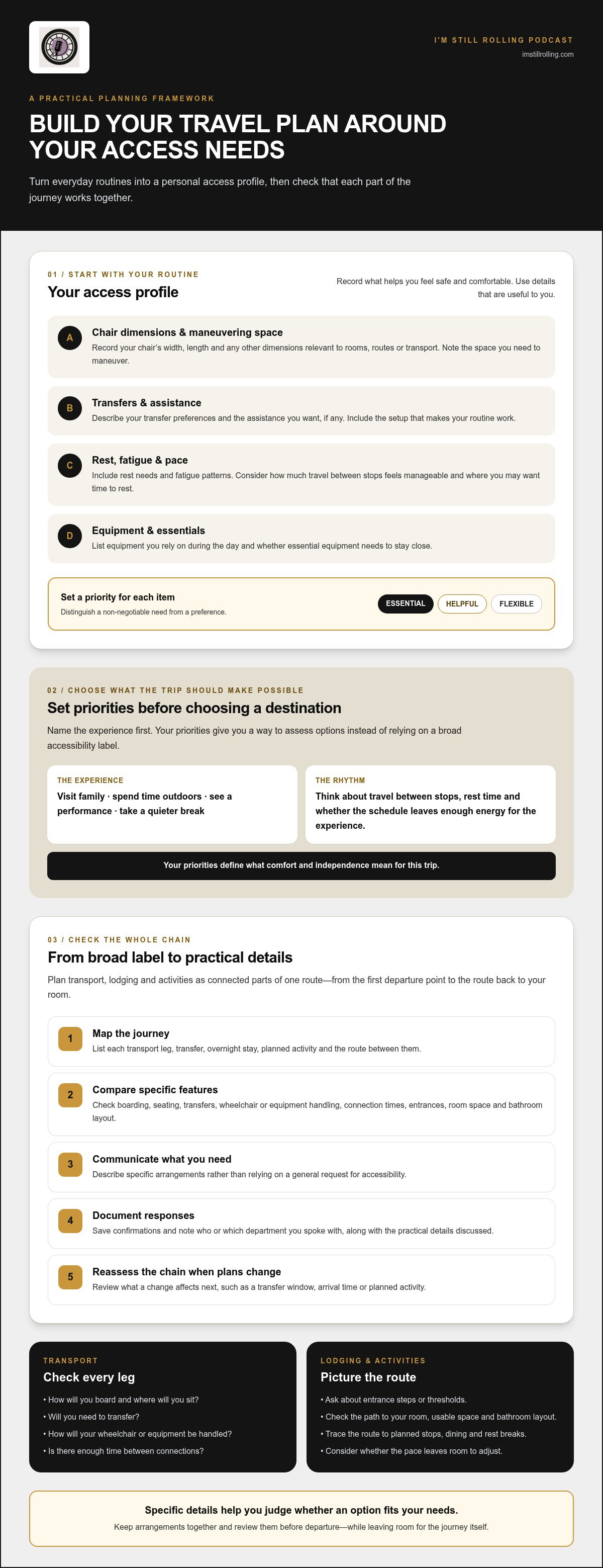
Wheelchair users don’t share one set of requirements. Mobility, transfer methods, seating needs, chair dimensions, equipment and preferred assistance all vary. Accessible travel planning begins with your individual access requirements. Start an access profile: a practical record of the daily routines, assistance and features that help you feel safe and comfortable. The broader idea of access across destinations and travel experiences is explored in the Accessible Tourism Overview. Your own profile helps turn that general idea into useful planning criteria.
Turn everyday routines into a travel access checklist
Think through an ordinary day at home. Which routines need to remain possible during the trip, and what makes them work? Note the details that could affect transport, lodging or activities, such as your transfer setup, the space you need to maneuver and whether essential equipment needs to stay close.
Record your chair’s width, length and any other dimensions relevant to rooms, routes or transport.
Describe your transfer preferences and the assistance you want, if any.
Include rest needs, fatigue patterns and equipment you rely on during the day.
Mark each item as essential, helpful or flexible so a preference isn’t mistaken for a non-negotiable need.
This is a working tool, not a demand to explain or justify your needs. Write it in language that’s useful to you, then update it if the trip’s pace or setting changes what matters most.
Set trip priorities before choosing a destination
Before comparing routes or attractions, decide what you most want the trip to make possible. You may want to visit family, spend time outdoors, see a performance or take a quiet break with fewer transfers. Naming the experience first gives you a clear way to assess options, rather than letting a broad accessibility label decide for you.
Next, picture the rhythm of the trip. Consider how much travel between stops feels manageable, where you might want rest time and whether a packed schedule leaves enough energy for the experience itself. One traveler may prefer fewer stops; another may want a fuller itinerary with planned pauses. There’s no universal measure of comfort or independence. Define what those mean for you, and use your priorities to guide the choices that follow.
How to plan wheelchair-accessible transport, lodging, and activities
Once you’ve outlined your access needs and trip priorities, plan the journey as one connected route. A flight or train may work well by itself, but a tight connection, distant lodging or inaccessible final stop can change the experience. The best accessible travel tips for wheelchair users account for every link, from the first departure point to the route back to your room.
An accessibility label names a category; details about specific features help you judge whether a place or service fits your needs. Use this sequence to turn a broad claim into a practical decision:
Map the journey. List each transport leg, transfer, overnight stay and planned activity, including the route between them.
Compare options. Consider whether boarding, seating, transfers, wheelchair or equipment handling and connection times work for you.
Communicate specifics. Describe the arrangements you need instead of relying on a general request for accessibility.
Document responses. Save confirmations and note who or which department you spoke with, along with the practical details discussed.
Reassess the chain. If one part changes, review what it affects next, such as a transfer window, arrival time or planned activity.
Written details make it easier to refer back to an arrangement, but they can’t prevent circumstances from changing. Keep the information together and review it before departure.
Compare transport options against your wheelchair and support needs
For each part of the trip, consider how you’ll board, where you’ll sit, whether you’ll need to transfer, how your equipment will be handled and how much time you have between connections. For air travel in the United States, the Air Carrier Access Act and the Department of Transportation are relevant to passenger rights and protections. Rules can differ across countries and travel modes, so use guidance that applies to your itinerary. For wider context on disability rights coverage, explore this disability rights and journalism guide.
Assess lodging and activities by their actual features
Ask for details that help you picture the route and space: entrance steps or thresholds, the path to your room, usable space and bathroom layout. Then trace the route from the lodging to each planned stop. A room may meet your needs while the route to dinner, an attraction or a place to rest does not.
Plan for the full day, not just its headline activity. Include dining, rest stops and the connections between them, and consider whether the pace leaves room to adjust. When a venue description is broad, focus on the specific information you need to compare it with your access profile. For perspectives grounded in disability stories and lived experience, explore the I'm Still Rolling Podcast.
How to compare accessibility information and avoid planning blind spots
After gathering details about transport, lodging and activities, compare them in a format that makes gaps easy to spot. A description can sound reassuring but leave out the one feature that determines whether a space works for you. Treat broad labels as a starting point, not proof that a particular wheelchair setup or support need will be accommodated.
Use the same four prompts for each option. For example, a room described as accessible might have a step-free entrance but no information about turning space or bathroom layout. Record what’s stated, what’s unanswered and whether the described features suit your needs. This makes the comparison personal instead of assuming one access standard works for everyone.
Access feature: What matters to you, such as an entrance, route, room or transport connection?
Available detail: What exactly does the description say? Note measurements or a clear description when available.
Unanswered question: What would help you judge the feature with more confidence?
Personal fit: Does the information meet your needs, fall short or leave the fit uncertain?
For instance, “step-free entrance” describes one feature, but doesn’t tell you whether the route beyond it has a surface or slope that works for you. Keep that distinction visible. A missing detail isn’t automatically a deal-breaker; it’s a reason to pause before relying on an assumption.
What useful accessibility information should describe
Look for details about the whole route, not just the destination: entrances, surfaces, changes in level, room features and transport arrangements. For lodging, bathroom layout or usable space may matter more than a general label. For an activity, the route from drop-off to the entrance can matter as much as access inside. Record what’s explicit and keep unanswered questions visible rather than filling gaps with guesses.
How to weigh firsthand accounts against formal descriptions
Firsthand accounts can add context that a formal description leaves out: how a route felt, where a difficulty arose or how an arrangement worked in practice. Read them as one person’s experience, not a guarantee for your trip. For example, an account from a manual chair user may not answer the same questions for someone using a powered chair.
Compare the details that affect fit, including chair type, route, timing, assistance and conditions during the visit. Circumstances may have changed, too, so use firsthand accounts alongside current, specific descriptions. The value of lived experience is also reflected in spinal cord injury recovery stories, which offer perspectives on individual lives rather than destination advice.
These accessible travel tips for wheelchair users are most useful when they help you make a grounded decision, not promise certainty. Compare what you know, identify what’s missing and decide whether the remaining uncertainty is manageable for you.
A wheelchair travel checklist for preparation and unexpected changes
A checklist can reduce the number of decisions you have to hold in your head, especially on a busy travel day. It can’t prevent every delay, route change or equipment issue. Its purpose is to keep essential information within reach and give you a clear starting point if something changes.
Organize your notes by stage and save them in a format that works for you, such as a phone note, printed page, accessible document or combination of formats. Include important contact details and arrangements, not just booking references. If someone is traveling with you, agree on where to find shared information and who will lead communication if a problem comes up.
Before departure: confirm details and organize essentials
In the days before you leave, review each part of the itinerary. Compare current transport and transfer arrangements, lodging details and activity plans with the confirmations you’ve saved. If something has changed, update your notes so you’re not relying on an older version during the trip.
Booking: Keep confirmation numbers, agreed arrangements and relevant contact details together.
Pre-departure: Review transport, lodging, transfers and planned activities. Prepare useful information about your wheelchair or other equipment, along with essential personal items.
Travel day: Keep confirmations and key contacts easy to find, with enough time to refer to them without rushing.
Arrival: Note your next step from the arrival point, such as a transfer, route to lodging or planned place to rest.
Consider making a short, clear summary of important arrangements that you can show or share if explaining them aloud is difficult. Store it somewhere you can reach, and make sure it works with your preferred access tools. Keep equipment information practical and relevant to the journey rather than carrying details you’re unlikely to need.
During the trip: respond when arrangements change
If an access feature isn’t available as expected, identify who can address that part of the plan. For transport, speak with the staff responsible for the service or assistance. At lodging or an activity, talk with the person overseeing the booking or guest arrangements. Describe the immediate issue clearly, say what you need next and refer to the written details you brought.
Focus first on what matters now. Is there a safe place to wait? Do you need a workable route, a revised transfer or time to rest before deciding what comes next? Once the immediate need is addressed, identify the next practical step. A delayed connection may affect your arrival plans; a closed route may mean choosing a different stop or a slower pace.
Leave room in the itinerary for rest and changes. Flexibility isn’t a failure of preparation; it’s part of planning for real life. For disability stories grounded in lived experience, explore the I'm Still Rolling Podcast. Preparation supports your choices, while the journey remains yours.
Accessible travel can be planned without letting logistics define the journey
Travel can involve extra checks and unanswered questions when access information is incomplete. That work is real, but it isn’t a test you have to pass before you’re allowed to go. Preparation helps you decide what fits, what needs clarification and where you’re willing to adapt. It can’t remove every barrier, and it doesn’t guarantee that nothing will change.
Keep the process simple: define your needs, compare specific details, communicate the arrangements that matter and prepare to adapt. Then bring your attention back to what you want from the trip. A plan should support your autonomy, not turn the journey into a checklist you have to complete perfectly.
Make the next trip-planning step manageable
You don’t have to solve the whole trip today. Choose one useful next action: write an access profile, identify the experience you most want from the journey or map how you’ll get from your arrival point to your first stop. One small step can make the next decision clearer without requiring you to plan for every possible obstacle at once.
Revise the plan as you learn more. A route, activity or arrangement may need another look; changing your approach is part of planning, not evidence that you got it wrong. Keep the experience itself in view: the people you hope to see, the place you want to explore or the time away you’re making room for.
Accessible travel tips for wheelchair users matter most when they leave room for different bodies, routines and definitions of independence. One traveler may prioritize a familiar transfer setup; another may value a slower itinerary or fewer changes between stops. Those choices are personal. The aim isn’t to copy somebody else’s idea of a successful trip, but to create conditions that make your own priorities more possible.
Find more stories grounded in lived experience
I'm Still Rolling is a podcast about disability, resilience and life after adversity, hosted by seasoned journalists Mike Sugerman and Janice Wright. Each episode brings journalistic insight together with guests’ personal experiences, with honest conversations about subjects including caregiving, disability rights and personal growth. Those stories make room for perspectives that reflect individual lives and experiences.
Explore I'm Still Rolling Podcast episodes in audio or video, or read the written transcripts. Subscribe to the newsletter to stay updated on new content and hear more conversations about disability and resilience.
Let your next step bring the journey into focus
You don’t need a perfect plan before you start imagining where you’d like to go. Choose one experience that matters to you, then let it guide the next question you ask or detail you clarify. The most useful accessible travel tips for wheelchair users make room for your pace, priorities and decisions, even when some uncertainty remains.
Access barriers are real, and preparation won’t erase them. A plan can help you recognize what you need, make informed choices and keep the purpose of the trip in view. Your journey doesn’t have to look like anyone else’s to be worthwhile.
For honest conversations about disability and resilience, explore I'm Still Rolling's podcast episodes, videos and transcripts. Subscribe to the newsletter to stay connected and discover new stories.
Frequently Asked Questions
Can wheelchair users travel alone?
Yes. Some wheelchair users travel alone, while others prefer or need support for particular parts of a trip. The choice depends on your routines, support preferences, destination and transport arrangements, not on wheelchair use alone. Consider what you want to manage independently and where another person’s help would make the trip work better for you. Accessible travel tips for wheelchair users should support that personal choice, not prescribe one way to travel.
Is travel insurance worth considering when you use a wheelchair?
It may be worth comparing policies as one part of your preparation. Review the terms for trip interruption, medical needs and mobility equipment, since coverage, exclusions and limits vary by policy. For example, check how the wording addresses a delayed trip or equipment-related claim instead of assuming either is covered. Keep relevant policy information easy to access while traveling. Insurance doesn’t replace checking access arrangements, and no policy should be assumed to cover every circumstance.
What happens if an airline damages a wheelchair during a trip?
If you discover damage, document the wheelchair’s condition and report the issue promptly to the airline’s designated staff. Keep a record of who you spoke with, when you reported it and any instructions you received. Explain any immediate mobility or safety needs as well. Procedures and passenger protections depend on jurisdiction, airline and circumstances, so don’t assume a particular remedy or timeline. For U.S. flights, consult the U.S. Department of Transportation’s current air-travel guidance.
Can a service animal travel with a wheelchair user?
A service animal may be able to travel with you, but requirements depend on your destination, transport mode and applicable rules. Check current official guidance for each part of the itinerary, including any border or carrier requirements that apply. Consider the animal’s welfare during transfers and waiting periods, and how route length, relief opportunities and documentation may affect the journey. Policies can differ between providers and countries, so don’t assume one set of requirements applies everywhere. This isn’t legal advice.
How can wheelchair users find accessible bathrooms while traveling?
Start by identifying what makes a restroom workable for you, such as space for your chair, transfer setup or privacy needs. Look for specific descriptions in venue and transport information, and mark possible stops along longer routes. A general “accessible” label may not answer the details that matter for your setup. Facilities can vary, even within one venue, so having another possible stop in mind can reduce pressure if the first option doesn’t meet your needs.
Do international trips require different wheelchair travel preparation?
Yes. Transport procedures, local infrastructure, access descriptions and relevant protections can differ between countries, and information from one destination may not apply to another. Review official destination and carrier guidance for each leg, including transfers across borders or between transport modes. Allow time for connections where possible, and keep important arrangements available in a format you can use. Flexibility can help if local conditions differ from expectations, while your own trip priorities remain the guide.
What should I do if an accessible feature is unavailable after I arrive?
First identify the immediate barrier and what you need right now, such as a usable entrance or a different route. Contact the relevant staff member or host and describe the specific issue plainly. You aren’t responsible for fixing systemic access failures, but you can decide whether an alternative works for you. If the feature affects safety or comfort, consider changing the plan rather than pushing through. Keep a record of significant issues if you may need to follow up later.



Comments